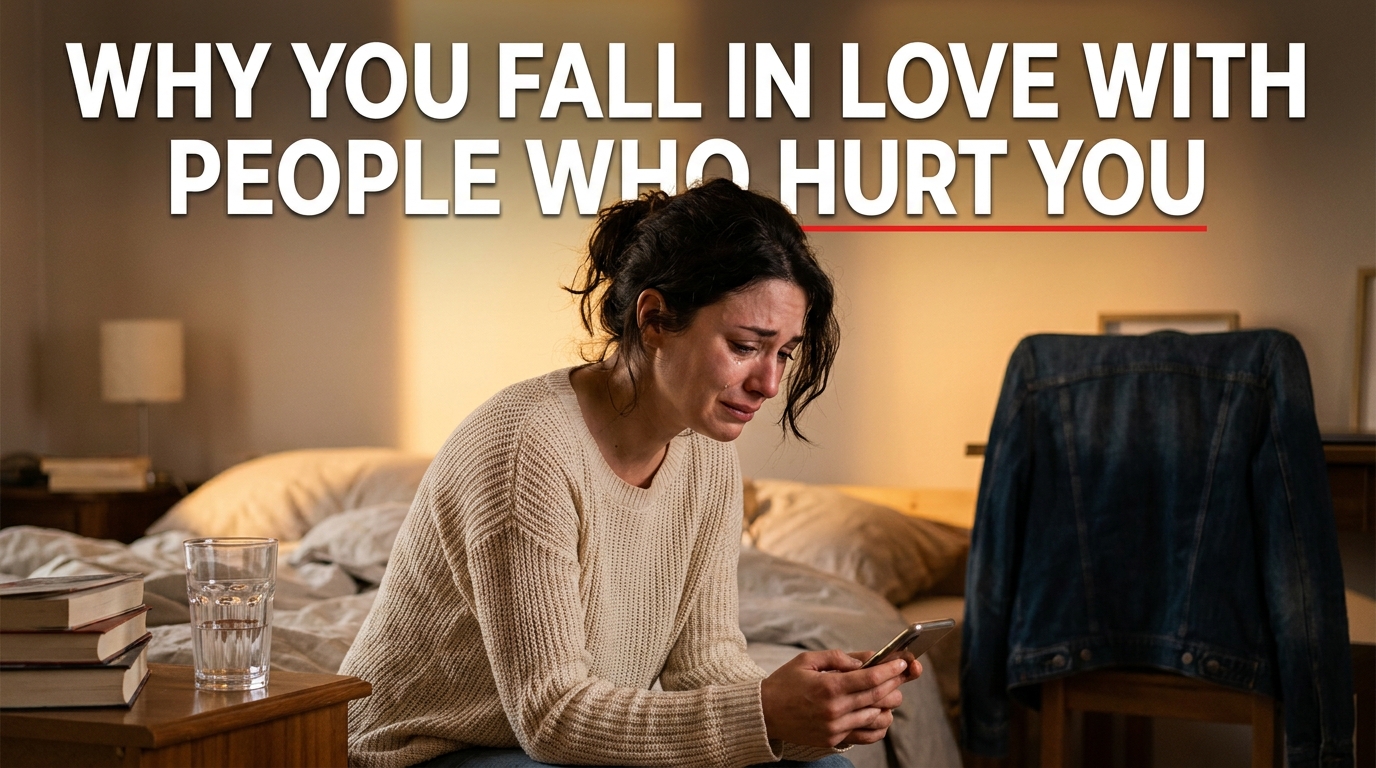
You have done this before. Maybe not with this exact person — but this shape of love, this particular dynamic, this specific flavor of pain. The person who makes you feel electric and then makes you feel invisible. The one who is extraordinary when they are present and devastating when they are not. The relationship that feels more alive than anything you have experienced — precisely because of the uncertainty at its center. And somewhere in the clarity of a hard moment, you have probably asked yourself the question that this article is going to answer honestly: why do you keep fall in love with people who hurt you?
The psychology behind this pattern is one of the most researched and least popularly understood areas of relationship science. It is not a character flaw. It is not self-destruction. It is not proof that you love too easily or trust too quickly. Research from attachment theory, neuroscience, and trauma psychology converges on a clear and compassionate explanation — one that begins not in your adult relationships but in the earliest experiences your nervous system had of what love looks and feels like.
A landmark study published in the Journal of Personality and Social Psychology found that individuals consistently choose romantic partners whose emotional style mirrors that of their primary caregivers — even when, and sometimes especially when, that style involved inconsistency, withdrawal, or emotional pain.
This article will take you through the full psychological architecture of why this happens — and what it actually takes to change it.
The Pattern Most People Do Not See Until It Has Repeated Itself Twice
Before the psychology, a moment of honest recognition. Because one of the most disorienting things about this pattern is how invisible it is from the inside. Each relationship feels different — different person, different context, different specific problems. It is only from the outside, or from the vantage point of retrospect, that the underlying shape becomes visible.
The person changes. The dynamic remains.
There is always something extraordinary about them at the beginning — a quality of aliveness, intensity, or magnetic presence that feels rare. The connection feels significant in a way you struggle to articulate. And then, at some point, the pain begins. Not always dramatic. Not always a single event. Often a slow accumulation of moments where you felt unseen, dismissed, destabilized, or made to feel that your love was more present than theirs.
And then, often, they pull you back. Through warmth, through a return of that early presence, through the particular tenderness that people who have hurt you sometimes offer in the aftermath. And the cycle restarts.
What most people do not recognize is that this cycle — the intensity, the pain, the withdrawal, the return — is not random. It is a pattern that is being generated, from both sides, by something that has nothing to do with the specific person and everything to do with the nervous system’s definition of what love feels like.

The Psychology of Familiarity — Why Painful Love Feels Like Home
The central psychological mechanism behind why you fall in love with people who hurt you is deceptively simple: the nervous system does not distinguish between what is good for you and what is familiar to you. It only knows what feels like home.
Your earliest experiences of love — with parents, caregivers, or primary attachment figures — created a template. A felt sense of what love is supposed to feel like, what it requires of you, how reliable it is, and what emotional register it tends to occupy. This template is formed before you have language for it. Before you have the cognitive capacity to evaluate it. It is written directly into the nervous system as the definition of love itself.
If your early experience of love was warm, consistent, and reliably responsive — if you were seen, soothed, and returned to reliably — your nervous system learned that love is safe. That closeness is nourishing. That you can bring your full self into intimacy and expect it to be welcomed.
But if your early experience of love was inconsistent — warm sometimes and cold others, present and then suddenly withdrawn, loving in moments and critical or unavailable in others — your nervous system learned something different. It learned that love is uncertain. That it must be earned and re-earned. That closeness is both desperately wanted and inherently unstable. And it learned, at the deepest level of felt experience, that this particular emotional texture — this mixture of warmth and withdrawal, connection and uncertainty — is what love feels like.
Not what love should feel like. What love feels like. The distinction is everything.
This is why, as an adult, when you encounter someone who replicates that emotional texture — who is intermittently warm and withdrawing, who makes you feel special and then unsettled, whose presence is thrilling and whose absence is devastating — it does not feel like a red flag. It feels like recognition. It feels like finding something you already know. It feels, in the deepest, most pre-verbal part of your nervous system, like coming home.
And home, even when it was not safe, is the most powerful attractor the human psyche knows.
Repetition Compulsion — The Unconscious Drive to Rewrite the Past
Freud introduced the concept of repetition compulsion more than a century ago, and while much of his theoretical framework has been revised or abandoned, this particular observation has been consistently validated by contemporary psychology: human beings have a powerful, largely unconscious drive to repeat early relational experiences — not because they enjoy pain, but because the unconscious mind is attempting to master something that was never resolved.
When a child experiences love as inconsistent or painful — when the caregiver who was supposed to be a reliable source of safety was also a source of fear, rejection, or unpredictability — a part of the psyche holds onto the hope of resolution. The situation was not finished. The love was not fully given. The wound was never healed.
In adult relationships, this unfinished business expresses itself as an unconscious seeking of situations that replicate the original dynamic — with the hope, always unconscious, always unrealized, that this time it will end differently. This time the unavailable person will become available. This time the love will be fully given. This time the wound will finally close.
This is repetition compulsion. It is not masochism. It is not stupidity. It is the psyche’s attempt, using the only materials available, to complete something that was left unfinished at a time when you had no other options.
The tragedy of repetition compulsion is that it almost never produces the resolution it seeks — because the adult relationship, however much it resembles the original dynamic emotionally, cannot actually heal the original wound. Only specific, intentional therapeutic work can do that. The adult relationship simply replicates the pain, in a new context, with a new person, until the underlying pattern is understood and interrupted.
“You are not drawn to people who hurt you because you want to be hurt. You are drawn to them because somewhere in you, there is still a child trying to finish a story that was never allowed to end well.”
The Neurochemistry of Painful Love — Why It Feels So Much More Intense
There is a neurological dimension to why painful love feels more compelling than peaceful love — and understanding it is not just intellectually interesting. It is practically liberating.
When love is consistent and secure, the neurochemical experience is relatively stable. Oxytocin — the bonding hormone — is present in steady, sustaining amounts. Cortisol — the stress hormone — is low. The overall felt experience is warmth, safety, and contentment. These are not small things. But they do not produce the biochemical intensity of unpredictable love.
When love is inconsistent — when you are never quite certain of your partner’s warmth, when their presence and withdrawal are unpredictable — the brain’s dopamine system activates in a fundamentally different way. Dopamine is not, as commonly believed, the pleasure chemical. It is the anticipation and pursuit chemical. It fires most intensely not when you receive a reward, but when you are uncertain whether you will receive it.
This is the same neurological mechanism that makes gambling so difficult to stop: the unpredictability of the reward, not its size or quality, is what produces the most intense dopamine response. An emotionally inconsistent partner — one who is sometimes warm and sometimes cold, sometimes close and sometimes distant — produces a neurochemical experience that is genuinely more intense than a consistently loving partner.
This intensity gets interpreted, by the conscious mind, as chemistry. As depth of feeling. As evidence that this love is more real or significant than calmer loves have been. It is not. It is a stress response that the brain has learned to experience as desire.
Dr. Helen Fisher’s neuroimaging research at Rutgers University found that the brain scans of people in early romantic love are nearly identical to brain scans of people with obsessive-compulsive disorder — and that the brain scans of people in painful, uncertain love show even higher activation in the dopamine reward system than those in stable love. You are not imagining that the uncertain love feels more alive. Neurochemically, it genuinely does. That is exactly what makes it so difficult to leave — and so important to understand.
Attachment Wounds — The Specific Injuries That Make This Pattern More Likely
Not everyone is equally vulnerable to falling in love with people who hurt them. The pattern is more pronounced in individuals with specific attachment wounds — early relational injuries that shaped their nervous system’s relationship with intimacy, safety, and love.
The wound of inconsistent love — experienced by children whose caregivers were sometimes warm and present and sometimes cold, withdrawn, or emotionally unavailable — produces anxious attachment in adulthood. The anxiously attached person developed, in childhood, a hypervigilant monitoring system oriented toward their caregiver’s emotional state — because the caregiver’s availability was unpredictable and therefore required constant tracking.
In adult relationships, this hypervigilance continues. The anxiously attached person is exquisitely attuned to their partner’s emotional temperature, perpetually monitoring for signs of withdrawal or dissatisfaction, and neurologically primed for the specific experience of uncertain love. When they encounter an emotionally inconsistent partner, the match feels profound — not because it is healthy, but because it is familiar at the deepest level.
The wound of conditional love — experienced by children whose love and belonging were contingent on performance, achievement, appearance, or emotional management — produces adults who believe, at an implicit level, that love must be earned. They seek partners who require earning — partners who are withholding enough that sustained effort, self-improvement, or emotional management might finally unlock their full presence and approval.
The wound of abandonment — whether through parental absence, loss, or emotional withdrawal — produces adults who simultaneously crave closeness and expect it to disappear. They may unconsciously choose partners who are likely to leave, confirm the abandonment fear, or provide enough emotional distance to keep the fear active and familiar.
The wound of enmeshment — experienced by children whose caregivers had poor boundaries and used the child to meet their own emotional needs — can produce adults who confuse intensity with love, who have learned that love means being consumed by and responsible for another person’s emotional state.
Each of these wounds, unaddressed, functions as an invisible filter through which potential partners are assessed — selecting for familiarity over health, and for emotional texture over genuine availability.

The Trauma Bond — When Pain and Love Become Chemically Indistinguishable
In relationships where the pain is significant and the cycle of rupture and repair is pronounced, something more serious than simple familiarity can develop: a trauma bond.
Trauma bonding — a term developed from Patrick Carnes’ research on abusive relationships, though applicable across a spectrum of painful dynamics — describes the powerful psychological and neurochemical attachment that forms between two people through cycles of tension, rupture, and intermittent positive reinforcement.
The mechanism works like this. The relationship produces stress — uncertainty, emotional pain, fear of loss or abandonment. This stress activates the body’s cortisol and adrenaline systems. When the rupture resolves — when the person returns, becomes warm again, offers the affection or reassurance that the stress period withheld — the relief produces a flood of oxytocin and dopamine that is significantly more intense than it would be in a consistently loving relationship.
Over repeated cycles, the brain begins to associate the person — specifically this person — with the resolution of distress. They become, neurochemically, both the source of the pain and the only available relief from it. This is the architecture of a trauma bond: a neurological dependency that has very little to do with healthy love and a great deal to do with the brain’s learned association between a specific person and the relief of suffering.
This is why leaving a traumatically bonding relationship feels so much harder than the relationship’s quality would seem to justify. It is not weakness. It is neurochemistry. The brain has encoded this person as a primary source of relief — and withdrawing from them produces a withdrawal experience that genuinely resembles the withdrawal from an addictive substance.
Understanding this does not make leaving easier in the moment. But it does make the difficulty of leaving make sense — which is the beginning of responding to yourself with compassion rather than judgment.
Why the Good Moments Feel So Significant
One of the things that keeps people in relationships with people who hurt them is the quality of the good moments — and the way those moments feel more vivid, more meaningful, and more real than good moments in healthier relationships have felt.
This is not an illusion, exactly. The good moments are real. The warmth, the connection, the specific feeling of being seen by this person — these are genuine experiences. But their intensity is partly a product of contrast. They feel so good because the difficult periods are so painful. The warmth feels so valuable because it has been withheld.
This is the mechanism that sustains the cycle. If the relationship were entirely painful, leaving would be straightforward. If it were consistently loving, the pattern of painful love would not be replicated. It is the mixture — the specific alternation of pain and relief, withdrawal and return — that makes the relationship both unbearable and impossible to leave.
The brain, presented with this mixture, does something predictable: it selects for the positive moments as evidence of what the relationship truly is, and files the painful moments as temporary aberrations. This is not self-deception exactly — it is hope. The belief that the person you see in the good moments is the real one, and that the person who caused the pain was a circumstantial version of them that can be reduced or eliminated through enough love, patience, or effort on your part.
“The good moments in a painful relationship are not proof that you are wrong about the pain. They are the reason the pain is so hard to leave.”

What This Pattern Is Costing You — An Honest Inventory
The pattern of falling in love with people who hurt you has costs that extend beyond any individual relationship. Over time, repeated experiences of painful love produce specific and cumulative damage to the way you see yourself, the way you experience relationships, and the way you move through the world.
Erosion of self-worth. In relationships where love is inconsistent, the human mind tends to locate the instability in itself. If they do not love me consistently, it must be because I am not consistently lovable. This logic is almost always wrong — but it is almost always present. And across repeated relationships, this self-questioning accumulates into a structural belief: I am someone who gets almost-love. I am someone who needs to earn it. I am someone who does not quite deserve the full version.
Increasing tolerance for pain. Each relationship that follows the pattern recalibrates your baseline expectation downward. What you would have recognized clearly as unacceptable in a first relationship begins to feel like simply the way things are. The tolerance for being hurt quietly expands with each repetition, making each subsequent iteration of the pattern harder to identify from the inside.
Distrust of healthy love. Perhaps the most lasting consequence: repeated experiences of painful love can make genuinely available, consistently loving relationships feel wrong. Too easy. Not enough chemistry. Boring. Your nervous system, calibrated to painful love as its reference point, reads security as flatness and consistency as lack of passion. This is the cruelest part of the pattern — it makes the cure feel like the problem.
Disconnection from your own needs. In relationships with people who hurt you, the emotional labor of managing the dynamic tends to crowd out the simpler practice of knowing and honoring your own needs. Over time, you may become significantly better at reading your partner’s emotional state than your own — more attuned to their needs, more practiced at managing their volatility, and less connected to the quieter signals of your own interior life.
How to Actually Break the Pattern — What the Research Supports
Understanding why you fall in love with people who hurt you is meaningful. But understanding without action is just a more articulate version of staying stuck. Here is what psychology actually supports for breaking this pattern.
Therapy — specifically attachment-focused or trauma-informed. The pattern is rooted in the nervous system, not the intellect. Reading about it helps. Talking about it in a structured, relational context with a skilled therapist is what actually creates change at the level where the pattern lives. Emotionally Focused Therapy, Internal Family Systems, and EMDR are all approaches with strong research support for the kind of attachment and trauma work this pattern requires.
Learning to recognize the feeling of familiarity as a signal, not a sign. The feeling of intense recognition — of “this is it, this is someone I already know” — is often the most important early warning sign that the pattern is activating. Not because it is always wrong, but because it warrants curiosity rather than automatic trust. When the pull is very strong, very fast, and accompanied by a sense of electricity and uncertainty — pause. That feeling deserves investigation, not immediate surrender.
Building a relationship with secure people — even platonically. One of the most effective and least discussed interventions for breaking the pattern of painful love is deliberately cultivating relationships — friendships, community, therapeutic relationships — with people who are consistently safe, warm, and reliably present. Earned security — security that is built through experience rather than inherited from early childhood — is a real and well-documented psychological phenomenon. The nervous system can learn new templates from new experiences, even in adulthood.
Grieving the original wound — not just the adult relationships. The adult relationships are replications. The original is the early experience of love that was inconsistent, painful, or insufficient. Real healing of this pattern requires, at some point, grieving that original loss — not just the adult versions of it. The grief of a childhood where love was conditional, or inconsistent, or accompanied by fear or pain, is a real loss that deserves to be fully acknowledged before the pattern it created can genuinely shift.
Deliberately choosing differently — and tolerating the discomfort. At some point, healing from this pattern requires an act of will: choosing to engage with people who are safe, consistent, and genuinely available — and tolerating the initial discomfort that safe love produces in a nervous system that has been calibrated to uncertainty. This discomfort does not mean the relationship is wrong. It means your nervous system is in unfamiliar territory. With time and repeated experience, new familiarity builds.

What Choosing Differently Actually Looks Like
It is worth being specific here, because “choose differently” is advice that sounds simple and is anything but.
Choosing differently does not mean choosing someone who does not attract you at all. It does not mean settling for a relationship that feels fundamentally wrong. It means learning to distinguish between attraction rooted in genuine compatibility and attraction rooted in familiarity with pain — and gradually building the capacity to be drawn toward the former.
It means noticing when early-relationship intensity feels like electricity and asking honestly: is this excitement, or is this anxiety? Is this chemistry, or is this the nervous system’s recognition of a familiar dynamic? The two can feel nearly identical from the inside. With practice — and usually with therapeutic support — they become distinguishable.
It means giving time to people who are consistent before deciding there is no chemistry. The nervous system, calibrated to uncertainty, reads consistent warmth as flat before it learns to read it as safe. The chemistry with a genuinely available person often builds more slowly — not because it is lesser, but because it does not carry the cortisol and dopamine spike of uncertain love. Learning to value that slow build is part of the work.
It means being willing to have the relationship that surprises you — that does not feel like the ones that have felt most alive — and staying present long enough to discover whether what grows there is actually what you have been looking for all along.
The Bottom Line — The Pattern Is Not Your Destiny
Perhaps the most important thing to carry away from this article is this: understanding why you fall in love with people who hurt you is not an explanation of something unchangeable. It is a map — and maps exist for navigation, not for resignation.
The patterns described here are real, they are psychologically well-documented, and they have genuine costs. They are also patterns — not traits, not destiny, not the permanent truth of who you are or what you are capable of. They were formed by experiences that happened to you when you had no other options. And they can be changed by experiences you choose now, with intention, support, and genuine commitment to your own growth.
The love you want — the kind that does not require your suffering as a price of admission, that does not use uncertainty as its primary currency, that does not make you feel electric and then invisible — exists. It is not the opposite of passion. It is not boring or small or insufficient. It is simply built differently — on consistency rather than intensity, on genuine knowing rather than compelling mystery, on being chosen every day rather than being chased and then abandoned.
You deserve that love. Not as a consolation for the pattern you are leaving, but as the full, real thing you were always supposed to have.
The pattern brought you here. Let understanding be the beginning of something else.
FAQ
Q: Is it possible to have a healthy relationship with someone who hurt you in the past? A: It depends entirely on whether the person who caused the hurt has done genuine work on themselves — demonstrated through consistent behavioral change, not promises — and whether the dynamic between you has fundamentally shifted, not just temporarily improved. In most cases, returning to a relationship that established a painful dynamic reactivates the same patterns rather than transcending them. A skilled therapist can help you assess this honestly.
Q: How do I know if my attraction to someone is a red flag or genuine connection? A: Genuine connection tends to build gradually and feel increasingly settled. Red-flag attraction often feels very intense very quickly — accompanied by a specific kind of anxiety that masquerades as excitement, a sense of urgency around securing the person’s affection, and a pull that is difficult to examine rationally because it feels so urgent. Ask: do I feel more like myself around this person, or do I feel like I am performing? Does this feel like recognition of something good, or recognition of something familiar? The distinction between those two is where the answer lives.
Q: Can someone who grew up with consistent, loving parents still fall into this pattern? A: Yes — though it is less common. People can develop anxious attachment or patterns of painful love through experiences outside the primary caregiver relationship: early romantic relationships, bullying, peer rejection, loss, or trauma in adolescence. The pattern can also develop through cultural conditioning, previous adult relationships, or through the specific neurochemical experience of very intense but painful early romantic love.
Q: How long does it take to break the pattern of falling for people who hurt you? A: There is no universal timeline, and anyone who offers one is not being honest with you. Meaningful progress — the kind where you reliably notice the pattern before you are deeply inside it — typically takes one to three years of active, therapeutic work. Full integration, where the pattern no longer exerts its former pull, often takes longer. This is not discouraging. It is honest. The pattern took years to build. Patience with the process of rebuilding is not weakness — it is wisdom.
Q: Is it possible to love someone who hurt you and also know it is not right? A: Not only possible — it is extremely common. Love and wisdom are not the same faculty. You can love someone completely, genuinely, and specifically — and simultaneously know, with equal clarity, that the relationship is not good for you. Holding both truths at once is one of the most painful and most mature things a human being can do. The love does not have to disappear before you make a decision. It only has to be held alongside the truth.
You Recognized the Pattern. That Already Changes Something.
Most people spend years inside this cycle without ever being able to name it. You just named it. That is not a small thing.
💾 Save this article — come back to it on the days when the pull toward the familiar feels stronger than the commitment to what you know. Let it be the voice that names what you are feeling before you act on it.
📤 Share it with someone you love who is in the middle of a relationship they know is hurting them but cannot seem to leave. Not to push them toward a decision — but to give them language for something they have been living without words for.
💬 Leave a comment — at what point in this article did something shift? What word or paragraph named something you had been carrying without a name? This community is real and this conversation matters.
🔁 Tag someone who needs to understand that the reason they keep ending up here is not a character flaw — it is a pattern, and patterns can be changed. That reframe alone can be transformative.
➕ Follow Truthsinside.com for Love & Emotions content that does not offer easy answers — only honest, psychology-grounded ones that actually help you understand yourself more deeply.
📖 Read next: The Psychology of Forgiveness: Why Letting Go Is About You, Not Them — because healing from the people who hurt you, and the patterns that led you to them, almost always includes learning to forgive — yourself most of all.
📃 Related article: Signs He Likes You But Is Scared: 18 Behaviors Men Show When Afraid to Commit
You are not broken. You are patterned. And patterns, unlike character, can be rewritten.
🎵 Music
Maren Lull is a singer-songwriter who writes from the places most people don’t talk about out loud.
Not the dramatic grief. Not the obvious heartbreak. The quiet kind — the ordinary Tuesday emptiness, the habit of reaching for someone who isn’t there anymore, the particular exhaustion of being strong for so long that the strength itself wears thin.
Her music lives at the intersection of emotional honesty and soft beauty — breathy vocals over gentle piano, slow tempos, lyrics that feel less like songs and more like something you wrote in a private notebook at two in the morning and never showed anyone.
Maren Lull writes for the people who feel everything deeply and say very little about it. For the ones who listen to sad music not because they want to feel worse — but because being understood, even by a song, makes the feeling easier to carry.
📱 Follow Maren Lull:
→ Spotify
→ Apple Music
→ Youtube
→ Audiomack