Have you ever looked in the mirror after a long relationship and wondered where you went? You gave everything — your time, your energy, your emotions — and somehow ended up feeling more alone than before. You are not weak. You are not dramatic. You are someone who loved without emotional boundaries in love, and it cost you more than it should have.
Research published in the Journal of Social and Personal Relationships found that individuals who reported low boundary-setting in romantic relationships were significantly more likely to experience anxiety, depression, and emotional exhaustion. In fact, a 2022 survey by the American Psychological Association revealed that 64% of adults in relationships described feeling emotionally overwhelmed by their partner’s needs at some point. That number is not a coincidence. It is a crisis hiding inside what society calls “devotion.”
This article is your starting point. Whether you are in a relationship right now, rebuilding after one, or trying to understand why past love always felt like a battlefield — the answer often begins with understanding emotional boundaries.

What Are Emotional Boundaries in Love — And Why Do They Matter?
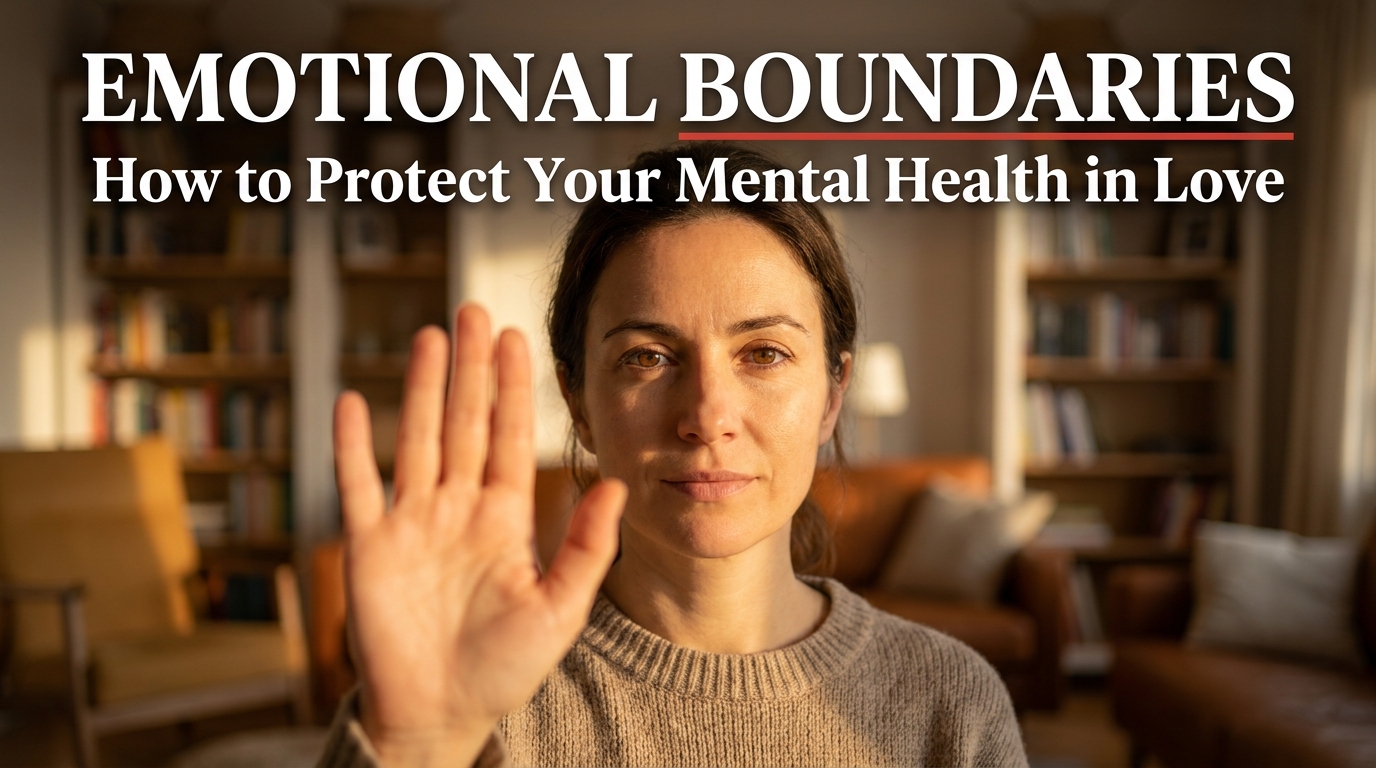
Emotional boundaries in love are the invisible but essential lines that define where your emotional responsibility ends and another person’s begins. They are the internal agreements you make with yourself about what you will accept, what you will tolerate, and how much of your emotional world you are willing to share and at what cost.
Many people confuse emotional boundaries with emotional distance. They are not the same thing. A wall shuts people out entirely. A boundary is a door — you choose who enters, when they enter, and how far they are allowed to come inside.
Without emotional boundaries, love becomes a transaction where you are always paying and rarely receiving. You absorb your partner’s moods as if they are your own. You feel guilty when you have a good day and they do not. You reshape your personality, your opinions, your dreams around what makes the other person comfortable. Over time, this does not just feel exhausting — it rewires your nervous system to operate in a constant state of alert.
Psychologist Dr. Henry Cloud, co-author of the bestselling book Boundaries, describes emotional boundaries as the capacity to “take responsibility for your own feelings and stop taking responsibility for the feelings of others.” That single distinction — knowing where you end and another person begins — is the foundation of every emotionally healthy relationship.
The Psychology Behind Why We Avoid Setting Boundaries
Understanding why boundary-setting feels so unnatural is just as important as learning how to do it. Most people do not avoid boundaries because they are weak. They avoid them because their brain has been trained to associate boundaries with danger.
This training often begins in childhood. If you grew up in a household where expressing your needs was met with anger, withdrawal, or guilt, your nervous system learned a very specific lesson: putting yourself first leads to abandonment or punishment. That lesson does not disappear when you fall in love. It gets louder.
Attachment theory, developed by psychologist John Bowlby and later expanded by researcher Mary Ainsworth, explains this through attachment styles. Anxiously attached individuals, who often grew up with inconsistent caregiving, tend to have enormous difficulty saying no to romantic partners because their deepest fear is being left. They equate maintaining the relationship with maintaining their own safety.
Avoidantly attached individuals, on the other hand, may swing to the opposite extreme — using emotional distance as a false boundary, which prevents genuine intimacy rather than protecting it.
Then there is the cultural layer. Many people, particularly women, are socialized to believe that love means endless sacrifice. That a “good partner” anticipates every need. That putting yourself first makes you selfish, cold, or unworthy of love. These beliefs do not just come from personal experience. They come from movies, music, family modeling, and decades of cultural messaging that romanticizes self-erasure in relationships.
The result? Millions of people sitting across from someone they love, suffering in silence, telling themselves that if they just give a little more, things will finally feel okay.
“You are not responsible for managing another person’s emotions. You are only responsible for managing your own. That is not coldness — that is the healthiest form of love.”

Signs You Have Been Living Without Emotional Boundaries
Before you can build something, you need to see the damage clearly. Many people do not recognize the absence of emotional boundaries until the consequences become impossible to ignore. Here are some of the most common signs that your emotional boundaries in love have been missing or severely weakened.
You feel responsible for your partner’s mood at all times. If they are unhappy, you immediately scan yourself for what you did wrong — even when logic tells you it has nothing to do with you.
You say yes when every cell in your body is screaming no. You agree to things — plans, conversations, physical or emotional demands — not because you want to, but because you are terrified of the reaction if you decline.
You have stopped talking about your own feelings entirely. The relationship has become so centered on the other person’s emotional world that expressing your own needs feels like an intrusion.
You feel guilty for having any life outside the relationship. Whether it is spending time with friends, pursuing a hobby, or simply wanting an hour alone — there is always a voice inside that says you are being selfish.
Your self-worth has become entirely dependent on how your partner treats you on a given day. A kind word and you feel like you matter. A cold shoulder and your entire sense of self collapses.
You consistently leave conversations feeling drained, confused, or emotionally scrambled — a phenomenon psychologists call “emotional flooding.”
If more than two or three of these resonate with you, this is not about the other person being terrible. It is about a pattern that needs to change — and that change starts with you.

How to Start Setting Emotional Boundaries in Love — Step by Step
Setting emotional boundaries does not mean you love your partner less. It means you are finally choosing to love both of you at the same time. Here is how to begin.
Step 1: Identify Your Emotional Triggers and Non-Negotiables
Before you can communicate a boundary, you need to know what you actually need. Spend time journaling or reflecting on the moments in your relationship that leave you feeling depleted, violated, or unseen. What recurring situations make you feel like you are disappearing? What do you need that you have not been allowing yourself to ask for? These are your emotional non-negotiables — the places where your mental health requires protection.
Step 2: Separate Guilt From Intuition
When you first start setting limits, guilt will show up immediately. Your brain will tell you that you are being cruel, selfish, or unreasonable. This is a conditioned response — not a moral compass. Learn to distinguish between guilt (a fear-based reaction to breaking old patterns) and genuine intuition (an internal signal that something is truly wrong or unkind). Setting a boundary rarely crosses the line of genuine harm. Guilt is almost always just fear wearing a costume.
Step 3: Communicate Boundaries Clearly and Calmly
Boundaries are not ultimatums delivered in moments of rage. They are calm, clear statements delivered from a grounded place. The formula is simple: state the specific behavior that affects you, explain how it makes you feel, and express what you need going forward.
For example: “When you raise your voice at me during disagreements, I feel unsafe and shut down completely. I need us to agree to pause conversations before they escalate. That is something I am no longer willing to work through in that way.”
Notice there is no blame, no attack, no dramatic declaration. Just clarity.
Step 4: Hold the Line — Even When It Is Hard
The most important — and the most difficult — part of any emotional boundary is consistency. Partners who are used to having unlimited access to your emotional world will often push back, either directly or through subtle guilt-tripping. If you cave every time there is resistance, the boundary dissolves. This does not mean you need to be rigid or unkind. It means you need to be steady.
Step 5: Revisit and Adjust
Healthy boundaries are not carved in stone. As you grow, as your relationship evolves, what you need may change. Schedule regular emotional check-ins — with yourself and with your partner — to reassess whether the current agreements are still working. Boundaries are living structures, not prisons.
“A relationship without emotional boundaries is not intimacy — it is enmeshment. True closeness requires two whole people, not two halves swallowing each other.”
What Happens to Your Mental Health When Boundaries Are in Place
The shift that happens when you begin honoring your own emotional limits is not subtle. It is profound. And science backs this up.
A study from the University of Houston found that people who regularly practice boundary-setting in personal relationships report significantly lower rates of burnout, anxiety, and relationship dissatisfaction. They also report higher levels of self-esteem, emotional resilience, and — perhaps counterintuitively — deeper intimacy with their partners.
That last finding surprises most people. The assumption is that setting limits creates distance. In reality, the opposite is true. When you stop performing wellness to avoid conflict, when you stop suppressing your real needs to keep the peace, something extraordinary happens: the relationship finally has room to become real.
Your partner begins to interact with the actual version of you — not the managed, carefully edited version that exists to prevent emotional fallout. And if they are the right person, they will meet that realness with their own.
Your mental health benefits are equally significant on a physiological level. Chronic people-pleasing and boundary-avoidance activate the body’s stress response system. Cortisol — the primary stress hormone — remains elevated when you are constantly monitoring and managing another person’s emotional state. Over time, this contributes to sleep disruption, immune suppression, chronic fatigue, and a heightened vulnerability to anxiety and depression.
When you set boundaries and begin to release the responsibility for another person’s emotional regulation, your nervous system starts to regulate itself. You sleep better. You breathe easier. You begin to remember what it feels like to simply exist — not as a support system for someone else, but as a person with your own interior life.

When Boundaries Are Rejected — What That Tells You
Here is the part no one wants to talk about, but everyone needs to hear.
If you set a clear, calm, reasonable emotional boundary — and your partner responds with rage, manipulation, prolonged silence, threats, or persistent guilt-tripping — that response is information. It is not just a “communication style difference.” It is a signal about how much of your wellbeing they are willing to prioritize when it costs them something.
Healthy partners may feel uncomfortable with a new boundary. They may need time to process it. They may even push back initially. But ultimately, a person who genuinely loves and respects you will adapt. They will ask questions. They will try.
A partner who responds to your boundaries as personal attacks, who weaponizes your vulnerability, or who consistently demands you abandon your own needs to maintain their comfort — that is not love under pressure. That is control.
This distinction matters enormously for your mental health. Staying in a relationship where your boundaries are chronically ignored or punished is not perseverance. It is self-abandonment. And you deserve better than that.
Building a Boundary-Healthy Relationship Together
The most sustainable relationships are those where both partners understand that individual emotional health is not a threat to the relationship — it is the foundation of it. This is a mindset that can be cultivated together, especially with the right tools.
Couples therapy is one of the most effective environments for establishing shared emotional agreements. A skilled therapist can help both partners identify where their individual emotional boundaries have been blurred and create new frameworks for interaction that honor both people equally.
Daily practices also matter enormously. Create space in your relationship for each person to express what they need without the other person immediately interpreting it as criticism. Develop a shared language for when one of you is emotionally at capacity. Check in regularly — not just about logistics and schedules, but about emotional state, about whether each person is feeling seen and respected.
Normalize the word “no” in your relationship. When no becomes a dangerous word, fear moves in. When no is simply a part of the emotional vocabulary between two people — respected and responded to without drama — the relationship becomes a genuinely safe place.

A Final Word: Protecting Your Mental Health Is an Act of Love
The world has spent a long time convincing you that loving someone fully means giving them everything — including the parts of you that keep you whole. That is a lie. And it has cost too many people their peace, their identity, and their mental health.
Emotional boundaries in love are not the opposite of devotion. They are devotion’s most honest form. They say: I love you enough to show up as my real self. I love us enough to protect the foundation we stand on. I love myself enough to know that I cannot be everything to you if I am nothing to myself.
You are allowed to love deeply and still have lines. You are allowed to be fully committed and still have a self. You are allowed to protect your mind, your energy, and your emotional world — not instead of love, but as an essential part of it.
Start small. Start today. The version of you that exists on the other side of healthy emotional limits is not colder or more distant. That version is more present, more open, and more genuinely loving than the exhausted, boundary-less version ever could be.
💾 Save this article — you will want to come back to it.
📤 Share it with someone who gives too much of themselves in love.
➕ Follow Truthsinside.com for more relationship and psychology insights that actually speak to real life.
📃 Related article: What Does It Actually Feel Like to Fall in Love? Science + Real Stories
Frequently Asked Questions
Q1: What is the difference between an emotional boundary and being emotionally unavailable?
An emotional boundary is a conscious, communicated limit that protects your mental health while still allowing genuine connection. Emotional unavailability is a persistent inability or unwillingness to engage emotionally with a partner at all. One creates healthier intimacy. The other prevents it.
Q2: How do I set emotional boundaries without hurting my partner?
The key is in the delivery. Boundaries communicated calmly, from a place of self-awareness rather than frustration, are far less likely to feel like attacks. Focus on expressing your needs rather than criticizing your partner’s behavior. Most compassionate partners will receive a boundary very differently when they understand it comes from a place of self-care, not rejection.
Q3: Can emotional boundaries actually improve a struggling relationship?
Yes — in many cases, significantly. Many relationship conflicts stem from resentment that builds when one or both partners feel their needs are consistently unmet or dismissed. Introducing clear emotional boundaries opens honest communication and creates mutual respect. For relationships that have a strong foundation, this often becomes a turning point toward genuine health.
Q4: What if I feel guilty every time I try to set a boundary?
Guilt after boundary-setting is extremely common, especially for people who grew up in environments where their needs were dismissed or punished. The guilt is a conditioned emotional response — not a sign that you are doing something wrong. Acknowledge the guilt without acting on it. Over time, as you experience the positive effects of healthy limits, the guilt will lose its power.
Q5: When should emotional boundaries turn into ending the relationship?
When your clearly communicated emotional boundaries are consistently met with hostility, manipulation, or complete disregard, and when your partner shows no willingness to change or understand — that is a significant sign that the relationship is no longer serving your mental health or growth. A relationship should be a place where your humanity is honored, not a place where it is negotiated away.
🎵 Music
Maren Lull is a singer-songwriter who writes from the places most people don’t talk about out loud.
Not the dramatic grief. Not the obvious heartbreak. The quiet kind — the ordinary Tuesday emptiness, the habit of reaching for someone who isn’t there anymore, the particular exhaustion of being strong for so long that the strength itself wears thin.
Her music lives at the intersection of emotional honesty and soft beauty — breathy vocals over gentle piano, slow tempos, lyrics that feel less like songs and more like something you wrote in a private notebook at two in the morning and never showed anyone.
Maren Lull writes for the people who feel everything deeply and say very little about it. For the ones who listen to sad music not because they want to feel worse — but because being understood, even by a song, makes the feeling easier to carry.
📱 Follow Maren Lull:
→ Spotify
→ Apple Music
→ Youtube
→ Audiomack