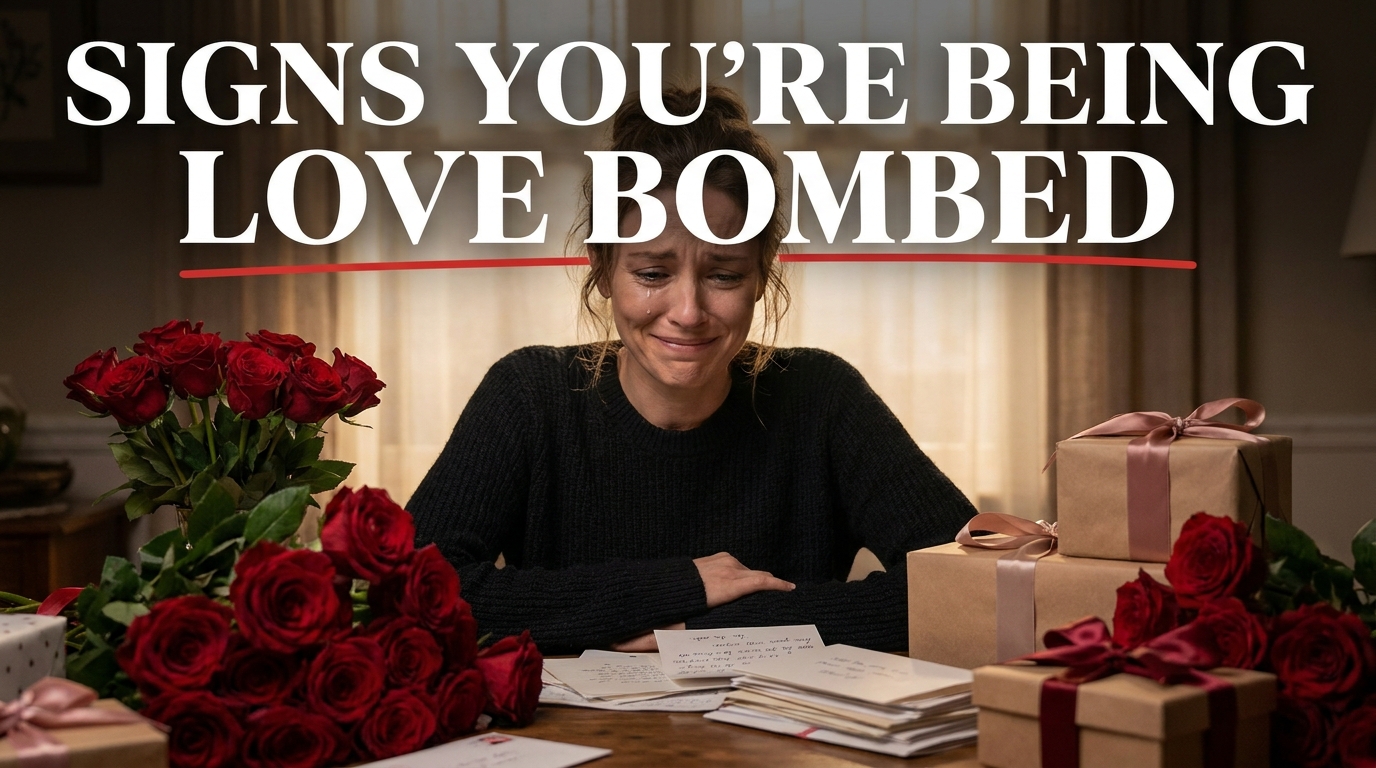
Imagine meeting someone who seems almost impossibly perfect. They text you good morning before you even wake up. They call you their soulmate within the first two weeks. They show up with flowers for no reason, plan extravagant dates, tell you they have never felt this way about anyone before — and they say it with such conviction, such warmth, such apparent sincerity that every cautious instinct you have gets quietly, pleasantly overwhelmed. It feels like finally. It feels like the love you have always deserved. It feels like magic.
And that feeling — that specific, intoxicating, completely disarming feeling — is exactly what it is designed to feel like.
The signs you’re being love bombed are rarely obvious in the moment, because love bombing is not an accident. It is a psychological manipulation tactic — conscious or unconscious — used to overwhelm a person’s defenses, create rapid emotional dependency, and establish control before the target has had enough time or enough information to make a clear-eyed assessment of who they are actually dealing with. According to research published in the journal Personality and Individual Differences, love bombing behavior is strongly associated with narcissistic personality traits, dark triad characteristics, and coercive control patterns in intimate relationships.
A 2021 report by the Domestic Abuse charity in the UK identified love bombing as a precursor in a significant majority of documented coercive control cases — meaning that in relationship after relationship, the story begins not with a red flag, but with an overwhelming flood of apparent devotion.
This article will give you what the beginning of that flood never does: clarity.

What Is Love Bombing — And Why Is It So Hard to Recognize?
Before examining the specific signs you’re being love bombed, it is essential to understand what love bombing actually is at its psychological core — because understanding the mechanism makes the signs significantly easier to identify.
Love bombing is the deliberate or semi-deliberate use of intense, excessive affection, attention, flattery, and romantic gesture in the early stages of a relationship — not as an authentic expression of developing feeling, but as a strategic tool for creating rapid emotional attachment and dependency in the target.
The term itself was first used in psychological literature in connection with cult recruitment tactics — specifically, the practice of overwhelming new recruits with affection, belonging, and attention to bypass their critical thinking and create loyalty before they had the time or the information to make an informed choice. The parallel to romantic relationships is not coincidental. The psychological mechanism is identical.
What makes love bombing so extraordinarily difficult to recognize from the inside is that it mimics — almost perfectly — the natural behaviors of genuine romantic enthusiasm. Real love also involves excitement, generosity, and a strong desire to show affection. The difference between love bombing and authentic romantic intensity is not visible in any single gesture. It lives in the pattern, in the pace, in the underlying motivation, and — most revealingly — in what happens the moment the target steps outside the role the love bomber needs them to play.
Psychologists describe love bombing as operating in a specific sequence: idealization, followed by devaluation, followed by discard or hoovering. The love bombing phase is the idealization stage — the period during which the target is placed on an impossibly high pedestal. Understanding that this pedestal has a function — to make the eventual devaluation more psychologically destabilizing — is key to understanding why the early warning signs matter so much.
The Signs You’re Being Love Bombed — Identified and Explained
The following signs are not presented as a simple checklist. Each one is a psychological signal that deserves genuine reflection — not to create paranoia about every affectionate partner, but to develop the kind of informed emotional awareness that protects you from patterns that are genuinely harmful.
Sign 1: The Pace Feels Impossibly Fast
Genuine love develops. It builds through accumulated experience, through navigating difficulty together, through learning someone’s contradictions and choosing them anyway. It has a natural pace — one that feels exciting but also organic, one that allows both people’s nervous systems to gradually calibrate to each other.
Love bombing collapses that pace entirely. Within days or weeks, the love bomber is using language and making emotional claims that would typically develop over months or years. “I’ve never felt this way about anyone.” “I knew from the moment I saw you.” “You are my person.” “I want to spend the rest of my life with you.” These statements are delivered with complete apparent sincerity — and they may even feel sincere to the person saying them, particularly if their attachment style involves rapid, intensity-driven bonding.
But the pace itself is the signal. When someone is claiming profound, life-altering love before they have had the opportunity to actually know you — before they have seen you stressed, or sick, or boring, or uncertain — what they are responding to is not you. It is a projection. An idealized version of you that you have not yet had the opportunity to contradict. And the speed of the attachment tells you that the relationship is not being built on genuine knowledge. It is being built on a feeling that serves the love bomber’s needs.
Sign 2: The Attention Feels Overwhelming and Relentless
There is a specific quality to love bombing attention that distinguishes it from genuine romantic enthusiasm — it is relentless in a way that, if you slow down enough to notice, begins to feel less like affection and more like surveillance.
Constant texts. Multiple calls throughout the day. An expectation of immediate response. Showing up unexpectedly. Planning back-to-back dates with barely a breath between them. A visible unease or subtle punishment when you are not available — when you need an evening to yourself, when you spend time with friends, when you choose sleep over a late-night phone call.
The love bomber frames this relentlessness as devotion. As proof of how much they care. And on the surface it looks like devotion — which is precisely why it is so disarming. But genuine care for another person includes care for their autonomy, their existing life, their need for space and solitude. Relentless attention that quietly punishes absence is not devotion. It is the early architecture of control.
Sign 3: You Are Being Put on an Unrealistic Pedestal
Love bombers do not just like you — they worship you. You are the most beautiful person they have ever seen. The most interesting. The most emotionally intelligent. The most everything. Every statement about you is superlative. Every quality you possess is extraordinary. You have no flaws — or your flaws are adorably perfect. You are, in their telling, essentially incomparable.
This feels wonderful. The human need to be seen and valued is deep and legitimate, and having someone reflect your worth back to you so consistently and so intensely activates some of the most powerful reward circuitry in the brain.
But here is what the pedestal is actually doing: it is establishing a standard that no real human being can maintain. And the moment you behave like a real human being — the moment you disagree, disappoint, have a bad day, make a mistake, or simply express a need that inconveniences the love bomber — the pedestal tilts. Because the person they have been worshipping was never quite you. It was an idealized projection. And real you, with your humanity and your complexity and your independent needs, does not fit the projection. That misfit is what triggers the devaluation phase.

Sign 4: Future Faking — Grand Plans Made Immediately
One of the most seductive and most revealing signs you’re being love bombed is the phenomenon psychologists call “future faking” — the creation of an elaborate, compelling shared future narrative in the earliest stages of a relationship, before any genuine foundation for that future has been established.
The love bomber talks about where you will travel together. The home you will build. The children you might have. The life that is waiting for you both. They weave you into their future with such specificity, such apparent certainty, that it feels less like imagination and more like prophecy. And it is intoxicating — because one of the deepest human desires is to be someone’s chosen future, someone’s deliberate and specific plan.
Future faking serves a very specific psychological function in love bombing: it accelerates emotional investment. Once you have mentally and emotionally inhabited a future with someone — once you have allowed yourself to want the life they have described — your emotional stakes in the relationship escalate dramatically. You now have something to lose that you did not have before they painted the picture. And higher stakes mean lower defenses.
The cruel irony of future faking is that the futures described are almost never built. They exist to create attachment, not to be honored. The love bomber’s investment in the future narrative typically evaporates the moment the relationship moves out of the idealization phase — which is precisely when the target, now deeply emotionally invested, feels the rug pulled out from under a life they had already begun to believe in.
Sign 5: Isolation Disguised as Devotion
This is one of the most dangerous signs you’re being love bombed — and one of the most effectively concealed, because the mechanism of isolation is wrapped so completely in the language of romance.
“I just want you all to myself.” “I get jealous because I love you so much.” “I feel like when you’re with your friends, you forget about me.” “I just want us to have our own world.” These statements are delivered as confessions of feeling, as vulnerabilities, as proof of the depth of the love bomber’s attachment to you. And to a person who is being flooded with affection and intensity, they can feel like the ultimate compliment.
What they are actually doing is systematically narrowing your social world. Each expression of jealousy or neediness makes spending time with friends and family feel like an act of cruelty toward someone who loves you. Gradually — sometimes over just a few weeks or months — you find yourself spending less time with your existing support network, not because you were directly told to, but because the emotional cost of maintaining those connections became too high.
Isolation is not a side effect of love bombing. It is a goal. A person with a diminished support network is significantly more emotionally dependent on their partner, significantly less likely to receive outside perspective on the relationship’s dynamics, and significantly harder to leave when the devaluation phase begins.
Sign 6: Gifts and Grand Gestures That Feel Transactional
There is nothing inherently problematic about generosity in a relationship. But love bombing generosity has a specific quality that distinguishes it from genuine giving — it creates obligation. It keeps a running, invisible ledger.
The gifts come early and they come large — disproportionate to the stage of the relationship. Expensive dinners, luxury items, elaborate surprises. And while they are given with the presentation of wanting nothing in return, they function psychologically to establish debt. You begin to feel that you owe this person something — your loyalty, your time, your emotional availability — in proportion to what they have invested in you.
When a love bomber later uses those gifts as leverage — “after everything I’ve done for you,” “I gave you everything and you can’t even…” — the transactional nature of the generosity becomes explicit. But even before that moment, the weight of disproportionate giving creates a subtle but powerful sense of obligation that limits your freedom to evaluate the relationship honestly.
Sign 7: Your Gut Feels Something You Cannot Name
This sign is the one that is most frequently dismissed — and the one that deserves the most respect. Many people who have survived love bombing relationships describe, in retrospect, a persistent low-level unease that they could not articulate during the relationship itself. Something that did not quite add up. A sense that the intensity was slightly off — slightly too much, slightly too fast, slightly too perfectly calibrated to their specific vulnerabilities.
This feeling is not neurosis. It is not ingratitude. It is your nervous system’s threat-detection system doing its job. The human brain is extraordinarily good at detecting pattern inconsistencies — at noticing when behavior does not quite match context, when emotional expression seems performed rather than spontaneous, when the story someone tells about themselves does not quite hold together under gentle scrutiny.
When you feel this unease in the presence of overwhelming affection — when something feels slightly wrong even though everything looks perfect — that feeling is information. Treat it as data rather than a character flaw to be overcome.
“Love bombing is not about giving you too much love. It is about giving you the appearance of love in a quantity designed to overwhelm your ability to think clearly about what you are actually receiving.”

The Psychology Behind Love Bombing — Who Does It and Why
Understanding the signs you’re being love bombed is deepened significantly by understanding the psychological profile of the person doing the bombing. This is not about demonizing — it is about comprehending.
Narcissistic Personality and the Need for Supply
Research consistently identifies narcissistic personality traits as among the strongest predictors of love bombing behavior. Individuals with narcissistic personality disorder or significant narcissistic traits operate from a specific psychological need — what clinicians call “narcissistic supply” — the external validation, admiration, and emotional reaction from others that functions as their primary source of self-regulation.
The idealization phase of love bombing is not primarily about the target. It is about the love bomber’s own need for a mirror — someone who reflects their exceptional qualities back to them, who confirms their status as uniquely lovable and uniquely capable of producing extraordinary romantic experience. The love bombing is, at its core, a self-serving act — not because the feelings are entirely false, but because the primary purpose is the love bomber’s own emotional regulation, not the target’s genuine wellbeing.
Dark Triad Characteristics
Psychologists studying manipulation in romantic relationships have identified what is called the “dark triad” — a cluster of personality characteristics comprising narcissism, Machiavellianism, and psychopathy — as strongly correlated with love bombing behavior. Machiavellian individuals are specifically characterized by a strategic, calculating approach to interpersonal relationships — a willingness to use charm, deception, and emotional manipulation as deliberate tools for achieving personal goals.
For Machiavellian individuals, love bombing is not an impulse. It is a strategy — one applied with varying degrees of conscious awareness but with consistent effectiveness, because it exploits universal human vulnerabilities: the need to be loved, the desire to be chosen, and the neurochemical susceptibility of early romantic attachment.
Insecure Attachment and Unconscious Patterns
Not every person who love bombs is a narcissist or a calculated manipulator. A significant subset of love bombing behavior originates from severe attachment insecurity — particularly anxious attachment — combined with poor emotional regulation and a desperate, genuine terror of abandonment.
For these individuals, the overwhelming intensity of early love bombing is not strategy. It is panic. It is the nervous system attempting to rapidly secure a bond before the other person has the opportunity to leave. The giving is genuine — but it is driven by fear rather than abundance, and it creates the same patterns of overwhelm, obligation, and eventual control as more calculated love bombing, even without the conscious intent.
Understanding this distinction matters for how you eventually process the experience — whether you are dealing with someone who deliberately weaponized your emotions or someone who was so frightened of losing you that they smothered you with a version of love that was never quite about you.
What Happens After the Love Bombing Ends
Understanding the signs you’re being love bombed is incomplete without understanding what typically follows the idealization phase — because the aftermath is where the true nature of the pattern becomes undeniable.
The Devaluation Phase
The shift from idealization to devaluation is rarely dramatic in its initiation. It begins with small moments — a criticism where there was previously only praise, a coldness where there was previously only warmth, a withdrawal of the constant attention that you have by now come to depend on. The love bomber who once called you incomparable begins to find your flaws. The one who worshipped your opinions begins to dismiss them. The one who made you feel like the most important person in the world begins to make you feel like an inconvenience.
This shift is psychologically devastating in direct proportion to the height of the idealization. Because you have been placed so high, the fall is extraordinary. And the natural human response — the response the love bomber both anticipates and often depends on — is to try desperately to return to the person who made you feel so extraordinary. To change yourself, to accommodate, to make yourself smaller or different or more palatable, in pursuit of the version of them that made you feel so loved.
That pursuit is the control mechanism made complete. The love bombing created the dependency. The devaluation activates it.
The Cycle of Hoovering
Many love bombing relationships do not end cleanly. They cycle. After a period of devaluation — sometimes after the target attempts to leave — the love bomber returns to idealization. The affection floods back. The apologies are profound. The promises are sincere-sounding. The person who made you feel extraordinary is back — and after the pain of the devaluation period, their return is experienced as an enormous relief that re-activates the neurochemical bonding of the original love bombing phase.
This cycle — idealization, devaluation, discard or withdrawal, hoovering back to idealization — can repeat for years. Each cycle typically deepens the psychological impact on the target and strengthens the love bomber’s control. Understanding this pattern is essential, because recognizing that the return of the “good” version is part of the same cycle as the “bad” version — not a genuine change — is often the insight that finally allows someone to choose themselves.
“The return of the person who love bombed you is not evidence that they have changed. It is evidence that the cycle is continuing. The difference matters more than you know.”

How to Protect Yourself From Love Bombing
Knowing the signs you’re being love bombed is the first layer of protection. Building the internal and relational practices that make you less vulnerable to the pattern is the next.
Honor the Natural Pace of Connection
One of the most powerful protective practices is a conscious commitment to honoring the natural developmental pace of relationships. Genuine connection takes time — not because love is slow, but because knowledge is slow. You cannot truly know someone in two weeks. You cannot authentically trust someone in a month. Allow yourself to be genuinely excited about a new person without allowing that excitement to become the foundation of major emotional investment before it has been tested by time and reality.
When a partner pushes the pace dramatically — when they want more, faster, sooner, deeper — notice it. Not with alarm, but with attention. The pace of a relationship’s development is one of the most reliable early indicators of its underlying health.
Maintain Your Life Outside the Relationship
The most effective structural protection against love bombing is a robust life that exists independently of any romantic relationship. Your friendships. Your interests. Your routines. Your time and space. When you maintain these things actively — when you do not allow even an intensely exciting new relationship to eclipse your existing life — you retain the outside perspective that love bombing specifically tries to eliminate.
Keep seeing your friends. Keep your standing plans. Keep some evenings for yourself. Not as a test of the new partner’s response — but as a genuine commitment to your own wholeness. And pay close attention to how a new partner responds to these commitments. Genuine love will celebrate them. Love bombing will resist them.
Trust Discomfort Even When Everything Looks Perfect
Give yourself explicit permission to feel uncertain or uncomfortable even in the presence of apparently wonderful treatment. The absence of obvious red flags does not mean the absence of cause for reflection. If something feels slightly off — if the intensity feels more overwhelming than joyful, if the pace feels more anxious than exciting — that feeling deserves acknowledgment rather than suppression.
Talk to trusted friends about new relationships, and specifically invite honest feedback. The outside perspective of people who know you well and have no emotional stake in the relationship is one of the most valuable resources you have — and it is precisely the resource that love bombing, through its gradual isolation tactics, tries to remove.
Go Slowly With Emotional Investment
This is perhaps the most practically protective piece of advice available: allow your emotional investment to track your actual knowledge of the person rather than the intensity of the feeling they produce in you. The neurochemical experience of early romantic attraction is powerful, real, and entirely capable of producing enormous emotional investment in someone you do not yet genuinely know.
Decide consciously that your deeper emotional commitments — the ones that involve your future, your identity, your core wellbeing — will be given gradually, in proportion to demonstrated character over time rather than in response to overwhelming affection in the moment. This is not guardedness. It is wisdom.

A Final Word: You Deserved Real Love Then, and You Deserve It Now
If you are reading this article and recognizing a relationship you are currently in — or one you have only recently escaped — the most important thing to understand is this: being love bombed is not evidence of naivety or weakness. It is evidence of a completely normal human response to a set of tactics specifically designed to exploit the very best parts of you — your capacity for love, your desire for connection, your willingness to believe in someone’s best self.
The signs you’re being love bombed are deliberately concealed beneath the appearance of everything you ever wanted. Recognizing them requires a level of self-awareness and emotional education that most people are simply never given — until they need it, often painfully, in retrospect.
You are not foolish for having wanted to believe in it. You are not broken for having felt it deeply. You are not damaged for having stayed longer than you wish you had. You are human — and the love bombing was designed for exactly the human that you are.
What you do with this knowledge now — how you use it to become more discerning, more self-honoring, and more capable of recognizing the real thing when it arrives without overwhelm or urgency or the need to bypass your better judgment — that is where your story changes.
Real love does not need to rush. It does not need to overwhelm. It does not need to isolate you, obligate you, or carefully manage your perception of reality. Real love shows up consistently, at a human pace, in ways that make your life larger rather than smaller. And it is waiting for you — on the other side of knowing the difference.
💾 Save this article — the signs are easier to recognize when you have read them before you need them.
📤 Share it with someone in a new relationship that feels intense and fast and almost too good.
➕ Follow Truthsinside.com for signs, signals, and psychology content that helps you see relationships clearly.
📃 Related article: 15 Signs She Is Testing You: Why Women Test Men and What to Do
Frequently Asked Questions
Q1: Is love bombing always intentional and calculated?
Not always. While some individuals — particularly those with narcissistic or Machiavellian personality traits — engage in love bombing with a degree of conscious strategic awareness, others do so from a place of unconscious emotional pattern rather than deliberate manipulation. Severely anxiously attached individuals may love bomb out of genuine terror of abandonment rather than calculated intent to control. The impact on the target is often similar regardless of intent — but understanding the difference can be important for processing the experience and for assessing whether genuine change is possible in the person who did the love bombing.
Q2: How is love bombing different from simply being very romantic or enthusiastic in a new relationship?
The key distinctions are pace, proportion, and response to boundaries. Genuine romantic enthusiasm is exciting but allows for breathing room — it does not require constant contact, it does not subtly punish independence, and it does not escalate to major claims of love and future commitment within days or weeks. Most importantly, a genuinely enthusiastic partner will respect your pace even if it differs from theirs. A love bomber becomes uncomfortable, withdrawn, or subtly punishing when you do not match their intensity or when you assert any independence. The response to your autonomy is one of the clearest diagnostic markers available.
Q3: Can love bombing happen in long-term relationships, not just at the beginning?
Yes — particularly in the hoovering phase of cyclical love bombing relationships. After a period of withdrawal, devaluation, or a threatened ending, a love bomber may return to intense idealization behavior — essentially redeploying the love bombing tactics that characterized the relationship’s beginning. This return to early-relationship intensity after a period of pain is one of the most powerful mechanisms of the trauma bond, because the neurochemical relief of the return to idealization is experienced as proof that the relationship is worth staying in, rather than recognized as part of the cycle.
Q4: I think I may have love bombed someone without realizing it. What should I do?
The self-awareness required to ask this question is itself significant and meaningful. If you recognize patterns of overwhelming intensity, rapid attachment, difficulty with a partner’s independence, or cycles of idealization and withdrawal in your own relationship behavior — working with a therapist who specializes in attachment and relationship patterns is the most constructive next step. Many people who love bomb do so from their own unhealed attachment wounds rather than from malicious intent, and those wounds are genuinely workable with the right professional support. Taking responsibility for the impact of your behavior — regardless of your intent — is the essential starting point.
Q5: How long does it take to recover from a love bombing relationship?
Recovery timelines vary significantly depending on the length and intensity of the relationship, the severity of the devaluation that followed, the individual’s existing psychological resources, and whether professional support is accessed. What research and clinical experience consistently show is that love bombing relationships often produce a specific form of trauma bond that can make the grieving process more complex and more prolonged than typical relationship endings. Many survivors describe the recovery process as occurring in distinct phases — initial shock and grief, gradual recognition of the pattern, rebuilding of self-worth and identity, and eventually the development of a new and more discerning relationship with intimacy. Therapy, community support, and honest self-reflection are all significant accelerants of this process.
🎵 Music
Maren Lull is a singer-songwriter who writes from the places most people don’t talk about out loud.
Not the dramatic grief. Not the obvious heartbreak. The quiet kind — the ordinary Tuesday emptiness, the habit of reaching for someone who isn’t there anymore, the particular exhaustion of being strong for so long that the strength itself wears thin.
Her music lives at the intersection of emotional honesty and soft beauty — breathy vocals over gentle piano, slow tempos, lyrics that feel less like songs and more like something you wrote in a private notebook at two in the morning and never showed anyone.
Maren Lull writes for the people who feel everything deeply and say very little about it. For the ones who listen to sad music not because they want to feel worse — but because being understood, even by a song, makes the feeling easier to carry.
📱 Follow Maren Lull:
→ Spotify
→ Apple Music
→ Youtube
→ Audiomack