
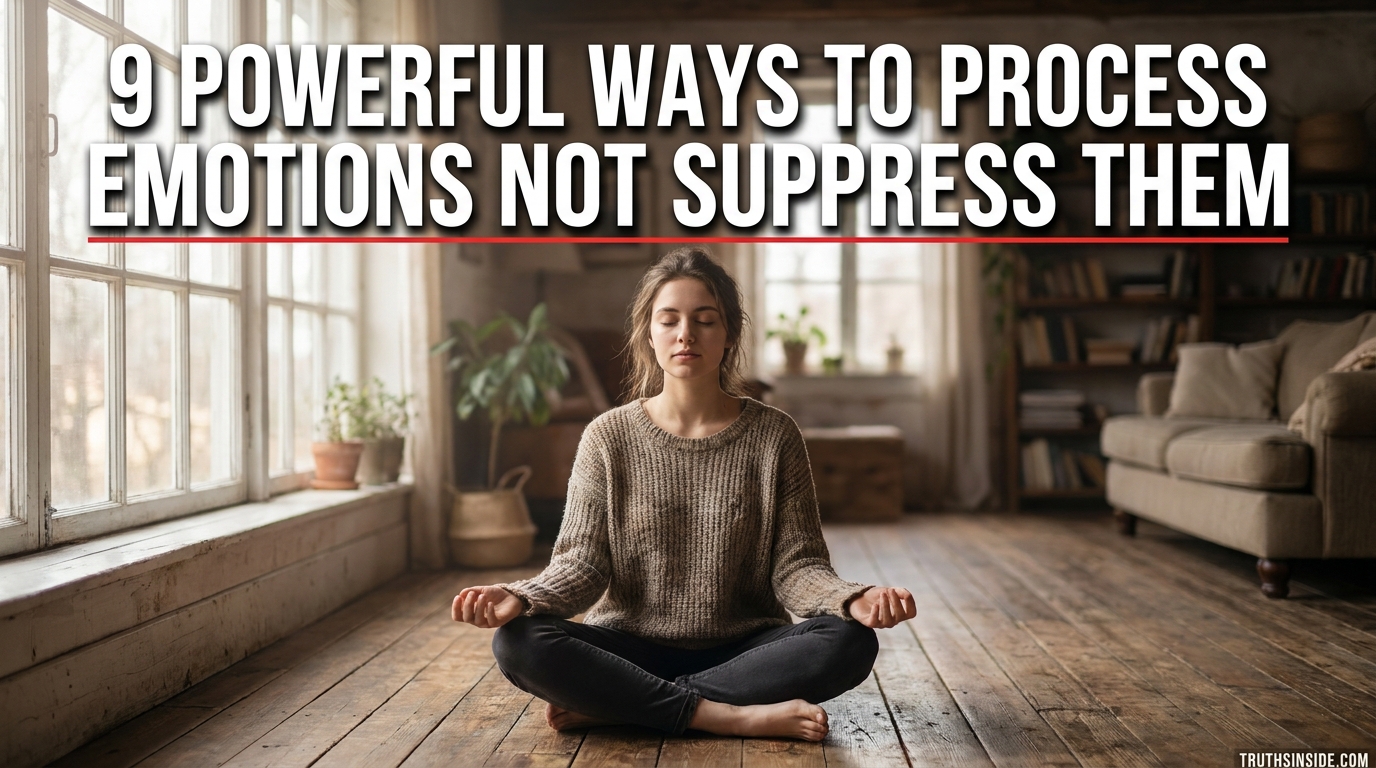
Learning to process emotions is one of the most transformative skills a human being can develop — and one of the least taught. From childhood, most of us absorbed a simple and damaging message: certain feelings are acceptable and others are not. Happiness, excitement, and gratitude were welcomed. Anger, grief, jealousy, and fear were uncomfortable for the people around us, so we learned to make them uncomfortable for ourselves too.
We learned to suppress.
And suppression works — for a while. It gets you through the meeting, through the dinner party, through the breakup, through the loss. But it does not process anything. It stores it. And stored emotion does not disappear. It accumulates, compounds, and eventually expresses itself in ways that are far harder to manage than the original feeling would have been — through anxiety, through explosive anger, through emotional numbness, through physical illness, through patterns in relationships that seem impossible to break.
The good news is that emotional processing is a skill. It can be learned at any age, at any stage of life, regardless of how long you have been suppressing. What follows are nine strategies grounded in psychology and emotional neuroscience that will help you move through your feelings rather than around them.
1. Name What You Are Actually Feeling
The first and most foundational step to process emotions is deceptively simple: name them. Not broadly — not just “I feel bad” or “I’m stressed” — but with precision.
Psychologist Dr. Dan Siegel coined the phrase “name it to tame it,” and neuroscience backs it up completely. Research from UCLA found that when participants labeled their emotions with specific language, activity in the amygdala — the brain’s fear and threat center — decreased significantly. Simply finding the right word for what you feel creates measurable distance between you and the emotional intensity of the experience.
The challenge is that most people have a limited emotional vocabulary. They know happy, sad, angry, and scared. But emotions are far more layered than that. What feels like “anger” might actually be humiliation underneath. What presents as “anxiety” might actually be grief. What looks like “numbness” might be an overwhelmed nervous system that has temporarily shut down to protect itself.
Consider keeping an emotion wheel nearby — a visual tool that maps dozens of nuanced emotional states radiating from core feelings. When something rises in you, sit with the question: what is this, really? Is it disappointment? Resentment? Longing? Shame? The more precisely you can name it, the more effectively you can process it.
This practice alone — the daily habit of naming what you feel with honesty and specificity — builds emotional intelligence that transforms every relationship you are in, including the one you have with yourself.

2. Allow the Feeling Without Judgment
Once you have named what you are feeling, the next crucial step is to allow it to exist without immediately trying to fix, fight, or justify it.
This is where most people struggle most. The moment an uncomfortable emotion surfaces, the internal critic arrives right behind it. “You shouldn’t feel this way.” “This is so irrational.” “Other people have it so much worse.” “Stop being so sensitive.” These judgments do not help the emotion move through you. They freeze it in place — layering shame on top of the original feeling and creating a second wound on top of the first.
Psychologists call this “meta-emotion” — how we feel about how we feel. And research shows that people who experience high levels of negative meta-emotion — who judge themselves harshly for having uncomfortable feelings — suffer significantly more psychological distress than those who allow emotions to exist without self-condemnation.
Allowing does not mean wallowing. It does not mean acting on every feeling you have. It means giving the emotion permission to be real, to exist in your body and mind for a moment, without the additional weight of shame or self-criticism.
A simple practice: when an uncomfortable emotion arises, place your hand on your heart and say internally, “This is a moment of pain. Pain is part of being human. I am allowed to feel this.” That brief act of self-compassion — research by Dr. Kristin Neff at the University of Texas shows — reduces emotional reactivity and accelerates the natural processing of difficult feelings.
“You cannot heal what you are not allowed to feel. Giving your emotions permission to exist is not weakness — it is the beginning of every real transformation.”
3. Feel It in Your Body, Not Just Your Mind
Emotions are not only mental events. They are physical ones. Fear tightens the chest. Grief sits heavy in the throat. Shame heats the face. Anger clenches the jaw. Anxiety flutters in the stomach. Emotions are experienced in the body first, and processed through the body as much as through the mind.
This is the central insight of somatic psychology — the field that studies the relationship between physical sensation and emotional experience. Dr. Bessel van der Kolk, author of The Body Keeps the Score, explains that trauma and suppressed emotion are stored in the body’s tissues and nervous system, and that purely cognitive approaches to emotional healing are often insufficient on their own.
To process emotions somatically, practice turning your attention to the physical sensations of what you feel rather than the story about it. When grief arrives, instead of running the narrative of why you are sad, ask: where do I feel this in my body? What does it feel like — heavy, hollow, tight, sharp? Can I breathe into that space?
This kind of body-based attention allows the nervous system to complete the emotional cycle that suppression interrupts. Research on the “felt sense” — a concept developed by psychologist Eugene Gendlin — shows that when people track the physical location and quality of an emotion in their body and stay present with it, the emotion often shifts, softens, or releases within minutes.
4. Move Your Body to Move Your Emotions
There is a reason human beings cry at funerals and rage feels like fire that needs somewhere to go. Emotions are energy — and energy needs movement to complete its cycle.
Physical movement is one of the most scientifically supported methods for emotional processing. Exercise triggers the release of endorphins and serotonin, yes — but more relevant here is what movement does to the body’s stress response. When an emotion activates the fight-or-flight system, the body prepares for action. Suppression tells the body to stand down without completing that action. Movement lets the body complete it.
This does not require an intense workout. A brisk walk can move grief through the body in ways that sitting still cannot. Shaking — literally, gently shaking the arms, legs, and torso — is used in somatic therapies specifically to discharge stored stress and emotional tension. Dance, yoga, swimming, even gardening — any form of purposeful physical engagement gives the nervous system the outlet it is biologically designed to use.
Research published in the journal Emotion found that participants who engaged in physical activity after experiencing an emotional stressor showed significantly faster emotional recovery and lower levels of residual stress than those who remained sedentary. Your body is not separate from your emotional life. It is your emotional life’s home.

5. Write It Out Without Editing Yourself
Journaling is one of the most extensively researched tools for emotional processing available — and one of the most underestimated. Not aesthetic journaling. Not gratitude lists. Expressive writing — the raw, unfiltered kind where you write exactly what you feel without worrying about grammar, logic, or what it says about you.
Dr. James Pennebaker, a psychologist at the University of Texas at Austin, has spent decades studying expressive writing and its effects on emotional and physical health. His research consistently shows that people who write about their deepest thoughts and feelings surrounding difficult experiences show significant improvements in immune function, mental health, and emotional clarity — often within just three to four sessions of writing.
The mechanism behind this is profound: when you write about an emotional experience, you engage both the emotional and analytical parts of your brain simultaneously. You are feeling and making meaning at the same time. This dual engagement helps transform raw emotional experience into narrative — and narrative is one of the primary ways human beings process and integrate difficult events.
The only rule for this kind of writing is that there are no rules. Write ugly. Write in circles. Write things you would never say out loud. Write the feelings you are most ashamed of. The page does not judge you — and the relief on the other side of honest expression is real.
6. Talk to Someone Who Can Truly Witness You
Human beings are wired for co-regulation — the neurological phenomenon where one person’s calm, regulated nervous system helps another’s dysregulated system find balance. This is why a hug from the right person can dissolve a panic attack. Why telling a trusted friend about your grief can bring relief that hours of private rumination cannot.
Talking about your emotions with someone who can truly witness you — not fix you, not minimize you, not immediately redirect the conversation to their own experience — is a powerful form of emotional processing. The key word is witness. Someone who can hold space without flinching, who does not rush your pain toward a resolution, who simply stays present with you while you feel.
This is also why therapy is so effective for emotional processing. A skilled therapist provides what attachment researchers call a “secure base” — a relational context in which it is safe to feel, safe to be messy, safe to not have the answers yet. Within that safety, emotions that have been suppressed for years can finally surface and move.
If therapy is not currently accessible to you, be intentional about who you turn to. Choose people who listen more than they talk, who validate before they advise, and who make you feel less alone rather than more judged.
“The emotions you carry alone become heavier with time. The ones you share with the right person become lighter — not because they disappear, but because you are no longer carrying them alone.”
7. Practice Mindfulness to Create Space Around Emotions
Mindfulness does not mean emptying your mind of emotions. It means learning to observe them with a quality of awareness that is curious rather than reactive — present rather than consumed.
When you are not practicing mindfulness, emotions tend to arrive as total experiences. You do not feel angry — you become anger. You do not feel anxious — anxiety becomes your entire reality in that moment. Mindfulness creates what psychologists call “the observer self” — a part of your awareness that can notice “I am experiencing anger right now” rather than “I am angry” — a distinction that sounds small but creates enormous psychological freedom.
Neuroscience research on long-term meditators shows that regular mindfulness practice literally changes the structure of the brain — thickening the prefrontal cortex (responsible for emotional regulation) and reducing the reactivity of the amygdala. You do not have to meditate for years to experience benefits. Studies show measurable changes in emotional regulation after as few as eight weeks of consistent practice.
Begin simply. Set a timer for five minutes. Sit quietly. When an emotion arises, do not fight it or follow it. Simply notice it, name it silently, and return your attention to your breath. This practice, repeated daily, becomes one of the most powerful emotional regulation tools you will ever develop.

8. Identify the Trigger, Not Just the Feeling
Emotional processing goes deeper when you move from the surface feeling to the root trigger. An emotion is a messenger — and the message it carries is often about something older, deeper, or more significant than the immediate situation that sparked it.
For example: your partner forgets to respond to a text and you feel a wave of disproportionate anxiety and hurt. The surface feeling is hurt. But the trigger might be an old wound — a parent who was emotionally unavailable, a past relationship where you were chronically deprioritized, a deep fear of abandonment that this small moment has accidentally activated.
Understanding the difference between the trigger and the current situation is essential for two reasons. First, it allows you to respond to your partner in proportion to what actually happened — rather than from the full weight of everything this moment has reminded you of. Second, it allows you to recognize which of your emotional reactions are about the present and which are about the past wounds still seeking healing.
Therapy — particularly approaches like Internal Family Systems (IFS), EMDR, or psychodynamic therapy — is especially effective for this level of emotional excavation. But even without a therapist, developing the habit of asking yourself “what does this remind me of?” or “what does this feeling tell me I need?” can begin to reveal the deeper architecture of your emotional life.
9. Give Yourself Time — But Not Avoidance
Processing emotions is not instant. Some feelings take minutes to move through. Others — grief, trauma, profound loss — take months or years. The goal is not to rush through emotions but to remain in relationship with them rather than cutting off the connection through suppression.
There is an important distinction between giving yourself time and using time as a form of avoidance. Giving yourself time looks like: “I am not ready to talk about this today, but I will come back to it. I will journal about it tonight. I will bring it to my therapist. I will let myself cry on the weekend when I have space to.” Avoidance looks like: “I’m just going to stay busy and not think about it and hopefully it goes away.”
Time plus engagement equals healing. Time plus avoidance equals accumulation.
Be patient and honest with yourself about which one you are doing. Check in regularly. Notice what emotions are asking for your attention. Give them the respect of a response — even if that response is simply sitting quietly with the feeling for a few minutes before your day begins.
The emotions you are willing to sit with will move. The ones you keep running from will follow you.

Why Emotional Suppression Damages Your Relationships
It is impossible to talk about learning to process emotions without addressing what suppression costs the people closest to you — because emotional suppression is never just a private matter.
When you suppress your emotions, you do not become neutral. You become unavailable. The emotional walls you build to keep pain out also keep love from fully reaching you. Partners of emotionally suppressed people often describe feeling like they are talking to a wall — present but not there, physically close but emotionally unreachable.
Suppressed emotion also tends to leak — often in misdirected ways. The anger that was never addressed at work comes home to a partner. The grief that was never processed becomes explosive irritability over something small. The fear that was never acknowledged becomes controlling behavior or irrational jealousy.
Research in couples psychology consistently shows that emotional avoidance — defined as the habitual suppression of emotions within relationships — is one of the strongest predictors of relationship dissolution. Not conflict. Not difference. Avoidance. Because you cannot build genuine intimacy with someone who is not fully present — and suppression is the enemy of presence.
Learning to process emotions is not just an act of self-care. It is one of the most loving things you can do for the people in your life.
Final Thoughts
Learning to process emotions instead of suppressing them is not a destination you arrive at. It is a practice you return to — imperfectly, repeatedly, with compassion for yourself when you forget and courage when you remember.
You will not do this perfectly. You will suppress sometimes. You will go numb sometimes. You will choose busyness over feeling on the days when feeling is too much. That is human. The goal is not perfection. The goal is direction — a consistent turning toward your inner life rather than away from it.
Every time you name what you feel, allow it without judgment, move your body, write the honest words, reach for the right person, or simply sit quietly with what is real — you are doing the work. You are building the emotional life you deserve. You are becoming someone who can be fully present with their own experience — and therefore fully present for the people they love.
That is not a small thing. That is everything.
CTA
Save this article so you can return to these strategies the next time emotions feel overwhelming and you are not sure what to do with them.
Share it with someone you love who has always been told to “toughen up” — they may need this more than you know.
Follow Truthsinside.com for honest, research-backed content on emotions, relationships, love, and the psychology of becoming whole.
Related article: What Does It Actually Feel Like to Fall in Love? Science + Real Stories
FAQ
Q1: What is the difference between processing emotions and wallowing in them?
Processing is active and intentional — it involves naming, feeling, moving through, and making meaning of an emotion. Wallowing is passive and repetitive — it involves cycling through the same emotional narrative without movement or insight. The difference lies in whether the emotion is shifting and teaching you something, or whether you are stuck in the same loop without forward movement.
Q2: How long does it take to process a difficult emotion?
It depends on the emotion and its roots. A situational frustration might process in minutes with the right tools. Grief, trauma, or deeply rooted emotional patterns can take months or years of consistent work. The important thing is that you remain in relationship with the emotion rather than cutting it off — because avoided emotions do not have a timeline, they simply wait.
Q3: Is it healthy to cry as a form of emotional processing?
Yes. Crying is one of the body’s most effective self-regulation mechanisms. Research shows that emotional tears contain stress hormones and other biochemicals — meaning crying is literally the body expelling stress. People who allow themselves to cry typically feel calmer and more emotionally clear afterward. Suppressing tears is a form of suppressing the emotion itself.
Q4: Can emotional suppression cause physical illness?
Yes, and significantly so. Research consistently links chronic emotional suppression to elevated cortisol levels, weakened immune function, cardiovascular stress, gastrointestinal issues, and higher rates of depression and anxiety. The body and the emotional mind are not separate systems — what happens in one is felt throughout the other.
Q5: What if I have suppressed emotions for so long that I feel nothing at all?
Emotional numbness is a protective response — often the result of prolonged suppression or trauma. It does not mean your emotions are gone. It means your nervous system has learned to shut them down as a form of survival. Working with a therapist, particularly one trained in somatic or trauma-informed approaches, can gently help you reconnect with your emotional experience at a pace that feels safe.
🎵 Music
Maren Lull is a singer-songwriter who writes from the places most people don’t talk about out loud.
Not the dramatic grief. Not the obvious heartbreak. The quiet kind — the ordinary Tuesday emptiness, the habit of reaching for someone who isn’t there anymore, the particular exhaustion of being strong for so long that the strength itself wears thin.
Her music lives at the intersection of emotional honesty and soft beauty — breathy vocals over gentle piano, slow tempos, lyrics that feel less like songs and more like something you wrote in a private notebook at two in the morning and never showed anyone.
Maren Lull writes for the people who feel everything deeply and say very little about it. For the ones who listen to sad music not because they want to feel worse — but because being understood, even by a song, makes the feeling easier to carry.
📱 Follow Maren Lull:
→ Spotify
→ Apple Music
→ Youtube
→ Audiomack