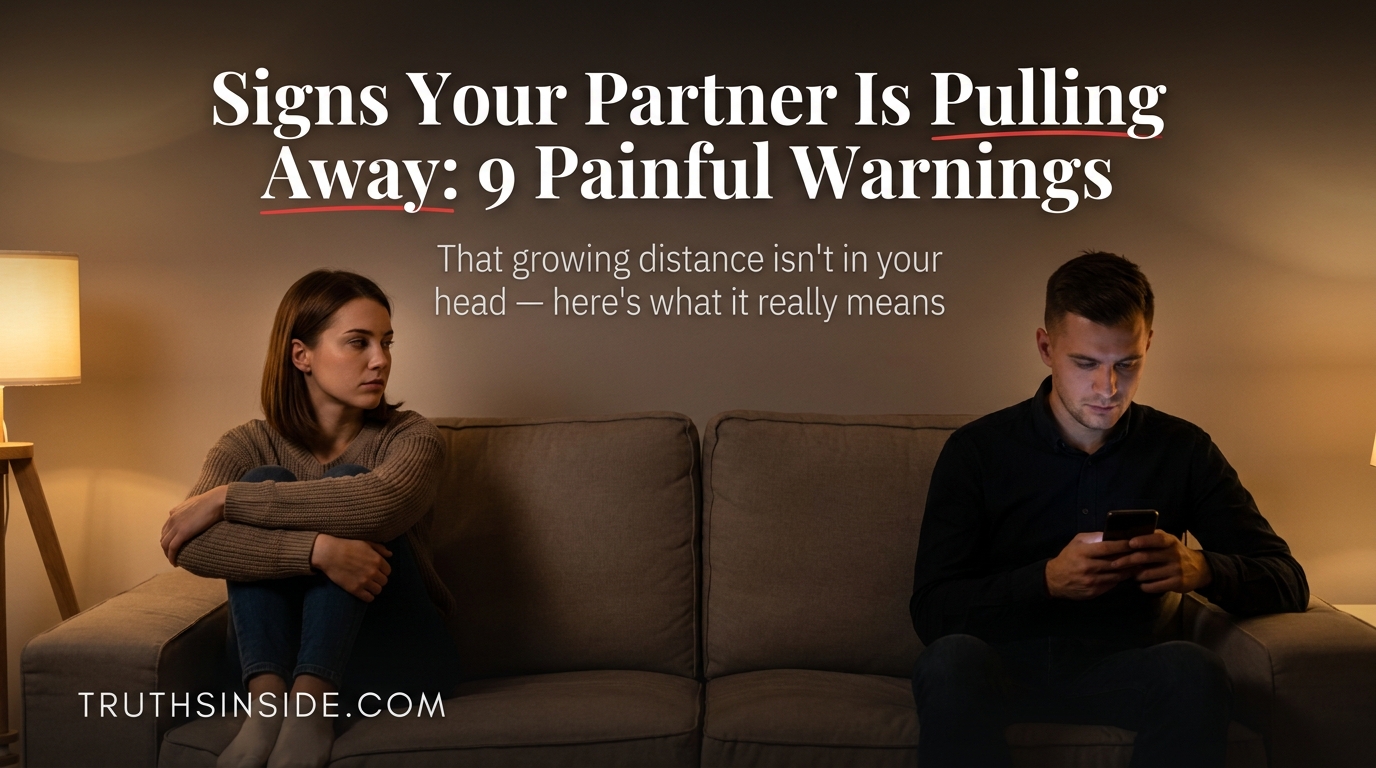
There is a specific kind of loneliness that has nothing to do with being alone — and everything to do with lying next to someone who no longer feels close. You can feel it in the conversations that used to flow effortlessly and now require effort. You can feel it in the goodnight kisses that have become shorter, or disappeared entirely. You can feel it in the way they look at their phone instead of at you, and in the silence that has started to feel less comfortable and more like something being withheld. You know something has changed. You just can’t get them to confirm it.
Recognizing the signs your partner is pulling away is one of the most emotionally difficult experiences in a relationship — precisely because the distance is real enough to feel but ambiguous enough to doubt. According to a 2020 study published in the Journal of Social and Personal Relationships, emotional withdrawal is one of the leading precursors to relationship dissolution — yet it is also one of the most commonly minimized warning signals, both by the person experiencing it and by the partner exhibiting it. People tell themselves it is stress. A phase. Something that will pass.
Sometimes it does pass. But sometimes it doesn’t. And the difference between those two outcomes often depends on whether the withdrawal is recognized and addressed early — or ignored until the distance becomes permanent. This article is here to help you see clearly, understand honestly, and respond wisely to one of the most painful signals a relationship can send.
Why Partners Pull Away — The Psychology Behind the Distance
Before naming the signs your partner is pulling away, it is essential to understand that emotional withdrawal in relationships is rarely a simple, singular thing. People pull away for vastly different reasons — and the reason matters enormously for what comes next.
Some partners withdraw because of personal stress, mental health struggles, or overwhelming external pressure that has nothing to do with the relationship itself. Some pull away because of unresolved attachment wounds — avoidant attachment styles, in particular, cause people to instinctively create distance when intimacy deepens or vulnerability feels threatening. Some withdraw because of genuine relationship dissatisfaction — growing incompatibility, unmet needs, or resentment that was never properly addressed. And some pull away as a precursor to ending the relationship, consciously or unconsciously creating distance to soften what they already know is coming.
Each of these reasons calls for a different response. And yet in all cases, the early behavioral signals look remarkably similar. Learning to read those signals — while holding space for multiple possible explanations — is what separates a panicked reaction from an emotionally intelligent one.
📃 Related article: 15 Signs She Is Testing You: Why Women Test Men and What to Do
“The distance your partner is creating is a communication. The question is not whether to hear it — it is whether you’re willing to understand what it is actually saying.”
9 Painful Signs Your Partner Is Pulling Away
Sign 1: Conversations Have Become Surface-Level and Transactional
One of the earliest and most telling signs your partner is pulling away is a fundamental shift in how — and what — you communicate. Conversations that once had depth, humor, vulnerability, and genuine curiosity begin to shrink into logistics. “What do you want for dinner?” “Did you pay the electric bill?” “I’ll be home late.”
The easy, effortless conversation — the kind where you talked about everything and nothing for hours — quietly disappears. And in its place is a functional exchange that keeps the household running but does nothing to close the emotional gap that is slowly opening between you.
Relationship researcher Dr. John Gottman identifies emotional attunement — the practice of turning toward each other with genuine interest and presence — as one of the cornerstones of lasting relationships. When that attunement begins to erode, when curiosity about each other fades, it is one of the clearest behavioral indicators that emotional investment is declining. It doesn’t always mean the relationship is over. But it does mean something significant has shifted and deserves direct, honest attention.
Sign 2: Physical Affection Has Decreased or Disappeared
Touch is one of the most fundamental languages of connection in intimate relationships. It communicates safety, desire, belonging, and care in ways that words alone cannot replicate. When a partner begins to pull away emotionally, physical affection is often one of the first casualties — sometimes before the person even consciously recognizes what they are doing.
The goodnight kiss becomes perfunctory or stops happening. Hands that used to find each other naturally now stay separate. Hugs become brief and stiff rather than warm and lingering. Initiating physical connection begins to feel like reaching for someone who is already slightly out of reach.
It is worth noting that decreases in physical affection can also result from physical health issues, depression, high stress, or medication changes — none of which are necessarily relationship-related. This is why a single sign should never be read in isolation. But when a decline in physical affection appears alongside other signals, it becomes part of a pattern that is harder to explain away.
Sign 3: They Are Emotionally Unavailable During Your Hard Moments
A partner who is genuinely present and invested in a relationship shows up during vulnerability. When you’ve had a hard day, when you’re anxious about something, when you’re hurting — their instinct is to move toward you, offer support, and be present with you in the difficulty.
One of the most painful signs your partner is pulling away is noticing that this instinct has changed. They are distracted when you share something important. They offer minimal responses to things that would once have drawn their full attention. They seem present in the room but absent in the conversation. And afterward, you feel oddly alone — as if you shared something real and it landed nowhere.
Emotional availability is an act of will and investment. When it decreases, it is almost always because something internal has shifted — whether that is personal overwhelm, relationship disengagement, or something deeper that hasn’t yet been named. Either way, the signal is real and significant.

Sign 4: Their Phone Has Become a Barrier Between You
This sign requires nuance — because phone use in relationships is contextual and not inherently a red flag. But there is a specific quality to phone behavior that signals emotional withdrawal rather than simply modern distraction.
When a partner is pulling away, the phone often becomes a tool for creating distance — a socially acceptable way to be present in the body while absent in the relationship. It appears during dinner conversations, in moments that used to be shared, in the space where connection once lived. And more than the frequency of use, what changes is the instinct to put it down. A partner who is emotionally invested will naturally set the phone aside when you’re together. A partner who is withdrawing may not even notice — or may notice and choose not to.
There can also be a secretiveness that develops around phone use — screens turned away, notifications silenced more consistently, or a slight tension when the phone is unexpectedly visible. This dimension of the sign moves beyond simple distraction and into territory that warrants a direct, honest conversation.
Sign 5: Future Plans Are No Longer Being Made
Couples who are emotionally invested in each other naturally think and talk about the future together. Not necessarily grand declarations of forever, but the ordinary, organic kind of future-making that reflects a mutual assumption of continued presence. “We should try that restaurant next month.” “I was thinking for the holidays we could…” “Next summer, what if we…”
When a partner begins pulling away, future-making language quietly disappears. Plans that were vague but assumed become plans that are never mentioned. Invitations to future events are answered noncommittally. And the horizon of the relationship, which once felt expansive, begins to feel strangely short — like they are only willing to commit to the very near term.
This is one of the signs your partner is pulling away that people often explain away most aggressively — “they’re just not a planner,” “we don’t need to plan everything” — because acknowledging it requires acknowledging that the relationship may no longer feel like a certainty to the other person. But the shift in future language is a meaningful signal that deserves honest reflection.
📃 Related article: Signs He Likes You But Is Scared: 18 Behaviors Men Show When Afraid to Commit
Sign 6: Arguments Feel Different — Resigned Rather Than Passionate
This sign surprises many people, because they assume that a pulling away partner would create fewer conflicts. But conflict in relationships actually requires investment. You fight because you care. You push back because the relationship matters enough to struggle for.
When a partner is genuinely withdrawing, arguments often change in quality rather than frequency. They become resigned rather than passionate. Instead of fighting to resolve something, one person goes quiet, agrees too quickly, or simply stops engaging. There is no longer the energy of someone who wants to fix it — there is only the flat compliance of someone who has decided it doesn’t matter enough to fight about anymore.
Psychologist Dr. John Gottman calls this stonewalling — a pattern where one partner emotionally shuts down during conflict — and identifies it as one of the Four Horsemen of relationship dissolution. But beyond the mechanics of conflict, the resignation itself is the signal. When someone stops fighting for the relationship, it often means they have already begun, at some level, to let it go.

Sign 7: They Are Investing More Heavily in Life Outside the Relationship
When a partner begins pulling away, they often begin redirecting their emotional energy into other areas of their life — work, friendships, hobbies, personal projects — in ways that feel qualitatively different from healthy independence. The balance shifts. The relationship, which once received a significant portion of their focus, attention, and enthusiasm, begins receiving less — while everything outside of it seems to receive more.
This can manifest as suddenly working longer hours without the relationship context that once accompanied those pressures. It can look like a social life that expands in ways that consistently exclude you. It can look like the rekindling of interests or friendships that had previously been shared with you, now pursued independently with an energy that feels almost deliberately separate.
Healthy independence within a relationship is essential and beautiful. But there is a specific quality to this kind of withdrawal — an exclusionary energy, a sense that the life being built outside the relationship is being built away from it rather than alongside it. That distinction, felt in the gut before it can be articulated, is worth trusting.
Sign 8: Intimacy Has Become Infrequent and Feels Disconnected
Sexual and emotional intimacy in relationships are deeply interconnected — and both are sensitive indicators of the overall health of the connection. When a partner is pulling away, changes in intimacy often reflect the broader emotional withdrawal taking place beneath the surface.
This can manifest as a significant decrease in frequency, but also — and perhaps more tellingly — as a change in quality. Intimacy that once felt connecting and present begins to feel mechanical, distracted, or emotionally absent. There is a going-through-the-motions quality that leaves both people feeling strangely alone afterward, even though they were physically together.
It is important to hold this sign with compassion and context. Stress, depression, hormonal changes, physical health issues, and medication can all affect intimacy in ways that have nothing to do with relationship withdrawal. But when changes in intimacy appear alongside other behavioral shifts — fewer conversations, less affection, more distance — it becomes part of a pattern rather than an isolated variable.
Sign 9: Your Gut Has Been Telling You Something Is Wrong
This is not a behavioral sign in the traditional sense. It cannot be measured or pointed to in a single moment. But it is perhaps the most consistently reliable signal that something has genuinely changed — and it deserves to be named and honored.
Your gut — your instinctive, body-level awareness of emotional dynamics in your relationship — is picking up information constantly. It reads micro-expressions, tonal shifts, patterns of presence and absence, energy that is subtly different from what it was before. And when it tells you, quietly but persistently, that something is wrong — that your partner feels different, that the relationship has shifted, that something is being withheld — that signal deserves respect.
The voice that says “I’m probably just overthinking it” is not always wisdom. Sometimes it is the part of you that is afraid of what the truth might mean. Learning to distinguish between anxious overthinking and genuine intuitive awareness takes practice — but the consistent, body-level sense that something has changed is rarely nothing. It is your emotional intelligence doing its job. Listen to it.
📃 Related article:What Does It Actually Feel Like to Fall in Love? Science + Real Stories
“You are not imagining the distance. And you are not wrong for feeling it. The question now is not whether something has changed — but what you are going to do with what you know.”
What to Do When You Recognize These Signs
Recognizing the signs your partner is pulling away is not the end of the road — but it is a fork in it. What you do next matters enormously. Here is how to approach it with emotional intelligence rather than fear or reactivity.
Don’t react from panic. The instinct when you feel a partner pulling away is often to pursue — to increase contact, demand reassurance, or escalate emotionally in an attempt to close the distance. In anxious attachment, this is the default response. But pursuit almost always accelerates withdrawal in a partner who is already pulling back. It confirms to them that the relationship is a source of pressure rather than support, and creates a pursuer-withdrawer dynamic that is very difficult to break.
Choose a calm, direct conversation. The most effective response to emotional distance is honest, low-pressure conversation initiated from a grounded place. Not “I feel like you don’t love me anymore” — but “I’ve noticed we haven’t been as connected lately, and I’d love to talk about it.” This opens a door without making the other person feel accused, trapped, or responsible for your emotional survival.
Create space for their truth, whatever it is. One of the hardest parts of this conversation is that you may hear something you don’t want to hear. Your partner may share that they’ve been struggling personally. They may share that something in the relationship isn’t working for them. They may not fully know themselves why they’ve been distant. All of those answers — even the painful ones — are better than the grinding uncertainty of unacknowledged distance. The truth, however hard, gives you something to work with.
Consider couples therapy. If direct conversation has been attempted and the distance continues or deepens, couples therapy with a skilled therapist can create a structured, safe environment for both people to express what they haven’t been able to say alone. Therapy is not a sign that a relationship is failing. It is a sign that both people care enough to try to understand each other better.
When Pulling Away Is About Them, Not the Relationship
It bears repeating — with genuine emphasis — that not every instance of emotional withdrawal is about relationship dissatisfaction. Sometimes the signs your partner is pulling away are real signals of genuine personal struggle rather than relationship failure.
Depression is one of the most common causes of emotional withdrawal in relationships. It looks, from the outside, almost exactly like relationship disengagement — decreased communication, less affection, withdrawal from shared activities, emotional flatness. But it is not about the relationship. It is a mental health condition that requires support, not a relationship conversation.
High levels of external stress — career pressure, family crisis, financial anxiety, health concerns — can also cause temporary emotional withdrawal that has nothing to do with how a person feels about their partner. Avoidant attachment styles cause people to instinctively pull back when the relationship deepens or when they feel emotionally overwhelmed — again, not because they want out, but because their nervous system has learned to cope with intensity through distance.
Understanding this doesn’t mean excusing or indefinitely accommodating withdrawal that affects you. But it does mean approaching the situation with curiosity rather than assumption — asking “what is happening with you?” before concluding “what is happening with us?”

FAQ: Signs Your Partner Is Pulling Away
Q1: How do I know if my partner is pulling away or just going through something personally?
Look for whether the withdrawal is specific to the relationship or more general. A partner dealing with personal stress or mental health struggles typically withdraws from multiple areas of life — work, friendships, hobbies — not just from you. A partner pulling away from the relationship specifically tends to maintain or even increase engagement with outside life while the connection at home grows quieter. Neither situation is without pain, but understanding which it is shapes how you respond.
Q2: Should I give my partner space or pursue connection when I notice these signs?
This depends significantly on your partner’s attachment style and the nature of the withdrawal. For partners with avoidant tendencies, pursuing connection often accelerates withdrawal. Creating a calm, non-pressured space while gently opening the door to conversation tends to be more effective. For partners going through personal struggle, gentle presence and explicit offers of support without pressure can be more helpful than respecting distance that the person may not actually want.
Q3: Can a relationship recover after one partner has pulled away significantly?
Yes — and it happens more often than people expect. Recovery requires honest conversation about what drove the withdrawal, genuine willingness from both people to address the underlying issues, and usually some form of structured support such as couples therapy. The relationship can not only recover but emerge with a deeper foundation than it had before — but only if both people are willing to do the real work of understanding and change.
Q4: What if I bring it up and they deny that anything is wrong?
This is a common and frustrating experience. If a direct, gentle conversation is met with dismissal — “you’re imagining it,” “everything’s fine,” “stop overthinking” — and the behaviors you’ve observed continue, trust your own perception. You know this relationship from the inside. Gaslighting — intentional or not — does not make your experience less real. Continue to observe, trust your gut, and consider whether the relationship environment is one where your perceptions are consistently invalidated.
Q5: Is it possible that I’m causing my partner to pull away?
It is worth honest self-reflection, yes — not from a place of self-blame but from genuine curiosity about relationship dynamics. High anxiety, frequent reassurance-seeking, emotional intensity, or unmet needs that have been expressed in overwhelming ways can all contribute to a withdrawing dynamic in a partner with avoidant tendencies. This doesn’t mean the withdrawal is your fault — it means that relationship dynamics are almost always co-created. Couples therapy is the most effective environment for exploring this honestly without either person becoming the villain of the story.
Final Thoughts
The signs your partner is pulling away are not always dramatic. They are rarely a single, unmistakable moment. More often, they are a collection of small, quiet signals — a shorter hug here, a distracted conversation there, a future plan that never gets made — that accumulate until the weight of them becomes impossible to ignore.
If you have been reading this article and nodding quietly at sign after sign, please hear this: what you are feeling is real. The distance you sense is not a product of insecurity or imagination. It is information. And information, however painful, is always better than the fog of uncertainty.
You deserve to know where your relationship stands. You deserve a partner who, even in their struggle, is willing to stay in the conversation with you. And whatever the outcome of the honest conversation ahead — whether it leads to reconnection, to deeper understanding, or to the difficult clarity of knowing it is time to let go — you deserve to face it with your eyes open.
See clearly. Speak honestly. And trust that whatever the truth turns out to be, you are strong enough to meet it.
💾 Save this article — share it with yourself when you need permission to trust what you feel.
📲 Share it with someone who has been quietly wondering if they’re imagining the distance.
➕ Follow Truthsinside.com for deeply honest content about love, relationships, and the signals we too often talk ourselves out of trusting.
📃 Related article: Gaslighting in Relationships: How to Recognize, Name, and Leave It
🎵 Music
Maren Lull is a singer-songwriter who writes from the places most people don’t talk about out loud.
Not the dramatic grief. Not the obvious heartbreak. The quiet kind — the ordinary Tuesday emptiness, the habit of reaching for someone who isn’t there anymore, the particular exhaustion of being strong for so long that the strength itself wears thin.
Her music lives at the intersection of emotional honesty and soft beauty — breathy vocals over gentle piano, slow tempos, lyrics that feel less like songs and more like something you wrote in a private notebook at two in the morning and never showed anyone.
Maren Lull writes for the people who feel everything deeply and say very little about it. For the ones who listen to sad music not because they want to feel worse — but because being understood, even by a song, makes the feeling easier to carry.
📱 Follow Maren Lull:
→ Spotify
→ Apple Music
→ Youtube
→ Audiomack