
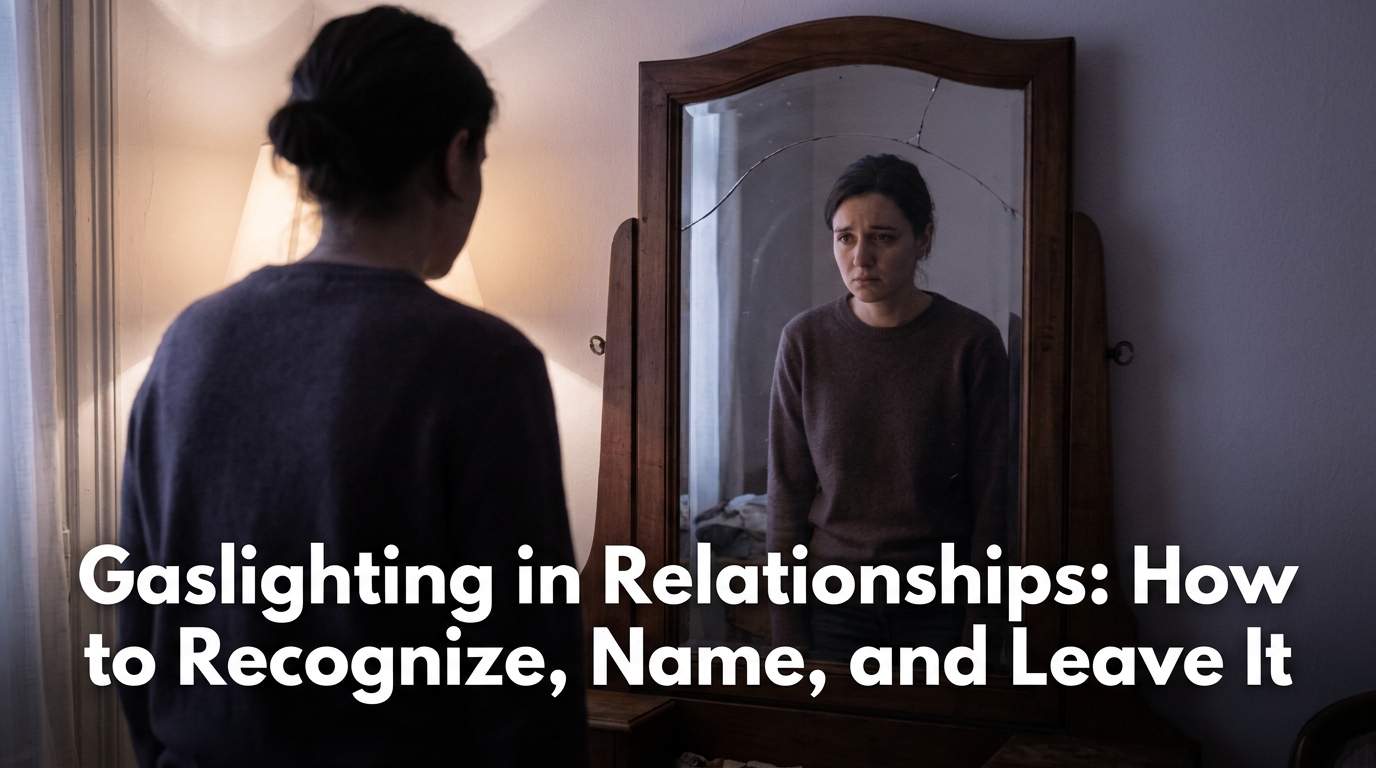
You remember it clearly. The words that were said, the tone, the moment. But when you bring it up, you’re told it never happened — or that you imagined it, or that you’re far too sensitive to be taken seriously. Over time, you stop trusting your memory. You second-guess your feelings. You wonder if you really are as unstable, dramatic, or unreasonable as they say. If this feels familiar, you may be experiencing gaslighting in relationships — one of the most psychologically damaging forms of emotional manipulation that exists. A 2022 survey by the Domestic Violence Hotline found that over 70% of abuse survivors reported experiencing gaslighting as part of their relationship. You are not imagining it. And you are not alone.

What Is Gaslighting?
The term gaslighting comes from the 1944 film Gaslight, in which a husband systematically manipulates his wife into believing she is going insane — dimming the gas lights in their home and then denying that anything has changed when she notices. The film gave a name to something that had existed long before it had language.
In modern psychology, gaslighting refers to a pattern of psychological manipulation in which one person causes another to question their own perception, memory, and reality. It is not a single argument or a moment of defensiveness. It is a sustained pattern — one that, over time, systematically dismantles a person’s trust in their own mind.
Gaslighting can occur in romantic relationships, family dynamics, friendships, and even workplace settings. But it is most damaging — and most difficult to recognize — in intimate partnerships, where emotional investment, love, and the desire to make things work create the perfect conditions for the manipulation to take hold and go unquestioned.
It is important to understand: gaslighting is not always conscious or deliberately calculated. Some people gaslight as a learned defense mechanism, a way of avoiding accountability they genuinely cannot face. But whether intentional or not, the impact on the person experiencing it is the same — and the impact is serious.
“Gaslighting is not about disagreement. It is about the systematic destruction of another person’s trust in their own reality.” — Dr. Robin Stern, The Gaslight Effect
Why Gaslighting Is So Hard to Recognize
Unlike physical abuse, which leaves visible evidence, gaslighting leaves no mark that can be pointed to. The damage is internal — a slow erosion of self-trust so gradual that the person experiencing it rarely recognizes what is happening until they are deep inside it.
Several factors make gaslighting particularly difficult to identify.
It happens gradually. No one begins a relationship by openly denying their partner’s reality. Gaslighting starts small — a dismissal here, a minor reframing there — and escalates incrementally. By the time the pattern is entrenched, it has become the normalized baseline of the relationship.
It is mixed with love and warmth. Gaslighting rarely exists in isolation. The same partner who denies your reality on Tuesday may be genuinely affectionate, generous, and loving on Wednesday. This inconsistency — sometimes called the cycle of abuse — makes it almost impossible to hold a clear, consistent picture of what is actually happening.
It exploits your desire to be fair. Most people in relationships want to be reasonable. They don’t want to be the partner who overreacts, who can’t take a joke, who holds grudges. Gaslighters exploit this desire relentlessly — turning your reasonable instinct for fairness into a weapon against your own perception.
It makes you doubt your own mind. That is, quite literally, its purpose. By the time you are asking “am I the problem here?” — you are already inside it.

12 Signs You Are Being Gaslit
1. Your Reality Is Consistently Denied
You remember something clearly — a conversation, an incident, a promise. Your partner tells you it didn’t happen, or that it happened very differently. This occurs not occasionally, but regularly. Over time, you begin to wonder if your memory is simply unreliable.
2. You Are Told How You Feel — Rather Than Asked
“You’re not actually upset, you’re just tired.” “You don’t really believe that.” “You’re being paranoid.” Your emotional experience is not explored or validated — it is overwritten. Your partner decides what you feel, then presents their version back to you as fact.
3. You Apologize Constantly — Even When You’re Not Sure What You Did
You find yourself apologizing reflexively, often before you’ve even fully understood what went wrong. The need to restore peace has become more urgent than the need to understand truth.
4. Your Concerns Are Met With Ridicule or Dismissal
When you raise something that upset you, the response is not engagement — it is contempt. “Here we go again.” “You’re so dramatic.” “This is exactly why I can’t talk to you.” The issue is never addressed because the conversation is immediately derailed by an attack on your reasonableness.
5. You Feel Confused After Most Conversations
You entered the conversation with a clear concern. You left it feeling somehow responsible, confused, or apologetic — without being entirely sure how you got there. This conversational reversal — where the person raising the concern ends up comforting the person being confronted — is a hallmark of gaslighting.

6. You’ve Started to Feel Like You’re “Going Crazy”
This is one of the most chilling signs — and the one most aligned with the origin of the term. You question your sanity. You wonder if something is genuinely wrong with your perception or memory. You may have started to research whether you have a mental health condition that would explain why you keep getting things so wrong.
7. Your Partner Uses Your Vulnerabilities Against You
Things you shared in moments of trust — past trauma, insecurities, mental health history — are weaponized during conflict. “Of course you think that, you’ve always had anxiety.” “This is exactly what your ex used to say about you.” Your history is used to pre-emptively discredit your present experience.
8. Everything Becomes About Their Feelings
You raise a concern. Somehow, within minutes, the conversation is entirely about how your raising it has hurt them. You find yourself managing their emotional reaction to being challenged rather than addressing the original issue. You leave the conversation having received nothing — and having given everything.
9. You Have Started Hiding Things to Avoid Reactions
You don’t mention certain friends. You don’t share certain thoughts. You preemptively edit your reality to avoid triggering a reaction you’ve learned to fear. This is not consideration — it is the behavior of someone who no longer feels safe being fully themselves in their own relationship.
10. Other People Have Started Noticing Changes in You
Friends or family who knew you before this relationship comment that you seem different — quieter, less confident, more anxious, less like yourself. When someone who loves you and has no stake in your relationship notices that you have changed, that observation carries weight.

11. You Are Told No One Else Would Put Up With You
Subtle or direct variations of this statement — “you’re lucky I stay,” “no one else would tolerate this,” “you’d be alone without me” — are designed to do one thing: eliminate your sense of alternatives. If you believe you are fundamentally too difficult to be loved by anyone else, you are far less likely to leave.
12. Your Sense of Who You Are Has Become Blurry
You used to know what you thought, what you wanted, what you believed. Increasingly, you’re not sure. Your opinions feel uncertain. Your preferences have faded. You look to your partner to tell you how to feel about things because your own inner compass has been so thoroughly disrupted that you no longer trust it.
The Psychological Impact of Gaslighting
Gaslighting is not simply unpleasant. It causes measurable, lasting psychological harm. Research in trauma psychology has linked sustained gaslighting to:
- Chronic anxiety and hypervigilance
- Depression and a pervasive sense of worthlessness
- Complex PTSD, particularly in long-term relationships
- Dissociation — a feeling of being disconnected from oneself
- Profound difficulty trusting one’s own judgment — which can persist long after the relationship ends
The recovery from gaslighting is not simply a matter of leaving. It requires rebuilding an entire internal architecture of self-trust that was systematically dismantled — often over years. This is real psychological injury, and it deserves real psychological support.
How to Name It — Even When You’re Still Unsure
One of the most paralyzing aspects of gaslighting is the self-doubt it produces. You may read this article, recognize every sign, and still wonder: but what if I am the problem? That doubt is not a sign that you are wrong. It is a symptom of the gaslighting itself.
Here are ways to begin naming what is happening — even from inside the confusion.
Start documenting. Write things down immediately after they happen — what was said, what you remember, how it was received. Your written record, made in real time, is far harder to argue with than memory alone.
Talk to someone outside the relationship. A trusted friend, family member, or therapist who is not invested in your relationship can offer perspective that cuts through the fog. Tell them what has been happening. Listen to their response without immediately defending your partner.
Research and education. Reading about gaslighting — as you are doing now — is itself an act of self-recovery. Giving the pattern a name is the first and one of the most powerful steps toward reclaiming your reality. You cannot challenge what you cannot name.
Trust the pattern, not the exception. Your partner may be wonderful much of the time. But a pattern of reality-denial, dismissal, and manipulation — however surrounded by warmth — is still a pattern. The good moments do not cancel the harmful ones. They make them harder to see clearly.

How to Leave Gaslighting — Safely and With Clarity
Leaving a gaslighting relationship is rarely simple — and it is important to acknowledge that directly. The psychological manipulation that has taken place may have left you doubting your right to leave, your ability to survive alone, or whether what happened was even real enough to justify ending the relationship.
It was. And you can.
Build your support network before you leave. Isolation is often a companion to gaslighting. Reconnect with friends and family now — before you exit. You will need people around you who know the truth of what happened.
Speak with a therapist — ideally before leaving. A therapist who understands emotional abuse and gaslighting can help you rebuild enough self-trust to act. They can also help you create a safety plan if the relationship has any potential for escalation.
Do not expect closure from the person who gaslit you. The final conversation — the one where they acknowledge what they did, validate your experience, and apologize meaningfully — almost never comes. Waiting for it keeps you tethered. Closure, in these situations, must be something you create for yourself.
Prepare practically. If you share finances, a home, or other practical ties, get advice on those specifics before you leave. Organizations like the National Domestic Violence Hotline (1-800-799-7233) can provide confidential support and practical guidance regardless of whether physical abuse was present.
Know that leaving is just the beginning of healing — not the end of it. The effects of gaslighting do not disappear when the relationship does. The self-doubt, the hypervigilance, the difficulty trusting your own perception — these need active, supported healing. Therapy — particularly trauma-informed approaches like EMDR and internal Family Systems — can be profoundly restorative.
You Are Not Crazy. You Never Were.
If there is one thing to take from this article, let it be this: the confusion you feel is not evidence of your instability. It is evidence of what was done to you. A healthy relationship does not make you question your memory, your feelings, or your sanity. A healthy partner does not need you to doubt yourself in order to feel safe.
You were not too sensitive. You were not overreacting. You were not difficult to love. You were in a relationship with someone who needed you to believe those things — and who worked, consistently, to make you believe them.
Your perception was accurate. Your feelings were real. Your memory can be trusted.
And you deserve a relationship in which all of those things are never once in question.
The most radical act after gaslighting is this: to trust yourself again. Fully. Without apology.
💾 Save this article — it may be exactly what someone needs to read today. 📤 Share it quietly with someone you’re worried about. 👣 Follow Truthsinside.com for honest, psychology-backed content on love, red flags, and healing.
Frequently Asked Questions
Q1: Is gaslighting always intentional? Not always. Some people gaslight as an unconscious defense mechanism — they genuinely cannot tolerate accountability and have developed reality-denial as a way of protecting their self-image. Others are deliberate and calculated. Regardless of intent, the impact on the person experiencing it is the same: a systematic erosion of self-trust. Whether intentional or not, the behavior is harmful and warrants the same response — recognition, naming, and change or exit.
Q2: Can gaslighting happen in otherwise loving relationships? Yes — and this is precisely what makes it so confusing. Gaslighting does not require a partner who is cruel all the time. It can coexist with genuine affection, generosity, and warmth. The loving moments are real. But they do not cancel the harm of the gaslighting. Both things can be true simultaneously — and recognizing that is one of the most difficult and important steps in understanding what is happening.
Q3: How do I know if I’m gaslighting my partner unintentionally? Honest self-reflection is the starting point. Ask yourself: do I regularly tell my partner their feelings are wrong? Do I deny things they remember clearly? Do I deflect accountability by focusing on their behavior when challenged? Do conversations consistently end with them apologizing to me? If your partner has raised concerns about feeling unheard or having their reality denied, take that seriously rather than dismissing it. A willingness to genuinely examine these questions is itself a meaningful differentiator from those who gaslight with full defensiveness.
Q4: How long does it take to recover from gaslighting? Recovery is not linear and varies enormously depending on how long the gaslighting continued, the severity of the manipulation, and the support available afterward. Some people begin to feel clearer within weeks of leaving. For others — particularly those who experienced years of sustained gaslighting or who had previous trauma — recovery is a longer, deeper process. Trauma-informed therapy is one of the most effective paths to rebuilding self-trust and processing the psychological impact of what occurred.
Q5: What is the difference between gaslighting and simply having different perspectives? This is an important distinction. Healthy couples disagree about events, interpretations, and feelings — and those disagreements are normal. The difference with gaslighting is pattern, intent, and impact. Gaslighting involves a consistent, repeated pattern of one person’s reality being denied, ridiculed, or overwritten — not occasional disagreement. It leaves one person chronically doubting themselves while the other remains certain. And over time, it produces measurable psychological harm. Occasional misremembering or disagreement is human. A sustained pattern of reality-denial is something else entirely.