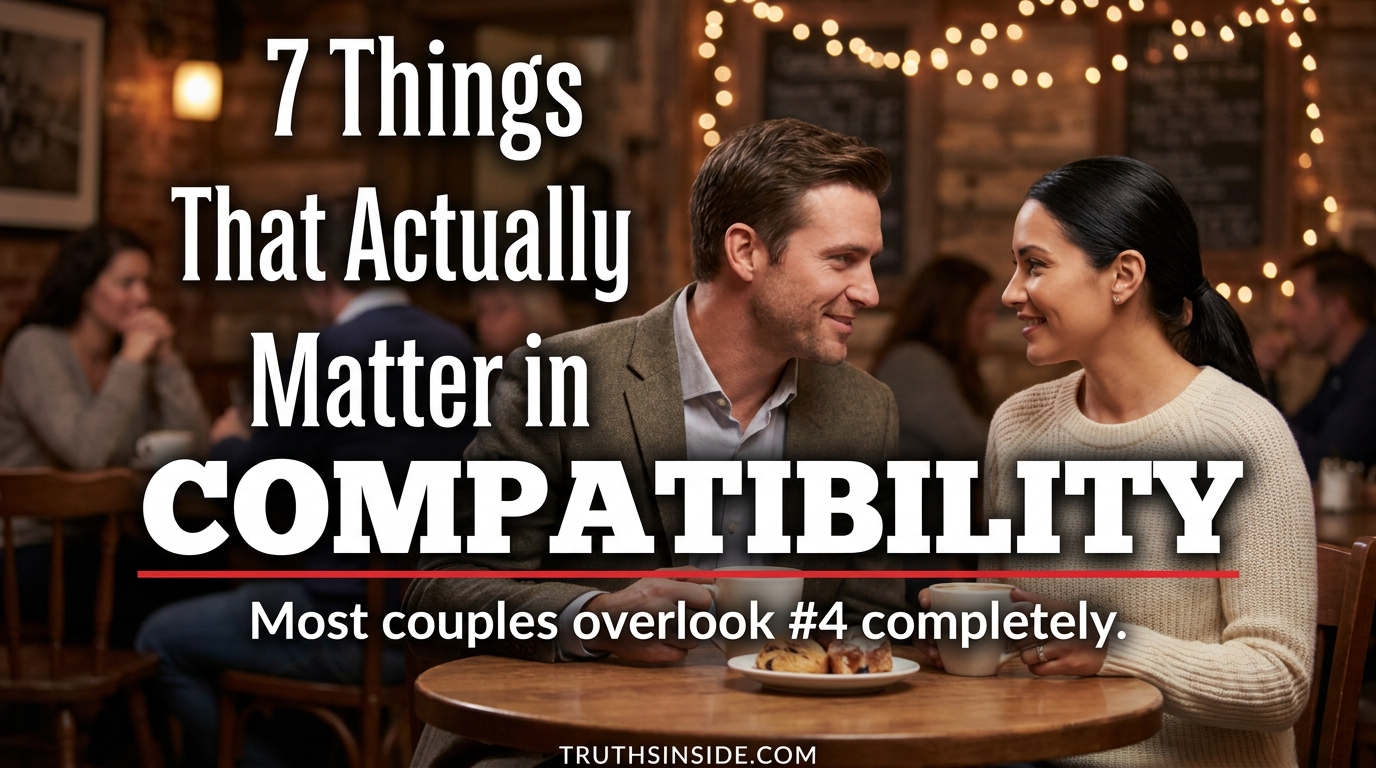
Have you ever loved someone deeply and still felt like something was fundamentally missing? You’re not alone — and you’re not broken. Millions of people around the world find themselves in relationships full of love but void of true connection, and they can’t quite explain why. According to a study published in the Journal of Personality and Social Psychology, compatibility — not passion — is the single strongest predictor of long-term relationship satisfaction. Yet most people spend years chasing chemistry and almost no time evaluating what actually keeps two people together for the long run.
Relationship compatibility isn’t about finding someone perfect. It’s about finding someone who is right for you — someone whose values, communication style, life goals, and emotional rhythms align with yours in a way that makes love sustainable. Research from the Gottman Institute, after studying thousands of couples over four decades, consistently found that couples who share core compatibility markers stay together significantly longer and report deeper emotional fulfillment than those who rely on attraction alone.
This article isn’t here to scare you. It’s here to give you clarity — the kind of clarity that saves you years of confusion, heartbreak, and staying in something that was never built to last. Whether you’re in a new relationship trying to figure out if this person is “the one,” or you’re years deep and quietly questioning everything, these 7 things that define true relationship compatibility are the ones that actually matter. Let’s get into it.
1. Shared Core Values — The Foundation Everything Else Is Built On
When people talk about compatibility, they often start with personality. But personality is surface-level. What truly determines whether two people can build a life together is whether they share the same core values — the deep-seated beliefs that guide how they live, make decisions, and define what a good life looks like.
Core values include things like: how you feel about family, religion or spirituality, money and financial responsibility, career ambition, lifestyle priorities, ethics, and what you believe a relationship should look like at its foundation. These aren’t preferences you can negotiate away. They are the architecture of who you are as a person.
A couple might be wildly attracted to each other but hold completely different values about money — one is a saver, the other a spender. Or one deeply values having children, while the other is firmly child-free. These aren’t small disagreements. These are structural cracks that grow wider over time, no matter how strong the love is. Relationship compatibility begins and ends with whether your core values align — not perfectly, but enough to build something real.
Ask yourself: Do we want the same kind of life? If the honest answer is no, love alone won’t be enough to bridge that gap.
2. Communication Style — The Way You Talk and the Way You Fight
Every couple fights. Every couple has difficult conversations. But what separates compatible couples from incompatible ones isn’t whether they argue — it’s how they argue and how they talk to each other in the everyday moments in between.
Compatible couples share a communication style, or at minimum, they understand and respect each other’s differences and know how to bridge them. One person might process emotions internally and need space before they can talk. The other might need to talk things out immediately or they feel abandoned. If neither person is aware of this difference and neither has the willingness to adapt, even small conflicts can spiral into full emotional shutdowns.
Research from UCLA found that couples who communicate openly and use “soft startups” — beginning difficult conversations without blame or criticism — have measurably better relationship outcomes than couples who default to defensiveness or stonewalling. Compatible partners don’t just love each other; they know how to reach each other, especially when things get hard.
Relationship compatibility in communication means you can be honest without cruelty, vulnerable without shame, and disagreeable without becoming enemies. If talking to your partner consistently leaves you feeling unheard, dismissed, or emotionally exhausted — that’s not just a bad day. That’s a compatibility gap worth taking seriously.
Related article: The 5 Love Languages Explained: Which One Are You?
“The right relationship doesn’t mean never fighting. It means knowing how to find your way back to each other every single time.”
3. Emotional Intelligence and Maturity — Can They Handle the Hard Stuff?
Love is easy when everything is going well. True compatibility is tested in moments of crisis, vulnerability, loss, and stress. This is where emotional intelligence becomes everything.
Emotional intelligence (EQ) refers to a person’s ability to recognize, understand, and manage their own emotions — and to respond to the emotions of others with empathy and thoughtfulness. A partner with high EQ will show up for you during your worst moments. They won’t crumble, deflect, or punish you for having needs. They’ll be present, even when being present is uncomfortable.
A partner with low EQ, no matter how charming or attractive, tends to make difficult seasons feel impossibly harder. They may shut down when you need them to open up. They may lash out when they feel threatened. They may minimize your pain because they haven’t learned how to sit with their own. This isn’t necessarily a character flaw — it’s often a developmental gap — but it is a compatibility issue, especially if you’re someone who processes emotions deeply and requires emotional reciprocity.
Emotional maturity also means owning mistakes without defensiveness, setting healthy boundaries, and knowing how to repair after conflict. These are skills, and relationship compatibility in this area means you and your partner are either at a similar level of emotional development, or one of you is genuinely willing to grow. Growth is possible. But it has to be chosen — it cannot be forced.

4. Life Goals and Future Vision — Are You Heading the Same Direction?
This is the one most couples skip, especially early in a relationship when everything feels magical and the future seems endless and full of possibility. But two people can love each other genuinely and still be heading in completely opposite directions — and that incompatibility will eventually pull them apart no matter how strong the bond.
Life goals include: where you want to live, whether you want children, how important career advancement is to you, your financial goals and timeline, how you envision your family structure, and what kind of lifestyle you want to build. These are not minor details. These are the pillars of a shared future.
Compatible couples don’t have to want identical lives. But they do need a shared direction — a vision of the future that overlaps enough to build something meaningful together. When two people’s life goals fundamentally diverge, the relationship often becomes a slow negotiation of sacrifice and resentment, with someone always having to give up something core to who they are.
Have the honest conversations early. Ask: Where do you see yourself in five years? Do you want kids? Would you ever relocate for a partner? These conversations might feel heavy in the early stages, but they are infinitely lighter than staying in a relationship for years only to discover your futures were never compatible to begin with. Relationship compatibility requires a shared destination, even if you each have your own unique path to get there.
5. Attachment Style — How You Love and How You Need to Be Loved
Attachment theory, developed by psychologist John Bowlby and later expanded by researchers like Dr. Sue Johnson, reveals that the way we bonded with our caregivers as children directly shapes how we attach in adult romantic relationships. And this is one of the most quietly powerful factors in relationship compatibility.
There are four primary attachment styles: secure, anxious, avoidant, and fearful-avoidant (disorganized). A securely attached person is comfortable with closeness and can tolerate distance without panic. An anxiously attached person craves closeness and may interpret space as rejection. An avoidantly attached person values independence and may feel suffocated by emotional demands. A fearful-avoidant person swings unpredictably between craving and fearing intimacy.
The most compatible pairing tends to involve at least one securely attached partner, because a secure person can often provide the stability that helps an anxiously or avoidantly attached partner feel safer over time. The most challenging pairing — and also one of the most common — is an anxious person and an avoidant person together. The anxious partner’s need for closeness triggers the avoidant partner’s need for space, which then amplifies the anxious partner’s fear, which then drives the avoidant partner further away. It becomes a painful, self-reinforcing cycle.
Understanding your attachment style — and your partner’s — isn’t about labeling or limiting each other. It’s about finally understanding why the relationship feels the way it does, and whether the two of you have the self-awareness and willingness to create security together.
Related article: Gaslighting in Relationships: How to Recognize, Name, and Leave It
“Compatibility isn’t about being the same person. It’s about being two different people who know how to make each other feel safe.”
6. Respect, Admiration, and Genuine Liking — Do You Actually Like Who They Are?
This sounds almost too simple — but it is wildly underestimated. The Gottman Institute’s research identified something called the “Sound Relationship House,” and at its very foundation is fondness and admiration — the genuine liking and respect couples have for each other as people.
Love is a feeling. Respect is a choice. And relationship compatibility requires both.
Couples who are truly compatible don’t just love each other — they like each other. They find each other interesting. They are proud of each other. They think well of each other even during disagreements. They have a baseline of deep respect that doesn’t disappear when things get difficult.
On the flip side, one of the biggest warning signs of incompatibility is contempt — the feeling of looking down on your partner, mocking them, being dismissive of their thoughts or experiences. According to Gottman’s research, contempt is the single greatest predictor of relationship failure. It erodes the foundation of genuine liking that compatible relationships are built on.
Ask yourself honestly: Do I admire this person? Do I respect their character, their mind, their choices? Not in a pedestal-on-a-pedestal kind of way — but in the real, ordinary, everyday way that says: I genuinely think highly of who you are. If the answer is consistently no, that is a compatibility gap no amount of chemistry can fill.

7. Growth Compatibility — Are You Growing Together or Growing Apart?
People change. Over the course of a relationship, you will both evolve — your opinions will shift, your priorities will transform, your understanding of yourself will deepen. Relationship compatibility in the long run isn’t just about who you are right now. It’s about whether you are capable of growing alongside each other.
Growth compatibility means you share a similar openness to change and self-improvement. It means when one person grows, the other is capable of respecting and even celebrating that growth — rather than feeling threatened by it. It means you are both curious about life, willing to learn, and committed to being better versions of yourselves — individually and as a couple.
The couples who drift apart over time often do so not because of dramatic events, but because one partner grows and evolves while the other resists change. The person who once seemed like a perfect match slowly becomes someone they can no longer connect with on a deeper level. Interests diverge. Conversations become shallow. The relationship starts to feel like a shared routine rather than a shared life.
Compatible couples grow in the same direction, even when they grow in different ways. They remain curious about each other. They continue choosing each other, not out of habit or fear, but because they genuinely like and respect the person their partner is becoming. That ongoing choice — renewed day after day — is the truest form of long-term relationship compatibility.

The Truth About Compatibility Most People Miss
Here’s what no one tells you: relationship compatibility is not a fixed state. It is not something you either have or you don’t. It is something two willing, self-aware people can build, nurture, and deepen over time — but only if both people are genuinely invested in the process.
The couples who last don’t just happen to be compatible. They choose to be. They have the hard conversations. They do the internal work. They show up for each other in the unsexy, unglamorous, everyday moments that don’t make it onto social media but are the real substance of a lasting relationship.
Compatibility isn’t about being identical. It’s about being aligned — in your values, your vision, your emotional availability, and your willingness to keep choosing each other even when it’s hard. Chemistry starts a relationship. Compatibility sustains it.
So look honestly at your relationship through the lens of these 7 areas. Not to tear something apart, but to understand it more clearly. Because the goal was never to find a perfect partner. The goal was always to find the right one — and to be the right one in return.
Related article:Anxious Attachment: Signs, Causes, and How to Heal
FAQ — Relationship Compatibility
Q1: Can two people be compatible even if they have different personalities?
Absolutely. Compatibility isn’t about being the same — it’s about being aligned in the areas that matter most: values, goals, communication, and emotional availability. Different personalities can actually complement each other beautifully, as long as core values and mutual respect are present.
Q2: Is it possible to become more compatible over time?
Yes, especially if both partners are self-aware and growth-oriented. Emotional intelligence, communication skills, and even attachment patterns can shift over time with effort, therapy, and genuine commitment. However, compatibility in areas like core values and life goals is harder to shift and generally needs to be present from the start.
Q3: How do I know if my relationship is incompatible or just going through a rough patch?
A rough patch is temporary and usually tied to a specific stressor — a job loss, a family crisis, a life transition. Incompatibility is persistent and systemic. If the same core issues come up repeatedly and never truly resolve, and if one or both of you feel fundamentally misunderstood as a person, that points to deeper incompatibility rather than a passing season.
Q4: What is the most important compatibility factor out of the 7?
While all 7 matter, shared core values consistently ranks highest across relationship research. Everything else can be worked on — but if two people fundamentally want different things from life, the relationship will face constant structural pressure that is very difficult to sustain long-term.
Q5: Should I end a relationship if I discover we’re not fully compatible?
Not necessarily. No relationship is 100% compatible in every area. The real question is: are the incompatibilities in areas you can both work with, and are both of you genuinely willing to do that work? Honest reflection, open conversation, and sometimes professional couples counseling can help you make that determination with clarity.
Save This. Share It. Follow for More.
If this article gave you something to think about — save it so you can come back to it. The 7 things covered here aren’t a one-time checklist. They’re a framework you’ll want to revisit as your relationship evolves.
Share it with someone you care about — a friend in a complicated relationship, a sibling asking relationship questions, or your partner themselves. Sometimes the most important conversations start with an article like this.
And follow Truthsinside.com for more relationship advice, psychology insights, and real talk about love that’s grounded in research and lived experience. We publish content designed to help you understand yourself, your relationships, and the patterns that shape them — so you can make choices that actually serve your life.
You deserve a relationship that doesn’t just feel good on good days. You deserve one that holds strong on the hard ones too.
🎵 Music
Maren Lull is a singer-songwriter who writes from the places most people don’t talk about out loud.
Not the dramatic grief. Not the obvious heartbreak. The quiet kind — the ordinary Tuesday emptiness, the habit of reaching for someone who isn’t there anymore, the particular exhaustion of being strong for so long that the strength itself wears thin.
Her music lives at the intersection of emotional honesty and soft beauty — breathy vocals over gentle piano, slow tempos, lyrics that feel less like songs and more like something you wrote in a private notebook at two in the morning and never showed anyone.
Maren Lull writes for the people who feel everything deeply and say very little about it. For the ones who listen to sad music not because they want to feel worse — but because being understood, even by a song, makes the feeling easier to carry.
📱 Follow Maren Lull:
→ Spotify
→ Apple Music
→ Youtube
→ Audiomack