There is a particular kind of pain that comes from having your faith weaponized against you. It doesn’t announce itself the way physical abuse does. It doesn’t leave visible marks. But it reaches into the most sacred part of who you are — your spiritual identity, your relationship with God or your higher power, your deepest moral framework — and it twists those things into tools of control.
This is spiritual abuse, and according to a growing body of research in psychology and trauma studies, it is far more common in intimate relationships than most people realize. A 2022 study published in the Journal of Interpersonal Violence found that spiritually abusive dynamics occur across all religious traditions and affect people of every demographic background.
What makes spiritual abuse red flags so uniquely devastating is how effectively they hide. They hide behind devotion. They hide behind scripture. They hide behind the language of love, commitment, and divine purpose. The person experiencing them often doesn’t recognize them as abuse at all — because the very beliefs they’ve been taught to trust are the ones being used against them. They may feel spiritually confused, morally ashamed, or convinced that their suffering is God’s will rather than one person’s manipulation. This confusion is not accidental. It is often the most deliberate and calculated element of the abuse itself.
Understanding spiritual abuse red flags is not an act of faithlessness. It is an act of self-protection. Healthy spirituality — and healthy relationships built around faith — should bring you closer to your sense of self, your values, and your inherent worth. When someone consistently uses spiritual language or religious authority to make you smaller, more compliant, or more afraid, that is not devotion. That is control. And recognizing the difference may be one of the most important things you ever do for yourself.
What Is Spiritual Abuse?
Spiritual abuse is a form of emotional and psychological abuse in which religious beliefs, spiritual authority, or faith-based language is used to manipulate, control, isolate, or demean another person. It can occur in romantic relationships, family dynamics, church communities, and any setting where spiritual authority is claimed or perceived.
Psychologist and author Dr. Marlene Winell, who coined the term “Religious Trauma Syndrome,” defines spiritually abusive dynamics as any pattern in which spiritual belief systems are used to override a person’s autonomy, suppress their critical thinking, or enforce compliance through fear, guilt, or shame. The abuser in these situations rarely presents as overtly controlling — they present as spiritually superior, divinely guided, or morally righteous. Their manipulation is framed as spiritual leadership, godly correction, or loving accountability.
This framing is what makes spiritual abuse so difficult to identify from the inside. When the person hurting you appears to be acting on behalf of God, faith, or divine truth — challenging them can feel like challenging God itself. That psychological barrier is not an accident. It is the mechanism through which spiritual abuse maintains its power.
Why Spiritual Abuse Red Flags Are So Hard to See
Before we examine the specific red flags, it’s important to understand why they are so consistently missed — even by people who are otherwise intelligent, self-aware, and psychologically informed.
First, spiritual abuse exploits trust at the deepest possible level. Faith is not a superficial thing. For most people, their spiritual beliefs are foundational to their identity and their understanding of the world. When someone uses that foundation against you, it creates a form of cognitive dissonance that is extraordinarily difficult to process. Your heart says something is wrong. Your indoctrinated mind says questioning it is sinful.
Second, spiritual abuse is socially reinforced. In many religious communities, the behaviors that constitute spiritual abuse — unquestioning submission, prioritizing the relationship above personal needs, enduring suffering as a spiritual discipline — are actively taught as virtues. This means that not only is the abuser manipulating you, but the community around you may be validating the abuse as godly behavior.
Third, spiritual abusers are often extraordinarily charming and socially respected. They may be leaders in their faith community, known for their devotion and moral character. The contrast between their public persona and private behavior is one of the most disorienting aspects of the experience.
Related article: Gaslighting in Relationships: How to Recognize, Name, and Leave It
9 Spiritual Abuse Red Flags in Relationships
Red Flag 1: Using Scripture or Religious Doctrine to Justify Control
One of the clearest spiritual abuse red flags is the selective and strategic use of religious texts to justify controlling behavior. The spiritually abusive partner may quote scripture to demand obedience, enforce gender roles, restrict your autonomy, or silence your disagreements. Any resistance you express is framed as spiritual rebellion or faithlessness.
This is not genuine spiritual leadership. Authentic faith-based guidance invites reflection, dialogue, and mutual discernment. It does not weaponize sacred texts to shut down conversation or enforce compliance. When scripture is used as a tool of silencing rather than a source of wisdom, the manipulation is the message — not the verse.
Red Flag 2: Claiming to Have Special Divine Authority Over You
Does your partner regularly claim that God has specifically given them authority over your life, your decisions, or your spiritual direction? Do they position themselves as the spiritual head of the relationship in a way that eliminates your voice entirely? Do they claim divine revelation to justify their demands — telling you that God told them what you should do, think, or feel?
This pattern is among the most dangerous spiritual abuse red flags because it places the abuser in an position of unchallengeable authority. If their will is framed as God’s will, disagreeing with them becomes equivalent to disagreeing with God. This is a profoundly manipulative dynamic that systematically dismantles your capacity for independent spiritual discernment.
Red Flag 3: Spiritual Gaslighting — Making You Question Your Own Faith
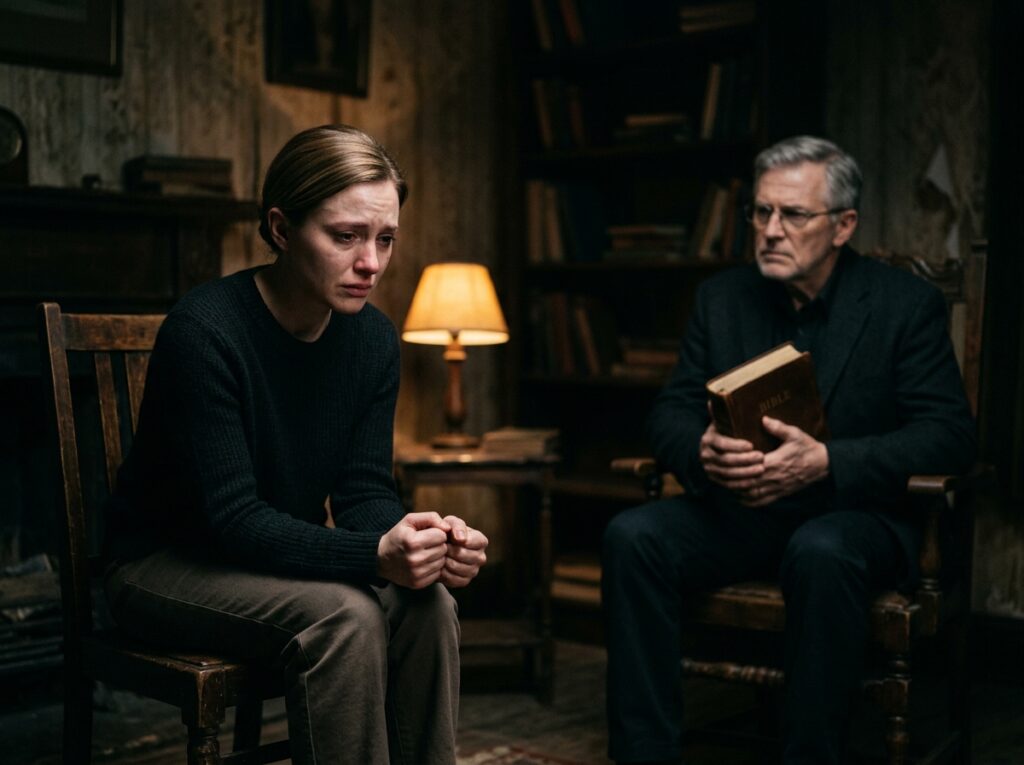
Spiritual gaslighting occurs when an abusive partner consistently undermines your spiritual experiences, perceptions, and convictions. They may tell you that your sense of God’s leading is wrong, that your prayers are spiritually immature, or that your spiritual instincts cannot be trusted because of your sin or spiritual weakness.
Over time, this form of gaslighting erodes your confidence in your own spiritual discernment — which is precisely its purpose. When you no longer trust your own sense of right and wrong, your own experience of God, or your own moral compass, you become entirely dependent on your abuser to tell you what is spiritually true. This dependency is the goal.
Red Flag 4: Using Guilt and Shame as Weapons of Compliance
Healthy spiritual communities acknowledge human imperfection while affirming inherent worth and the possibility of growth and forgiveness. Spiritually abusive relationships use guilt and shame as ongoing instruments of control — not to encourage growth, but to enforce compliance and suppress self-advocacy.
If you find yourself constantly feeling spiritually condemned, morally insufficient, or unworthy of God’s love specifically in the context of your relationship — and specifically when you express needs, set limits, or question your partner’s behavior — that is a significant red flag. Genuine spiritual accountability builds people up. Spiritual abuse uses shame to keep people down and controllable.
Red Flag 5: Forbidding Outside Spiritual Input or Community
A spiritually abusive partner will often work to isolate you from any spiritual community, pastor, counselor, or faith leader outside of their direct influence. They may discourage you from attending church independently, criticize any spiritual mentor who challenges their authority, or frame outside spiritual input as spiritually dangerous or divisive.
This isolation serves a clear purpose: it eliminates the possibility that someone outside the relationship will name what is happening or offer you a perspective that contradicts your abuser’s narrative. When your entire spiritual world is filtered through one person’s interpretation and approval, your ability to access truth — spiritual or otherwise — is severely compromised.
“Spiritual abuse doesn’t destroy your faith in God — it destroys your faith in yourself. And that is exactly what it was designed to do.”
Red Flag 6: Framing Leaving the Relationship as Spiritual Failure or Damnation
Perhaps the most powerful tool in the spiritual abuser’s arsenal is the threat of spiritual consequences for leaving. You may be told that ending the relationship is a sin, that God will punish you for breaking a spiritual covenant, that you will lose your salvation, or that leaving means abandoning your faith entirely.
This tactic is extraordinarily effective because it targets the thing you may value most — your relationship with God and your spiritual integrity. The fear of spiritual condemnation can keep people trapped in genuinely dangerous relationships long after every other instinct is telling them to leave. It is important to name this clearly: no authentic spiritual tradition teaches that God requires you to remain in an abusive relationship. That teaching is the abuser’s, not God’s.

Red Flag 7: Controlling Your Spiritual Practices and Expression
Does your partner dictate how you pray, what you read, how you worship, or which aspects of your faith you are permitted to explore? Do they critique or mock your personal spiritual experiences? Do they insist that their interpretation of faith is the only valid one and that your independent spiritual expression is a sign of rebellion or immaturity?
Authentic love within a faith context honors each person’s individual spiritual journey. It creates space for questions, growth, and personal connection with the divine. When one partner systematically controls, criticizes, or overrides the other’s spiritual expression, what they are controlling is not spiritual truth — it is another human being’s autonomy. That is abuse, regardless of the religious language used to justify it.
Red Flag 8: Spiritual Superiority and Chronic Moral Condemnation
Spiritually abusive partners frequently position themselves as spiritually superior — more devout, more disciplined, more in tune with God’s will — while consistently positioning you as morally deficient, spiritually weak, or chronically failing to meet God’s standard. This dynamic creates a permanent power imbalance that makes genuine equality, mutuality, and partnership impossible.
In a healthy faith-based relationship, both partners recognize their shared humanity, their shared imperfection, and their equal standing before God or their higher power. When one person consistently occupies the role of spiritual judge and the other consistently occupies the role of the spiritually condemned — that is not a relationship. That is a hierarchy built on shame and maintained through spiritual weaponry.
Red Flag 9: Your Emotional and Physical Needs Are Called Spiritually Selfish
One of the most insidious spiritual abuse red flags is the reframing of your legitimate human needs as spiritual failures. Your need for emotional support is labeled as neediness or lack of faith. Your need for physical safety is dismissed as worldly thinking. Your need for reciprocity, respect, or healthy limits is framed as selfishness, spiritual immaturity, or a failure to embody Christ-like sacrifice.
This tactic is particularly devastating because it turns your own values against you. If you genuinely believe in self-sacrifice as a spiritual virtue, being told that your needs are spiritually selfish can silence you more effectively than any direct command. But the truth is that healthy spirituality honors the full humanity of every person — including their need for safety, dignity, respect, and love that does not require self-erasure.
“Faith that requires you to disappear is not faith. It is a cage built from scripture and held together by shame.”
The Long-Term Impact of Spiritual Abuse
The psychological consequences of spiritual abuse are serious, well-documented, and often long-lasting. Survivors frequently report experiences of religious trauma syndrome — a complex constellation of symptoms including anxiety, depression, difficulty trusting authority figures, spiritual disconnection, and a profound loss of identity rooted in the dismantling of their core belief system.
Many survivors describe a grief that is unlike any other — the grief not just of losing a relationship, but of losing their relationship with God, their faith community, and their entire spiritual framework. Rebuilding after spiritual abuse requires not just emotional healing but a careful, compassionate reconstruction of one’s spiritual identity outside of the abuser’s control and interpretation.
The healing path is real. But it begins with recognition.
How to Protect Yourself and Begin Healing
If any of the spiritual abuse red flags in this article resonated with your experience — past or present — the most important first step is naming what happened. Spiritual abuse is real. It is documented. It has a name. And it is not God’s will for your life.

Seek a trauma-informed therapist who has specific experience with religious trauma and spiritually abusive dynamics. Not all therapists are equipped to navigate the unique complexity of faith-based abuse, so specificity in your search matters.
Reconnect with your own spiritual instincts. The goal of spiritual abuse is to make you distrust your own sense of God, truth, and self. Rebuilding means slowly learning to trust your own spiritual perceptions again — outside of your abuser’s framework.
Find safe community. Whether that is a faith community that honors your autonomy, a support group for spiritual abuse survivors, or trusted individuals who affirm your full humanity — isolation was used against you, and connection is part of the cure.
Give yourself permission to grieve. What was lost in a spiritually abusive relationship is not just a partnership. It is often an entire worldview, community, and spiritual identity. That grief is legitimate and it deserves space.
Related article: 15 Subtle Red Flags in a New Relationship Most People Miss
Final Thoughts
Spiritual abuse red flags are not always loud. They don’t always arrive with obvious cruelty or overt aggression. They often arrive wrapped in the language of love, commitment, and divine purpose — which is exactly what makes them so extraordinarily dangerous.
Your faith was never meant to be a weapon used against you. Your spirituality was never meant to be a mechanism of control. And your relationship with God — whatever that looks like for you — was never meant to require the sacrifice of your dignity, your voice, or your safety.
Recognizing spiritual abuse red flags is not a betrayal of your faith. It is an act of faith in your own worth. And that worth — unconditional, inherent, and real — is something no person and no manipulation can ever legitimately take from you.
💾 Save this article — it may be exactly what you or someone you love needs to see.
📤 Share it — spiritual abuse thrives in silence, and your share could break that silence for someone.
👉 Follow Truthsinside.com for more honest, research-based content on relationships, psychology, and healing.
FAQ — Spiritual Abuse Red Flags
Q1: Can spiritual abuse happen outside of organized religion?
Yes. While spiritual abuse most commonly occurs within religious contexts, it can also happen in relationships centered around any spiritual belief system — including New Age spirituality, cult-like wellness communities, or any framework where one person claims spiritual authority over another. The defining feature is the use of spiritual or metaphysical beliefs to manipulate and control, regardless of the specific tradition involved.
Q2: Is it possible to have genuine faith-based disagreements without it being spiritual abuse?
Absolutely. Healthy couples with different spiritual views can navigate those differences through mutual respect, open dialogue, and genuine honoring of each other’s autonomy. The distinction between a faith-based disagreement and spiritual abuse lies in power, intent, and pattern. Disagreement becomes abuse when one person consistently uses spiritual authority to silence, shame, or control the other.
Q3: What if my religious community doesn’t recognize spiritual abuse as real?
This is unfortunately common, and it is one of the reasons spiritual abuse is so difficult to escape. If your faith community minimizes, dismisses, or actively denies the reality of spiritual abuse, seeking support outside that community becomes especially important. Trauma-informed therapists, online support groups for religious trauma survivors, and organizations like the Religious Trauma Institute can provide validation and guidance independent of your specific community’s response.
Q4: Can the spiritually abusive person change?
Change is theoretically possible but statistically rare without deep, sustained, and genuinely self-motivated therapeutic work. Spiritual abusers typically lack the self-awareness to recognize their behavior as abusive — they genuinely believe they are acting in righteousness. Without professional intervention and authentic accountability, behavioral change is unlikely. Your safety and healing should not be contingent on waiting for that change to occur.
Q5: How do I know if what I experienced was truly spiritual abuse or just a difficult religious relationship?
Ask yourself these key questions: Did your partner’s spiritual behavior consistently make you feel afraid, ashamed, or spiritually condemned? Did it eliminate your voice and autonomy? Did it use faith to justify control? Did it isolate you from outside spiritual support? Did it make you feel that leaving would result in divine punishment? If the answer to several of these is yes, what you experienced almost certainly falls within the definition of spiritual abuse — and you deserve support in processing and healing from it.
🎵 Music
Maren Lull is a singer-songwriter who writes from the places most people don’t talk about out loud.
Not the dramatic grief. Not the obvious heartbreak. The quiet kind — the ordinary Tuesday emptiness, the habit of reaching for someone who isn’t there anymore, the particular exhaustion of being strong for so long that the strength itself wears thin.
Her music lives at the intersection of emotional honesty and soft beauty — breathy vocals over gentle piano, slow tempos, lyrics that feel less like songs and more like something you wrote in a private notebook at two in the morning and never showed anyone.
Maren Lull writes for the people who feel everything deeply and say very little about it. For the ones who listen to sad music not because they want to feel worse — but because being understood, even by a song, makes the feeling easier to carry.
📱 Follow Maren Lull:
→ Spotify
→ Apple Music
→ Youtube
→ Audiomack
Written by the editorial team at Truthsinside.com — your trusted source for honest relationship insights, psychological clarity, and real support for real people