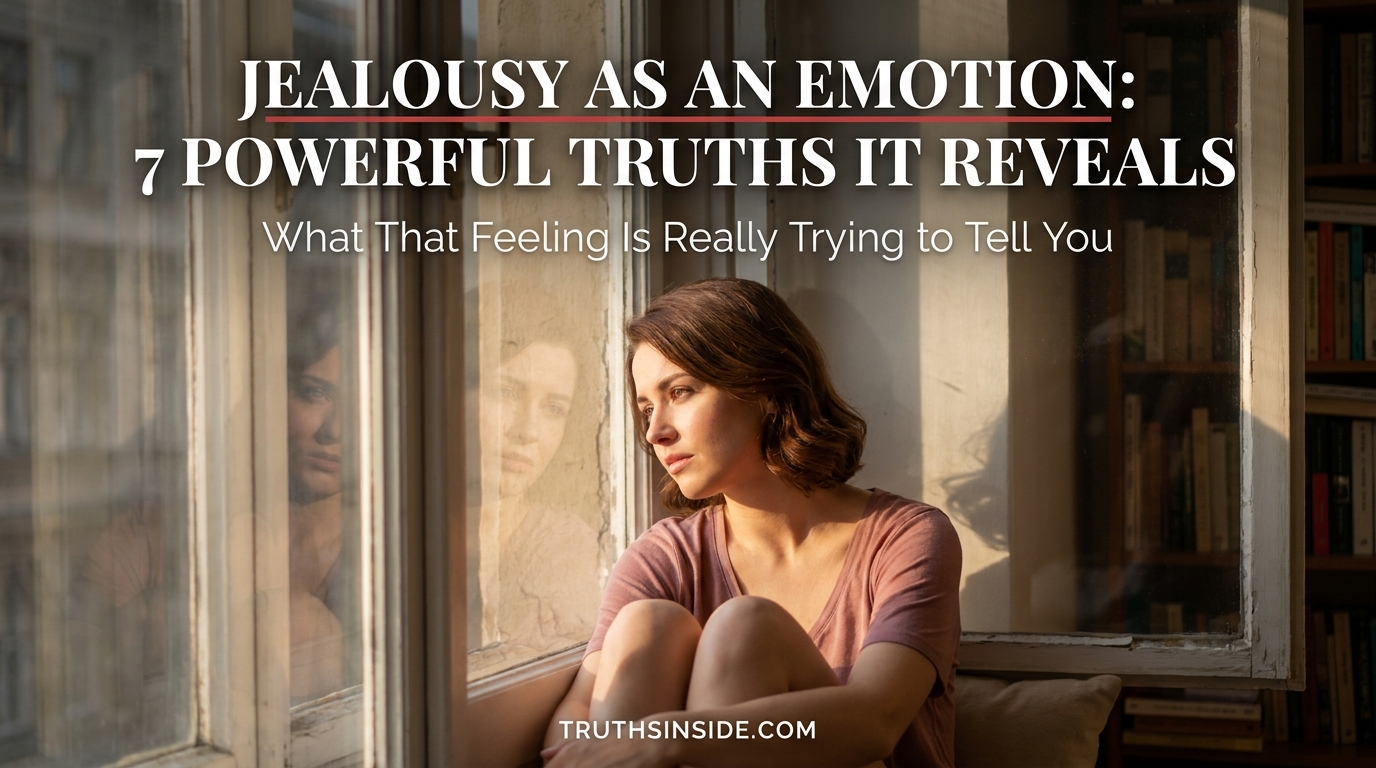
You felt it before you could even name it. That sudden tightening in your chest when they laughed a little too long at someone else’s joke. The quiet spiral that started the moment you saw that comment on their photo. The way your whole body went still when their phone lit up with a name you did not recognize. You told yourself it was nothing. You told yourself you were being irrational. But the feeling did not care what you told it — it just kept sitting there, heavy and insistent, waiting for you to pay attention.
Jealousy as an emotion is one of the most universally experienced and least understood feelings in the entire landscape of human psychology. Research from the University of California found that jealousy is reported by over 79% of people in romantic relationships at some point — making it one of the most common emotional experiences in love, yet one of the least openly discussed. A 2021 study published in the Journal of Social and Personal Relationships identified jealousy as a complex emotional state involving simultaneous activation of fear, anger, sadness, and shame — four distinct emotional systems firing at the same time, which explains why it feels so overwhelming and so difficult to process clearly.
Here is what most people get wrong about jealousy as an emotion: they treat it as the problem. They feel ashamed of it, suppress it, or weaponize it — and in doing so, they miss what it is actually doing. Jealousy is not a character flaw. It is not proof that you are too much or not enough. It is a messenger. A highly uncomfortable, frequently misread messenger that is carrying specific and meaningful information about your fears, your needs, your values, and the health of your relationship. This article is going to help you finally hear what it has been trying to say.
What Jealousy as an Emotion Actually Is — And What It Is Not
Before we can understand what jealousy is telling us, we need to be clear about what it actually is — because jealousy is one of the most misidentified emotions in the human experience. People confuse it with envy, with possessiveness, with love, and with insecurity. While it can intersect with all of these, jealousy is its own distinct psychological experience.
Envy is the desire to have something someone else has. Jealousy is the fear of losing something — or someone — you already have. That distinction is critical. Jealousy as an emotion is fundamentally rooted in perceived threat. Something you value — a relationship, a bond, a sense of security within a connection — feels at risk. And your emotional system, which is wired to protect the things it cares about, responds with an alarm.
Psychologist Dr. Robert Leahy, author of Jealousy: How to Get the Better of It, describes jealousy as a “threat-detection emotion” — one that evolved specifically to protect pair bonds and social alliances that were critical to human survival. This means jealousy, at its most fundamental level, is not a sign of weakness. It is a sign that you care about something enough to fear its loss. The question is not whether you feel it. The question is what you do with the information it carries.
The Difference Between Healthy and Destructive Jealousy
Not all jealousy operates the same way or carries the same implications. Understanding the spectrum is essential to decoding what jealousy as an emotion is communicating in your specific situation.
Healthy jealousy is proportionate. It arises in response to a genuine, observable signal — a pattern of behavior that reasonably warrants attention — and it motivates honest, calm communication rather than reactive behavior. It is acknowledged, explored, and expressed constructively. It leads to a deeper understanding of needs and boundaries. And when those needs are addressed and those boundaries are respected, it naturally dissolves.
Destructive jealousy, by contrast, is disproportionate to the actual threat. It is chronic — present regardless of the partner’s behavior. It is rooted not in the current relationship’s dynamics but in unresolved wounds from previous experiences: past betrayals, attachment injuries from childhood, or deep-seated beliefs about one’s own unworthiness of love. Destructive jealousy does not dissolve when reassured. It escalates. And when left unexamined, it becomes the very mechanism that destroys the relationship it was trying to protect.
The crucial insight here is that jealousy as an emotion is not good or bad in itself. It is the origin, the interpretation, and the response that determine whether it serves you or damages you.
“Jealousy doesn’t lie. It points directly at what you are most afraid to lose — and what you most need to examine within yourself.”
7 Powerful Truths Jealousy as an Emotion Is Trying to Tell You
Truth 1: Jealousy as an Emotion Reveals What You Genuinely Value
The first and most fundamental message carried by jealousy as an emotion is deceptively simple: you care. Deeply. You do not experience jealousy over things that are replaceable or unimportant to you. The fact that you feel it means this relationship, this person, this connection matters to you in a real and significant way.
This sounds obvious — but for many people, particularly those who have learned to minimize their own emotional needs, the experience of jealousy is the first honest signal that a relationship has become truly meaningful to them. Some people do not realize how deeply invested they are until jealousy arrives and makes that investment undeniable.
Rather than immediately reacting to the jealousy or drowning in shame about it, begin by sitting with this first truth. Ask yourself: what specifically am I afraid of losing? What does this relationship represent to me that I am not yet sure I can protect? The answers are not small. They are the map of your deepest relational values — and they deserve your respectful attention.
Truth 2: Jealousy as an Emotion Points to an Unmet Need
Behind almost every experience of jealousy is an unmet need that has not yet been clearly named or communicated. The jealousy is not the need itself — it is the signal that the need exists and is not currently being satisfied within the relationship.
That unmet need might be for more quality time and presence. It might be for clearer reassurance of your importance to your partner. It might be for greater transparency and open communication. It might be for physical affection, emotional intimacy, or simply the consistent feeling of being chosen and prioritized.
Jealousy as an emotion becomes toxic primarily when the underlying need is never identified — when the feeling is acted on directly through accusations, ultimatums, or controlling behavior, rather than translated into the honest, vulnerable communication that could actually address what is missing. The next time jealousy rises, before you do anything else, ask: what do I need right now that I am not getting? That question, answered honestly, is more productive than any accusation.

Truth 3: Jealousy as an Emotion Exposes Your Core Attachment Fears
Attachment theory — developed by psychologist John Bowlby and extensively expanded by researchers like Dr. Sue Johnson — teaches us that human beings are wired for deep emotional bonds, and that the fear of losing those bonds activates our most primal survival responses. Jealousy as an emotion is, at its psychological core, an attachment fear made visible.
Depending on your attachment style, jealousy will show up differently. People with an anxious attachment style — who already operate from a baseline fear of abandonment and a chronic need for reassurance — tend to experience jealousy more frequently and more intensely. For them, even neutral situations can trigger the alarm because the underlying belief (“I am not enough to keep someone close”) is always running in the background.
People with an avoidant attachment style may experience jealousy just as intensely but respond by pulling away, suppressing the feeling, or acting indifferent — because acknowledging jealousy would require acknowledging vulnerability and need, which their emotional system has learned to avoid. Understanding your attachment style is one of the most clarifying lenses through which to view your experience of jealousy as an emotion — because it tells you not just what you are feeling, but why you are wired to feel it the way you do.
📃 Related article: What Does It Actually Feel Like to Fall in Love? Science + Real Stories
Truth 4: Jealousy as an Emotion Reflects Your Current Level of Self-Worth
This truth is the one most people resist — because it requires looking inward rather than outward. The intensity of jealousy in a relationship is often directly proportional to how secure or insecure you feel within yourself at that particular moment. When your sense of self-worth is solid — when you feel genuinely confident in your own value, your own attractiveness, your own worthiness of love — jealousy, even when triggered, tends to be manageable. It rises, you notice it, you communicate it, and it passes.
But when self-worth is fractured — by a previous betrayal, a period of personal struggle, or a deep-seated belief that you are somehow less than — jealousy as an emotion becomes amplified through that fracture. Every perceived threat feels existential because the underlying story is not “my partner might be interested in someone else” but rather “I was never enough to hold someone’s attention, and this is the proof.”
This is not comfortable to examine. But it is essential. Because no amount of reassurance from a partner can fill a self-worth deficit that lives inside you. The work of healing that deficit — through therapy, through self-compassion practices, through gradually building evidence of your own capacity and value — is work that only you can do. And it is the most effective long-term antidote to chronic jealousy that exists.
“The louder jealousy screams, the more quietly and honestly you need to ask: what is this really about inside me, not just between us?”
Truth 5: Jealousy as an Emotion Can Signal a Real Problem in the Relationship
While much of this article has focused on what jealousy reveals about internal experience, it is equally important to acknowledge that jealousy as an emotion is sometimes a rational response to actual behavior in the relationship. Not all jealousy is projection. Not all of it is insecurity. Sometimes it is legitimate intuition responding to patterns that deserve to be taken seriously.
If your partner is consistently secretive about their phone, emotionally withdrawn, suddenly defensive about their schedule, or engaging in behaviors that feel boundary-crossing — and jealousy arises in response to these specific, observable patterns — that jealousy may be your intuition doing its job accurately. Research on emotional intelligence consistently shows that our emotional responses often register information before our conscious mind processes it. The feeling arrives first. The evidence catches up later.
The key is learning to distinguish between jealousy that is triggered by internal wounds and jealousy that is responding to external reality. One way to do this is to ask: is the thing I am responding to a specific, concrete behavior — or am I responding to a fear I carried into this relationship before this person did anything? That question does not always have a clean answer. But asking it honestly moves you significantly closer to one.
Truth 6: Jealousy as an Emotion Reveals the Boundaries You Have Not Yet Named
Every human being carries a set of personal boundaries — values-based lines that define what they are and are not comfortable with within a relationship. Many of these boundaries exist before they are ever articulated. We know them not through words but through the feeling that arises when they are crossed.
Jealousy as an emotion frequently signals a boundary crossing — even when neither partner has clearly established or communicated that boundary. Your partner spends hours texting someone you do not know, and jealousy rises. Your partner makes plans with someone they once had feelings for without mentioning it, and jealousy rises. These situations trigger jealousy not because you are irrational but because something in you recognizes a line being approached — a line you perhaps had not yet put into words but whose existence is now undeniable.
The productive response is to use that signal as an invitation to get clear. What exactly feels uncomfortable, and why? What would you need from your partner in this context to feel safe? What is the boundary you now realize you have, and how can you communicate it clearly, calmly, and respectfully? Jealousy, in this light, is not an accusation waiting to be made. It is a boundary waiting to be named.

Truth 7: Jealousy as an Emotion Is an Invitation to Choose Conscious Love
The final and most transformative truth about jealousy as an emotion is this: every episode of jealousy is a choice point. A fork in the road between reactive behavior and conscious growth. Between using the feeling as a weapon and using it as a window.
Reactive jealousy — accusations, ultimatums, surveillance, emotional punishment — rarely produces the security it is seeking. It typically produces the opposite: distance, resentment, and an acceleration of the very disconnection it was trying to prevent. The partner on the receiving end of reactive jealousy does not usually feel more bonded or more motivated to reassure. They feel controlled. And the emotional retreat that often follows reactive jealousy compounds the original fear.
Conscious love — the kind that is possible when you are willing to sit with jealousy as an emotion rather than immediately acting it out — looks entirely different. It looks like saying: “I notice I am feeling insecure right now, and I want to share that with you honestly.” It looks like creating space for a real conversation rather than a confrontation. It looks like doing your own internal work on the wounds that this feeling has exposed, rather than outsourcing all responsibility for your emotional state to your partner.
This kind of conscious engagement with jealousy does not just protect the relationship. It deepens it. Because the willingness to be emotionally honest about fear — rather than covering it with anger or control — is one of the most intimate and courageous things a person can offer their partner.

How to Work With Jealousy Instead of Against It
Understanding what jealousy as an emotion is trying to communicate is only the beginning. Working with it constructively requires a practical approach that honors both the feeling and the relationship.
Step 1 — Pause before you act. Jealousy in its acute phase is neurologically similar to a stress response. Your heart rate rises, your thinking narrows, and your impulse is to act immediately. Resist that impulse. Give yourself at least 20 to 30 minutes before you say or do anything significant. This is not suppression — it is regulation.
Step 2 — Name the feeling accurately. Instead of saying “I’m angry” or “I don’t care,” practice saying “I’m feeling jealous and I’m not entirely sure why yet.” Naming the emotion accurately activates the prefrontal cortex and reduces the intensity of the emotional response — a process neuroscientist Dr. Matthew Lieberman calls “affect labeling.”
Step 3 — Identify the root. Is this jealousy responding to something specific your partner did? Or is it amplifying a fear you carried into this relationship? Is there an unmet need beneath it? A boundary that has been crossed? A wound from the past that has been reopened? The more precisely you can identify the root, the more clearly you can address it.
Step 4 — Communicate with vulnerability, not accusation. There is a world of difference between “You were flirting with them” and “I felt insecure when I saw that interaction and I want to talk about it.” The first closes the conversation. The second opens it. Vulnerable communication about jealousy — while uncomfortable — is far more likely to produce the closeness and reassurance you are actually seeking.
Step 5 — Do the inner work. If you notice that jealousy is chronic — appearing frequently regardless of your partner’s behavior — that is the signal to look inward. Consider working with a therapist who specializes in attachment or relationship psychology. Not because something is wrong with you, but because the patterns driving chronic jealousy are patterns that deserve skilled, compassionate attention.
📃 Related article: The 5 Love Languages Explained: Which One Are You?
When Jealousy Becomes a Warning Sign About the Relationship
There are situations in which jealousy as an emotion is not just an internal signal but an external one — a warning about the dynamic you are in rather than solely about your inner world. If your partner deliberately provokes your jealousy — through flirtatious behavior with others, strategic omission of information, or using your jealousy as evidence of your irrationality — that is not a reflection of your insecurity. That is a reflection of your partner’s behavior. Intentional provocation of jealousy is a manipulation tactic, sometimes used to maintain power in a relationship or to keep a partner feeling unstable and therefore less likely to leave.
If you notice that your jealousy consistently escalates in response to your partner’s specific choices — choices that, when you describe them to trusted friends or a therapist, register as genuinely concerning — trust that signal. Jealousy as an emotion is not always wrong about its object. Sometimes it is your most honest and accurate perception of a relationship that is not safe.
FAQ: Jealousy as an Emotion
Q1: Is jealousy in a relationship normal?
Yes — jealousy is one of the most commonly reported emotions in romantic relationships. Experiencing jealousy does not mean you have an unhealthy relationship or an unhealthy mind. What matters is how frequently it occurs, how intensely it presents, and most importantly, how it is handled. Occasional, proportionate jealousy that is communicated openly and addressed constructively is a normal part of intimate relationships. Chronic, overwhelming jealousy that leads to controlling behavior is a different matter entirely and warrants professional support.
Q2: Can jealousy actually strengthen a relationship?
In some cases, yes. When jealousy is processed consciously and communicated with vulnerability, it can spark important conversations about needs, boundaries, and mutual reassurance that deepen the emotional bond between partners. Research published in Evolutionary Psychology found that moderate expressions of jealousy — when handled maturely — can increase perceived partner value and motivate investment behaviors that strengthen the relationship. The key word is “moderate,” and the essential qualifier is “handled maturely.”
Q3: What is the difference between jealousy and possessiveness?
Jealousy is an emotional response to a perceived threat to a valued relationship. Possessiveness is a behavioral pattern that attempts to control the other person in response to that threat. Jealousy is felt; possessiveness is acted on. Jealousy, when processed well, leads to honest communication. Possessiveness leads to surveillance, restriction, and control. The line between them is the choice between expressing vulnerability and exercising control.
Q4: How do I stop being jealous in a relationship?
The goal is not the elimination of jealousy — which is neither realistic nor necessary — but the development of a healthier relationship with the emotion. This involves building self-worth independent of the relationship, developing secure attachment patterns through consistent and honest communication, and addressing the specific wounds or beliefs that are amplifying your jealous responses. Therapy — particularly attachment-focused therapy or cognitive behavioral therapy — is highly effective for people experiencing chronic or distressing jealousy.
Q5: What should I do when my partner expresses jealousy?
Listen without immediately becoming defensive. Acknowledge that their feeling is real and valid, even if you do not believe you did anything to cause it. Ask what they need — not as a concession to control, but as a genuine effort to understand. At the same time, maintain your own boundaries: your partner’s jealousy does not give them the right to monitor, restrict, or punish you. There is a meaningful difference between supporting your partner through a vulnerable feeling and being held responsible for managing their emotional state entirely.
Final Thoughts
Jealousy as an emotion is not your enemy. It is not proof that you are broken, clingy, insecure, or unworthy of love. It is one of the most complex and information-rich emotions in the human experience — and it has been trying to tell you something important every single time it has appeared.
The next time it arrives — that chest-tightening, stomach-dropping, thought-spiraling feeling — instead of fighting it, suppressing it, or immediately acting on it, try pausing long enough to ask: what are you trying to tell me? What do I value? What do I need? What am I afraid of? What have I not yet said?
The answers, however uncomfortable, are always worth hearing. Because inside jealousy is a map — a map of your deepest fears, your most important needs, and your most honest sense of what you are looking for in love. And that map, read carefully and with compassion, can lead you somewhere far more powerful than the feeling itself ever could.
Save this article — the next time jealousy shows up, you will want this perspective within reach.
Share it with someone who struggles to understand their own emotional responses in love.
Follow Truthsinside.com for honest, psychology-backed content on love, emotions, and everything in between.
🎵 Music
Maren Lull is a singer-songwriter who writes from the places most people don’t talk about out loud.
Not the dramatic grief. Not the obvious heartbreak. The quiet kind — the ordinary Tuesday emptiness, the habit of reaching for someone who isn’t there anymore, the particular exhaustion of being strong for so long that the strength itself wears thin.
Her music lives at the intersection of emotional honesty and soft beauty — breathy vocals over gentle piano, slow tempos, lyrics that feel less like songs and more like something you wrote in a private notebook at two in the morning and never showed anyone.
Maren Lull writes for the people who feel everything deeply and say very little about it. For the ones who listen to sad music not because they want to feel worse — but because being understood, even by a song, makes the feeling easier to carry.
📱 Follow Maren Lull:
→ Spotify
→ Apple Music
→ Youtube
→ Audiomack