How to Love an Avoidant Without Destroying Yourself
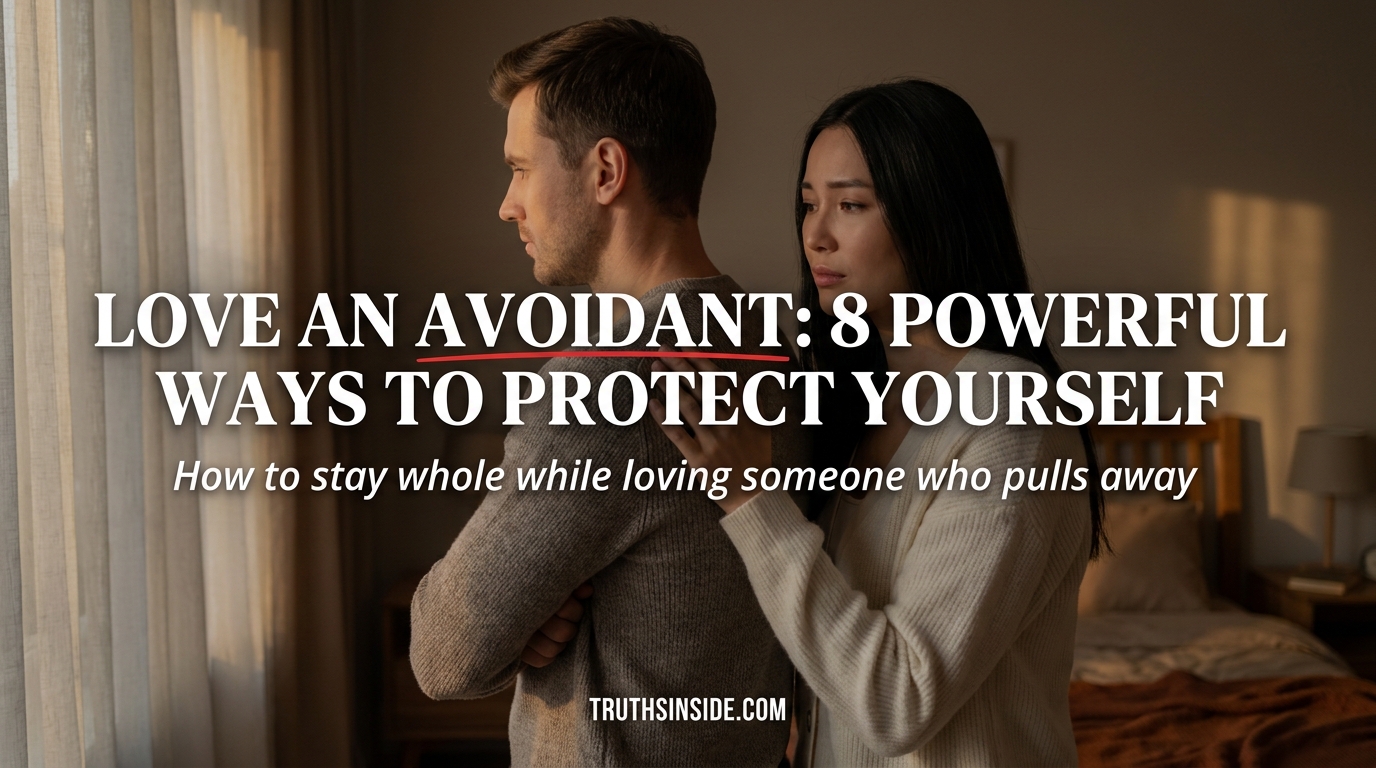
Learning to love an avoidant is one of the most emotionally complex experiences a person can navigate inside a relationship. If your partner pulls away when things get close, shuts down during emotional conversations, or seems to need more space than connection — and if you find yourself chasing, overexplaining, or quietly shrinking to keep them comfortable — you are not imagining the dynamic. You are living inside one of the most well-documented attachment patterns in relationship psychology.
Research from the Journal of Personality and Social Psychology estimates that approximately 25% of adults carry an avoidant attachment style — meaning the person you love may be genuinely wired to experience closeness as threatening, not because of who you are, but because of how their nervous system learned to protect itself long before you arrived.
This article is not about fixing your avoidant partner. It is not a manipulation guide to make them more emotionally available through strategy or pressure. It is something far more important than either of those things — it is a guide for you. For the person on the other side of the distance, trying to love someone who struggles to be fully loved without flinching. Because that experience, however quietly it happens, has a cost. And protecting yourself while staying present is both possible and necessary.
Understanding avoidant attachment — how it forms, how it shows up, and how to respond to it without abandoning your own needs — is where this journey begins. What follows are eight grounded, psychologically honest ways to love an avoidant without losing yourself in the process.
Understanding Avoidant Attachment First
Before anything else, it helps to understand what avoidant attachment actually is — and is not. Avoidant attachment develops in early childhood when emotional needs are consistently unmet, dismissed, or met with withdrawal. The child learns, at a nervous system level, that needing others leads to disappointment or rejection. The adaptive response is self-sufficiency — suppress the need, avoid the vulnerability, depend on no one.
In adulthood, this survival strategy becomes the template for romantic relationships. Avoidants genuinely want connection — research consistently shows they are not indifferent to love. But when closeness increases, their nervous system triggers an unconscious alarm. Intimacy begins to feel suffocating. Vulnerability feels dangerous. And their instinctive response — pulling away, going quiet, needing space — is not a choice they are consciously making to hurt you. It is a deeply ingrained protective reflex that activates before logic can intervene.
Understanding this distinction — between intentional rejection and involuntary self-protection — does not excuse hurtful behavior. But it fundamentally reframes the emotional meaning of their withdrawal. They are not pulling away because you are not enough. They are pulling away because closeness itself feels like a threat their nervous system hasn’t learned to tolerate yet.

1. Stop Taking the Distance Personally — Genuinely
This is the first and most critical shift for anyone who loves an avoidant — and it is far harder in practice than it sounds in theory. When someone pulls away after closeness, the human brain’s default interpretation is rejection. It reads withdrawal as evidence that something is wrong with you, that you said or did something to push them away, that you are not lovable enough to make them stay.
That interpretation feels real. But for avoidant partners, it is almost never accurate. Their withdrawal is not a verdict on your worth. It is a response to their own internal alarm system — one that was calibrated in childhood and has very little to do with the specific person in front of them.
Psychologist Dr. Amir Levine, co-author of Attached, describes this as the “protest cycle” — where the avoidant’s withdrawal triggers the anxious partner’s protest behaviors (chasing, over-texting, seeking reassurance), which in turn makes the avoidant feel more suffocated and withdraw further. Breaking this cycle begins with the anxious partner finding a way to not take the distance personally — which requires understanding its actual source. This doesn’t mean suppressing your feelings. It means not assigning yourself the blame that doesn’t belong to you.
📃 Related article: Jealousy as an Emotion: 7 Powerful Truths It Reveals
2. Learn the Difference Between Space and Abandonment
One of the most painful aspects of loving an avoidant is that their need for space can feel indistinguishable from abandonment — especially if you carry any anxious attachment tendencies yourself. When they go quiet, when they seem emotionally unreachable, when they need a day or weekend to decompress alone — everything in your nervous system may read that as “they’re leaving.”
Learning to distinguish between these two things is genuinely life-changing. Space is a temporary, self-regulatory need — a nervous system reset that allows an avoidant to return to closeness with more emotional availability. Abandonment is a permanent disconnection. They are not the same experience, even though they can feel identical in the moment.
Practically, this means building your own tolerance for the space they need without interpreting it as a crisis. It means developing your own life, interests, support system, and sense of self that are not dependent on their constant presence to feel stable. This is not about caring less. It is about being secure enough in yourself — and in the relationship — that their need for space does not collapse your sense of worth or safety. That security, paradoxically, makes you far more attractive and less threatening to an avoidant than anxious pursuit ever could.
“The most loving thing you can do for an avoidant partner is build a life so full and rooted that their need for space never empties yours.”
3. Communicate Directly — Without Pressure or Pursuit
Avoidants do not respond well to emotional pursuit. The more intensely a need or concern is expressed — with urgency, tears, ultimatums, or repeated attempts to get a response — the more their nervous system activates its protective withdrawal. This is not cruelty. It is neurobiology. Pressure, to an avoidant’s nervous system, registers as threat.
This creates a frustrating reality for their partners: the more you need something, the harder it becomes to ask for it in a way they can receive. The solution is not to suppress your needs. It is to learn to communicate them with calm directness and without emotional pressure attached.
Instead of “You always pull away and I never know where I stand — I can’t keep doing this,” try “I’ve been feeling disconnected lately and I’d love some time to talk when you’re ready.” One creates urgency and implied threat. The other communicates the same need with emotional regulation intact. Avoidants respond to the latter. They shut down in response to the former — not out of indifference, but because their nervous system cannot process escalated emotional bids for connection without activating self-protection.
This takes real emotional discipline — especially when you are hurting. But it is the communication style most likely to actually reach them.
4. Protect Your Own Emotional Needs Fiercely
Here is the truth that gets buried under all the compassionate advice about understanding avoidant attachment: understanding your partner’s attachment wounds does not mean accepting an emotionally unsustainable relationship. You have needs. Real, legitimate, non-negotiable needs for connection, consistency, reassurance, and emotional presence. Those needs do not become less valid because your partner struggles to meet them.
Loving an avoidant well does not mean loving yourself less. It does not mean becoming so understanding that you silently absorb every withdrawal, every emotional absence, every moment of unavailability without voicing its impact on you. That path leads to resentment, depletion, and the quiet disappearance of the person you were before the relationship.
Protecting your emotional needs means continuing to express them — calmly and clearly — even when they’re inconvenient. It means maintaining your friendships, your passions, your sense of humor, your dreams — the things that make you you — independent of whether your partner is emotionally present on any given day. It means having a clear internal line between “I understand why they struggle” and “I accept being emotionally starved.” The first is compassion. The second is self-abandonment.

5. Recognize the Anxious-Avoidant Dance — And Refuse to Keep Dancing
The anxious-avoidant dynamic is one of the most commonly occurring — and most emotionally exhausting — relationship patterns in modern psychology. It works like this: the avoidant’s withdrawal triggers the anxious partner’s fear of abandonment. The anxious partner pursues — seeking reassurance, connection, resolution. The avoidant feels overwhelmed by the pursuit and withdraws further. The anxious partner escalates. The avoidant disappears deeper. Both people end up more dysregulated than before — and nothing gets resolved.
This cycle can repeat hundreds of times in a single relationship — often with neither person fully understanding what’s happening or why. Each repetition deepens the pattern and increases the emotional exhaustion on both sides. The avoidant feels smothered and controlled. The anxious partner feels invisible and unimportant. Neither experience is accurate — but both are real.
Breaking the cycle requires one person to step off the dance floor. Usually, given that avoidants are less likely to initiate behavioral change without significant internal motivation, it falls to the anxious partner to interrupt the pattern first. That means choosing not to pursue when they withdraw. Choosing to regulate your own anxiety rather than seeking to resolve it through them. This is not playing games. It is refusing to participate in a dynamic that hurts you both.
📃 Related article: Signs He Likes You But Is Scared: 18 Behaviors Men Show When Afraid to Commit
6. Celebrate Small Openings Without Demanding More
Avoidant partners often show love in ways that are easy to miss if you’re looking for grand emotional gestures. They may not say “I love you” easily or often. They may struggle with long emotional conversations. But they might show up to fix something without being asked. They might sit close to you without talking. They might reach for your hand quietly during a film. These are not small things. For an avoidant, they are significant.
Learning to recognize and genuinely appreciate these smaller acts of closeness — without immediately pushing for more — is one of the most effective ways to slowly expand the emotional space an avoidant feels safe inhabiting with you. Every time you receive their form of connection without escalating into demand for more, you teach their nervous system that closeness is survivable. That you won’t consume them. That being near you is safe.
This is patient, nuanced work. It does not mean pretending you don’t need more — you may well need more, and that’s valid. It means understanding that with avoidants, the pathway to more is almost never pressure. It is consistent, received safety — shown over time in accumulated small moments.
“An avoidant doesn’t fall deeper in love through grand romantic gestures. They fall deeper through the quiet accumulation of moments where being close to you felt safe.”
7. Know What You Are — And Are Not — Responsible For
You are responsible for how you communicate your needs. You are responsible for managing your own emotional reactions. You are responsible for the choices you make about staying or leaving, pursuing or pausing. You are responsible for your own healing and growth.
You are not responsible for healing your avoidant partner’s attachment wounds. You are not responsible for being so perfectly calm, patient, and non-threatening that they finally decide to open up. You are not responsible for loving them in exactly the right way so that they become emotionally available. That work belongs to them — and it requires their own awareness, their own willingness, and most effectively, their own therapeutic process.
This boundary matters enormously. Many partners of avoidants unconsciously take on the project of “fixing” them — becoming emotional contortionists, bending themselves into shapes designed to make the avoidant feel safe enough to show up. This is not love. It is a trauma response wearing love’s clothing. Real love requires two people who are each responsible for their own inner world. Carrying both is not sustainable — and it will cost you far more than the relationship is worth.
8. Be Honest With Yourself About Whether This Relationship Is Working
This is the hardest point — and the most important. All the understanding in the world, all the patience and communication skills and self-awareness, cannot make a relationship work if only one person is committed to doing the work. Avoidant attachment is not a life sentence — people can and do develop greater emotional availability, usually through therapy and genuine self-examination. But they have to want to.
If your avoidant partner acknowledges the pattern, shows genuine effort over time, and is actively working — in therapy or otherwise — toward greater emotional availability, that is a fundamentally different situation from a partner who denies the pattern, refuses to engage with it, and leaves you doing all the emotional labor while they remain unchanged.
Ask yourself honestly: Am I growing in this relationship, or am I shrinking? Is this relationship bringing out the fullest version of me, or am I becoming a smaller, more anxious, more guarded version of myself? Is the connection genuinely deepening over time — even slowly — or have we been in the same stuck place for years?
These questions deserve honest answers. And those answers deserve to be honored — whatever they are. Loving an avoidant is possible. Loving an avoidant at the permanent expense of your own emotional health, growth, and happiness is not love. It is sacrifice without return. And you were never meant for that.

A Final Word for the One Doing the Loving
If you’ve read this far, you are almost certainly someone with a deep capacity for love — patient, empathetic, willing to understand before condemning. Those are extraordinary qualities. They are also the qualities that can make you vulnerable to giving far more than you receive in a relationship with someone who struggles to be emotionally present.
Take those qualities seriously enough to protect them. The goal of loving an avoidant well is not to disappear into their comfort zone. It is to build a relationship where both people are gradually, honestly moving toward each other — at a pace that is real, not performed. Where you feel genuinely seen, not just tolerated. Where your presence adds to your life rather than quietly subtracting from it.
You deserve a love that doesn’t require you to make yourself smaller to keep it. Understanding avoidant attachment gives you the tools to love more wisely. What you do with that wisdom — how firmly you hold your own worth inside it — is entirely up to you. And whatever you decide, let it be a decision made from clarity and self-respect, not fear of being alone.
📃 Related article: Psychology of Ghosting: 7 Shocking Truths About Ghosters
💾 Save this article. Share it with someone who needs this clarity. Follow Truthsinside.com for love and psychology content that honors both your heart and your healing.
FAQ
Q1: Can a relationship with an avoidant partner actually work long-term?
Yes — but it requires specific conditions. The avoidant partner must have some level of self-awareness about their patterns and genuine willingness to work on emotional availability. The other partner must have strong self-worth, clear boundaries, and the ability to self-regulate without constant reassurance. Couples therapy, particularly Emotionally Focused Therapy, has shown strong results with anxious-avoidant pairs when both partners are committed.
Q2: How do I know if my partner is avoidant or just not interested?
Avoidants typically show consistent care in non-verbal or practical ways — they stay, they show up functionally, they demonstrate investment through action even when words and emotional expression are limited. Someone who is simply not interested tends to be consistently inconsistent in all areas — effort, presence, and follow-through. If your partner pulls away after closeness but returns, that cyclical pattern is more characteristic of avoidant attachment than disinterest.
Q3: Will an avoidant ever become more emotionally available?
Some do — significantly. Change is most likely when the avoidant person independently recognizes their pattern causes problems, engages in individual therapy, and has a partner who provides consistent emotional safety without anxious pressure. Change is least likely when the avoidant sees no problem with current behavior. Growth is possible but cannot be forced, manipulated, or loved into existence by the other partner alone.
Q4: Is the anxious-avoidant relationship dynamic always toxic?
Not inherently — but it has a high potential to become painful without awareness and active management from both partners. The dynamic becomes toxic when neither person understands the pattern, when the anxious partner escalates pursuit and the avoidant escalates withdrawal indefinitely, and when no growth occurs over time. With mutual awareness, communication, and often professional support, anxious-avoidant couples can build deeply satisfying relationships.
Q5: What if I’m both anxious and avoidant depending on the relationship?
This is called fearful-avoidant or disorganized attachment — and it’s more common than people realize. It means you simultaneously crave and fear closeness, and your attachment behavior may shift depending on the relationship dynamic. If this resonates, individual therapy focused on attachment work is particularly valuable. Understanding your own pattern with compassion is the most important first step toward consistently healthier relating.
🎵 Music
Maren Lull is a singer-songwriter who writes from the places most people don’t talk about out loud.
Not the dramatic grief. Not the obvious heartbreak. The quiet kind — the ordinary Tuesday emptiness, the habit of reaching for someone who isn’t there anymore, the particular exhaustion of being strong for so long that the strength itself wears thin.
Her music lives at the intersection of emotional honesty and soft beauty — breathy vocals over gentle piano, slow tempos, lyrics that feel less like songs and more like something you wrote in a private notebook at two in the morning and never showed anyone.
Maren Lull writes for the people who feel everything deeply and say very little about it. For the ones who listen to sad music not because they want to feel worse — but because being understood, even by a song, makes the feeling easier to carry.
📱 Follow Maren Lull:
→ Spotify
→ Apple Music
→ Youtube
→ Audiomack