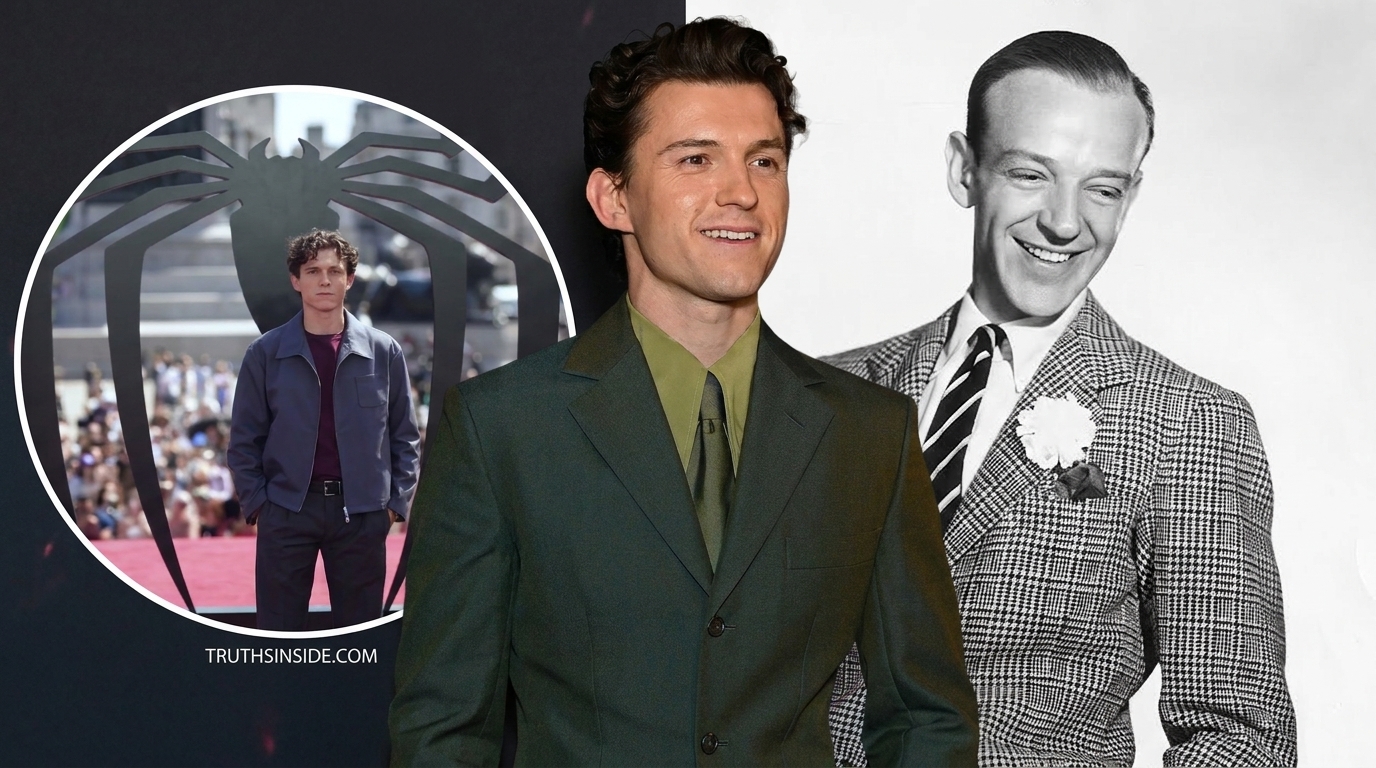
Tom Holland Fred Astaire Biopic: Brave New Role — Everything We Know So Far
There is something deeply human about standing at the edge of a challenge that feels just slightly too big to conquer. Most of us know that feeling intimately — and so does Tom Holland. The Tom Holland Fred Astaire biopic has officially moved from exciting Hollywood announcement into the very real, very demanding world of rehearsals, and Holland has been refreshingly honest about how overwhelming it already feels. According to a 2022 study published in the Journal of Applied Psychology, high performers who acknowledge fear while pursuing ambitious goals are statistically more likely to achieve excellence than those who deny the pressure entirely. Holland, it seems, is wired exactly right for this.
Since being cast in 2021, Holland has carried the weight of one of Hollywood’s most iconic legacies on his still-young shoulders. Fred Astaire wasn’t just a dancer. He was a standard-setter — a man whose precision, elegance, and technical mastery redefined what performance could look like on film. Stepping into those shoes requires far more than talent. It requires obsession, humility, and an almost reckless willingness to commit fully. And from everything Holland has shared publicly, that is precisely the energy he is bringing to this project.

Tom Holland Fred Astaire Biopic: How the Casting Happened
The story of how Tom Holland came to be cast as Fred Astaire is almost as cinematic as the biopic itself promises to be. In a detail that has delighted fans and journalists alike, Holland revealed that he learned about his casting during a FaceTime call — while taking a bath.
It’s the kind of unexpectedly ordinary backdrop for an extraordinary professional moment that feels almost scripted. But Holland has confirmed the story repeatedly with the kind of specificity that only comes from genuinely remembered experience. One minute he was in the tub. The next, his life had changed in a significant and irreversible way.
What makes the casting story even more remarkable is what Holland did next. He accepted the role before he had read a single word of the script. There was no careful review of the source material, no deliberate consideration of creative direction, no waiting for the full picture to emerge. Holland heard “Fred Astaire biopic” and said yes immediately, operating on instinct and enthusiasm alone.
That kind of unconditional commitment is rare in Hollywood, where actors routinely attach conditions, negotiate creative controls, and reserve the right to step back if the material doesn’t meet expectations. Holland threw all of that caution out and committed fully — which tells you everything about how much the project means to him personally.
📃 Related article: Dakota Mortensen New Relationship and Custody Battle Exposed
Why Fred Astaire’s Legacy Sets the Bar Impossibly High
To understand the magnitude of what Tom Holland is attempting, it helps to understand exactly who Fred Astaire was — and why his legacy continues to cast such a long shadow over the entertainment world nearly four decades after his death.
Fred Astaire was, by almost universal consensus, the greatest dancer in the history of Hollywood cinema. His career spanned more than six decades, from his Broadway origins in the 1910s through a film career that produced some of the most technically extraordinary dance sequences ever captured on screen. His partnership with Ginger Rogers became one of cinema’s most celebrated collaborations, producing a string of films throughout the 1930s that remain benchmarks of elegance and grace.
What set Astaire apart wasn’t simply technical skill, though his technique was flawless. It was his philosophy of performance. Astaire insisted on filming his dance numbers in continuous, uncut takes — a decision that forced both him and his directors to achieve perfection in a single run rather than stitching together a performance from multiple angles and edits.
This approach was demanding beyond measure. It meant that every step, every arm movement, every transition had to be executed perfectly from beginning to end without the safety net of editing. It demanded a level of physical preparation and mental discipline that most performers never reach. And it is precisely this approach that Tom Holland has committed to replicating.
“The pressure of honoring Fred Astaire’s legacy is real — but so is Tom Holland’s determination to meet it head-on, one continuous take at a time.”
Tom Holland’s Training: The Physical and Emotional Weight of the Role
Holland’s recent interview on Good Morning America offered fans a candid and remarkably unguarded look at where he is emotionally in this process. He described the experience of beginning rehearsals as simultaneously exciting and filled with dread — a combination that speaks to both his awareness of what’s at stake and his genuine investment in getting it right.
The dread is understandable. Holland is an exceptional physical performer — his work as Spider-Man has demonstrated extraordinary athleticism, agility, and commitment to physical preparation. But dancing at the level Fred Astaire operated is a different discipline entirely. It requires not just physical strength and coordination, but a sensitivity of movement, a musicality, and a quality of expression that takes years to develop even in dedicated professional dancers.
Holland is approaching this with the full awareness that he is not starting from the top of the mountain. He is starting at the base camp, with the summit somewhere in the clouds above him, and he is climbing with everything he has.
The rehearsal process has clearly already begun in earnest. Holland’s comments suggest he is deep in the physical work of building the technical foundation required to carry the role credibly. The commitment to performing without dance doubles means there is no exit strategy — no fallback position if the dancing doesn’t reach the required standard. Holland has to get there himself.
📃 Related article: Kaylee Hottle Tragic Death: Full Story Revealed
The One-Shot Philosophy: Honoring Astaire’s Technical Signature
Of all the creative decisions surrounding the Tom Holland Fred Astaire biopic, the commitment to one-shot dance sequences is perhaps the most audacious. It is also the most meaningful — because it gets to the very heart of what made Astaire’s performances so remarkable in the first place.
In contemporary filmmaking, dance sequences are almost always assembled from multiple shots, angles, and takes. Technology allows editors to construct a seamless-looking performance from dozens of individual fragments, masking mistakes and optimizing each moment independently. The result can be visually impressive, but it fundamentally changes the nature of what is being captured. It’s a performance reassembled rather than a performance experienced.
Astaire refused to work that way. He believed — and his films prove — that the power of a dance number came from its continuity. When you watch Astaire perform in a single unbroken take, you are watching a complete, sustained act of human expression. Every moment flows into the next with the logic and inevitability of music itself. You cannot fake that in the editing room.
By committing to the same approach, Holland and the filmmakers behind this biopic are making a statement about what this film intends to be. It will not be a greatest hits package assembled from the best available footage. It will be an attempt to recreate the live, sustained, breathtaking experience of watching Fred Astaire perform in real time.
That is an extraordinary ambition. It is also the only approach that could truly honor the man being portrayed.

“Tom Holland accepted the Fred Astaire biopic role before reading a single word of the script — and has been proving that instinct right ever since.”
Tom Holland Fred Astaire Biopic: What This Role Means for His Career
Tom Holland has already achieved something remarkable in his career. The Spider-Man franchise made him a global star, and his performances — particularly in Spider-Man: No Way Home — demonstrated a depth of emotional range that surprised even his most enthusiastic supporters. He has proven that he can carry a blockbuster franchise while also delivering genuinely moving dramatic work.
But the Fred Astaire biopic represents something different. It is a swing at a different kind of legacy — the kind built not on box office numbers or franchise success, but on the quality and authenticity of a single sustained performance.
Biopic roles are among the most scrutinized in Hollywood. When an actor takes on a real historical figure — particularly one as beloved and technically accomplished as Fred Astaire — the critical bar is set by the subject’s own achievements. Audiences don’t compare the performance to other films. They compare it to the real thing.
Holland is walking into that comparison willingly, with full awareness of what it means. That level of professional courage is rare, particularly for someone whose career still has decades ahead of it. A misstep in a role this high-profile could leave a mark. But a success — a truly authentic, technically accomplished, emotionally resonant performance — could define his legacy in ways that no franchise ever could.

The Emotional Dimension: Excitement and Dread as Motivators
It would be easy to read Holland’s admitted dread as a warning sign — evidence that the role might be beyond his reach. But that would be a significant misreading of what he is communicating.
The most accomplished performers in any field — athletes, musicians, actors, dancers — consistently report that the presence of fear before a significant challenge is not a sign of weakness. It is a sign that the challenge is real, that the stakes are understood, and that the performer is appropriately calibrated to the difficulty of what they are attempting.
An actor who approached the Fred Astaire biopic without any dread would be an actor who didn’t fully understand the scale of the challenge. Holland’s honesty about his emotional state is actually a strong indicator that he grasps exactly what is required — and that he is taking it with the seriousness it deserves.
The excitement is equally important. Holland’s enthusiasm for this project has been consistent since the moment he took the FaceTime call in the bath in 2021. That sustained excitement — maintained through years of waiting and now through the hard early work of rehearsals — suggests a genuine personal connection to the material that goes beyond professional ambition.
When an actor both loves a role and fears it appropriately, the conditions are set for something exceptional.

What Fans and Critics Are Saying
The announcement of Holland’s casting generated significant discussion across entertainment media and among fans, and opinions have been characteristically divided. Some expressed immediate enthusiasm, pointing to Holland’s physical capabilities and his demonstrated ability to handle demanding material with emotional nuance.
Others raised legitimate questions about whether a young actor — however talented — can capture the particular quality of Fred Astaire’s presence. Astaire had a sophistication, a suaveness, and an old-Hollywood elegance that exists in a very different register from the contemporary performers Holland typically plays. The translation from Spider-Man’s youthful energy to Astaire’s refined, timeless grace is not an obvious one.
But that gap may be precisely what makes this casting interesting. Holland is not the safe, obvious choice. He is a bold one. And bold casting decisions — when they work — produce the most memorable performances in cinema history.
The commitment to performing the dances himself, without doubles, and in continuous takes, has generally been received as a strong sign of intent. It signals that this will not be a vanity project or a surface-level impersonation, but a genuine attempt to inhabit and honor one of Hollywood’s most enduring legacies.

A Timeline of the Tom Holland Fred Astaire Biopic Journey
Understanding the full arc of this project helps contextualize just how long Holland has been carrying this commitment.
In 2021, Holland was cast in the role — accepting before a script existed, driven purely by the significance of the opportunity and his personal enthusiasm for the project. The announcement generated immediate excitement and considerable media attention.
In the years since, Holland has continued to build his career through the conclusion of his Spider-Man tenure and other projects, all while this biopic has remained in development. The patience required to carry a project in this state — committed but not yet filming — is its own form of professional discipline.
By July 2025, Holland appeared on Good Morning America to discuss the project, revealing that rehearsals had recently begun and sharing his candid emotional response to the experience. The interview confirmed that the project is actively moving forward and that Holland remains as committed as ever.
The road ahead is still long. But it is now clearly, definitively, underway.
FAQ: Tom Holland Fred Astaire Biopic
1. When was Tom Holland cast as Fred Astaire?
Tom Holland was cast in the Fred Astaire biopic in 2021. He accepted the role before receiving or reading a script, driven by his enthusiasm for the project.
2. How did Tom Holland find out about his casting?
Holland has shared that he learned about his casting during a FaceTime call while he was taking a bath — an unexpectedly personal and memorable moment for a major career announcement.
3. Will Tom Holland do his own dancing in the biopic?
Yes. Holland has committed to performing all dance sequences himself, without the use of dance doubles. He has also committed to filming the dances in continuous one-shot takes, mirroring Fred Astaire’s original technique.
4. How does Holland feel about the role?
Holland has described his feelings as a mixture of excitement and dread — acknowledging both the honor of portraying such an iconic figure and the immense technical and emotional challenge the role presents.
5. What makes the one-shot dance filming approach significant?
Fred Astaire was known for insisting on filming his dance numbers in continuous, uncut takes rather than assembling performances through editing. By replicating this approach, Holland and the filmmakers are honoring Astaire’s artistic philosophy and committing to the same uncompromising standard of performance he set.
Final Thoughts: The Right Actor at the Right Moment
The Tom Holland Fred Astaire biopic is shaping up to be one of the most compelling and closely watched Hollywood projects of the coming years. Holland’s combination of physical capability, emotional honesty, and genuine reverence for Astaire’s legacy creates the conditions for something truly special.
Will it be easy? Absolutely not. Holland himself has made that clear. Will it be worth watching? Given everything he has committed to — performing every dance himself, filming in single continuous takes, honoring the craftsmanship that made Astaire legendary — it is already shaping up to be unmissable.
Fred Astaire spent his career proving that perfection was achievable, one unbroken take at a time. Tom Holland is now on that same path. And the journey, even from the outside, is already extraordinary to witness.
💾 Save this article so you don’t miss a single update on the Fred Astaire biopic.
📤 Share it with every Tom Holland and classic Hollywood fan you know.
👣 Follow Truthsinside.com for the latest Celebrity entertainment news and exclusive coverage.
🎵 Music
Maren Lull is a singer-songwriter who writes from the places most people don’t talk about out loud.
Not the dramatic grief. Not the obvious heartbreak. The quiet kind — the ordinary Tuesday emptiness, the habit of reaching for someone who isn’t there anymore, the particular exhaustion of being strong for so long that the strength itself wears thin.
Her music lives at the intersection of emotional honesty and soft beauty — breathy vocals over gentle piano, slow tempos, lyrics that feel less like songs and more like something you wrote in a private notebook at two in the morning and never showed anyone.
Maren Lull writes for the people who feel everything deeply and say very little about it. For the ones who listen to sad music not because they want to feel worse — but because being understood, even by a song, makes the feeling easier to carry.
📱 Follow Maren Lull:
→ Spotify
→ Apple Music
→ Youtube
→ Audiomack