
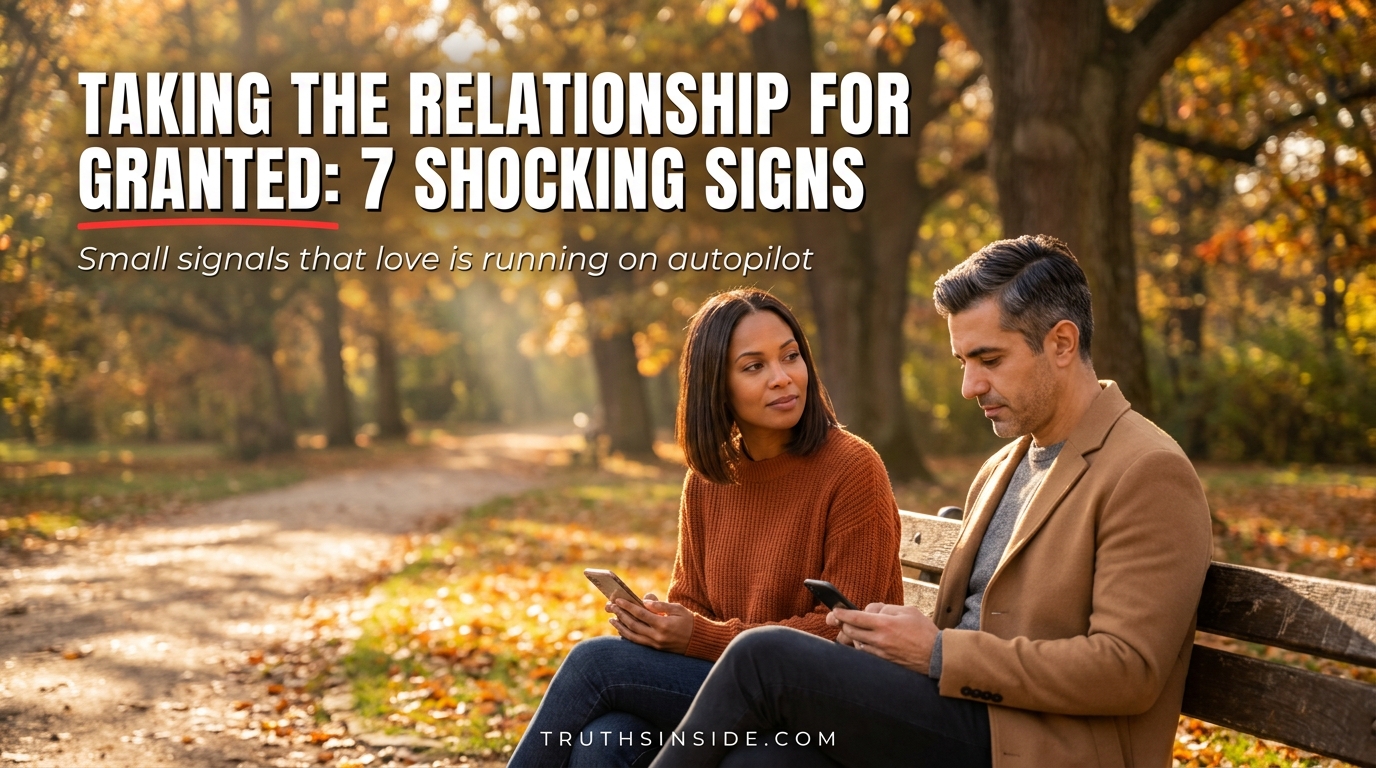
Signs You’re Both Taking the Relationship for Granted
Taking the relationship for granted never starts with a decision. Nobody wakes up and chooses to care less. It begins with a busy week, a skipped thank-you, a quick glance at the phone while your partner is mid-sentence, and a quiet assumption that love will simply wait. If you have felt more like roommates than partners lately, you are far from alone.
Psychologists call part of this hedonic adaptation: humans adjust to good things so quickly that we stop noticing them. Research by psychologist Sara Algoe suggests that expressing gratitude helps people notice and strengthen the relationships they value. When thanks fade, taking the relationship for granted quietly takes its place.
This guide explains what taking the relationship for granted really means, seven signs that you are both drifting into it, and practical ways to reconnect before small habits harden into distance.
What Does Taking the Relationship for Granted Really Mean?
Taking the relationship for granted means treating your partner’s presence, effort and love as guaranteed, so they no longer feel worth noticing, protecting or celebrating. It is less about cruelty and more about inattention. The relationship becomes a background fixture, like the furniture you stopped seeing years ago.
It is different from comfort. Comfort feels like safety: you can relax around each other, share silence and be fully yourselves. Taking the relationship for granted feels like autopilot: you stop trying because you assume nothing could go wrong. One deepens love. The other slowly starves it.
Importantly, this pattern is rarely one-sided. In many couples, both partners drift at once, each waiting for the other to make the first move while privately feeling unseen. That is why this article speaks to “both” of you. The goal is not to find a villain. It is to notice the pattern together and change it as a team.

Why Couples End Up Taking the Relationship for Granted
The first culprit is novelty fading. In the early months, everything is new, so your brain pays close attention. Over time, familiar becomes invisible. Your partner’s thoughtful habits, which once made your heart race, become part of the scenery. Nothing has gotten worse. You just stopped noticing.
The second culprit is stress and logistics. Work, money, children, health and family obligations demand energy, and the relationship often gets what is left. Many couples fall into a pattern where they manage a household together beautifully but rarely meet as people. Taking the relationship for granted feels efficient in the short term, because the relationship seems stable enough to wait.
The third culprit is the belief that love maintains itself. We would never expect a garden to thrive without water, but many of us expect a relationship to do so. Research on relationship maintenance suggests that small, regular acts of care, such as appreciation, shared time and attention, are what keep satisfaction high over the years. When those acts slip, taking the relationship for granted fills the gap.
Love rarely leaves in a storm. More often, it drifts away while nobody is looking.
7 Shocking Signs You’re Both Taking the Relationship for Granted
Read these honestly and notice which ones feel familiar. One sign is not a verdict, since every couple has seasons of busyness. What matters is a cluster that lasts for months.
Sign 1: Conversations Shrink to Logistics
When did you last talk about something that was not schedules, bills or chores? In couples taking the relationship for granted, conversation becomes a project meeting: who is picking up the kids, what is for dinner, which bill is due. Dreams, fears and funny thoughts get saved for friends, coworkers or nobody at all.
Sign 2: “Thank You” Disappears
Daily kindness becomes invisible. Nobody thanks anyone for cooking, driving, earning or remembering, because “that is just what they do.” This silence is one of the clearest signals of taking the relationship for granted. Gratitude is how partners tell each other they are seen, and without it, effort starts to feel like a thankless job.
Sign 3: Phones Win the Room
You sit on the same sofa, each in a private screen world. Researchers sometimes call ignoring a partner for a phone “phubbing,” and studies link it with lower relationship satisfaction. A glance at a notification is harmless once. As a daily default, it tells your partner they are the least interesting thing in the room, which is exactly how taking the relationship for granted feels from the inside.
Sign 4: Dates and Rituals Quietly Vanish
Anniversaries get a rushed text. Date nights become “we should do that sometime.” The small rituals, such as morning coffee together, a weekend walk or a goodnight kiss, slip away one by one. Because nothing dramatic happened, nobody notices the loss until the relationship feels flat. Couples taking the relationship for granted often say, “We have just been so busy.”
Sign 5: Your Best Energy Goes Elsewhere
Your partner gets the tired, irritable version of you, while colleagues, friends and even strangers get your charm. You have energy for hobbies, social media and favors, but not for a ten-minute conversation at home. This imbalance is a hallmark of taking the relationship for granted, because it assumes your partner will forgive the leftovers.
Sign 6: You Stop Turning Toward Each Other
Relationship researcher John Gottman describes “bids for connection”: small attempts to share something, such as pointing out a funny video or sighing after a hard day. Happy couples often respond to these bids. In couples drifting apart, bids are met with a grunt or silence. Over time, people stop making them, which feels peaceful but is really withdrawal.
Sign 7: Curiosity Dies and Criticism Grows
You assume you already know everything about each other, so you stop asking questions. At the same time, small irritations seem louder than affection. You notice the dishes left out but not the effort behind the day. When curiosity fades and criticism grows, taking the relationship for granted has become the relationship’s default setting.

Quick Self-Check: How Much Are You Taking the Relationship for Granted?
Answer these questions privately, then compare notes with your partner. Be generous with yourselves, because the point is awareness, not blame.
- When did we last have a conversation that was not about logistics?
- When did I last thank my partner for something specific?
- Do we have a regular ritual that belongs only to us?
- How often is my phone in my hand during our time together?
- When my partner shares something, do I really turn toward them?
- Do I still ask questions I do not know the answers to?
If several answers make you wince, you are not failing. You have simply found the places where attention has drifted. The good news is that taking the relationship for granted is one of the most fixable relationship problems, because the cure is small, specific and available today.
📃 Related article: Processing Emotions Together: 7 Powerful Ways to Heal
Taking the Relationship for Granted at Different Stages of Love
The pattern wears different clothes at different stages. In the first years of living together, it often looks like settling into routine: the dating energy fades and nobody replaces it. In these years, small rituals matter most, because they keep the relationship feeling like a choice instead of a default.
For new parents, taking the relationship for granted often comes from sheer exhaustion. Every spare minute goes to the baby, and the couple becomes a logistics team. Short, protected moments, such as a ten-minute conversation after bedtime, can keep the bond alive until sleep returns.
In long marriages, the danger is certainty. After decades together, it is easy to assume you know every thought your partner has, and to stop asking. Couples who keep learning about each other, even through old stories told with new questions, often describe feeling younger together.
When children leave home, some couples discover that busy years were hiding a quiet distance. That can be frightening, but it is also an invitation to begin again. Whatever your stage, the principle is the same: love needs attention, not just time.
The Hidden Cost of Taking the Relationship for Granted
The danger of this pattern is that it feels harmless. There is no fight, no betrayal, no crisis, only a slowly growing quiet. But over time, that quiet turns into loneliness. Partners feel unappreciated, then resentful, then indifferent. Each small neglect adds a drop to the same bucket.
Unmet needs tend to look for somewhere to go. Some people pour their energy into work or hobbies. Others become more vulnerable to attention from outside the relationship, not because they planned to stray, but because someone else noticed them when their partner did not. Taking the relationship for granted does not cause betrayal, yet it leaves the door unguarded.
The reverse is also true. Couples who keep noticing and appreciating each other tend to feel more secure and satisfied, even when life is hard. That is why this issue deserves attention now, while the repair costs only a few minutes a day.
How to Stop Taking the Relationship for Granted: 7 Practical Steps
Change does not require a grand gesture. It requires small, repeated signals that say, “I see you, and you matter.” Choose one or two steps to start, and add more as they feel natural.
Step 1: Say a Specific Thank-You Every Day
Move beyond a vague “thanks.” Try “Thank you for handling the morning rush, it made my day easier.” Specific gratitude shows that you noticed the effort behind the act. It is the fastest antidote to taking the relationship for granted, and it costs nothing.
Step 2: Turn Toward Small Bids
Practice noticing when your partner reaches for you. Put the phone down, look up and respond, even briefly. A smile, a question or a laugh counts. These moments are the building blocks of trust, and they remind both of you that connection is still available.
Step 3: Protect Phone-Free Time
Agree on a daily window, such as the first twenty minutes after work or the dinner hour, when phones stay away. Make it a team agreement, not a punishment. Even short stretches of undivided attention can feel luxurious to a partner who has been competing with a screen.
Step 4: Bring Back the Rituals
Revive one ritual, or invent a new one. It might be a Sunday walk, a weekly breakfast or a goodnight question. Put it on the calendar, because rituals thrive on repetition. They tell your relationship it still deserves a place in your busy life, and they stop taking the relationship for granted from becoming permanent.
Step 5: Get Curious Again
Ask questions you do not know the answers to: “What are you looking forward to this year?” or “What is something you have been worried about lately?” People change constantly, and the person beside you is not the same as five years ago. Curiosity turns an old relationship into a living one.
Step 6: Try Something New Together
Psychologist Arthur Aron and colleagues found that couples who shared novel, mildly exciting activities reported higher relationship quality. Try a new trail, a cooking class or a short trip to somewhere unfamiliar. Novelty wakes up the attention that routine put to sleep.
Step 7: Hold a Weekly Check-In
Spend twenty minutes each week sharing one appreciation, one thing that felt hard and one request for the coming week. Keep it kind and specific. Regular check-ins stop small issues from piling up and keep taking the relationship for granted from sneaking back.

A Real-Life Example: Hannah and Marcus
Hannah and Marcus had been together for nine years. They rarely fought, but they rarely laughed either. Each evening, they ate dinner while scrolling, shared a few lines about the day and went to bed with their backs to each other. Neither felt wronged. Both felt oddly lonely.
One night, Hannah noticed Marcus had fixed the leaking tap without being asked, and realized she could not remember the last time she had thanked him. She said, “I noticed you fixed that. Thank you, it means a lot.” Marcus looked up, surprised, and said, “I was not sure you noticed anything anymore.”
That small exchange opened a longer conversation about how both of them had been taking the relationship for granted. They agreed to a phone-free dinner twice a week and a Sunday walk. Nothing dramatic changed overnight, but within a month, the laughter slowly returned. The couple did not need a new partner. They needed to see the one they already had.
📃 Related article: Partner Losing Interest: 7 Hidden Long-Distance Signs
When Taking the Relationship for Granted Is Part of a Bigger Problem
Sometimes drifting is more than neglect. If your relationship contains frequent contempt, mockery, stonewalling, chronic resentment or betrayal, the issue goes beyond forgetting to say thank you. In those cases, a licensed couples therapist can help you uncover patterns that are hard to see from inside.
Therapy is also useful if one partner has already emotionally checked out, or if repeated attempts to reconnect keep failing. Approaches such as the Gottman Method and Emotionally Focused Therapy give couples a structured way to rebuild closeness, with a neutral guide to keep conversations safe.
If your relationship ever involves fear, threats or controlling behavior, please treat it as a safety issue, not a connection problem. In the United States, the National Domestic Violence Hotline is available at 1-800-799-7233. Everyone deserves a relationship where they feel safe and respected.
Appreciation is not a luxury for new love. It is the daily maintenance that keeps old love alive.
FAQ: Taking the Relationship for Granted
Is taking the relationship for granted the same as falling out of love?
No. Taking the relationship for granted usually means attention has faded, not that love has disappeared. Many couples find that renewed appreciation, curiosity and shared time bring feelings of closeness back.
How do I tell my partner I feel taken for granted without starting a fight?
Choose a calm moment and describe your feelings with “I” statements: “I miss feeling noticed, and I would love more time together.” Avoid blaming language, and invite your partner to share their experience too.
Can a long-term relationship avoid taking each other for granted?
Yes. Couples who keep up small habits such as daily thanks, regular dates, curiosity and phone-free time tend to stay connected for years. Taking the relationship for granted is a habit, so it can be replaced with better habits.
What if only one of us is making the effort?
Start with your own half. Offer specific appreciation and turn toward your partner’s bids, which often invites the same in return. If one partner stays dismissive despite repeated, kind attempts, couples therapy can help.
How long does it take to reconnect?
Many couples notice small shifts within a couple of weeks of consistent effort, such as warmer conversations and more laughter. Deeper trust and closeness build over months, so treat the process as a lifestyle change instead of a quick fix.
Final Thoughts
The most dangerous thing about taking the relationship for granted is how ordinary it feels. There is no alarm, only a gentle fading of color. Yet the reverse is just as quiet: a thank-you, a look, a hand reached across the sofa can start the color returning.
You do not need a perfect relationship, only a willingness to notice each other again. Choose one small step tonight, and let it be the first signal that you are choosing each other, not just staying together.
Found this helpful? Please do three things:
- Save this article so you can return to the seven signs and steps when life gets busy.
- Share it with a partner or friend who deserves to feel noticed.
- Follow Truthsinside.com for more signs, signals and relationship insights.
🎵 Music
Maren Lull is a singer-songwriter who writes from the places most people don’t talk about out loud.
Not the dramatic grief. Not the obvious heartbreak. The quiet kind — the ordinary Tuesday emptiness, the habit of reaching for someone who isn’t there anymore, the particular exhaustion of being strong for so long that the strength itself wears thin.
Her music lives at the intersection of emotional honesty and soft beauty — breathy vocals over gentle piano, slow tempos, lyrics that feel less like songs and more like something you wrote in a private notebook at two in the morning and never showed anyone.
Maren Lull writes for the people who feel everything deeply and say very little about it. For the ones who listen to sad music not because they want to feel worse — but because being understood, even by a song, makes the feeling easier to carry.
📱 Follow Maren Lull:
→ Spotify
→ Apple Music
→ Youtube
→ Audiomack