
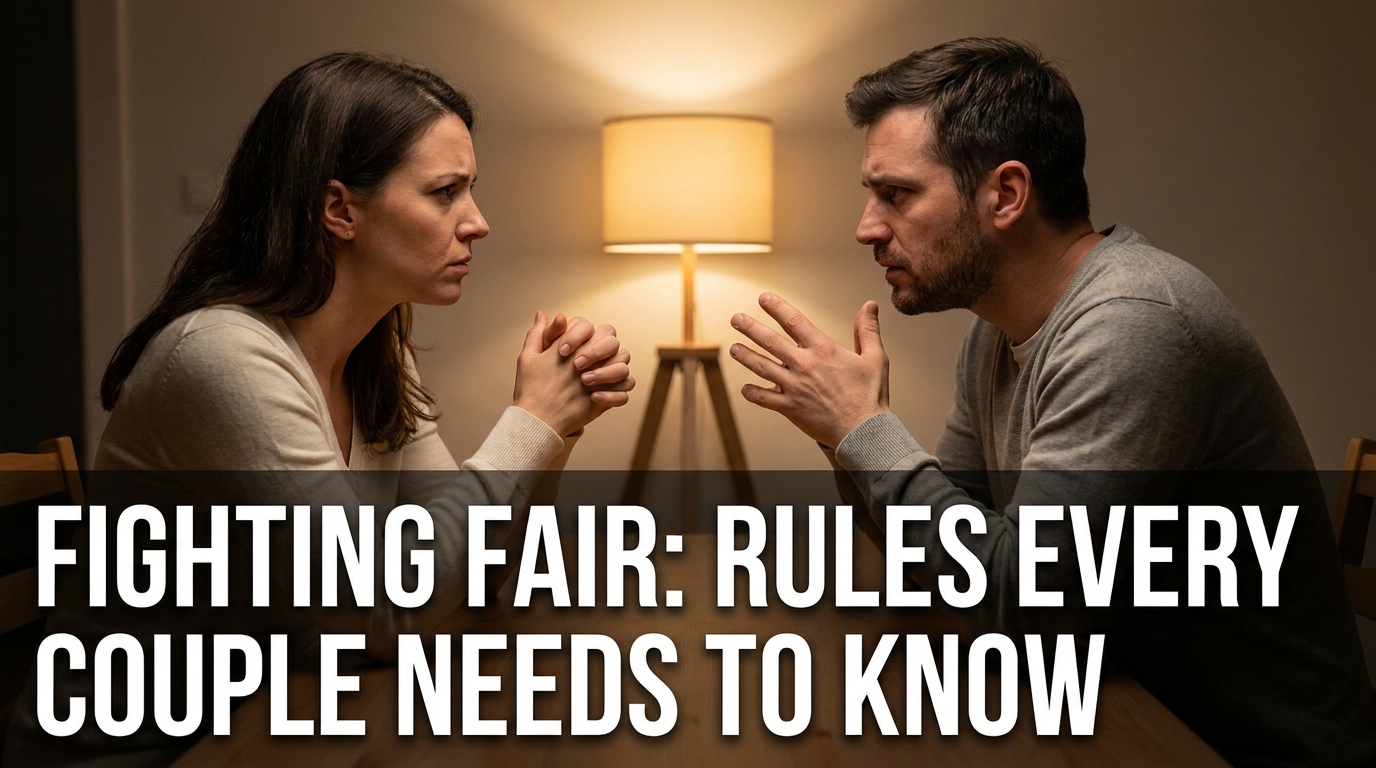
Every couple fights.
The ones who tell you they never do are either not being honest — or are avoiding something important.
Conflict in relationships is not evidence that something is wrong. It is evidence that two real people with different needs, histories, and ways of seeing the world are trying to build a life together. That process is inherently imperfect. It will produce friction. And friction, handled badly, causes damage. Handled well, it creates something stronger than what existed before.
The difference is not whether you fight. It is how.
Research from the Gottman Institute — drawn from over four decades of studying couples — found that 69 percent of relationship conflicts are perpetual, meaning they never fully resolve. The couples who stay together and stay happy are not the ones who solve these conflicts. They are the ones who have learned to navigate them without destroying each other in the process.
Fighting fair is not about being polite when you are furious. It is about having enough respect for your partner — and your relationship — to follow certain rules even when everything in you wants to break them.

Why How You Fight Matters More Than What You Fight About
Most couples believe that the content of their arguments is the problem. If they could just resolve the thing they are fighting about, the relationship would be fine.
But research consistently shows that the content of the argument matters far less than the process — the emotional tone, the communication behaviors, the level of respect maintained, and whether repair happens afterward.
Dr. John Gottman’s research identified what he called the Four Horsemen — four specific communication behaviors during conflict that are so predictive of relationship breakdown that trained observers can watch a couple argue for just a few minutes and predict divorce with over 90 percent accuracy. These are criticism, contempt, defensiveness, and stonewalling.
None of these are about the topic being argued. All of them are about how the argument is being conducted.
Conversely, couples who fight in ways that maintain basic respect, allow both partners to feel heard, and end with genuine repair — even when the underlying issue remains unresolved — consistently report higher relationship satisfaction, greater emotional intimacy, and significantly better long-term outcomes.
The argument is not the relationship. But how you conduct yourself in it reveals everything about it.
“It is not conflict that destroys relationships. It is the contempt, the stonewalling, the criticism, and the defensiveness — the ways we fight — that does the damage.” — Dr. John Gottman
The 4 Horsemen — What to Avoid
Before exploring the rules of fighting fair, it is worth naming clearly what fighting unfairly actually looks like. Gottman’s Four Horsemen are the most well-researched destructive patterns in relationship conflict.
Criticism attacks the person rather than the behavior. “You are so selfish” is criticism. “I felt hurt when you made that decision without asking me” is a complaint — which is legitimate and very different.
Contempt communicates fundamental disrespect — eye-rolling, mockery, sarcasm deployed as a weapon, name-calling, hostile humor at the partner’s expense. Contempt is the single strongest predictor of relationship dissolution. It says: I am superior to you. I hold you in low regard. It is impossible to resolve conflict with someone you fundamentally disrespect.
Defensiveness responds to a complaint by immediately deflecting responsibility — counter-attacking, making excuses, or reframing the situation so the partner is actually the problem. It communicates: I will not take responsibility for any of this. Everything you are feeling is your fault.
Stonewalling is the complete withdrawal from the interaction — shutting down, going silent, leaving the room. In men particularly, it is often a response to emotional flooding. It communicates: I am done with this conversation and possibly with you. Whatever its cause, it leaves the other partner with nowhere for their distress to go.
Knowing these patterns — and being able to recognize them in yourself in real time — is the foundation of fighting fair.

15 Rules of Fighting Fair Every Couple Needs to Know
1. Attack the Problem, Never the Person
This is the single most important distinction in fair fighting. There is always a legitimate concern underneath every argument — an unmet need, a violated expectation, a genuine disagreement that deserves to be addressed. The problem is the legitimate target.
The moment the argument shifts from the problem to the person — from “I felt hurt when you did that” to “you are selfish and you always do this” — the conversation is no longer about resolution. It is about winning. And nobody wins an argument with their partner. Both people lose, every time.
Ask yourself before you speak: am I addressing what happened, or am I attacking who they are?
2. Stay in the Present Tense
One of the fastest ways to derail a conflict into something unresolvable is to introduce everything that has ever gone wrong. The argument about tonight’s dinner becomes the argument about the dinner from three months ago, the pattern of behavior you have always resented, the incident from two years ago that was never fully resolved.
This is sometimes called kitchen sinking — throwing everything in at once. It makes the current issue impossible to address because it is buried under the weight of accumulated grievance.
One argument. One issue. At a time. Address the thing that is actually happening right now — and resist the pull to make it about everything that has ever been wrong.
3. No Name-Calling. Ever.
This should not need to be said — and yet it needs to be said, because in the heat of an argument, name-calling is one of the most common escalation behaviors.
The moment you call your partner a word designed to diminish, demean, or humiliate them — however satisfying it might feel in the moment — you have crossed a line that takes significant time and repair to come back from. Words said in anger do not disappear when the anger does. They become part of the emotional history of the relationship.
There is nothing that needs to be communicated that cannot be communicated without using a word intended to hurt. Nothing.

4. Take Responsibility for Your Own Part
Very few conflicts are entirely one person’s fault. Most arguments involve two people who have each contributed something — even when the contributions are not equal.
The willingness to say “I know I handled that badly” or “I can see how what I said came across” — before or alongside raising your own concern — is one of the most disarming and productive moves available in conflict. It does not mean accepting blame for everything. It means being honest about your own role.
A partner who can never take even partial responsibility — whose defensive response means every argument ends with it being entirely your fault — is a partner with whom genuine resolution is impossible. And you do not want to be that partner either.
5. Use ‘I’ Statements — Not ‘You’ Accusations
Every “you” statement in a conflict carries implicit blame and triggers defensiveness. Every “I” statement takes ownership of your own experience and keeps the door open for genuine dialogue.
“You never make time for me” closes a door. “I have been feeling really disconnected from you lately and I miss us” opens one.
The content is essentially the same. The emotional architecture is completely different. “I” statements invite your partner into your experience. “You” statements put them on trial.
This is not about being soft or withholding your genuine feeling. It is about expressing that feeling in the way most likely to be heard.
6. Listen to Understand — Not to Win
In the middle of a conflict, most people are not listening. They are waiting — waiting for their partner to pause long enough for them to make their next point, continuing to build their case internally while appearing to hear what is being said.
Listening to understand means genuinely attempting to comprehend your partner’s experience — not to find the flaw in it, not to formulate the counter-argument, but to actually understand how they are feeling and why.
Try this: before you respond, reflect back what you heard. “What I’m hearing is that you felt overlooked when I made that decision without asking you — is that right?” This slows the conversation down. It confirms understanding. And it gives your partner the experience of being heard — which is often, genuinely, all they needed.

7. Never Threaten the Relationship
Threatening to leave — “if you do this again I’m done,” “maybe we just shouldn’t be together” — during an argument is one of the most destabilizing things you can introduce into a conflict.
Unless you genuinely mean it and have made a considered decision, these statements are emotional leverage — threats designed to produce compliance through fear. They work, in the short term. In the long term, they erode the sense of safety that a relationship depends on. A partner who fears the relationship will be threatened every time there is a significant conflict cannot be fully present in that relationship. They are always partially managing their proximity to the exit.
If you are genuinely considering leaving — that is a serious, separate conversation that deserves to happen outside the heat of a specific argument.
8. Take a Timeout When Flooded — And Come Back
Flooding — the state of neurological overwhelm in which the capacity for rational thought and empathy is significantly diminished — is real and it is common in conflict. When your heart rate is significantly elevated, when you can feel the emotional charge becoming overwhelming, productive conversation is no longer possible. You will say things you don’t mean. You will hear things that aren’t being said.
The right response is a timeout. Not stonewalling — a timeout is different from withdrawal. It requires two things: communicating that you need a break and committing to return.
“I’m feeling really flooded right now and I’m scared I’ll say something I don’t mean. Can we take 30 minutes and come back to this?” Then actually take those 30 minutes — doing something genuinely calming, not mentally rehearsing your argument — and actually come back.
The timeout is in service of the conversation. Not a replacement for it.
9. No Bringing in Third Parties
“My mother agrees with me.” “I talked to my friends about this and they all think you’re wrong.” “Even your own sister said you have this problem.”
Bringing outside parties into an argument — as validators of your position, as character witnesses against your partner — is a specific kind of unfairness that most people recognize instinctively when it happens to them.
Your argument should stand on its own merits. If it requires the endorsement of external people to seem legitimate, that is worth examining. And weaponizing relationships your partner has with people outside the relationship — particularly family — can cause damage that outlasts the argument significantly.
10. No Low Blows — Keep Vulnerabilities Sacred
Things your partner shared with you in moments of trust — their fears, their insecurities, their past traumas, their most private struggles — are sacred. They were given to you because they trusted you. Using them during arguments — as evidence against your partner’s character, as explanation for why they are the problem — is one of the deepest betrayals a relationship can sustain.
Every time something shared in vulnerability is used as ammunition in conflict, the willingness to be vulnerable shrinks slightly. Over time, both partners learn to share less — to protect themselves from having their openness used against them. The intimacy of the relationship quietly hollows out.
Nothing that was shared in trust should ever be deployed in anger.

11. Stay On Topic
This is closely related to staying in the present tense — but specifically about the tendency to introduce new complaints mid-argument as they come to mind.
You are arguing about one thing. Your partner says something that reminds you of another thing. You introduce that thing. Now you are arguing about two things simultaneously. Someone brings up a third. Nobody remembers where the original argument started.
This is one of the most reliable ways to ensure that no single issue ever gets genuinely addressed — because each issue is immediately buried under the next one.
When a new issue surfaces mid-argument, acknowledge it: “That’s important — I want to talk about that. Can we finish this first and then come back to that one?” Then follow through.
12. Avoid Generalizations — Never, Always, Every
“You never listen.” “You always do this.” “Every time without fail.”
These words are almost never literally true. And yet in arguments, they emerge with remarkable frequency — because they feel true in the heat of the moment, and because they carry emotional weight that specific examples do not.
The problem is that your partner cannot argue with a generalization — they can only deny it entirely or accept an indictment that is almost certainly more absolute than reality warrants. Neither response moves the argument forward.
Specific examples are harder to dismiss and more honest: “This is the third time this month that plans changed last minute and I ended up managing everything alone” is more accurate and more addressable than “you never show up for me.”
13. Remember You Are on the Same Team
In the middle of a heated argument, it is easy to forget this — easy to slide into an adversarial posture where winning becomes more important than connecting.
But you are not opponents. You are partners who disagree about something. The goal is not to defeat your partner. It is to understand each other well enough to find a path forward that both people can live with.
A useful thing to say — either silently to yourself or out loud when the moment allows: “I love this person. They are not my enemy. We are trying to solve something together.”
This reframe does not dissolve the conflict. But it changes the emotional stance from which you engage with it — and that stance determines almost everything about where the conflict ends up.
14. Watch Your Tone
You can say the exact right words in exactly the wrong tone and achieve nothing except escalation. Tone — the delivery of what is said, the emotional charge behind the words — carries more information than the words themselves.
Sarcasm, even when technically avoiding anything objectively unkind, communicates contempt. A cold, clipped tone communicates withdrawal. A raised voice communicates threat before it communicates anything about the content.
Monitor your tone — particularly when you are emotionally activated. This is harder than it sounds. It requires a level of self-awareness that is genuinely difficult to access in the middle of an argument. But the effort is worth it. A calm, even tone — maintained through genuine internal effort — changes what is possible in a conflict in ways that choosing the right words alone cannot.
15. Always Repair — Even Imperfectly
This is the most important rule of all.
No argument, however it goes, should end without some gesture of repair — some signal that whatever just happened, you are still on each other’s side. This does not have to be a formal resolution. It does not require full agreement. It requires something that says: we are still us.
It might be a touch on the arm. A quiet “I love you even when this is hard.” An acknowledgment that the conversation was difficult and you are both tired. A shared moment of simply sitting together in the aftermath without either person filling the silence.
Gottman’s research identifies the ability to make and receive repair attempts as one of the strongest predictors of relationship stability. In healthy couples, repair attempts are offered and received even in the middle of conflict. They signal: the relationship is more important than being right. And that signal — repeated consistently across a lifetime of inevitable disagreements — is what keeps a relationship alive.
What Fighting Fair Actually Builds
It might seem paradoxical. Fighting — with all its discomfort and tension — as a builder of intimacy.
But it is true. The couples who have learned to navigate conflict with basic respect, genuine listening, and consistent repair develop a kind of trust that easy relationships never produce. They know — through lived, repeated experience — that they can bring something difficult to their relationship and survive it. That disagreement does not mean abandonment. That being known fully — including in frustration and imperfection — is safe here.
That knowledge is not built in the easy moments. It is built in exactly this one — in the choice to fight fair when fighting dirty would be so much easier.
The couples who last aren’t the ones who never hurt each other. They’re the ones who chose, every single time, to come back. To repair. To keep choosing each other — even from inside the argument.
CALL TO ACTION
💾 Save this — share it with your partner before the next difficult conversation. 📤 Send it to a couple you care about who could use a new way through conflict. 👣 Follow Truthsinside.com for honest, psychology-backed relationship advice every week.
Frequently Asked Questions
Q1: Is it ever okay to walk away from an argument mid-conversation? Yes — but only if you communicate what you are doing and commit to returning. Walking away to self-regulate — to bring your nervous system back to a state where genuine conversation is possible — is not only acceptable, it is often wise. The critical difference is communication: “I need 20 minutes to calm down and then I want to come back to this” is self-regulation. Leaving without explanation and not returning for hours is stonewalling. The argument is paused by a timeout. It is not ended by it. The commitment to return is non-negotiable.
Q2: What if my partner fights dirty and won’t follow these rules? You cannot control your partner’s behavior in conflict — only your own. What you can do is model the behaviors you want to see, name the dynamic when it becomes harmful — “I feel like this conversation has moved into territory that isn’t fair to either of us, can we slow down?” — and hold your own boundaries about what you will and will not engage with.
If your partner consistently uses contempt, name-calling, or threats during conflict and is unwilling to examine or change those patterns, that is important information about the relationship that may benefit from couples therapy or a more serious conversation about what is and is not acceptable.
Q3: How do you repair after a really bad argument? Repair after a significant fight often happens in stages. The first stage is re-establishing basic warmth and safety — a gesture, a kind word, the simple return of normal temperature between you. The second is acknowledgment — each person taking responsibility for their part in how the argument went, separate from the underlying issue. The third is, if the issue remains unresolved, returning to it calmly and at the right time — ideally not immediately after the argument, when both people are still depleted. A genuine apology — specific about what happened, free of defensiveness, not contingent on the partner’s also apologizing — is one of the most powerful repair tools available.
Q4: Is it normal to feel emotionally exhausted after a fair fight? Completely normal. Even a well-conducted argument — one where both people stayed within the rules, listened genuinely, and repaired meaningfully — is emotionally demanding. Conflict activates the nervous system. Repair requires emotional vulnerability and effort. Feeling tired after a significant argument is not a sign that something went wrong. It is a sign that both people were genuinely present for something difficult. Rest, physical reconnection, and gentle low-demand time together afterward are all appropriate and valuable.
Q5: What if we keep having the same fight over and over? Recurring arguments that never resolve are almost always about an underlying need that is not being named or heard — or a genuine values difference that requires negotiation rather than resolution. The surface content of the argument changes, but the emotional core remains the same.
The most useful intervention is to change the level of the conversation — to move from arguing about the specific incident to asking: “What do you most need me to understand about why this keeps coming up for you?” This question invites the underlying need into the conversation, where it can actually be addressed. If the cycle persists despite genuine effort, couples therapy is often the most efficient path to understanding what the fight is actually about.
🎵 Music
Maren Lull is a singer-songwriter who writes from the places most people don’t talk about out loud.
Not the dramatic grief. Not the obvious heartbreak. The quiet kind — the ordinary Tuesday emptiness, the habit of reaching for someone who isn’t there anymore, the particular exhaustion of being strong for so long that the strength itself wears thin.
Her music lives at the intersection of emotional honesty and soft beauty — breathy vocals over gentle piano, slow tempos, lyrics that feel less like songs and more like something you wrote in a private notebook at two in the morning and never showed anyone.
Maren Lull writes for the people who feel everything deeply and say very little about it. For the ones who listen to sad music not because they want to feel worse — but because being understood, even by a song, makes the feeling easier to carry.
📱 Follow Maren Lull:
→ Spotify
→ Apple Music
→ Youtube
→ Audiomack