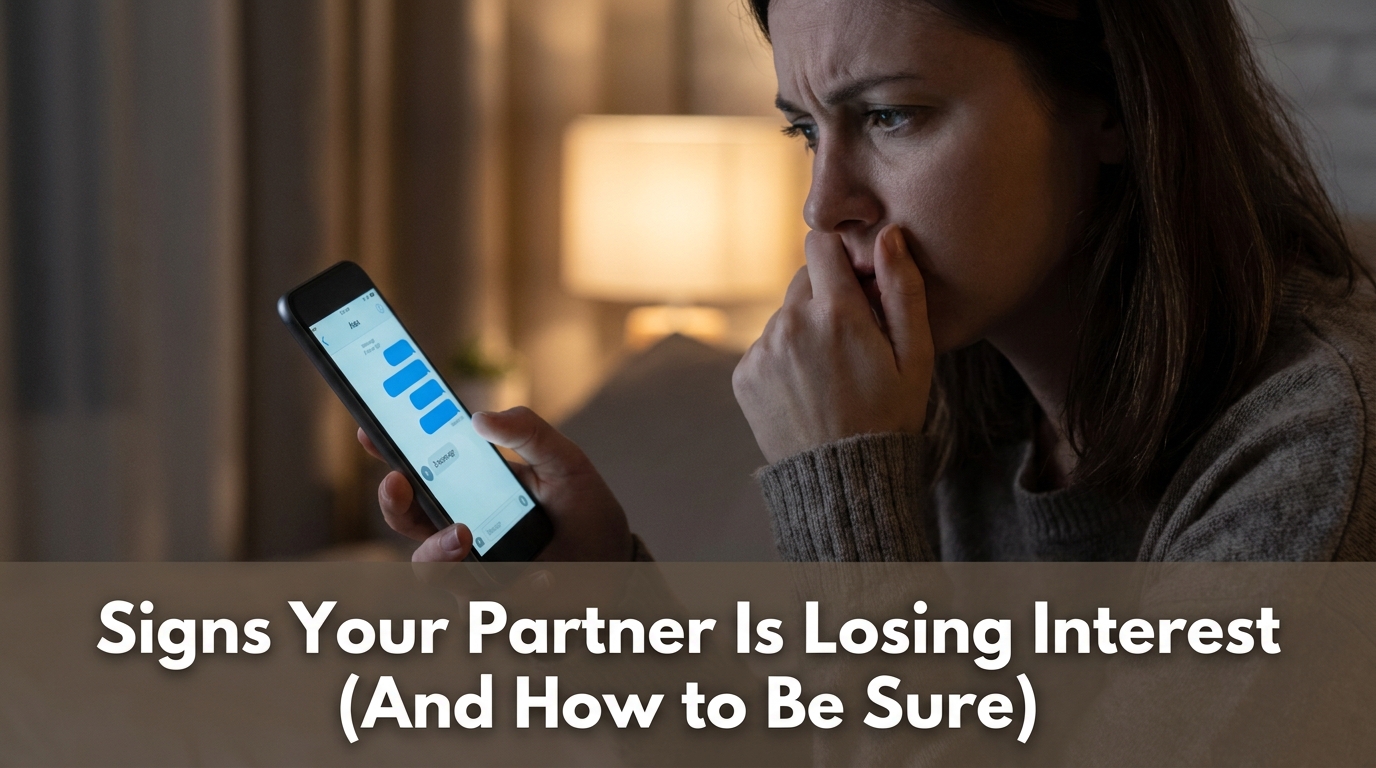
Something feels different. You can’t point to one specific thing — no fight, no obvious shift, no moment you can identify as the turning point. But the texts come a little slower now. The plans feel a little less certain. The warmth that used to be automatic feels like something you’re reaching for rather than receiving. And you’re trying to figure out if you’re imagining it — or finally paying attention to something that’s been changing for a while.
That quiet uncertainty is one of the most painful places to be in a relationship. According to research published in the Journal of Social and Personal Relationships, perceived withdrawal by a romantic partner activates the same neural threat-response as physical danger — producing anxiety, hypervigilance, and a desperate scanning for reassurance that can itself damage the relationship further. Understanding the genuine signs your partner is losing interest — and distinguishing them from temporary distance caused by stress, life pressure, or natural relationship ebbs — is the difference between responding wisely and reacting from fear. This article gives you both the clarity and the tools to do exactly that.

The Important Distinction First: Distance vs. Disengagement
Before the signs themselves, this distinction is essential — because conflating the two is the source of enormous unnecessary suffering.
Distance is temporary. It is caused by external stressors — work pressure, family difficulty, health challenges, periods of personal struggle — that reduce a person’s emotional availability without reflecting any change in their feelings for their partner. Distance looks like reduced initiation, shorter conversations, less energy for connection. And it resolves when the stressor does — particularly when both people communicate about it honestly.
Disengagement is different. It reflects a genuine shift in emotional investment — a pulling back from the relationship itself rather than from the demands of the moment. Disengagement tends to be more consistent, less explained by external circumstances, and more resistant to resolution through simple communication.
The signs in this article point toward disengagement — the patterns that, sustained over time and not explained by identifiable external circumstances, signal a genuine change in how your partner is experiencing the relationship. No single sign is definitive. The pattern across multiple signs, sustained over weeks or months, is what deserves serious attention.
The Signs Your Partner Is Losing Interest
1. The Quality of Their Attention Has Changed
It used to feel like you had all of them when you were together. Now you have their physical presence — but their attention is somewhere else. They’re on their phone more. They’re distracted mid-conversation. They listen without absorbing. The eyes are present but the mind has drifted elsewhere — not occasionally, as happens to everyone, but as a consistent new baseline.
Attention is the most fundamental currency of romantic investment. When its quality shifts — when being with you no longer commands their full presence the way it once did — it is one of the earliest and most reliable signals that something has changed in how they are experiencing the relationship.
2. Physical Affection Has Quietly Decreased
This is not only about sex — it is about all physical connection. The casual touch in passing. The hand held without thinking. The kiss that used to be automatic. When physical affection fades gradually and without explanation — when your partner stops initiating touch and responds to yours with less warmth than before — it is the body communicating what words haven’t yet said. Physical intimacy in a relationship tracks emotional intimacy closely. When one withdraws, the other almost always follows.
3. They Have Stopped Sharing the Small Things
You used to be the first person they told — about the funny thing that happened at work, the frustrating interaction with a colleague, the random thought that crossed their mind. Now they tell you less. Not because nothing is happening — but because the instinct to share it with you specifically has quietly diminished. When you are no longer someone’s primary emotional narrator — when their interior life is no longer naturally directed toward you — it signals a meaningful shift in how central you are to their inner world.

4. Future Plans Are Becoming Vague or Avoided
There was a time when the future was something you both talked about naturally — trips, plans, shared goals, casual references to a life that assumed your continued togetherness. Now those conversations have gone quiet. Plans are postponed or kept deliberately short-term. Any reference to the future beyond the immediate present is deflected or met with vagueness.
Future-planning requires commitment — even at the level of next month’s vacation. When a partner stops investing in shared futures, it often reflects an unconscious unwillingness to make promises they’re not sure they can keep. The disappearance of the future from your conversations is one of the most telling signs that something has shifted in how they see the relationship’s direction.
5. Conflict Has Either Escalated or Disappeared
Two patterns — seemingly opposite — can both signal losing interest, depending on the relationship.
The first is escalation: conflicts that feel disproportionate, frequent, or fueled by something that doesn’t fully match the surface issue. When a partner has emotionally withdrawn but hasn’t acknowledged or addressed it, that unprocessed distance often surfaces as irritability, criticism, and conflicts that are really about the relationship’s direction rather than whatever triggered them.
The second — and often more concerning — is the disappearance of conflict entirely. As explored earlier in this article series, the absence of conflict in a relationship with a history of engagement is not necessarily peace. It is often resignation. A partner who has stopped fighting for the relationship has often stopped believing the fight is worth having.
6. Your Emotional Needs Feel Like an Inconvenience
You express something that matters to you — a worry, a need, something that hurt — and instead of being received with care, it is met with impatience, dismissal, or a minimal response that communicates you’ve asked for too much. This shift — from a partner who engaged with your emotional world as something important, to one who treats it as something to be managed or avoided — is significant. It reflects not just reduced energy but reduced investment in your inner life specifically.
7. The Effort Has Become One-Sided
Planning falls to you. Initiating conversation falls to you. Creating connection, maintaining warmth, keeping the relationship alive — all of it has quietly shifted to one set of hands. This imbalance of effort is worth distinguishing from a partner who is temporarily depleted — because temporary depletion is followed by recovery and reciprocation. Sustained one-sidedness, with no acknowledgment and no effort to rebalance, is a pattern that speaks for itself.

8. Their Enthusiasm for Your Life Has Faded
They used to ask about your day with genuine interest. They remembered what you had coming up and asked about it afterward. They engaged with your worries, celebrated your wins, and showed curiosity about your world. Now the questions are fewer, the follow-ups are absent, and your life — beyond the logistics of sharing space — seems to occupy less of their attention than it used to.
A partner who is genuinely invested in a relationship is genuinely invested in your life. When that investment fades — when the curiosity, the follow-through, and the attentiveness that used to characterize how they related to your inner world quietly disappear — it is a meaningful signal worth taking seriously.
9. They Are Happier Elsewhere
They come home from time with friends more alive than they’ve seemed around you in months. They light up talking about work or a project or something entirely separate from the relationship in a way that they no longer seem to light up with you. This is not something to punish — finding joy outside the relationship is healthy. But a significant, sustained gap between how your partner shows up in other areas of their life versus how they show up with you is worth noticing. It suggests the relationship itself — not life circumstances — may be what’s depleting them.
10. Compliments and Appreciation Have Gone Quiet
The small expressions of appreciation — noticing what you’re wearing, acknowledging something you did, expressing gratitude for the ordinary ways you show up — have become rare or absent. This matters more than it might seem. Research from Dr. John Gottman found that the ratio of positive to negative interactions — including expressions of appreciation and affection — is one of the strongest predictors of relationship health. When the positivity stops flowing naturally, it often reflects a shift in how a partner is experiencing the relationship’s overall emotional landscape.
11. Conversations Have Become Transactional
You still talk. But about what? The schedule. Logistics. What needs to be done. Who’s going where and when. The conversations that used to include vulnerability, humor, curiosity, and genuine exchange have narrowed to the administrative maintenance of a shared life. Transactional communication is not always a sign of lost interest — but when it replaces rather than supplements meaningful connection, it reflects a relationship that has stopped being nourished at the level that sustains it.

12. Your Instincts Are Telling You Something
This is not a psychological study or a behavioral indicator — it is something more primal and equally important. You feel it. Not the anxious projection of an insecure mind, but the quiet, persistent knowing of someone who has been paying attention. Your nervous system is exquisitely calibrated to detect micro-changes in the behavior of people close to you — shifts in warmth, attention, and engagement that may not be articulable but are registered nonetheless.
If you have read this far and the recognition has been building with each sign — if something in you has been nodding not with anxiety but with honest acknowledgment — that feeling is data. Not a verdict, but data. And it deserves to be taken seriously rather than rationalized away.
How to Be Sure: Distinguishing a Rough Patch From a Real Shift
Before drawing conclusions or taking action, here is a framework for honest assessment:
Check the timeline. How long has this been happening? Two weeks of distance during a stressful work period is very different from three months of sustained withdrawal with no clear external cause. Duration matters.
Look for external explanations. Is your partner going through something significant — professionally, personally, within their family — that could reasonably account for reduced emotional availability? If yes, the compassionate response is support and communication, not alarm.
Assess the pattern across multiple signs. One sign in isolation can be explained away. Three or four signs sustained consistently over months form a pattern that deserves honest conversation.
Notice how they respond to connection attempts. When you reach toward them — emotionally, physically, through humor or tenderness or a direct conversation — what happens? Do they meet you partway? Or does the distance hold regardless of your approach? This response is one of the most revealing indicators available.
Have one honest, low-pressure conversation. Not an ultimatum, not an accusation — a genuine, calm expression of what you’ve been noticing and feeling. Their response — and their behavior in the weeks that follow — will tell you far more than any analysis can.

What to Do When You See These Signs
Start with honest self-reflection. Before the conversation with your partner, have the conversation with yourself. Are you seeing patterns clearly, or are you interpreting neutral behavior through the lens of anxiety? Both are possible. Honest self-assessment makes for a more grounded, productive conversation.
Choose the right moment. Not mid-argument, not at the end of a long day, not via text. A calm, private moment when both people are relatively rested and not under immediate pressure gives the conversation the best possible conditions.
Speak from experience, not accusation. “I’ve been feeling disconnected from you lately and I’d like to talk about it” opens a door. “You’ve been distant and I know you’re losing interest” closes one. The goal is understanding, not confrontation.
Listen to their response fully. Their answer — and what it reveals about their awareness, their honesty, and their investment in addressing what you’ve raised — is as important as anything you say. Pay attention to both the words and the behavior that follows.
Know what you need from the conversation. Not necessarily a resolution — but clarity. Are they aware of what you’ve noticed? Are they willing to engage honestly? Are they open to working on what’s been shifting? Their willingness to have the conversation is itself significant information.
Decide what comes next based on what you learn. If the conversation produces genuine acknowledgment, mutual investment in reconnection, and sustained behavioral change — that is a relationship worth fighting for. If it produces defensiveness, dismissal, or temporary improvement followed by return to the same patterns — that is equally important information about where things actually stand.
The Bottom Line
Signs your partner is losing interest are rarely dramatic. They arrive quietly — in the conversations that have shortened, the plans that have grown vague, the physical warmth that has become less automatic, the small enthusiasms that have gone quiet. By the time most people name what they’ve been sensing, they’ve known for a while.
This is not cause for despair. It is cause for honesty — with yourself about what you’re seeing, and with your partner about what you need. Some relationships, addressed early and honestly, recover completely. Others reveal, through that honest conversation, that something has already shifted beyond recovery.
Either outcome is better than the alternative: months or years of silent analysis, anxious monitoring, and reaching toward someone who is slowly becoming less present — without either person finding the courage to say what both of them already know.
The most loving thing you can do for a relationship — and for yourself — is to see it clearly. Not through the lens of what you hope is true, and not through the lens of your worst fear. Just clearly. Whatever that clarity reveals, you are better equipped to act on truth than to survive indefinitely on uncertainty.
📌 Save, Share & Follow
💾 SAVE this article — return to it when the quiet feeling that something has shifted won’t go away. 📤 SHARE this with someone who has been trying to figure out if what they’re sensing is real. 👉 FOLLOW TruthsInside.com for more honest, psychology-backed relationship content that gives you real clarity when you need it most.
❓ Frequently Asked Questions
Q1: How do I know if my partner is losing interest or just going through something? The key distinction is whether the withdrawal is explained by identifiable external circumstances — work stress, family difficulty, personal struggle — and whether it is accompanied by some acknowledgment of the distance and willingness to reconnect. A partner going through something difficult will usually, at some level, communicate that. A partner who is disengaging often goes quiet without explanation, and the distance persists regardless of external circumstances improving.
Q2: Should I bring it up or wait and see? If you have been waiting and seeing for more than a month or two without change, bringing it up is almost always the right move. Waiting indefinitely rarely produces spontaneous recovery — and the longer the conversation is avoided, the more distance accumulates and the harder it becomes to bridge. One honest, low-pressure conversation is almost always better than weeks of silent suffering and anxious monitoring.
Q3: Can a partner lose interest and then regain it? Yes — particularly when the loss of interest is driven by relationship neglect, unresolved conflict, or a temporary disconnection rather than fundamental incompatibility. Relationships that are honestly assessed and actively reinvested in can and do recover. What tends not to recover is interest lost because of genuine incompatibility, significant value misalignment, or a partner who has simply made a quiet internal decision without finding the courage to say it out loud.
Q4: What if I bring it up and they say everything is fine? Watch the behavior after the conversation more than the words during it. “Everything is fine” followed by sustained behavioral change — more presence, more effort, more warmth — is a meaningful response. “Everything is fine” followed by no change is itself an answer. A partner who is genuinely invested in the relationship will be moved by your vulnerability to respond with more than reassurance.
Q5: Is it possible that I’m the one losing interest and projecting it onto my partner? Genuinely possible — and worth asking honestly. Sometimes the anxiety about a partner’s withdrawal is driven by our own ambivalence, our own fear of the relationship’s direction, or patterns from past relationships that we’re unconsciously replaying. If honest self-reflection raises the possibility that the distance may be partly coming from you — that is equally important information, and equally worth a direct, honest conversation.
🎵 Music
Maren Lull is a singer-songwriter who writes from the places most people don’t talk about out loud.
Not the dramatic grief. Not the obvious heartbreak. The quiet kind — the ordinary Tuesday emptiness, the habit of reaching for someone who isn’t there anymore, the particular exhaustion of being strong for so long that the strength itself wears thin.
Her music lives at the intersection of emotional honesty and soft beauty — breathy vocals over gentle piano, slow tempos, lyrics that feel less like songs and more like something you wrote in a private notebook at two in the morning and never showed anyone.
Maren Lull writes for the people who feel everything deeply and say very little about it. For the ones who listen to sad music not because they want to feel worse — but because being understood, even by a song, makes the feeling easier to carry.
📱 Follow Maren Lull:
→ Spotify
→ Apple Music
→ Youtube
→ Audiomack