
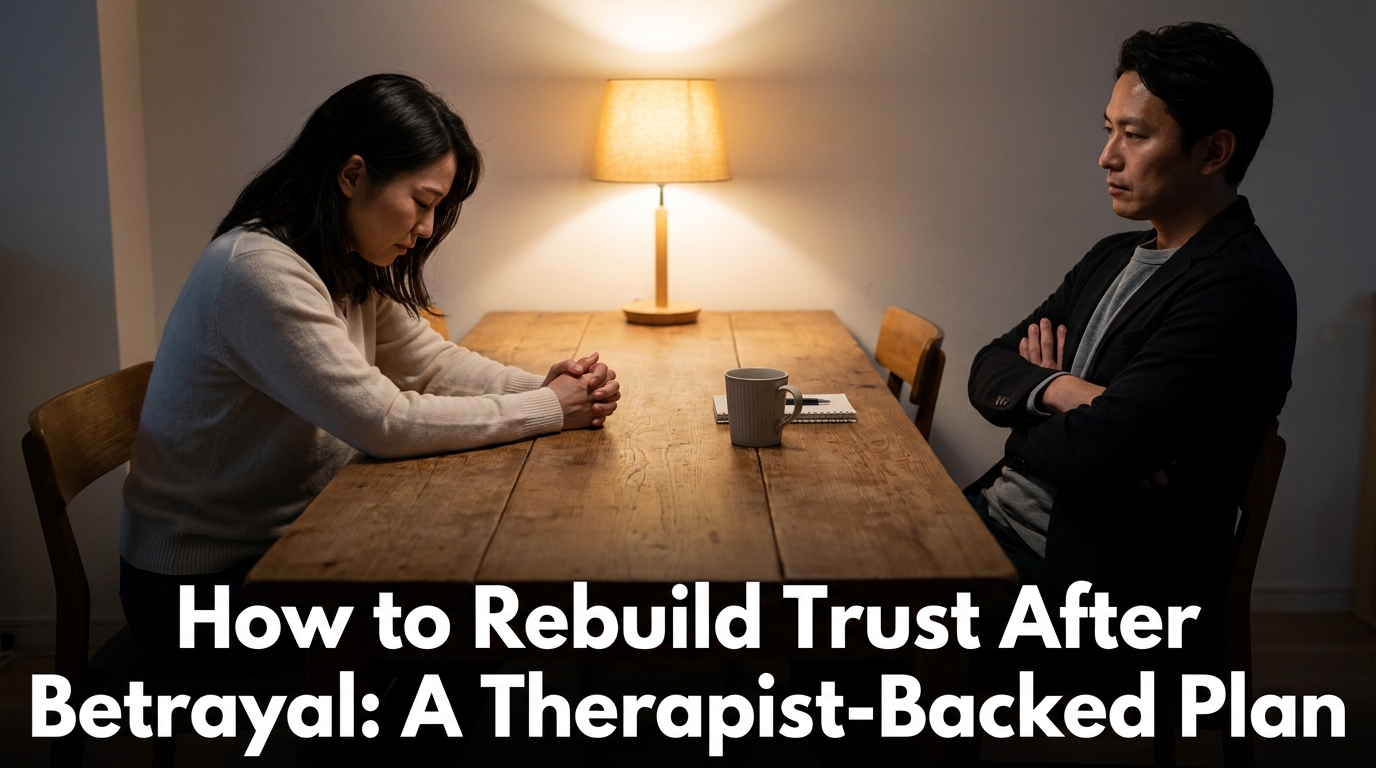
Trust, once broken, does not simply mend with time.
That is the uncomfortable truth that most people discover in the aftermath of betrayal — whether it was infidelity, a significant lie, a broken confidence, or any act that fundamentally altered their sense of safety in the relationship.
Time passes. The immediate devastation softens. And yet something remains — a guardedness, a hypervigilance, a flinch at ordinary moments that did not exist before. The relationship looks, from the outside, like it is recovering. The person inside it knows that something has changed that has not yet fully returned.
Research from the American Association for Marriage and Family Therapy found that 53 percent of couples who experience infidelity choose to stay together — and of those, the ones who rebuild successfully share specific, identifiable practices that those who do not rebuild successfully lack.
Trust can be rebuilt. Not restored to what it was — because what it was included a naivety that is now gone — but rebuilt into something that is, in some ways, more honest, more deliberate, and more durably grounded than the trust that preceded it.
This is the therapist-backed plan for doing so.

What Betrayal Actually Does — The Psychology Behind the Wound
Before mapping the path to rebuilding, it is important to understand what betrayal actually does — because the wound it creates is more complex and more specific than ordinary hurt.
Betrayal trauma — a term developed by psychologist Jennifer Freyd — describes the specific psychological injury that occurs when trust is violated by someone on whom we depend. It is distinct from other forms of trauma in one critical way: it is caused by the person who was supposed to be the source of safety.
This creates a particular kind of confusion that other trauma does not. The person who hurt you is also the person whose comfort you instinctively seek. The relationship that is the source of the pain is also the relationship that has been the source of your security. The very architecture of the bond has become both the wound and the only available salve.
Betrayal trauma produces a specific cluster of responses.
Hypervigilance. The nervous system, having learned that the threat was invisible until it was real, upgrades its monitoring. Ordinary moments become charged with potential evidence. A delayed text, a changed password, an unexplained mood — things that would previously have registered as unremarkable now activate the threat response.
Intrusive thoughts. The mind replays, reconstructs, and interrogates the betrayal repeatedly — not from masochism but from the survival imperative to understand what happened, to prevent it from happening again, to make sense of a reality that has been fundamentally disrupted.
Identity disruption. Significant betrayal does not just alter your view of your partner. It alters your view of yourself — your judgment, your perceptions, your sense of the world as fundamentally understandable. If this could happen without your knowing, what else might you be wrong about?
Grief. Not just for the relationship as it was, but for the version of yourself that existed before you knew. The person who trusted without this specific knowledge. That person is gone, regardless of what happens to the relationship.
Understanding these responses — and having a partner who understands them — is the foundation of genuine rebuilding.
“Rebuilding trust after betrayal is not about returning to what was. It is about building something new — with the full knowledge of what happened, and the deliberate choice to try anyway.” — Couples Therapy Research
Before Rebuilding: The Questions That Must Be Answered First
Rebuilding trust requires significant investment from both partners. Before that investment is made, certain foundational questions deserve honest answers.
Is the Betraying Partner Genuinely Remorseful — Or Just Regretful?
This distinction matters enormously. Regret is about consequences — “I regret this because of what it has cost.” Remorse is about impact — “I am genuinely sorry for the harm I caused you.” Only remorse provides a foundation for genuine rebuilding.
Genuine remorse looks like: taking full responsibility without minimization or deflection. Genuine curiosity about the impact of the betrayal on the hurt partner. Willingness to sit with the hurt partner’s pain without becoming defensive or shifting focus to their own. No timeline or expectation placed on the hurt partner’s recovery.
The absence of genuine remorse — replaced instead by defensiveness, minimization, blame-shifting, or impatience with the hurt partner’s process — is a significant indicator that the conditions for rebuilding are not yet present.
Is the Betraying Behavior Genuinely Over?
This sounds obvious. It is not always honoured.
Rebuilding trust while the betraying behavior is ongoing — or while the betraying partner is in contact with the person involved in the betrayal — is not rebuilding. It is building on sand. Whatever structure is created will not hold.
Complete, verified cessation of the betraying behavior is the non-negotiable precondition for everything that follows.
Do Both Partners Genuinely Want to Rebuild — For the Right Reasons?
Staying because leaving is frightening is not the same as staying because the relationship has genuine value worth preserving. Rebuilding from obligation, from financial dependency, from fear of being alone, or from social pressure produces a different and significantly less successful outcome than rebuilding from genuine desire to try.
Both partners should be able to honestly answer yes to: do I want to rebuild this relationship for reasons that are genuinely about this relationship?

The Therapist-Backed Plan: 10 Steps to Rebuilding Trust After Betrayal
Step 1 — Full Disclosure: One Time, Completely
One of the most consistent findings in couples therapy research on betrayal recovery is that partial disclosure — the truth revealed in stages, with additional details emerging over time — is significantly more damaging than complete disclosure delivered at once.
Every new revelation retraumatizes the hurt partner. Every “there’s something else I should tell you” restarts the trust-rebuilding process from the beginning, because it confirms the fear that was activated by the original betrayal: that there is more that has not been told, that the complete truth has not yet been offered.
Full, complete, one-time disclosure — however painful in the moment — gives both partners the clearest possible foundation from which to make their decision. The hurt partner can decide whether to rebuild with full information. The betraying partner is not carrying the weight of things still hidden.
This step is best done with the support of a couples therapist who can help both partners manage the disclosure conversation in a way that is as contained and supported as possible.
Step 2 — The Betraying Partner Takes Full Responsibility — Without Conditions
This step sounds straightforward. In practice, it is one of the most difficult for the betraying partner to sustain.
Full responsibility means exactly that — full. Not “I made a mistake but the relationship had problems.” Not “I understand why I did it given what I was going through.” Not “if you had been more available, this might not have happened.”
Every qualification, every contextual explanation offered in the same breath as the apology, communicates to the hurt partner: I am taking partial responsibility. The rest belongs to you. And that communication is incompatible with genuine trust rebuilding.
The betraying partner’s explanations — the context, the contributing factors, their own unmet needs — are legitimate and will eventually have a place in the healing conversation. That place is not alongside the apology. It is in later conversations, invited by the hurt partner when they are ready, after the full apology has been offered and received.
Step 3 — The Hurt Partner Is Allowed to Grieve — Fully, Without Timeline
The hurt partner’s grief does not follow a schedule. It does not move in a straight line. It includes anger, sadness, disbelief, moments of apparent resolution followed by renewed devastation, and triggers that produce intense emotional responses at moments that seem, from the outside, disconnected from the original event.
The betraying partner’s role in this step is not to manage the grief, speed it up, or protect themselves from its expression. It is to be present with it — to receive the anger without becoming defensive, to hold the sadness without redirecting it, to stay in the discomfort of the hurt partner’s process without making that process about their own discomfort.
This is extraordinarily difficult. The betraying partner is also in pain — carrying remorse, shame, the fear of losing the relationship. But the timing of healing requires that the hurt partner’s process takes precedence in this stage. Their grief is the direct consequence of the betraying partner’s actions. It deserves to be held, not managed.
A therapist can help the betraying partner develop the capacity to do this — to receive the hurt partner’s grief as the legitimate consequence of their actions rather than as an ongoing attack.

Step 4 — Transparency Is Offered Freely — Not Demanded
In the aftermath of betrayal, the hurt partner’s need for information and transparency is legitimate and understandable. They need to know where their partner is, who they are with, what they are doing — not because they want to surveil, but because their threat-detection system has been activated by the discovery that invisible threat was real.
The most effective rebuilding occurs when this transparency is offered freely by the betraying partner rather than extracted through demand and resistance.
Proactively sharing whereabouts. Making devices available. Answering questions honestly and without defensiveness. Ending contact with the person involved in the betrayal — and communicating that ending clearly and verifiably.
Transparency offered willingly communicates: I understand why you need this. I am not going to make you fight for information that you deserve to have. Your need to feel safe is more important, right now, than my preference for privacy.
Transparency demanded and reluctantly given communicates: I will give you what you need only when forced. Which is itself a form of continued betrayal.
Step 5 — Both Partners Seek Individual Therapy
Rebuilding after betrayal is work that benefits from support at three levels: individual therapy for both partners and couples therapy for the relationship.
Individual therapy for the hurt partner provides a space to process the grief, the identity disruption, and the complex emotional experience of betrayal without requiring the betraying partner to hold all of it. It builds the internal resources necessary to make the rebuilding possible.
Individual therapy for the betraying partner examines what led to the betrayal — not as justification, but as genuine self-understanding. What need was being met that the relationship was not meeting? What in their own history made the betrayal feel available as an option? What needs to change internally to ensure it does not happen again? Without this work, the risk of repetition is significantly higher.
Step 6 — Couples Therapy With a Betrayal-Informed Therapist
Couples therapy after betrayal is not the same as ordinary couples therapy. The betrayal creates a specific set of dynamics — power imbalance, trauma responses, hypervigilance, communication breakdown — that require a therapist specifically trained in this territory.
Emotionally Focused Therapy has the most robust research base for betrayal recovery — helping both partners understand the attachment needs and wounds that created the conditions for the betrayal and that are now active in the recovery.
The Gottman Institute’s Trust Revival Method — developed specifically for couples recovering from infidelity — provides a structured, researched framework for the three stages of rebuilding: atonement, attunement, and attachment.
A skilled couples therapist provides what neither partner can provide for themselves in this situation: a neutral, safe, boundaried space in which both people can speak and be heard, and a structured process through which the rebuilding moves in productive rather than circular directions.

Step 7 — The Hurt Partner’s Triggers Are Taken Seriously
Triggers after betrayal are not irrational. They are the nervous system’s learned response to stimuli that have been associated with threat — and they often appear in contexts that seem, from the outside, disconnected from the original betrayal.
A song. A location. A date. A phrase. A type of communication. Anything that was present in the landscape of the betrayal can become a trigger for the full emotional response — the hypervigilance, the grief, the anger — even long after the general trajectory of healing has moved forward.
The betraying partner’s response to these triggers is one of the most critical determinants of whether rebuilding is genuine or performative. Genuine rebuilding requires: acknowledging the trigger without minimizing it. Being present with the response without becoming defensive. Not placing a timeline on when the triggers should stop. Not communicating, through sighing, impatience, or withdrawal, that the hurt partner’s ongoing responses are a burden.
This is sustained, patient work. It does not have a clear end date. And the consistency with which the betraying partner meets the triggers — session after session, month after month — is the lived evidence of genuine commitment that words alone cannot provide.
Step 8 — Rebuild the Foundation of the Relationship — Not Just the Trust
One of the most important insights from betrayal research is that rebuilding trust in isolation — attempting to restore the specific trust that was broken while leaving everything else unchanged — is rarely sufficient.
Betrayal is almost never the cause of a relationship’s problems. It is a symptom — of disconnection, of unmet needs, of patterns that were present long before the specific act that broke the trust.
Genuine rebuilding addresses the foundation, not just the crack. What was the relationship missing that created the conditions for the betrayal? What communication failures persisted over years before the betrayal occurred? What needs were chronically unmet — on both sides — that no one found a direct way to name?
These questions are not asked to excuse the betrayal. They are asked because a relationship rebuilt on the same foundation that produced the original fracture is a relationship at ongoing risk.
Step 9 — Rebuild Intimacy Gradually and With Explicit Consent
Physical and emotional intimacy after betrayal cannot simply be resumed from where it was left. The hurt partner’s body and nervous system have been through a traumatic disruption. Their capacity for intimacy has been altered by the betrayal. Attempting to return to pre-betrayal intimacy on any kind of schedule — implicit or explicit — overrides the hurt partner’s genuine state and produces a form of pressure that is incompatible with genuine rebuilding.
Intimacy is rebuilt gradually, at the hurt partner’s pace, with explicit and ongoing consent. Not as a performance of recovery. Not as evidence that things are getting better. But as a genuine, incremental process in which each step is chosen freely rather than managed into.
The betraying partner’s role is to make the space available — to be warm, available, and patient — without making the hurt partner’s pace of return a source of pressure or injury.
Step 10 — Define What Rebuilt Trust Actually Looks Like — For Both People
This step is often skipped — and its absence is one of the most common reasons rebuilding efforts stall.
What does trust rebuilt look like, specifically, in this relationship? What behaviors would make the hurt partner feel genuinely safe? What would need to be consistently true for six months, for a year, for two years, for the hurt partner to feel that the foundation is genuinely solid?
And from the betraying partner’s side: what do they need in order to feel that the rebuilding is genuinely valued — that their sustained effort is being acknowledged, that the relationship is moving forward rather than permanently defined by this moment?
These conversations — specific, honest, conducted without agenda — give both partners a shared map of what they are working toward. Without a map, rebuilding wanders. With one, even imperfect progress in the right direction becomes visible and meaningful.
How Long Does Rebuilding Take — An Honest Answer
Research on couples who successfully rebuild after betrayal consistently points to a timeline of two to four years for genuine, durable trust restoration. Not two to four years of constant intensity — but two to four years of sustained, intentional effort, with professional support, during which the evidence of changed behavior accumulates to the point where trust becomes genuinely possible again.
This is longer than most people expect. It is also shorter than most people fear in the immediate aftermath of the betrayal, when the grief can make any recovery seem impossible.
The timeline is not fixed. It is shaped by the specific betrayal, the history of the relationship, the quality of both partners’ engagement with the rebuilding process, and the presence of consistent therapeutic support. What every honest source agrees on is that attempting to compress the timeline — to declare recovery complete before it genuinely is — produces relationships that appear rebuilt but carry the unprocessed weight of the original wound.
Trust rebuilt genuinely is worth the timeline it requires. It is not the trust that existed before — that trust was simpler and did not cost what this one costs. But it is, in many ways, more real.
When Rebuilding Is Not Possible — And Knowing the Difference
Not every relationship can or should be rebuilt after betrayal. And recognizing when rebuilding is not the right path is as important as knowing how to pursue it when it is.
Rebuilding is significantly less likely to succeed when the betraying partner shows no genuine remorse, when the betraying behavior continues or resumes, when there is a pattern of repeated betrayal rather than a single incident, when the hurt partner’s fundamental sense of safety cannot be restored regardless of the betraying partner’s efforts, or when either partner is staying for reasons that have nothing to do with genuine desire for the relationship.
Ending a relationship after betrayal is not failure. It is, in many cases, the most honest and the most courageous response available. The grief of ending is real. But it is grief that can be processed and moved through. A relationship rebuilt on a foundation that cannot hold produces a different and more prolonged kind of suffering.
The question is not whether rebuilding is theoretically possible. It is whether rebuilding is genuinely possible for these specific people, in this specific relationship, with the specific resources and willingness that are actually present.
That answer requires honesty — from both people, preferably with professional support to help distinguish between the answer they wish were true and the answer that actually is.
Rebuilding trust is not a gesture of forgiveness toward the person who hurt you. It is a decision — made with full knowledge, with open eyes, and with the complete understanding of what it will require — to build something real from the ruins of what was. That decision deserves to be made freely, honestly, and in full light.
CALL TO ACTION
💾 Save this — it may be the most important thing you read this year about your relationship. 📤 Share it with someone navigating the hardest decision of their relationship. 👣 Follow Truthsinside.com for honest, deeply researched relationship content every week.
Frequently Asked Questions
Q1: Can trust ever be fully rebuilt after infidelity? Yes — though “fully” requires a nuanced definition. Trust rebuilt after infidelity is not identical to the trust that existed before — that trust included an innocence that is now permanently altered. What can be built is something different but in many ways more durable: trust that has been tested, that is grounded in full knowledge rather than assumed safety, and that has been deliberately constructed through sustained, verified behavior change. Research consistently shows that couples who successfully rebuild after infidelity frequently report their relationship as stronger, more honest, and more genuinely intimate than it was before the betrayal. This is not universal. But it is documented, real, and worth knowing.
Q2: How do I know if my partner is genuinely remorseful or just sorry they got caught? Behavior over time is the most reliable indicator. Genuine remorse shows up in consistent behavior — taking full responsibility without deflection, prioritizing the hurt partner’s healing over their own discomfort, being transparent without being asked, and sustaining that posture not just in the immediate aftermath but across months and years.
“Sorry they got caught” typically shows up as defensiveness when confronted with questions, impatience with the hurt partner’s process, minimization of the impact, and behavior that reverts to self-protection as soon as the immediate crisis stabilizes. The pattern across time — not the intensity of the initial apology — is what reveals which one you are actually dealing with.
Q3: My partner says I should be over it by now. Is that reasonable? No — and this expectation, however understandable from the betraying partner’s perspective, is one of the most damaging things they can communicate during the rebuilding process. Research on betrayal trauma recovery consistently shows timelines of two to four years for significant healing in couples who rebuild successfully.
Placing a timeline on the hurt partner’s recovery — implying that their ongoing responses are excessive or unreasonable — communicates that their healing is less important than the betraying partner’s comfort. That communication is itself a form of ongoing harm. The hurt partner’s process takes the time it takes. The betraying partner’s role is to be present with it, not to manage it toward a more convenient schedule.
Q4: We have been trying to rebuild for a year and it still does not feel better. Should we stop? A year is within the normal range of the rebuilding process, and feeling like progress is incomplete at the one-year mark does not mean rebuilding is failing. The more useful questions are: is there genuine movement, even if slow? Is the betraying partner’s behavior consistently aligned with what the hurt partner needs?
Are both partners engaged with individual and couples therapy? Is the hurt partner’s pain diminishing at all, even gradually? If the answers to all of these are yes, and the pain is not diminishing, that is worth bringing to your couples therapist as a direct conversation. If the answer to any of these is no — particularly the first — that is important information about whether the conditions for rebuilding are genuinely present.
Q5: Is it possible to rebuild trust after betrayal without couples therapy? Possible — but significantly less likely. The research on successful rebuilding after significant betrayal consistently shows that professional therapeutic support is one of the strongest predictors of positive outcomes. This is because the dynamics that betrayal creates — the power imbalance, the trauma responses, the communication breakdown — require more than goodwill and effort to navigate.
A skilled therapist provides the neutral space, the structured process, and the specific expertise that the rebuilding process requires. Without that support, couples who are genuinely trying often find themselves cycling through the same conversations without progress, or mistaking surface calm for genuine healing. The investment in professional support is, in most cases, the most efficient path to the outcome both partners are seeking.
🎵 Music
Maren Lull is a singer-songwriter who writes from the places most people don’t talk about out loud.
Not the dramatic grief. Not the obvious heartbreak. The quiet kind — the ordinary Tuesday emptiness, the habit of reaching for someone who isn’t there anymore, the particular exhaustion of being strong for so long that the strength itself wears thin.
Her music lives at the intersection of emotional honesty and soft beauty — breathy vocals over gentle piano, slow tempos, lyrics that feel less like songs and more like something you wrote in a private notebook at two in the morning and never showed anyone.
Maren Lull writes for the people who feel everything deeply and say very little about it. For the ones who listen to sad music not because they want to feel worse — but because being understood, even by a song, makes the feeling easier to carry.
📱 Follow Maren Lull:
→ Spotify
→ Apple Music
→ Youtube
→ Audiomack