
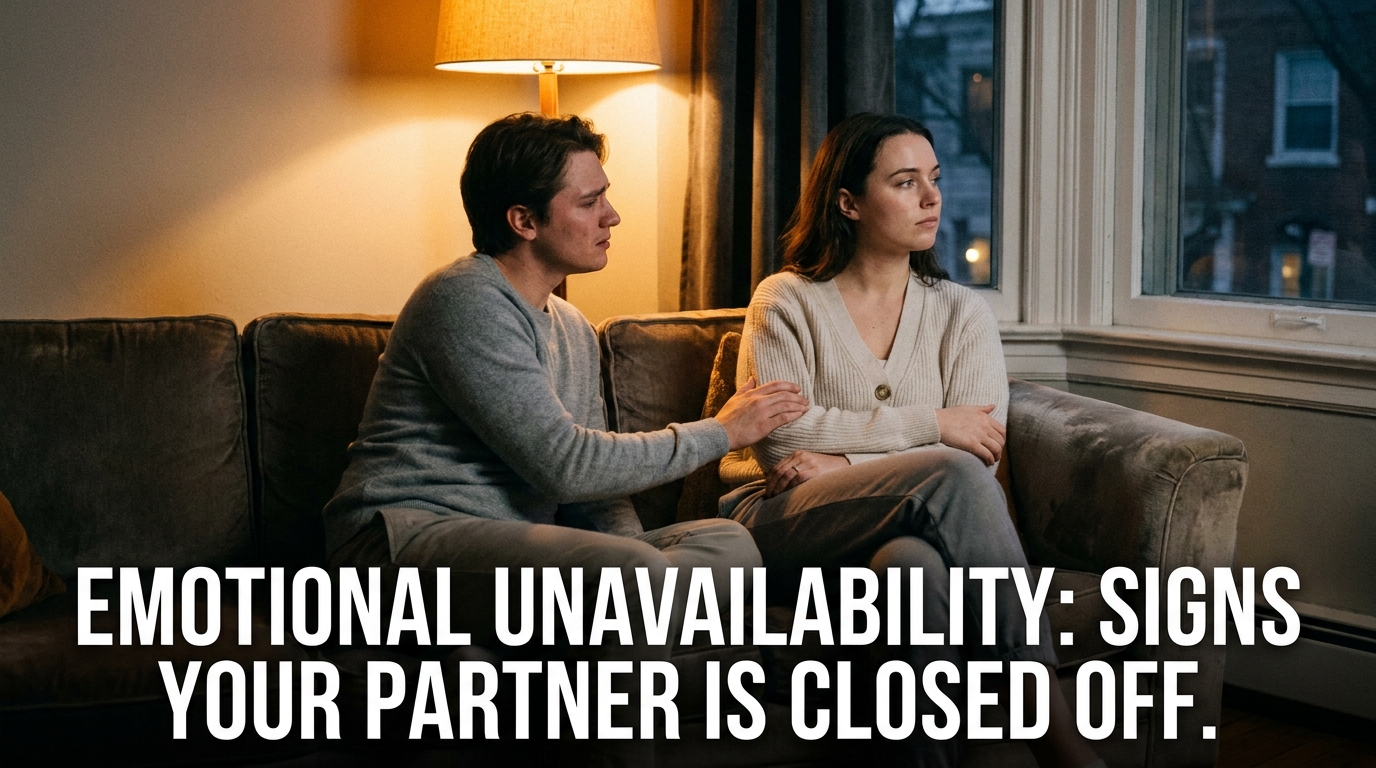
You can feel the wall before you can describe it. You’re close — physically, practically, in so many of the ways that look like intimacy from the outside. But there’s a part of them you’ve never quite reached. A room they never let you into. A depth of knowing that seems available in glimpses but never fully, never sustainably, never in a way that lets you rest in the certainty of being truly seen.
You keep trying. And they keep being almost there.
Emotional unavailability is one of the most quietly devastating dynamics in romantic relationships — not because it is dramatic or obvious, but because it is so easily confused with love. According to attachment researcher Dr. Sue Johnson, emotionally unavailable partners account for a significant proportion of the distressed couples she has worked with over decades of clinical practice — people who love each other and cannot reach each other, who are present in every visible way except the one that matters most. Understanding the signs of emotional unavailability in a partner — and what drives it — is the first step toward either bridging the gap or honestly assessing whether the gap can be bridged at all.

What Emotional Unavailability Actually Is
Emotional unavailability is not the same as introversion, reserved personality, or simply being less verbally expressive than a partner. It is a sustained pattern of difficulty with emotional intimacy — with vulnerability, with genuine mutual knowing, with the kind of deep emotional presence that healthy attachment requires.
An emotionally unavailable person is typically capable of connection — they may be warm, engaging, funny, and genuinely caring in many respects. What they struggle with is the specific depth of emotional exposure that real intimacy requires: being fully known, allowing genuine vulnerability, sustaining emotional presence when conversations become difficult or when feelings become the subject rather than ideas, events, or practical matters.
Emotional unavailability exists on a spectrum. At its milder end, it produces a relationship that feels slightly surface-level — pleasant but not deeply intimate, connected but not fully known. At its more significant end, it creates a dynamic where one partner is perpetually reaching for a depth of connection that the other is structurally unable or unwilling to provide — a dynamic that, sustained over time, produces loneliness, self-doubt, and a gradual erosion of the reaching partner’s own sense of worth.
What Causes Emotional Unavailability
Understanding the roots of emotional unavailability doesn’t excuse it — but it changes how you relate to it, and how honestly you can assess whether change is possible.
Avoidant attachment. The most common driver. Avoidant attachment develops in early childhood when caregivers were consistently emotionally unavailable, dismissive of emotional needs, or unpredictable in their responsiveness. The child learns that emotional needs are not reliably met — and develops a self-protective strategy of emotional suppression and self-sufficiency. In adult relationships, avoidant attachment produces exactly the pattern described above: closeness tolerated up to a point, then distance created when intimacy deepens beyond that threshold.
Past relational trauma. Betrayal, abandonment, or significant emotional harm in past relationships can produce acquired emotional unavailability — the deliberate or unconscious construction of walls that weren’t originally there, built to prevent a specific kind of pain from recurring. This form is often more conscious and more accessible to change, because the person can often identify what they are protecting against.
Depression or anxiety. Mental health conditions that deplete emotional bandwidth can produce what looks like emotional unavailability — withdrawal, flatness, difficulty with vulnerability — without reflecting a person’s baseline relational capacity. This form is worth distinguishing carefully, because it may resolve significantly with appropriate treatment.
Cultural and gender conditioning. Men, in particular, are often socialized in ways that punish emotional expression and reward emotional containment — producing a form of emotional unavailability that is learned rather than inherent, and that can be genuinely unlearned with awareness and support.

The Signs of Emotional Unavailability in Your Partner
1. Conversations Stay on the Surface
You can talk for hours. About ideas, events, opinions, plans, humor. But when the conversation moves toward feelings — toward what either of you is actually experiencing emotionally, toward the deeper questions of who you are and what you carry — something shifts. They deflect with humor. They pivot to something practical. They give brief, surface answers that close the door on the topic rather than opening it further.
This consistent surface-staying is not always conscious. For many emotionally unavailable people, the avoidance of emotional depth is so habituated that they genuinely don’t notice they’re doing it — only that they feel vaguely uncomfortable when conversations move in that direction and vaguely relieved when they don’t.
2. They Are Uncomfortable With Your Emotions
When you are distressed, grieving, anxious, or overwhelmed — their response is off. Not necessarily unkind, but somehow beside the point. They try to fix the problem. They minimize the feeling. They become slightly distant or awkward. They offer practical solutions to emotional experiences. They are most comfortable with you when you are fine — and visibly less comfortable when you are not.
This discomfort with emotional expression in others is a hallmark of emotional unavailability. Because they have difficulty processing their own emotional experiences, the emotional experiences of others produce an anxiety or discomfort that expresses itself as distance, deflection, or a compulsive movement toward resolution rather than the simple, sustained presence that emotional support actually requires.
3. Vulnerability Is Met With Withdrawal
You share something real — something that cost you something to say. A fear. An insecurity. Something you needed them to receive. And instead of the warmth, the closeness, the reciprocal opening that genuine vulnerability invites — there is a subtle pulling back. A change in the quality of their presence. Perhaps a pivot to something lighter. Perhaps a brief physical withdrawal. Perhaps just a quality of having received your vulnerability from behind glass rather than with full presence.
This response to vulnerability — the withdrawal rather than the approach — is one of the most consistent and most painful signs of emotional unavailability. It communicates, without words, that the depth you just offered was more than they could meet. And over time, it teaches you to stop offering it.
4. They Rarely Initiate Emotional Conversations
You are almost always the one who brings emotional topics to the relationship. The check-ins about how each other is feeling. The conversations about where things are going. The moments of intentional connection that require someone to open a door. They respond to these openings — sometimes well, sometimes guardedly — but they almost never initiate them. The emotional labor of maintaining the relationship’s depth falls consistently to you.
This asymmetry is worth examining honestly. In a healthy relationship, both partners bring themselves to the emotional dimension of the relationship — not necessarily equally, not necessarily in the same way, but with genuine mutual investment. When that investment is consistently one-directional, the relationship’s emotional life is being sustained by one person’s effort rather than two people’s presence.

5. The Relationship Has a Ceiling You Keep Hitting
Things are good — genuinely good, in many respects. But there is a point beyond which the relationship doesn’t seem to deepen. You reach a level of intimacy and then it plateaus. Attempts to go further — more vulnerability, more honesty, more genuine mutual knowing — are met with a subtle resistance that brings you back to the level that feels safe to them. The relationship has depth, but it has a ceiling. And you keep discovering that ceiling every time you reach for something more.
This ceiling is one of the most clarifying signs of emotional unavailability — because it distinguishes a relationship that is simply at an early stage of development from one that has reached its structural limit. In the former, depth grows over time. In the latter, it reaches a point and stays there, regardless of how long the relationship continues or how much effort one person invests in pushing through.
6. They Struggle to Say “I Love You” — Or It Feels Hollow
Not in the early stages, when love hasn’t yet been established — but in a relationship that has been significant and sustained. Either the words come rarely, with evident effort, or they come easily but without the weight that the words carry when said from a place of genuine emotional presence. The words are there but the person behind them feels somehow absent — as though the declaration is being made from behind a window rather than from within the room.
7. They Minimize Their Own Feelings
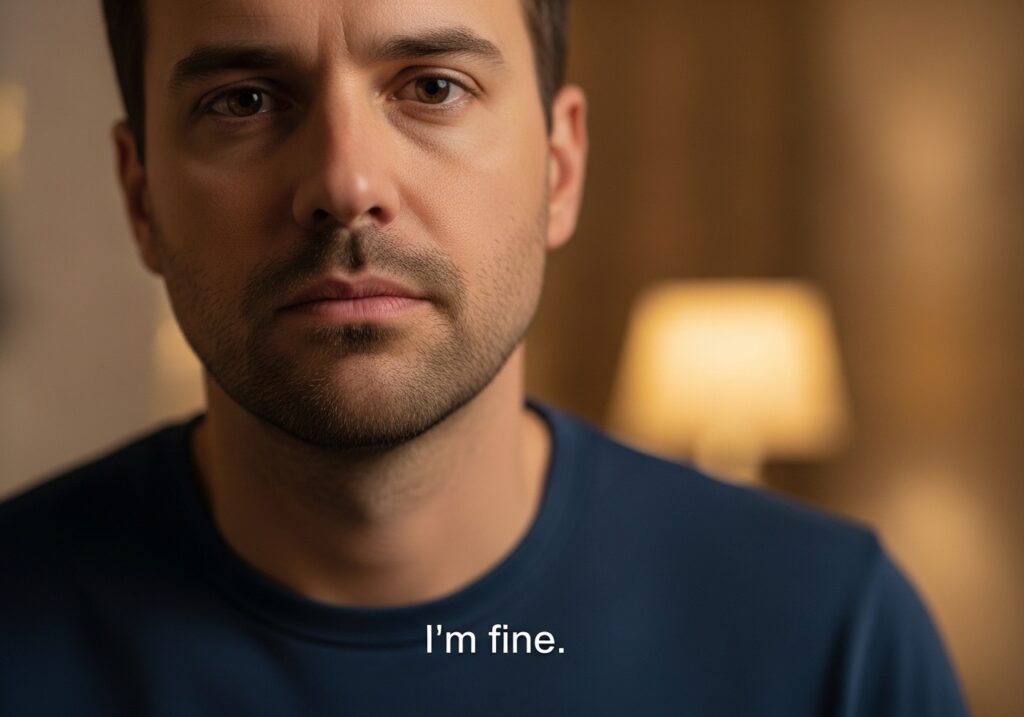
It’s not just your emotional experiences they distance themselves from — it’s their own. They are fine. Always fine. Or busy, or tired, or stressed — but never sad, never afraid, never overwhelmed in any way they’ll fully name or stay with. The vocabulary of their own emotional life is compressed into a narrow range of acceptable states, and anything outside that range is acknowledged briefly, if at all, before being managed back toward neutral.
This emotional compression — the inability or unwillingness to inhabit their own emotional experiences — is the interior experience of emotional unavailability. What shows up in the relationship as distance is, from the inside, a person who has lost — or never developed — the relationship with their own interior life that genuine emotional intimacy requires.
8. Conflict Is Avoided or Shut Down Immediately
Emotional unavailability and conflict avoidance are closely linked — because conflict requires emotional presence, emotional tolerance, and the willingness to stay in a difficult space until something is resolved. An emotionally unavailable partner will either avoid conflict entirely — deflecting, changing the subject, minimizing issues before they become conversations — or shut it down as quickly as possible once it begins, through withdrawal, through capitulation without genuine resolution, or through the emotional distancing that communicates “I cannot be here for this right now.”
The result is a relationship in which difficult things don’t get addressed — not because they don’t exist, but because the mechanism for addressing them is unavailable.
9. Physical Intimacy Is Easier Than Emotional Intimacy
Many emotionally unavailable people are comfortable with — and even skilled at — physical intimacy. Sex, physical affection, and closeness of the body are manageable in a way that emotional closeness is not. Physical intimacy does not require vulnerability in the same way. It does not require the specific exposure of being genuinely known.
When physical intimacy is consistently warmer, more available, and more reciprocal than emotional intimacy — when the body is present in ways the interior life is not — it can create a false sense of depth in a relationship that, examined more closely, has not achieved the genuine mutual knowing that characterizes true intimacy.
10. You Feel Lonely Inside the Relationship
This is the experiential signature of emotional unavailability — felt from the other side. You are not alone. You have a partner. And yet there is a loneliness in the relationship that is specific and persistent — the loneliness of someone who is not being fully met, who has parts of themselves that have nowhere to go, who reaches regularly toward a depth of connection that regularly fails to materialize.
If you feel more alone inside the relationship than you would outside it — if the specific quality of this loneliness is the loneliness of not being known rather than simply of being by yourself — that feeling is information. Not about your neediness or your expectations. About the structural reality of the connection you have been trying to build.
Can an Emotionally Unavailable Partner Change?
This is the question almost everyone in this situation is actually asking. And the honest answer is: yes — but with significant conditions.
Emotional unavailability is not a fixed trait. It is a pattern — rooted in attachment history, past experience, or learned behavior — that can genuinely change with the right combination of awareness, motivation, and support. Emotionally Focused Therapy, developed by Dr. Sue Johnson, has strong clinical evidence for helping avoidant partners develop greater emotional availability within the context of a supported relationship.
But change requires three things that cannot be provided by a partner: recognition of the pattern, genuine motivation to change it, and active engagement with the professional support that makes change possible. A partner who doesn’t acknowledge the emotional unavailability, who minimizes its impact, or who expects the relationship to simply adapt around it rather than addressing it is not a partner who is on a path toward change.
The most honest question to ask is not whether change is theoretically possible — it is whether your partner is demonstrating the specific conditions that make change actually likely. Recognition. Motivation. Action. Without all three, hope is not a strategy. It is waiting dressed as patience.

What to Do When Your Partner Is Emotionally Unavailable
Name it clearly — to yourself first. Before any conversation with your partner, name honestly what you are experiencing: not “they don’t communicate well” but “I am not being emotionally met in this relationship, and that is a genuine need, not an unreasonable expectation.”
Have the honest conversation once — from a grounded place. Not as an accusation but as an honest expression of your experience: “I’ve noticed that when I try to connect on an emotional level, there’s a distance that appears — and I’d like to understand it and talk about whether we can work on it together.” Their response — the quality of their honesty, their openness, their willingness to engage — is the most important data you will receive.
Be specific about what you need. “More emotional connection” is abstract. “I need to feel like I can tell you something difficult and have you stay present with me rather than trying to fix it or withdraw” is specific. Specificity gives your partner something to actually work toward rather than a vague standard they cannot measure themselves against.
Consider couples therapy. Emotional unavailability is one of the patterns most amenable to therapeutic intervention — and one of the hardest to address without it, because the conversations needed to change the pattern are exactly the kind of conversations the pattern makes difficult. A therapist provides the structure, safety, and specific tools that make those conversations possible.
Know your own limits. You are allowed to require emotional presence in a relationship. You are allowed to decide that a relationship without genuine mutual emotional intimacy is not the relationship you want. These are not unreasonable standards. They are the basic requirements of the kind of love that actually sustains both people — and knowing where your limits are is not selfishness. It is self-knowledge.
The Bottom Line
Emotional unavailability is not cruelty. It is not indifference. In most cases, it is a self-protective pattern built from experiences that taught someone that emotional openness was dangerous, costly, or simply unavailable. Understanding that does not make the loneliness of being with an emotionally unavailable partner any less real — but it does change how you understand what you’re facing, and what is actually required to change it.
You deserve a relationship in which you are genuinely known. Not almost known. Not known up to a certain point and then held at a careful distance. Fully, sustainably, reciprocally known — by someone whose presence meets yours in the place where real intimacy lives.
That is not too much to ask for. It is precisely what love is for.
The most painful thing about loving someone emotionally unavailable is not that they don’t care. It is that they do — and the wall between that caring and its full expression is so habituated that neither of you can see clearly where the person ends and the protection begins. That clarity, when it finally comes, is both the hardest and the most necessary thing in the world.
📌 Save, Share & Follow
💾 SAVE this article — return to it when the loneliness inside a relationship is harder to explain than loneliness alone. 📤 SHARE this with someone who has been trying to reach a partner through a wall they can feel but not quite name. 👉 FOLLOW TruthsInside.com for more honest, psychology-backed content on love, emotions, and the human experience of trying to truly connect.
❓ Frequently Asked Questions
Q1: Is emotional unavailability the same as introversion? No — and this distinction matters. Introversion is a personality trait related to how someone restores energy — through solitude rather than social interaction. It says nothing about emotional depth or availability. Many introverts are deeply emotionally available — they simply need more quiet time to restore. Emotional unavailability is about the capacity for and comfort with emotional intimacy specifically, regardless of social orientation. An introvert can be fully emotionally present. An extrovert can be emotionally unavailable. The two are unrelated.
Q2: Can I be emotionally unavailable myself without realizing it? Yes — and this is worth honest self-examination. Emotional unavailability often develops so gradually, and is so normalized within the person who carries it, that it is genuinely invisible from the inside. Signs that you may be emotionally unavailable include: consistent discomfort when conversations move toward feelings, a tendency to deflect or fix rather than simply be present with emotional experiences, difficulty with vulnerability even in close relationships, and a pattern of relationships that reach a certain depth and plateau there. If these resonate, individual therapy can be enormously clarifying and genuinely transformative.
Q3: How do I support a partner who is emotionally unavailable without losing myself? The key is maintaining your own emotional life and needs as visible and valid — not subordinating them indefinitely to the relationship’s limitations. You can be patient, compassionate, and genuinely supportive while also being clear and honest about what you need and what you are not getting. Support does not require self-erasure. And a partner who needs you to erase yourself in order to remain comfortable has not yet done the work that would allow genuine partnership.
Q4: What is the difference between someone being emotionally unavailable and someone just needing time to open up? Time and trajectory. Someone who needs time to open up shows gradual, consistent movement toward greater emotional availability as the relationship deepens and safety is established. Someone who is emotionally unavailable may show initial openness — particularly in the infatuation stage, when neurochemical intensity lowers defenses temporarily — followed by a plateau or withdrawal as the relationship asks for genuine sustained depth. The question is not where they are right now, but the direction and consistency of movement over time.
Q5: Is loving an emotionally unavailable person worth it? That depends entirely on two things: whether they are genuinely working toward greater emotional availability, and whether what the relationship currently offers is enough to sustain your own wellbeing and sense of self in the meantime. Love alone is not sufficient justification for indefinite emotional deprivation. What makes it potentially worth it is the combination of genuine love, genuine effort from both people, and a trajectory — however slow — toward the kind of mutual knowing that the relationship currently lacks.
🎵 Music
Maren Lull is a singer-songwriter who writes from the places most people don’t talk about out loud.
Not the dramatic grief. Not the obvious heartbreak. The quiet kind — the ordinary Tuesday emptiness, the habit of reaching for someone who isn’t there anymore, the particular exhaustion of being strong for so long that the strength itself wears thin.
Her music lives at the intersection of emotional honesty and soft beauty — breathy vocals over gentle piano, slow tempos, lyrics that feel less like songs and more like something you wrote in a private notebook at two in the morning and never showed anyone.
Maren Lull writes for the people who feel everything deeply and say very little about it. For the ones who listen to sad music not because they want to feel worse — but because being understood, even by a song, makes the feeling easier to carry.
📱 Follow Maren Lull:
→ Spotify
→ Apple Music
→ Youtube
→ Audiomack