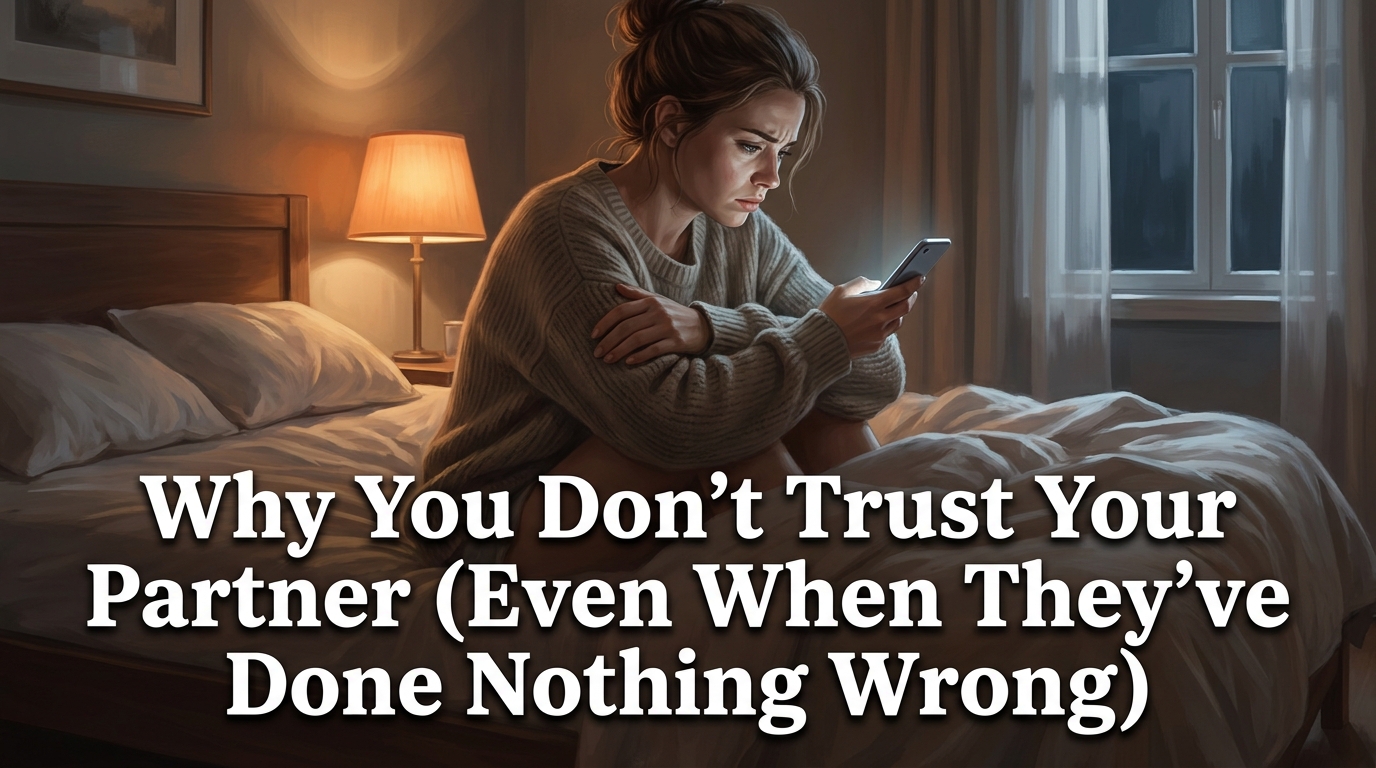
You check their phone when they leave the room. You replay their words, searching for hidden meaning. You ask where they’ve been — not because they gave you a reason to doubt, but because your mind won’t stop spinning. If you don’t trust your partner even though they’ve never betrayed you, you are not broken. You are carrying wounds that haven’t finished healing yet. Studies show that up to 40% of adults have an insecure attachment style, which quietly rewires how the brain processes love — turning safety into suspicion and closeness into a threat.
This is not a character flaw. It’s a survival pattern — and it can change.
What It Really Means When You Can’t Trust Someone Who’s Done Nothing Wrong
Most people assume trust issues come from being cheated on, lied to, or betrayed. And yes — those experiences absolutely leave a mark. But there’s another, quieter source of distrust that doesn’t get talked about nearly enough: the wounds from before the relationship even began.
Your nervous system learned its lessons long before your current partner ever showed up. If you grew up in an environment where love felt unpredictable — where a parent was sometimes warm and sometimes cold, where promises got broken, where you had to read the room just to feel safe — your brain built a model of how relationships work. And that model says: people leave. People lie. Closeness is dangerous. Letting your guard down gets you hurt.
The cruel irony is that the safer your partner actually is, the more that contrast can trigger anxiety. Your brain doesn’t know what to do with consistent, steady love. It waits for the catch. It looks for proof that what feels too good will eventually turn into something familiar — pain.
“The wound is not the problem. The wound is trying to protect you from a pain it already survived. Learning to trust again means teaching your nervous system that it doesn’t have to fight the same battle twice.”
The Psychology Behind Trust Issues: It’s Not About Them
Understanding why you don’t trust your partner starts with understanding attachment theory — one of the most well-researched frameworks in relationship psychology. Developed by psychologist John Bowlby and later expanded by Mary Ainsworth, attachment theory explains that the bond you formed with your earliest caregivers creates a template. A blueprint. A default setting for how you expect love to function.
There are four main attachment styles:
Secure attachment — You felt reliably loved and responded to. As an adult, intimacy feels natural. Trust comes relatively easily.
Anxious attachment — Love felt inconsistent. You never quite knew if the person would show up emotionally. As an adult, you crave closeness but live in fear of losing it. You may overthink texts, need constant reassurance, and feel irrationally jealous.
Avoidant attachment — Emotional connection felt suffocating or unsafe. You learned to handle things alone. As an adult, intimacy triggers discomfort, and you may unconsciously push people away just as things get serious.
Disorganized attachment — Love and fear became entangled — perhaps through trauma, neglect, or abuse. As an adult, you may desperately want closeness while simultaneously being terrified of it.
If you recognize yourself in anxious or disorganized attachment, that’s where your distrust likely lives. It was never really about your partner. It was about a pattern so deeply written into your nervous system that it plays out automatically — even when there’s no real threat.

7 Signs Your Trust Issues Are Coming From Inside, Not From Your Partner
It can be hard to see the difference between a legitimate red flag and your own fear projecting onto someone who doesn’t deserve it. Here are signs that your distrust is internal:
1. You look for “proof” even when nothing is wrong. You check their location, scroll their social media, or interrogate small details in their stories — not because something is suspicious, but because your mind needs to feel in control. The absence of evidence doesn’t calm you; you just look harder.
2. You assume the worst without evidence. They took longer than usual to reply. They must be avoiding you. They laughed at something on their phone. It must be someone else. The jump from neutral behavior to catastrophic conclusion happens so fast you don’t even notice it happening.
3. Reassurance works — but only for a few minutes. They tell you they love you. They show you their phone. They explain where they were. For a brief moment, you feel relief. But within hours — sometimes minutes — the anxiety creeps back. The reassurance never holds because the fear isn’t logical. It lives deeper than words can reach.
4. You feel jealous of people who pose no real threat. An old friend. A work colleague. Someone they’ve never even met in person. The jealousy doesn’t match the actual level of threat, and somewhere, part of you knows that. But you can’t stop feeling it.
5. You imagine scenarios that haven’t happened. Your mind writes entire stories. They’re bored of you. They’re falling for someone else. They’re going to leave eventually — so why not now? These aren’t memories. They’re fears dressed up as predictions.
6. You test them — sometimes without realizing it. You pull away to see if they’ll chase. You start arguments over small things to see how they react. You create situations designed to confirm or deny your deepest fears. These tests usually don’t end well — either because they fail them, or because even passing the test doesn’t make you feel better.
7. Stability makes you more anxious, not less. Healthy relationships are supposed to feel calm. But when someone is consistently kind, available, and honest, you feel unsettled. Like you’re waiting for something bad to happen. Like peace is just a setup for pain.

How Past Relationships and Childhood Shape Your Ability to Trust
One of the hardest things to accept is that the person who hurt you most may not have been your partner — it may have been someone from long before any romantic relationship existed.
Children are not born afraid of love. They learn to be. When a caregiver is emotionally unavailable, unpredictable, or unsafe, a child’s brain adapts. It starts watching more carefully. It stops expecting consistency. It builds walls — not out of weakness, but out of intelligence. The nervous system learns: closeness can be withdrawn at any moment. Don’t get too comfortable.
That adaptation keeps the child safe. But it follows them into adulthood, into every relationship — romantic and otherwise. And because it lives below conscious awareness, it’s not something you can simply decide to turn off.
Past romantic relationships also leave their mark. If you were cheated on, gaslit, or emotionally manipulated, your nervous system now uses that experience as a reference point. When someone new tries to get close, your brain pattern-matches — searching for similarities, looking for early warning signs. It is genuinely trying to protect you. The problem is that it cannot always distinguish between someone who is actually dangerous and someone who simply triggers the same kind of vulnerability.
The result is that good partners get treated like threats. Kindness feels suspicious. Consistency feels like a trap. Honesty feels too good to be true.
“You cannot out-logic a nervous system that was shaped by experience. Healing trust isn’t a decision — it’s a slow, patient process of giving your body evidence that safety is real.”
The Hidden Role of Self-Worth in Trust
Here is something that rarely gets discussed: sometimes the reason you don’t trust your partner has less to do with them — and more to do with how you see yourself.
If somewhere deep down, you don’t believe you’re truly worthy of love — consistent, reliable, unconditional love — then your partner’s goodness becomes evidence against you, not for you. You think: “They think they love me, but they don’t really know me. If they knew the real me, they’d leave.” Or: “I don’t deserve someone this good. Something is going to go wrong.”
This is called self-worth anxiety, and it quietly fuels distrust in a way that looks like suspicion of your partner but is actually fear of yourself being exposed or abandoned once truly seen.
Low self-worth also makes people hyper-vigilant to any sign of rejection — even imagined ones. A slight change in tone becomes evidence of disappointment. A partner being tired becomes evidence of falling out of love. The filter through which you interpret their behavior is distorted by what you believe, on some level, that you deserve.

What Happens to a Relationship When One Partner Doesn’t Trust
Trust issues don’t stay contained inside the person who has them. They spill into the relationship. They shape interactions. And over time — if unaddressed — they can erode even the strongest connection.
When you constantly seek reassurance, your partner may start to feel like nothing they do is ever enough. That emotional exhaustion is real. When you check their phone or question their stories, even a patient partner will eventually feel suffocated or accused of something they didn’t do. When you push them away to test if they’ll come back, you risk pushing them too far.
This doesn’t mean your partner’s feelings matter more than your pain. Both are real. But it does mean that your fear, when left unexamined and unaddressed, can become self-fulfilling. You fear abandonment — and the behaviors that fear produces make the relationship harder to sustain. The very thing you’re afraid of becomes more likely because of how you’re responding to the fear.
This is not your fault. You are not doing this on purpose. But you are responsible for working on it — because the alternative is carrying this pattern from relationship to relationship, always waiting for the other shoe to drop.

How to Start Healing Trust Issues — Even If You’ve Tried Before
Healing is possible. Not linear. Not fast. But real. Here’s where to begin:
1. Name it without shame. The first step is acknowledging that the trust issue exists — and that it belongs to you, not just your partner’s behavior. Saying “I have trust issues that come from my past” is not the same as saying “I am broken.” It is the beginning of taking your power back.
2. Learn your triggers. What specifically sets off your anxiety? A late reply? Physical distance? A partner talking about someone else? When you can name your triggers, you can start to pause between the trigger and the reaction — creating space to choose your response.
3. Communicate honestly — without accusation. Instead of “Why didn’t you text me back?” try “When I don’t hear from you, my brain goes to scary places. I know it’s not logical, but it helps me when you check in.” This kind of vulnerable communication invites connection instead of defensiveness.
4. Stop seeking reassurance as a solution. Reassurance feels good in the moment but feeds the anxiety long-term. Each time you seek reassurance, you’re reinforcing the idea that you cannot tolerate uncertainty. Practice sitting with the discomfort for a little longer before asking. Gradually, the tolerance builds.
5. Work with a therapist — especially one who understands attachment. Cognitive Behavioral Therapy (CBT) and Emotionally Focused Therapy (EFT) are both highly effective for trust issues and attachment wounds. A good therapist won’t just help you understand your patterns — they’ll help you rewire them.
6. Give your partner context, not control. Share your struggles with your partner — not to burden them, but so they understand the landscape. A partner who knows your history can be a steady anchor. But they cannot be your only source of reassurance. That work ultimately belongs to you.
7. Practice tolerating uncertainty — because life requires it. You will never be 100% guaranteed that your partner won’t leave or hurt you. No relationship comes with that promise. The goal isn’t certainty — it’s the ability to stay present in love without letting the fear of loss steal the experience of being loved.

You Are Not Too Much — You Are Unhealed
There will be moments in this journey where you feel like you’re too complicated. Too anxious. Too much work. Let that thought pass without believing it.
The people who struggle most with trust are often the people who have loved the most — who gave the most, who were hurt the most, who stayed when they should have left, who still believed in love even after it burned them.
Your trust issues are not proof that something is fundamentally wrong with you. They are proof that you have felt things deeply, that you have been shaped by your experiences, and that somewhere inside you still wants to love and be loved without fear.
That desire is worth fighting for.
Frequently Asked Questions (FAQ)
Q1: Can you have trust issues even if you’ve never been cheated on? Absolutely. Trust issues often develop long before any romantic relationship — through childhood experiences, emotionally unavailable caregivers, inconsistent parenting, or environments where safety felt unpredictable. Betrayal by a partner is one source; it is far from the only one.
Q2: Is it possible to fully recover from trust issues? Yes — with time, self-awareness, and the right support. Many people with significant attachment wounds go on to build deeply secure, trusting relationships. Recovery isn’t about forgetting the past; it’s about building new evidence that safety is possible.
Q3: How do I stop being jealous when my partner hasn’t done anything wrong? Start by separating the feeling from the action. You can feel jealous without acting on the jealousy. When jealousy arises, ask: “Is this fear or is this fact?” Then work backward — what story is your brain telling? Is there real evidence for it? Over time, this process becomes more automatic.
Q4: Should I tell my partner about my trust issues? Yes — when the time feels right and the relationship feels safe enough. You don’t need to disclose everything immediately, but allowing your partner to understand your patterns creates the opportunity for them to be a supportive presence rather than an unwitting trigger.
Q5: Can trust issues destroy a relationship even if both people love each other? Unaddressed trust issues can cause significant damage — not because of the feelings themselves, but because of the behaviors they produce. If both partners are committed, open, and willing to work through it (with or without professional help), love can absolutely survive and deepen through the process.
Call to Action
💾 Save this article — come back to it on the hard days when your mind won’t quiet down.
🔗 Share it with someone you love who’s fighting the same battle in silence.
👣 Follow Truthsinside.com for more honest content on love, psychology, and the truths we don’t always say out loud.
🎵 Music
Maren Lull is a singer-songwriter who writes from the places most people don’t talk about out loud.
Not the dramatic grief. Not the obvious heartbreak. The quiet kind — the ordinary Tuesday emptiness, the habit of reaching for someone who isn’t there anymore, the particular exhaustion of being strong for so long that the strength itself wears thin.
Her music lives at the intersection of emotional honesty and soft beauty — breathy vocals over gentle piano, slow tempos, lyrics that feel less like songs and more like something you wrote in a private notebook at two in the morning and never showed anyone.
Maren Lull writes for the people who feel everything deeply and say very little about it. For the ones who listen to sad music not because they want to feel worse — but because being understood, even by a song, makes the feeling easier to carry.
📱 Follow Maren Lull:
→ Spotify
→ Apple Music
→ Youtube
→ Audiomack