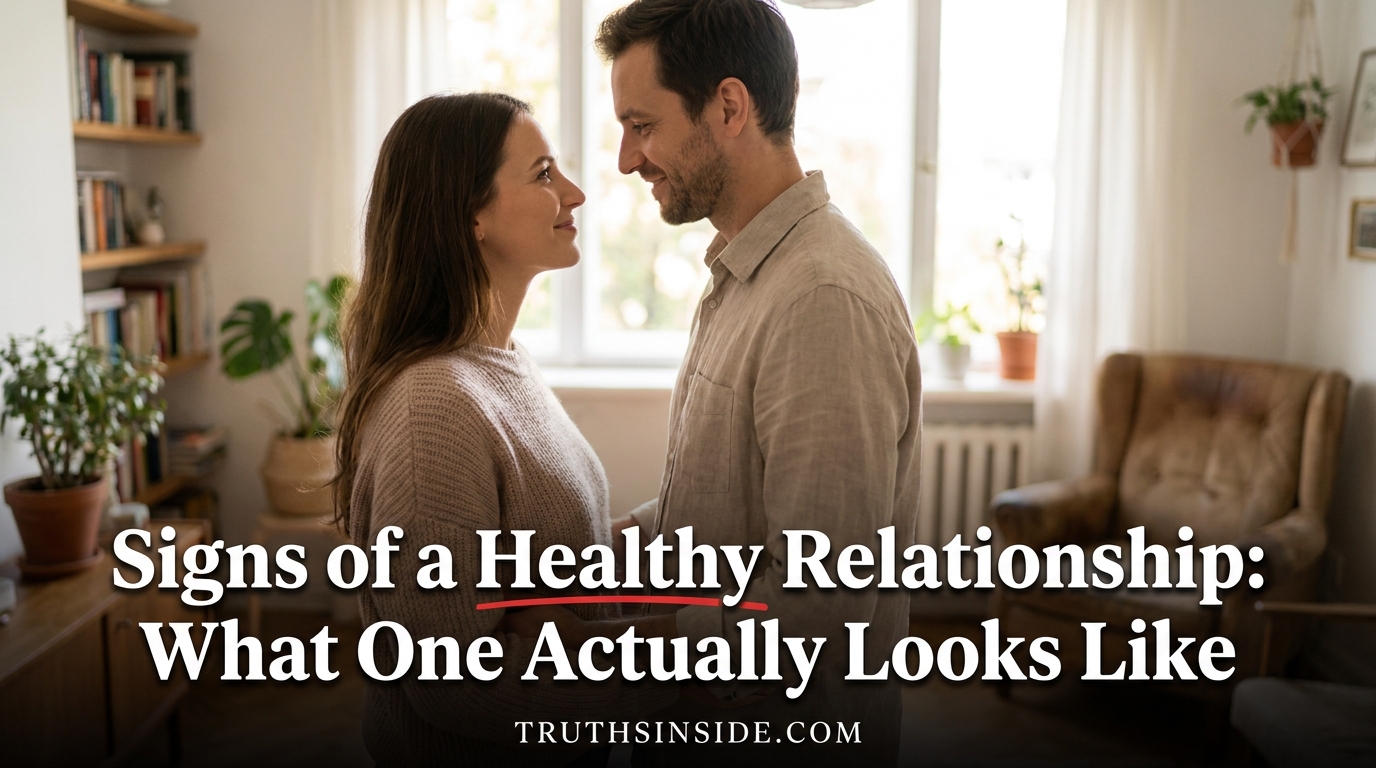
Most of us grew up learning what a bad relationship looks like — the yelling, the jealousy, the control. But very few of us were ever taught what a genuinely good one feels like from the inside. And that gap is more dangerous than it sounds. Research from the Gottman Institute, one of the most respected relationship science organizations in the world, found that people in unhealthy relationships often don’t recognize the dysfunction because they’ve normalized it. If you’ve been asking yourself lately whether what you have is real or just familiar, this guide is for you. These are the signs of a healthy relationship — not the fairy-tale version, but the real, research-backed, everyday kind that actually lasts.
What a Healthy Relationship Actually Feels Like — Not Just Looks Like
There’s a difference between a relationship that looks good on the outside and one that feels good on the inside. Social media has made this confusion worse. We see couples posting vacations and anniversary captions and assume that’s the benchmark. It isn’t.
A healthy relationship doesn’t have to be loud. It doesn’t have to involve grand gestures or constant displays of affection. In fact, many of the most genuinely healthy relationships are the quietest ones — because they don’t need to perform. The security is internal. The love doesn’t need an audience.
What a healthy relationship feels like, at its core, is safety. Not just physical safety, but emotional safety — the ability to be fully yourself, to say the wrong thing sometimes, to have hard conversations without fear, to disappoint each other and know the relationship can hold it.
That feeling of emotional safety is not a bonus feature. It is the foundation. Everything else — the fun, the intimacy, the growth — is built on top of it. When it’s missing, everything else is unstable, no matter how beautiful it looks from the outside.

Sign 1: You Can Communicate Without It Turning Into a War
Every couple argues. Conflict is not a sign that a relationship is failing — it is a sign that two real people with different inner worlds are trying to share a life. The question is never whether you disagree. It is how you disagree.
In a healthy relationship, disagreements feel more like collaborative problem-solving than combat. You might raise your voice occasionally. You might say something clumsy or get defensive. But underneath the friction, there is a shared understanding: we are not enemies. We are on the same team trying to solve a problem together.
Dr. John Gottman’s decades of research identified what he calls the “Four Horsemen” of relationship destruction — criticism, contempt, defensiveness, and stonewalling. Their antidotes — gentle start-ups, expressing appreciation, taking responsibility, and self-soothing — are the actual building blocks of healthy communication.
In practice, this looks like: choosing the right time to bring up a difficult topic instead of ambushing each other. It looks like saying “I feel hurt when…” instead of “you always…” It looks like being able to say “I need a few minutes to calm down” and having that respected. It looks like repair — the ability to come back after a fight, acknowledge what went wrong, and move forward without carrying it like a weapon.
Healthy communication doesn’t mean every conversation is comfortable. It means both people feel like they can speak and be heard, even when it’s hard.
Sign 2: You Trust Each Other — And You’ve Earned That Trust
Trust is one of those words that gets thrown around so frequently it’s lost some of its meaning. But in relationship psychology, trust is specific and measurable. It shows up in whether you believe your partner has your best interests at heart — not just when it’s convenient, but when it costs them something.
Researcher Brené Brown defines trust using the acronym BRAVING: Boundaries, Reliability, Accountability, Vault (keeping confidences), Integrity, Non-judgment, and Generosity. Every single element of that acronym is active in a healthy relationship.
In practical terms, trust looks like this: you don’t feel the need to check their phone. Not because you’ve been told not to, but because you genuinely don’t feel the anxiety that makes checking feel necessary. You know they will do what they say they’ll do — not perfectly, but consistently. When they mess up, they own it. When you share something vulnerable with them, it stays safe.
Trust also means trusting their feelings. Believing them when they say they’re hurt, even if you didn’t intend it. Believing them when they say they’re fine, without assuming they’re hiding something. Trust is not naive. It is the earned confidence that this person, in this relationship, has demonstrated over time that they are safe to rely on.
“A healthy relationship isn’t one where nothing ever goes wrong. It’s one where both people trust each other enough to work through it when it does.”

Sign 3: You Both Have Lives Outside the Relationship
This one surprises people. Isn’t love supposed to mean everything? Aren’t you supposed to want to spend all your time together?
Here’s what relationship psychology actually tells us: enmeshment — the state of being so intertwined with a partner that you lose your individual identity — is not a sign of deep love. It is a sign of unhealthy attachment. And it almost always leads to resentment, pressure, and eventual breakdown.
Healthy couples maintain separate friendships, individual hobbies, personal goals, and private inner lives. They don’t need to do everything together. They don’t feel threatened when the other person has a good time without them. They actively want each other to have full, rich, independent lives — because they understand that a person who is fulfilled on their own brings something real to the relationship.
This doesn’t mean emotional distance. It means the relationship is strong enough that it doesn’t need to consume both people in order to survive. You can miss each other and also be completely fine on your own. You can come home to each other with something new to share — a thought, an experience, a feeling — because you’ve both been living lives.
The healthiest relationships are made up of two whole people choosing each other, not two half-people depending on each other to feel complete.
Sign 4: Respect Is the Baseline — Even When You’re Angry
Respect in a relationship is not the same as agreement. You can deeply disagree with your partner and still respect them. What respect means is this: even in the heat of an argument, even when you’re frustrated or hurt, you do not attack their character, mock their feelings, belittle their experiences, or use information they shared vulnerably as ammunition.
This is harder than it sounds. When we’re hurt, the instinct is often to hurt back. But couples who sustain long-term health have developed the discipline — or the genuine care — to keep respect as a floor, not a ceiling.
Respect shows up in small moments too: not interrupting. Not dismissing. Not rolling your eyes when they talk about something they care about. Asking about their day and actually listening to the answer. Acknowledging their perspective even when you see things differently. Taking their needs seriously even when they inconvenience you.
Contempt — Gottman’s research shows — is the single greatest predictor of relationship failure. It is the opposite of respect: the sense that your partner is beneath you, ridiculous, or unworthy of basic consideration. Its presence is one of the clearest warning signs a relationship is in trouble. Its absence, combined with active respect, is one of the clearest signs of a healthy one.

Sign 5: You Feel Safe Enough to Be Honest
Honesty in a healthy relationship goes deeper than not lying. It means you feel safe enough to tell the truth — about your feelings, your needs, your fears, your mistakes — without bracing for punishment.
In relationships where honesty isn’t safe, people go underground. They say what they think their partner wants to hear. They hide their real thoughts to avoid conflict. They perform a version of themselves that is more palatable and less real. Over time, this creates a relationship with a stranger — because neither person ever actually shows up fully.
In a healthy relationship, you can say: “I need more alone time this week and it has nothing to do with you.” You can say: “That comment you made last week actually hurt me and I haven’t brought it up until now.” You can say: “I’m struggling with something and I need support, not solutions.” And you trust that your honesty will be received with care rather than defensiveness or punishment.
This kind of honesty requires courage from both people. The person sharing has to risk being vulnerable. The person receiving has to regulate their own reactions enough to stay open. When both people can do this — not perfectly, but consistently — the relationship becomes a place where real intimacy is possible.
Because real intimacy isn’t about physical closeness. It’s about being fully known by another person and fully accepted anyway.
“The sign of a truly healthy relationship isn’t that you never hide anything — it’s that you no longer feel like you have to.”
Sign 6: Your Partner Celebrates Your Growth — Even When It Changes Things
One of the less-discussed signs of a healthy relationship is this: your partner is genuinely happy when you grow. When you get the promotion, when you level up a skill, when you become more confident or more successful or more yourself — they celebrate you. Without competition, without subtle undermining, without jealousy dressed as concern.
This sounds obvious. But in reality, many relationships carry an unspoken contract: stay the same. Don’t outgrow me. Don’t become someone who might not need me anymore. This fear is understandable. It is also the enemy of genuine love.
A partner who truly loves you wants you to become the fullest version of yourself — even if that means the relationship has to evolve to accommodate it. They are not threatened by your ambition, your independence, or your evolution. They are inspired by it. They are proud of it.
And they are growing too. Because healthy relationships are not static. They are two people in motion, choosing to keep choosing each other as they both change — not holding each other in place out of fear.

Sign 7: Repair Happens — And It Happens Consistently
Every relationship experiences ruptures. Moments of disconnection, misunderstanding, hurt feelings, failed communication. The difference between relationships that thrive and relationships that slowly deteriorate is not the absence of ruptures. It is the presence of repair.
Repair means coming back. It means being the one to reach out after a fight, even when you feel like the one who was more wronged. It means saying “I’m sorry for the way I said that” even while you stand behind what you were trying to communicate. It means checking in after a hard conversation: “Are we okay? Is there anything left unresolved?”
In the Gottman model, the repair attempt is one of the most important predictors of long-term relationship success. Couples who master it can have significant conflict and still maintain a fundamentally strong relationship. Couples who don’t — who let ruptures calcify into resentment, distance, or contempt — find that the relationship slowly hardens around the cracks.
Repair doesn’t have to be elaborate. Sometimes it’s a hand on the shoulder. A text that says “I’ve been thinking about our conversation and I want to understand your perspective better.” A simple, genuine “I’m sorry.” What matters is that it happens — and that it happens not just once, but as a consistent pattern of mutual care that says: this relationship is worth coming back to.
Sign 8: You Like Each Other — Not Just Love Each Other
This one sounds almost too simple to mention. But it may be one of the most overlooked signs of a genuinely healthy relationship.
Romantic love is an intense, consuming experience. But it is not the only kind of love that sustains a long-term relationship. What sustains it — through the hard seasons, the boring seasons, the seasons of stress and change — is friendship.
Do you actually enjoy spending time with this person? Do you laugh together — not just at funny moments, but in that easy, familiar way that only happens with people you genuinely like? Do you find them interesting? Are you curious about how they see the world? Do you feel comfortable in the silence between conversations?
Research consistently shows that couples who describe their partner as their best friend report significantly higher relationship satisfaction and longevity. Not because the romance isn’t there, but because the friendship provides a foundation that romance alone cannot.
The fire of early romantic love naturally cools over time. This is not failure. It is biology. What remains — if you’ve built it — is something warmer and more durable: the deep, companionate love of two people who genuinely like who they are together.

Sign 9: Your Needs Are Taken Seriously — Even When They’re Inconvenient
Every person in a relationship has needs. Emotional needs, physical needs, practical needs, space needs, closeness needs. A healthy relationship doesn’t mean all needs are met perfectly all the time. It means needs are taken seriously, communicated openly, and honored whenever possible — with genuine effort rather than reluctant compliance.
In an unhealthy dynamic, needs are either weaponized (“you’re too needy”), dismissed (“you’re overreacting”), or used as leverage (“I’ll give you what you need if you give me what I want”). In a healthy one, needs are information — data about what this person requires to feel safe, loved, and functional. They are met with curiosity and care, not judgment.
This requires two things: the ability to identify and express your needs clearly, and a partner who responds to those needs without shaming you for having them. Both halves matter equally. If you can’t articulate your needs, your partner can’t meet them. If your partner punishes you for having needs, you’ll eventually stop expressing them — and eventually stop trusting the relationship entirely.
Sign 10: The Relationship Has Survived Something Hard — And You’re Still Here
No relationship truly earns its depth until it’s been tested. It might be a period of external stress — job loss, a family crisis, an illness. It might be an internal rupture — a betrayal, a serious conflict, a period of disconnect. The testing is not the point. What matters is what happened when it came.
Did you both stay? Did you communicate? Did you seek help when you needed it? Did you choose each other, deliberately, in a season when leaving would have been easier?
A relationship that has come through genuine difficulty together — and chose to remain and rebuild — has something that new relationships don’t yet have: proof. Proof that this love is not only for the easy seasons. Proof that these two people can face something real and come out the other side still holding hands.
This is not to romanticize suffering or suggest you should stay in relationships that are harmful. But it is to say that the durability of a healthy relationship is revealed not in the beautiful moments, but in how it survives the hard ones.
What to Do If You’re Not Sure Yours Qualifies
If you read this list and felt uncertain — that’s worth paying attention to. Not as a reason to panic, but as information.
No relationship hits every single sign perfectly at all times. Healthy relationships go through seasons too — seasons of more disconnection, more conflict, more distance. The question is whether those seasons are the exception or the rule. Whether there is movement back toward each other. Whether both people are willing to do the work.
If many of these signs feel foreign to your relationship — if trust, respect, honest communication, and emotional safety are consistently absent — it may be worth talking to a therapist, individually or as a couple. Not because the relationship is doomed, but because having a clear picture of what healthy looks like makes it possible to build toward it.
You deserve a relationship that feels like safety, not survival. Like connection, not performance. Like home, not a place you’re always one wrong move away from losing.
That relationship is possible. And knowing what it looks like is the first step toward it.
Final Thoughts: Healthy Love Is Quiet — But It’s Loud in All the Ways That Matter
A healthy relationship won’t always make a great story. It won’t have the dramatic peaks and valleys that make for compelling content. There’s no villain. There’s no rescue. There’s just two people, consistently choosing each other, building something real out of ordinary moments.
That is not boring. That is the whole point.
The signs of a healthy relationship aren’t fireworks. They’re the lights that stay on — steady, warm, reliable — even through the dark nights. They’re the safety of knowing someone is coming home. The comfort of being known. The joy of choosing and being chosen, again and again, not out of fear or habit, but out of something genuine.
If you have it — protect it. If you’re building toward it — keep going. If you’re not sure you’ve ever experienced it — now you know what to look for.
FAQ
1. How do I know if my relationship is healthy or just comfortable? Comfort alone is not health. A healthy relationship feels safe, mutual, and growth-oriented. If you feel like you’re staying mostly out of fear, habit, or fear of loneliness — rather than genuine love and connection — that distinction matters and is worth exploring, ideally with a therapist.
2. Can a relationship become healthy after being unhealthy? Yes, but it requires both people to acknowledge the problems honestly, commit to change, and often engage professional support. Change is possible — but it has to be genuine and sustained, not just promised during moments of crisis.
3. Is conflict a sign that a relationship isn’t healthy? Not at all. Conflict is normal and even necessary. The sign of a healthy relationship is not zero conflict — it’s how conflict is handled. Respect, repair, and the ability to disagree without contempt are what matter.
4. What if I have most of these signs but one or two are missing? No relationship is perfect. What matters is direction — are you moving toward health or away from it? A missing sign may be a growth area rather than a dealbreaker, especially if both partners are aware and working on it.
5. How do I bring this up if I feel like my relationship lacks some of these signs? Choose a calm moment, not the middle of a conflict. Use “I” statements: “I’ve been thinking about what I need to feel safe and connected, and I’d like to talk about a few things.” Frame it as wanting more closeness, not as a list of failures. If the conversation is met with defensiveness or dismissal, that itself is information.
CTA: 💾 Save this — screenshot the signs you want to remember. 📤 Share it with someone who needs a reality check on their relationship. 👣 Follow Truthsinside.com for psychology-backed relationship content every week.
🎵 Music
Maren Lull is a singer-songwriter who writes from the places most people don’t talk about out loud.
Not the dramatic grief. Not the obvious heartbreak. The quiet kind — the ordinary Tuesday emptiness, the habit of reaching for someone who isn’t there anymore, the particular exhaustion of being strong for so long that the strength itself wears thin.
Her music lives at the intersection of emotional honesty and soft beauty — breathy vocals over gentle piano, slow tempos, lyrics that feel less like songs and more like something you wrote in a private notebook at two in the morning and never showed anyone.
Maren Lull writes for the people who feel everything deeply and say very little about it. For the ones who listen to sad music not because they want to feel worse — but because being understood, even by a song, makes the feeling easier to carry.
📱 Follow Maren Lull:
→ Spotify
→ Apple Music
→ Youtube
→ Audiomack