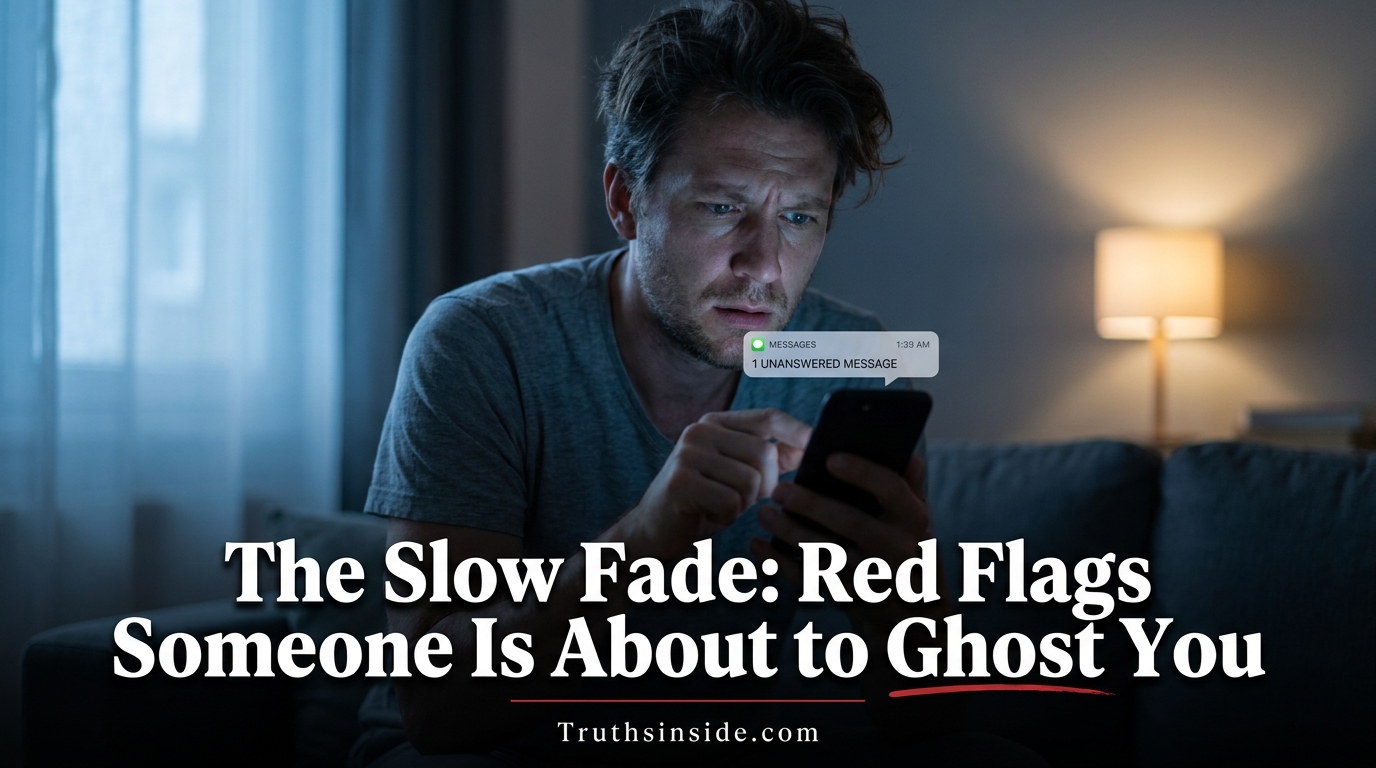
It never announces itself. There is no conversation, no argument, no dramatic ending. One day you are texting every morning, making plans, feeling certain — and then, almost imperceptibly, something begins to shift. The replies get shorter. The energy gets quieter. The plans get hazier. You tell yourself it’s nothing. You tell yourself everyone gets busy. But somewhere underneath the reasoning, something in you already knows. This is not just a busy week.
This is the beginning of a disappearance. Ghosting — the practice of ending a relationship by cutting off all communication without explanation — has become one of the defining relational experiences of the modern era, with a 2021 Journal of Social and Personal Relationships study finding that over 65% of adults reported being ghosted at least once. But before the ghost fully arrives, there are always red flags someone is about to ghost you — a pattern so consistent and recognizable that, once you know it, you will never unsee it.
What the Slow Fade Actually Is — And Why It Hurts More Than a Clean Break
The slow fade is not the same as ghosting — not exactly. Ghosting is the sudden, complete disappearance. The slow fade is the preamble: the gradual, deliberate withdrawal of presence, energy, and investment that happens before the silence becomes total.
It is, in many ways, worse than the clean break.
When a relationship ends with a direct conversation — even a difficult one — you receive something invaluable: closure. You know what happened. You can grieve something concrete. You can begin to move forward with accurate information about what the relationship was and why it ended.
The slow fade gives you none of that. Instead, it gives you ambiguity — the most psychologically corrosive relational experience there is. Because the human brain is a meaning-making machine, and in the absence of clear information, it will generate its own. It will run scenarios, reread messages, reinterpret moments, and search obsessively for the thing you must have done wrong. The uncertainty does not protect you from pain. It compounds it.
Research by psychologist Kristina Coop Gordon found that ambiguous relationship endings produce significantly higher rates of rumination, anxiety, and prolonged grief compared to explicit breakups — even when the explicit breakup involved conflict or harsh words. The mind, it turns out, can tolerate almost any clear truth. What it struggles to tolerate is not knowing.
Understanding the slow fade for what it is — a pattern of emotional withdrawal with a recognizable signature — is the first act of self-protection. Because you cannot respond wisely to something you haven’t named yet.

Red Flag 1: Their Response Time Has Quietly Shifted
In the early stages of a relationship or growing connection, communication tends to have a natural rhythm. You develop a pattern — how quickly they typically reply, how often they initiate, the general energy and warmth of the exchange. This baseline is the key, because the slow fade almost always begins here.
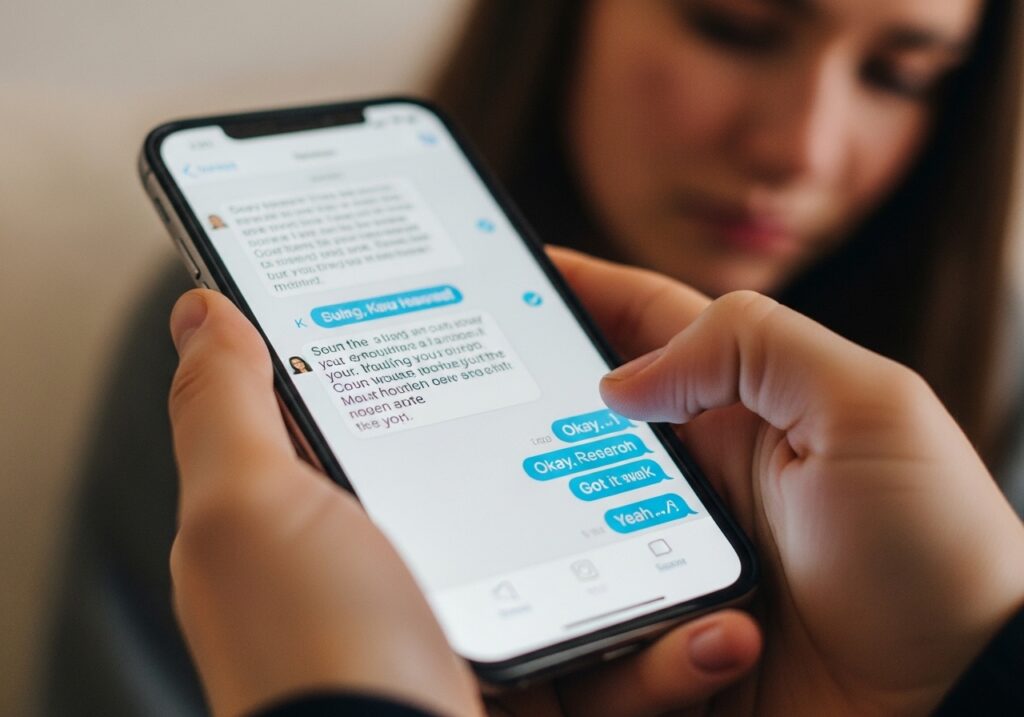
The first red flag is not that they take longer to reply once. It is that the shift becomes consistent and directional — always longer, never returning to the previous baseline, and accompanied by a subtle flattening of the content itself.
Where messages were once warm, detailed, curious — asking follow-up questions, sharing unprompted thoughts — they become functional. Brief. Just enough to keep the thread technically alive without actually sustaining the connection. The replies start to feel like someone doing the minimum required to avoid the accusation of disappearing — while, in fact, already disappearing.
What makes this particularly disorienting is that it happens gradually enough to be deniable. Each individual reply, taken alone, is explainable. But the pattern, tracked over days and weeks, tells a different story. Your gut registers the change before your conscious mind is willing to name it. Pay attention to that gap.
Red Flag 2: Conversation Has Become One-Sided
Healthy connection is reciprocal. There is a natural back and forth — of initiation, of curiosity, of emotional investment. Neither person is always the one reaching out, asking questions, or carrying the conversational weight. When that balance shifts consistently in one direction, it is one of the clearest early signals of the slow fade.
You notice you are always the one to text first. When you don’t reach out, hours or days pass in silence — and they do not seem to notice or care enough to break it. When you are together or on a call, you are the one asking questions, filling silences, generating energy. Their participation feels increasingly passive — present in the technical sense but emotionally absent.
This one-sidedness is painful in a specific way, because it forces you into an impossible position. If you keep initiating, you feel like you are chasing someone who is already leaving. If you stop initiating — to test the theory, to see if they’ll reach out — the silence confirms exactly what you feared. There is no comfortable option. This is by design, if not consciously then functionally: the slow fader avoids confrontation by never quite doing enough to be definitively called out, but never quite doing enough to sustain the relationship either.
“The slow fade is designed to make you feel like the relationship ended because of something you did — when really, it ended because they were never willing to say so out loud.”
Red Flag 3: Plans Get Made and Quietly Unmade
Another hallmark of the slow fade is a specific pattern around future plans. In the early stages of the fade, plans don’t get explicitly canceled — they get vague. The confirmation that was once enthusiastic becomes lukewarm. The specific time and place becomes a “we’ll figure it out.” The figured-out plan becomes a “let’s rain check.”
What distinguishes this from ordinary scheduling conflicts is the directionality and the texture. Scheduling conflicts happen to everyone, in all directions — sometimes they cancel, sometimes you cancel, and both people make genuine effort to reschedule. In the slow fade, the cancellations flow primarily in one direction, rescheduling is vague or never concrete, and the follow-through — even when plans are confirmed — has a distinct flatness to it.
You may find yourself increasingly in the position of being the one to suggest specific times, to push for confirmation, to do the logistical work of keeping plans alive. This effort, quietly, is doing what they have stopped doing — actively choosing the connection.
Pay attention to what someone’s behavior around plans communicates about their actual desire for your presence in their life. Enthusiastic, reliable follow-through is a form of choosing you. Persistent vagueness and cancellation is a form of slowly unchoosting you — without ever having to say it directly.
Red Flag 4: The Emotional Depth Has Disappeared
Early connection often has a quality of emotional openness — sharing, revealing, becoming known. People in genuine connection tend to open up over time, building increasing layers of vulnerability and intimacy. The slow fade reverses this process.
Where once there were real conversations — about feelings, fears, dreams, the texture of daily life — there is now only surface. Weather. Memes. Shallow observations. The kind of content that fills space without actually creating connection. If you try to deepen the conversation — to reintroduce emotional intimacy, to revisit something you discussed meaningfully before — it gets deflected, redirected, or met with replies so brief they functionally close the door.
This emotional retreat is one of the most painful dimensions of the slow fade because it is so stark against the baseline of what you had. You remember conversations that went on for hours. You remember feeling genuinely seen. The contrast between that past connection and the current flatness is its own form of grief — grieving something that is technically still present but functionally gone.
Psychologists call this “ambiguous loss” — the experience of losing someone who is still physically or communicatively present. It is disorienting in a way that clean endings are not, because you cannot grieve something that hasn’t officially ended. You are left holding the loss without the permission to name it.

Red Flag 5: Their Social Media Activity Tells a Different Story
This one is modern, specific, and more revealing than it might initially seem. In the context of someone who claims to be too busy to reply to your messages, their social media activity provides a quiet but concrete data point.
The slow fader is often active — posting stories, liking content, responding to others — at the same time or shortly after leaving your message on read. This is not accidental information. It is a visible demonstration that the issue is not availability. It is prioritization.
Now, it is worth noting that social media engagement requires far less psychological energy than a genuine reply to someone you’re pulling away from. Mindlessly scrolling or tapping a like is not the same cognitive and emotional load as composing a thoughtful message to someone you have complicated feelings about. So this signal is not definitive on its own.
But in combination with other patterns — the delayed replies, the one-sided initiation, the canceled plans, the emotional flatness — it forms part of a coherent picture. The person who has no energy to reply to you somehow has energy for everything else. That asymmetry is information.
Red Flag 6: They’ve Stopped Asking About Your Life
Genuine interest in another person is one of the most reliable signals of real connection. In early relationship stages, people tend to remember details, ask follow-up questions, and demonstrate curiosity about the inner world of someone they are drawn to. The slow fade erodes this almost completely.
You mention something significant — a work presentation you were nervous about, a family situation you’re navigating, a health concern you shared in a previous conversation — and it goes unremarked. They don’t ask how it went. They don’t circle back. They don’t demonstrate that they remember or care.
This absence of curiosity is particularly telling because curiosity, in relationships, is a form of care. When someone is genuinely invested in your wellbeing, they want to know how your life is going. They track the threads of your story. They follow up. When that stops — when your life becomes something they no longer ask about — it means their investment has quietly withdrawn.
This can be one of the subtler signals of the slow fade, and therefore one of the easier ones to rationalize away. But track it over time. A person who once remembered your coffee order and asked about your sister’s surgery, who now fails to follow up on major life events you’ve shared directly — that shift is not accidental.
“Ghosting doesn’t always happen in one moment. Sometimes it happens in a thousand small withdrawals — each one deniable, all of them telling the same story.”

Red Flag 7: Your Gut Has Been Trying to Tell You Something
This one deserves its own section, because it is consistently underrated and consistently accurate.
At some point during the slow fade — often early, often before you have enough concrete evidence to articulate it clearly — your gut begins to register the shift. Something feels off. The energy feels different. An invisible distance has opened that wasn’t there before. You notice yourself second-guessing, over-explaining, performing more enthusiasm than you actually feel in an attempt to close a gap you can’t quite name.
This internal signal — the vague but persistent sense that something has changed — is not anxiety inventing problems. It is pattern recognition. Your nervous system is processing thousands of micro-signals about this person’s behavior that your conscious mind hasn’t yet organized into a coherent narrative. The gut feeling arrives first because it is working faster, processing more, and drawing on the full baseline of your experience with this person.
Research in the field of somatic psychology and emotional intelligence consistently supports the reliability of these body-based intuitions in social and relational contexts. The work of neuroscientist Antonio Damasio, in particular, demonstrates that the body’s signals are integral to accurate social perception — not noise to be rationalized away.
When something feels wrong in a relationship — even without a smoking gun — take that seriously. Not as permission to act impulsively, but as information worthy of attention. The question worth sitting with is not “Am I being paranoid?” It is: “What has changed, and what is my gut responding to?”
Red Flag 8: The Excuses Have Become a Pattern
Life is genuinely busy. Stress is real. People go through seasons where they have less to give. This is true, and any fair analysis of someone’s communication and availability has to account for it.
But there is a meaningful difference between a person going through a legitimately difficult period — who communicates that context, who expresses genuine regret about their reduced availability, who re-engages when the pressure lifts — and a person whose busyness has become structural, whose excuses never resolve, and who never re-emerges with renewed energy or connection.
The slow fader’s excuses tend to share a few specific characteristics. They are vague rather than specific. They recur indefinitely rather than resolving. They are not accompanied by visible effort to maintain the connection despite the difficulty. And crucially — they do not come with dates or concrete plans for when things will be different.
“I’ve just been really slammed lately” is very different from “This week has been insane — can we plan something for Saturday?” The first is an explanation. The second is an explanation combined with evidence of genuine desire for the connection. The slow fade lives in the space of explanations without evidence — where every excuse is plausible but the pattern, accumulated over time, becomes unmistakable.

What to Do When You Recognize the Pattern
Recognizing the slow fade does not obligate you to simply endure it. You have options — and exercising them, even when the outcome is painful, is almost always better than the alternative of waiting indefinitely in ambiguity.
The most direct option is also the most courage-requiring one: name what you’re observing. Not as an accusation, but as an honest expression of your experience. Something like: “I’ve noticed things have felt different between us lately and I’d like to talk about it.” This opens the door to a real conversation — one they may have been avoiding but that you are now initiating.
Their response to this opening will tell you everything you need to know. A person who genuinely cares about you will engage with honesty, even if the honesty is difficult. A person who is mid-fade will deflect, minimize, or go even quieter. Both outcomes give you information — and information, even painful information, is more useful than ambiguity.
Some people choose to withdraw their own energy in response to recognizing the fade — to stop initiating, stop carrying the conversational weight, and simply observe what happens. This is a legitimate choice. It is, in its way, its own clarity-seeking strategy. If they reach out with genuine energy and reconnection, the pattern may not be what you thought. If the silence simply becomes permanent, you have your answer.
What is not recommended — for your own psychological wellbeing — is continuing to pour energy, vulnerability, and emotional investment into a dynamic that is giving you less and less in return, while telling yourself the situation will resolve on its own. The slow fade is rarely a phase. It is almost always a direction. And the sooner you name it, the sooner you can begin making decisions that actually serve you.
Why People Slow Fade Instead of Just Being Honest
Understanding why people ghost — and slow fade — doesn’t excuse it. But it can help you take it less personally, which matters for your recovery and for your understanding of how relationships actually work.
The most common driver of the slow fade is conflict avoidance. The person fading is not trying to be cruel. In many cases, they are trying to avoid the discomfort of a direct conversation — the guilt, the awkward exchange, the possibility of causing obvious pain. The slow fade feels, to the person doing it, like the kinder option. It is not. But that is its internal logic.
Fear of confrontation, low emotional communication skills, ambivalence about the relationship itself, and a genuine inability to tolerate the other person’s disappointment are all common contributors. Some people slow fade because they don’t know what they want and avoid making a decision by simply letting things trail off. Others have already made the decision internally but cannot bring themselves to communicate it externally.
None of this makes the experience less painful. But it does make it less about you. The slow fade is a communication style — a deeply flawed one — that says something significant about the other person’s emotional maturity and relational courage. It says very little about your worth, your lovability, or what you deserved from that connection.
Protecting Yourself: What You Deserve to Know
You deserve directness. You deserve the dignity of an honest conversation, even when the content of that conversation is painful. You deserve to be someone’s clear yes — not their indefinitely postponed maybe.
If you recognize the slow fade in a current relationship — whether romantic, friendship, or otherwise — trust what you are seeing. Trust your gut, trust the pattern, and move toward clarity rather than away from it. The ambiguity of the fade is designed, consciously or not, to keep you in suspension — hopeful enough to stay, confused enough not to confront.
Breaking that suspension — by naming the pattern, by asking directly, by withdrawing your own energy and observing what follows — is an act of self-respect. It may not give you the outcome you want. But it will give you something more valuable: the truth. And the truth, however uncomfortable, is the only thing that allows you to actually move forward.
You are not too much. You are not imagining things. The shift you felt was real. And you were right to notice it.
Final Thoughts: The Slow Fade Says Nothing About Your Worth
Being on the receiving end of the slow fade is one of the most disorienting relational experiences there is — not because of what it does to the relationship, but because of what it does to your sense of reality. It makes you question your perception. It invites you to blame yourself. It denies you the closure that a clear ending would provide.
But here is the truth the slow fade tries to obscure: the way someone exits your life says everything about their communication skills and emotional courage, and nothing about your value as a person.
You cannot control how people choose to leave. You can control whether you keep pouring into dynamics that are quietly draining you. You can control how much ambiguity you are willing to tolerate before you seek clarity. You can control the standard you hold for how you allow yourself to be treated.
The slow fade reveals the fader. Let it.
And let yourself grieve what you lost — because the connection was real, even if the ending wasn’t honest. Then give your energy, your openness, and your genuine self to someone who will be honest enough to either fully show up — or, if they must leave, to do so with enough respect to say so out loud.
You deserve both.
FAQ
1. Is the slow fade always intentional? Not always consciously, but it is always a choice. Some people slow fade without fully acknowledging — even to themselves — that they are doing it. They experience it as “things just fading out naturally.” But from the receiving end, the pattern is consistent and recognizable, and the decision to avoid a direct conversation is always, on some level, a choice.
2. Should I confront someone I think is slow fading me? “Confront” carries more aggression than necessary — but initiating an honest conversation? Absolutely yes. Something calm and clear like “I’ve noticed things feel different between us lately and I’d like to talk about it” is entirely reasonable and respectful. Their response will give you significantly more information than continued waiting will.
3. Why does being ghosted or slow faded hurt so much more than a normal breakup? Because ambiguity is psychologically more distressing than painful clarity. The human brain processes uncertainty as threat, and in the absence of clear information, it generates its own — usually the most self-critical narrative possible. A direct breakup, even a painful one, gives you something concrete to grieve. The slow fade leaves you stranded in uncertainty.
4. How do I stop myself from over-analyzing every small change in communication? Distinguish between a single data point and a pattern. One slow reply or canceled plan means nothing. A consistent directional shift across multiple dimensions — response time, initiation, depth, interest, follow-through — is a pattern worth taking seriously. Journal the specific behaviors over time rather than reacting to each individual moment.
5. Can a relationship recover after a slow fade? Occasionally, yes — particularly if the fade was driven by a specific external stressor that has since resolved, and if both people can have an honest conversation about what happened. But recovery requires the fader to demonstrate genuine change in behavior, not just explanation. If the underlying issue was avoidance or conflict aversion, that pattern will recur without significant personal work.
CTA: 💾 Save this — you’ll want to come back to this list when something feels off. 📤 Share it with someone who keeps making excuses for someone who’s already leaving. 👣 Follow Truthsinside.com for brutally honest relationship content that helps you see clearly.
🎵 Music
Maren Lull is a singer-songwriter who writes from the places most people don’t talk about out loud.
Not the dramatic grief. Not the obvious heartbreak. The quiet kind — the ordinary Tuesday emptiness, the habit of reaching for someone who isn’t there anymore, the particular exhaustion of being strong for so long that the strength itself wears thin.
Her music lives at the intersection of emotional honesty and soft beauty — breathy vocals over gentle piano, slow tempos, lyrics that feel less like songs and more like something you wrote in a private notebook at two in the morning and never showed anyone.
Maren Lull writes for the people who feel everything deeply and say very little about it. For the ones who listen to sad music not because they want to feel worse — but because being understood, even by a song, makes the feeling easier to carry.
📱 Follow Maren Lull:
→ Spotify
→ Apple Music
→ Youtube
→ Audiomack