
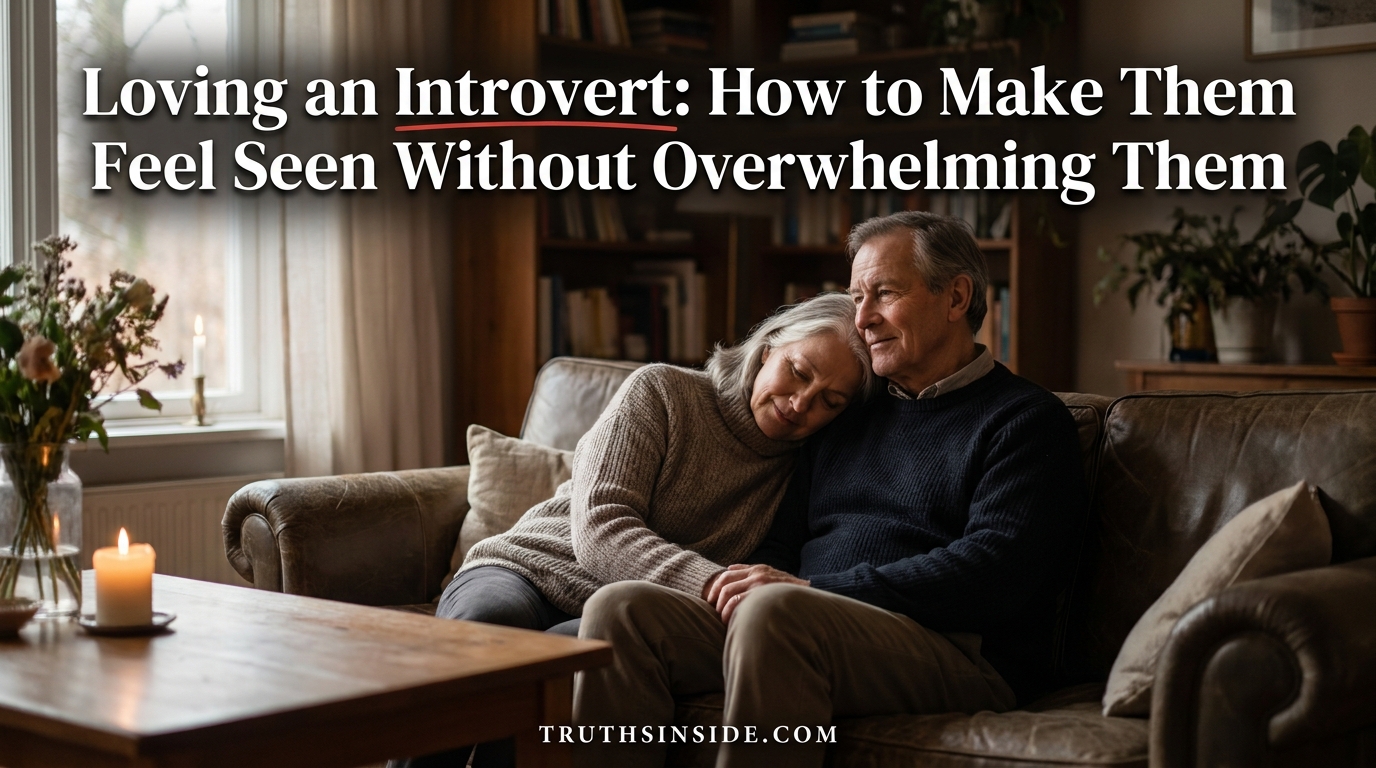
They are the person who lights up in a one-on-one conversation but goes quiet at the party. The one who needs an hour alone after a long day before they can fully be present with you. The one whose love runs deep and steady and slow — not because they feel less, but because they feel differently. If you love an introvert, you already know that something about the way they move through the world requires a different kind of understanding. And if you have ever felt confused, shut out, or unsure of whether you are getting it right — this is for you. Loving an introvert in a relationship is not about learning to need less or to want less.
It is about learning to love in a language that actually reaches them. According to psychologist Susan Cain, author of the landmark book Quiet, introverts make up an estimated 30 to 50 percent of the population — which means the chances are high that someone you love deeply is one of them, and that the way you have been taught to love may not be the way they need to receive it.
What Loving an Introvert in a Relationship Actually Requires You to Understand First
Before anything else — before the tips, the scripts, the strategies — there is one foundational truth about introverts that changes everything once you really absorb it.
Introversion is not shyness. It is not social anxiety. It is not a wound, a wall, or a problem to be fixed with enough patience and the right approach. It is a neurological orientation — a difference in how the brain processes stimulation — that makes solitude restorative rather than depleting, and sustained social engagement energetically costly rather than energizing.
Neuroscientist and introvert researcher Sophia Dembling, alongside work by developmental psychologist Jerome Kagan, has shown that introverted brains are more sensitive to dopamine stimulation than extroverted ones. Where an extrovert’s brain needs higher levels of external stimulation to feel activated and engaged, the introvert’s brain reaches optimal arousal — that sweet spot of focus, presence, and pleasure — with significantly less. Too much stimulation — too many people, too much noise, too much relentless social engagement — pushes them past that sweet spot into overwhelm.
This is not a preference. It is not a mood. It is neurological architecture. And once you understand it as such — rather than as rejection, coldness, or disinterest — the entire experience of loving an introvert shifts. Their need for quiet is not about you. Their desire for space is not withdrawal from you. It is refueling — the same way sleep is not rejection of the waking world, but the necessary condition that makes functioning within it possible.

They Show Love Differently — Learn to Read It
One of the most common sources of pain in relationships with introverts is the misreading of their love language. Because many cultural narratives around love emphasize extroverted expressions — grand gestures, constant contact, enthusiastic verbal affirmation, a high volume of shared activities — the quieter, more interior ways introverts love can be misread as indifference, low investment, or absence of feeling.
This misreading is both common and genuinely harmful. Because the introvert is often loving deeply, consistently, and with great intention — just in ways that require translation if your native relational language is more outwardly expressive.
Introverts tend to show love through presence that is chosen rather than constant. They are there when it matters — not everywhere all the time, but specifically, attentively, fully present in the moments they have decided to share with you. They show love through remembering: the details you mentioned three months ago that they held quietly and referenced at the exact right moment. They show love through deep listening — not the kind that waits for its turn to speak, but the kind that absorbs, reflects, and responds with a quality of attention that most people never experience.
They show love through consistency over spectacle. They may not plan elaborate surprises or write lengthy declarations — but they will show up, reliably, in the small repeated ways that build trust over time. They will think about you when you’re not there and tell you so in ways that feel understated on the surface but carry an ocean underneath.
Learning to read these expressions — rather than measuring them against a standard they were never trying to meet — is one of the most meaningful gifts you can offer someone you love who is wired this way.
Give Space Without Making It Feel Like Punishment
This is one of the most practically important and emotionally nuanced aspects of loving an introvert — and it is where many otherwise caring partners stumble.
The introvert’s need for solitude is real, consistent, and non-negotiable in the sense that it cannot be indefinitely overridden without cost. But how that space is given matters enormously. Space delivered with resentment, with sighing, with a pointed comment about how you always end up alone — is not really space. It is space with a price tag attached. And the introvert, acutely sensitive to emotional atmosphere, will feel that price even if it’s never directly stated.
Genuine space means releasing them into their solitude without attaching your emotional state to it. It means finding something that genuinely nourishes you — a friend, a hobby, a walk, a project — so that their alone time is also your own, rather than a period of waiting that breeds quiet resentment on both sides.
It also means not requiring them to perform gratitude for the space you’ve given. Not checking in frequently during their alone time. Not greeting their return with a tally of everything they missed or a demand for immediate reconnection. The return from solitude, for an introvert, is its own tender moment — they are ready to connect again, but the transition benefits from a little warmth rather than immediate intensity.
Think of it this way: space is not the opposite of love in this relationship. Space is the condition that makes their love available. Honor it as such, and you will get something extraordinary in return. Resent it, and you will spend years fighting a need that is not going to change.
“An introvert’s solitude is not a rejection of your love. It is what makes them capable of giving it. Protect their quiet, and they will bring you their whole heart.”

Depth Over Breadth: How Introverts Connect
Small talk is, for most introverts, a mild form of suffering. Not because they are antisocial or arrogant — but because their brains are oriented toward depth, meaning, and substance, and small talk provides none of those things. It is the relational equivalent of a meal with no nutritional value: technically food, but not actually nourishing.
What introverts crave, in conversation and in connection, is depth. The conversation that goes somewhere real. The question that requires actual thought to answer. The topic that matters — to both people, or just to one of them who trusts the other enough to go there. This is where introverts become most themselves, most animated, most fully present.
In a romantic relationship, this tendency is an extraordinary gift — if you know how to receive it. It means your introvert partner is capable of a quality of intimacy and conversation that many people spend their whole lives searching for. They want to know what you really think, how you really feel, what you’re actually afraid of, and what you dream about when you let yourself. And they want to share the same in return — once the trust is established and the environment feels safe enough.
The practical implication is this: build your connection through conversations that go deep rather than interactions that are merely frequent. One two-hour conversation where something real is said and heard will mean more to your introvert partner than a week of constant but shallow contact. Plan your shared time with this in mind. Ask better questions. Sit with their answers without immediately filling the silence. Follow the thread of what they’re actually telling you rather than redirecting to something easier.
You will not always succeed at this. Neither will they. But orienting your shared time toward depth over breadth is how you build the kind of connection that makes an introvert feel genuinely loved — not just companioned.
Don’t Mistake Quiet for Contentment — or for Distance
Introverts are often quiet. This is simply true. They spend significant mental energy in their interior world — processing, reflecting, holding ongoing internal conversations that have nothing to do with dissatisfaction or distance. In a long-term relationship, this interior quiet can be misread in both directions, and both misreadings cause problems.
The first misreading is assuming that quiet equals contentment. Just because your introvert partner is not voicing a concern does not mean there is no concern. Introverts often process internally for a long time before they feel ready — or find the words — to bring something outward. They may be sitting with something significant for days while appearing simply quiet. Asking gentle, specific questions — not interrogating, but genuinely checking in — creates the opening for what is actually there to emerge.
The second misreading is assuming that quiet equals distance or unhappiness. The introvert who has gone quiet after dinner is probably not upset with you. They are probably refueling, processing their day, or simply being comfortably interior in the presence of someone they trust enough to be quiet with. Being quiet with someone, for an introvert, is often the highest form of comfort — the sign that they feel safe enough not to perform.
Learning to ask rather than assume is the skill that navigates both misreadings. “You’ve been quiet tonight — are you doing okay, or just decompressing?” is a genuinely useful question. It acknowledges the observation without assigning meaning to it, and it gives your partner the opening to either share or to confirm that they are simply being themselves.

Protect Them at Social Events — Without Making Them Feel Fragile
Social events — particularly large, loud, or unfamiliar ones — are often genuinely draining for introverts in a way that extroverts rarely fully appreciate. This is not catastrophizing. It is neurological reality. After a long social event, many introverts need significant recovery time — sometimes the entire following day — before they feel like themselves again.
Loving your introvert well in these contexts means a few specific things.
First, give them advance notice. Surprises that involve social obligations — even enjoyable ones — are harder to prepare for than planned events. Knowing what’s coming allows the introvert to mentally prepare, manage their energy in the days preceding, and arrive ready rather than already depleted.
Second, never force them to work the room. Standing with them, facilitating introductions, and giving them a social home base — you, specifically — makes a crowd navigable in a way it otherwise isn’t. An introvert who knows they can drift back to you when the interaction becomes overwhelming will stay longer and enjoy themselves more than one who feels stranded in a sea of strangers.
Third, have an exit plan and honor it. Agreeing before you arrive on a reasonable departure time — and then actually leaving at that time — is an act of enormous good faith. When an introvert knows the event has a defined end, they can pace themselves and be genuinely present rather than counting down in quiet dread. When the promised end time is repeatedly extended, the message received is: your energy limits are less important than my desire to stay.
Finally, don’t process the event loudly in the car on the way home or immediately upon returning. That transition from social to private is a decompression zone the introvert needs — give it to them, and the conversation can always happen later.
Understand Their Relationship With Solitude — It Predates You
This point matters more than it might initially seem. Your introvert partner’s relationship with solitude is not a reaction to you. It is not a phase they are going through, or evidence of a problem in the relationship, or something that began when things got harder between you. It is a fundamental feature of who they are — one that existed before you met them and that will continue to be part of them for the entirety of your relationship.
This distinction sounds simple, but its emotional implications run deep. Partners of introverts — particularly those who are more extroverted themselves — often carry a quiet but persistent hope that the introvert will eventually need less solitude. That with the right level of connection, the right relationship, the right environment, the fundamental preference for quiet and interior time will soften into something more socially oriented.
It won’t. Not permanently, not structurally. This is not failure on anyone’s part. It is simply how they are built.
Accepting this — genuinely, without the residual hope that it will change — is one of the most loving things you can do. Because acceptance allows you to stop interpreting their solitude as data about the relationship and start experiencing it as simply a fact about the person. And facts about people, once fully accepted, stop being sources of friction and start being things you simply — and eventually, naturally — accommodate.
“Loving an introvert means accepting that their need for solitude is not the absence of their love for you. It is the presence of their truth. And you loving their truth is love in its most mature form.”

How to Ask for What You Need Without Making Them Feel Pressured
Every relationship requires both people’s needs to be expressed and honored — and relationships with introverts are no exception. If you are more extroverted, or simply more socially oriented than your partner, your needs for connection, shared activity, and togetherness are real and valid. The goal is not to suppress them. The goal is to express them in ways that create invitation rather than pressure.
Pressure, for introverts, has a specific and consistent effect: it makes the very thing being requested harder to give. When an introvert feels cornered into connection — when the ask comes with emotional urgency, with implicit guilt, with a sense that the wrong answer will create a problem — their system responds not with warmth but with retreat. This is not spite or resistance. It is the introvert’s nervous system protecting itself from an interaction that now feels threatening rather than connecting.
Invitation, by contrast, creates space for a genuine yes. It communicates: I would love this, and I also respect that you may not be in a position to give it right now. It removes the pressure of the wrong answer. And paradoxically, the absence of pressure is often what makes the yes more available.
In practical terms, this might sound like: “I’ve been missing some real time with you — not urgently, but when you’re feeling ready for it, I’d love to plan something.” Versus: “You never want to spend time with me anymore.” The content is similar — a need for more connection. The delivery is entirely different — and the introvert’s capacity to respond openly is entirely different as well.
Get comfortable expressing your needs as preferences rather than demands. Frame your desires as invitations to something you’d love rather than corrections of something that’s wrong. This is not about suppressing your own needs. It is about packaging them in a way your partner can actually receive without their nervous system closing the door.
When the Introvert Goes Quiet After Conflict
Arguments with introverts can be disorienting — particularly if your own conflict style is more immediate and emotionally expressive. Because introverts typically need to process internally before they can engage constructively, their response to conflict often involves going quiet — sometimes for hours, sometimes longer — in a way that can feel like stonewalling or emotional shutdown to a partner who processes differently.
It is usually neither. What is happening is this: the introvert’s internal processing system is working, actively, on what just happened. They are turning the conflict over, examining it, trying to understand their own feelings about it before bringing any of that outward. Bringing words before that process is complete feels — to them — like speaking before they know what they want to say. And saying the wrong thing in conflict, for many introverts, feels high-stakes enough that they would rather wait.
What helps enormously in these moments is explicit agreement — made outside of conflict, in calm times — about what the quiet means and how long it will last. Something like: “When I go quiet after an argument, I need some time to process. Can we agree that I’ll come back to you within a few hours, and that you’ll trust that I’m working on it rather than shutting you out?” This kind of pre-agreement transforms the silence from threatening to understandable.
It also helps to resist the urge to pursue — to knock on the closed door, to send multiple follow-up messages, to escalate in the hope of forcing resolution. For the introvert, pursuit during processing time is not comfort. It is pressure. And pressure, as noted earlier, almost always produces retreat rather than opening.
Give them the time. Trust the return. And when they do return — often calmer, often more articulate, often with something genuinely considered to say — receive it as the offering it actually is.

The Extraordinary Gift of an Introvert’s Full Presence
There is something about being loved by an introvert — when you understand what you are receiving — that is genuinely unlike anything else.
Because introverts do not give their energy freely to everyone. They are selective — sometimes exhaustingly so — about where their deepest presence, their most authentic selves, and their most vulnerable inner worlds go. The social world is full of interactions where they are present in body but managed in spirit — performing the required version of themselves, engaging adequately, and saving the real thing for somewhere else.
You, as their chosen person, are where the real thing goes.
When an introvert is fully present with you — when the guard is down, when the interior world is open, when the conversation goes to the places they never take it in public — you are receiving something precious. Something that most people in their life never get. The quality of attention an introvert brings to a person they deeply trust is among the rarest and most profound forms of being loved that exists.
They will remember what you told them the way most people don’t remember things. They will think about you when you’re not there — really think, deeply, in the way that their interior lives make possible — and those thoughts will show up, quietly, in how they treat you over time. They will be there, fully, on the days that matter most, with a quality of presence that makes you feel like the only person in the world.
That is the gift. And it is not a small one.
Final Thoughts: Love Them in the Language They Can Actually Receive
Loving an introvert well is not about loving less, wanting less, or shrinking yourself into someone quieter than you naturally are. It is about expanding your understanding of what love looks like when it lives in a different neurological home.
It is about learning to read their love rather than waiting for it to look like yours. It is about giving space with genuine grace rather than hidden resentment. It is about building depth in the time you share rather than volume. It is about trusting that their quiet is not distance — it is processing, refueling, being fully themselves in the way that makes giving themselves to you possible.
When you get this right — and you won’t get it right every time, and neither will they — something extraordinary becomes available. A relationship with an introvert, at its best, is one of the most quietly profound connections a human being can experience. It is intimate in ways that are not always visible but that run deep enough to last.
Love them in the language they can actually receive. And let them love you back in the language that is entirely, authentically theirs.
You may find it is the most fluent either of you has ever felt.
FAQ
1. How do I know if my introvert partner is pulling away or just needs space? The key distinction is consistency and context. Introvert recharging is predictable, non-personal, and followed by re-engagement. Genuine pulling away tends to involve emotional flatness, reduced initiation, and less warmth upon returning. When in doubt, ask directly and gently: “Are you doing okay, or do you need some space right now?” Their response — and what follows it — will tell you more than the silence alone.
2. Is it possible for an introvert-extrovert relationship to truly work long-term? Absolutely — and research suggests these pairings can be deeply complementary. The extrovert brings social energy, spontaneity, and connection to the wider world. The introvert brings depth, reflection, and a quality of presence that grounds the relationship. The key variable is mutual understanding and respect for each other’s neurological needs, not sameness.
3. My introvert partner rarely says “I love you” — should I be worried? Not necessarily. Many introverts express love through action rather than verbal declaration — through consistency, attention to detail, quality time, and remembered specifics. Have an honest conversation about love languages and what expressions mean the most to each of you. You may find they are saying it constantly in ways you haven’t fully learned to read yet.
4. How do I stop taking their need for alone time personally? Remind yourself, consistently, that their need for solitude predates you and is neurological rather than relational. Their recharging is not commentary on you or on the relationship. It may help to use their alone time intentionally — to invest in your own friendships, hobbies, or restoration — so that the time feels like something you’re both having rather than something they’re taking.
5. What is the biggest mistake people make when loving an introvert? Treating their introversion as a problem to be fixed or a phase to be waited out. The partners who thrive in these relationships are those who reach genuine acceptance — not just tolerance, but real appreciation — of their partner’s wiring. From that place of acceptance, everything else becomes navigable. From a place of hoping they’ll eventually change, almost everything becomes a source of friction.
CTA: 💾 Save this — share it with yourself the next time you feel confused about someone you love. 📤 Share it with anyone who loves an introvert and is trying to get it right. 👣 Follow Truthsinside.com for psychology-rooted content on love, connection, and what it really takes to make relationships work.
🎵 Music
Maren Lull is a singer-songwriter who writes from the places most people don’t talk about out loud.
Not the dramatic grief. Not the obvious heartbreak. The quiet kind — the ordinary Tuesday emptiness, the habit of reaching for someone who isn’t there anymore, the particular exhaustion of being strong for so long that the strength itself wears thin.
Her music lives at the intersection of emotional honesty and soft beauty — breathy vocals over gentle piano, slow tempos, lyrics that feel less like songs and more like something you wrote in a private notebook at two in the morning and never showed anyone.
Maren Lull writes for the people who feel everything deeply and say very little about it. For the ones who listen to sad music not because they want to feel worse — but because being understood, even by a song, makes the feeling easier to carry.
📱 Follow Maren Lull:
→ Spotify
→ Apple Music
→ Youtube
→ Audiomack