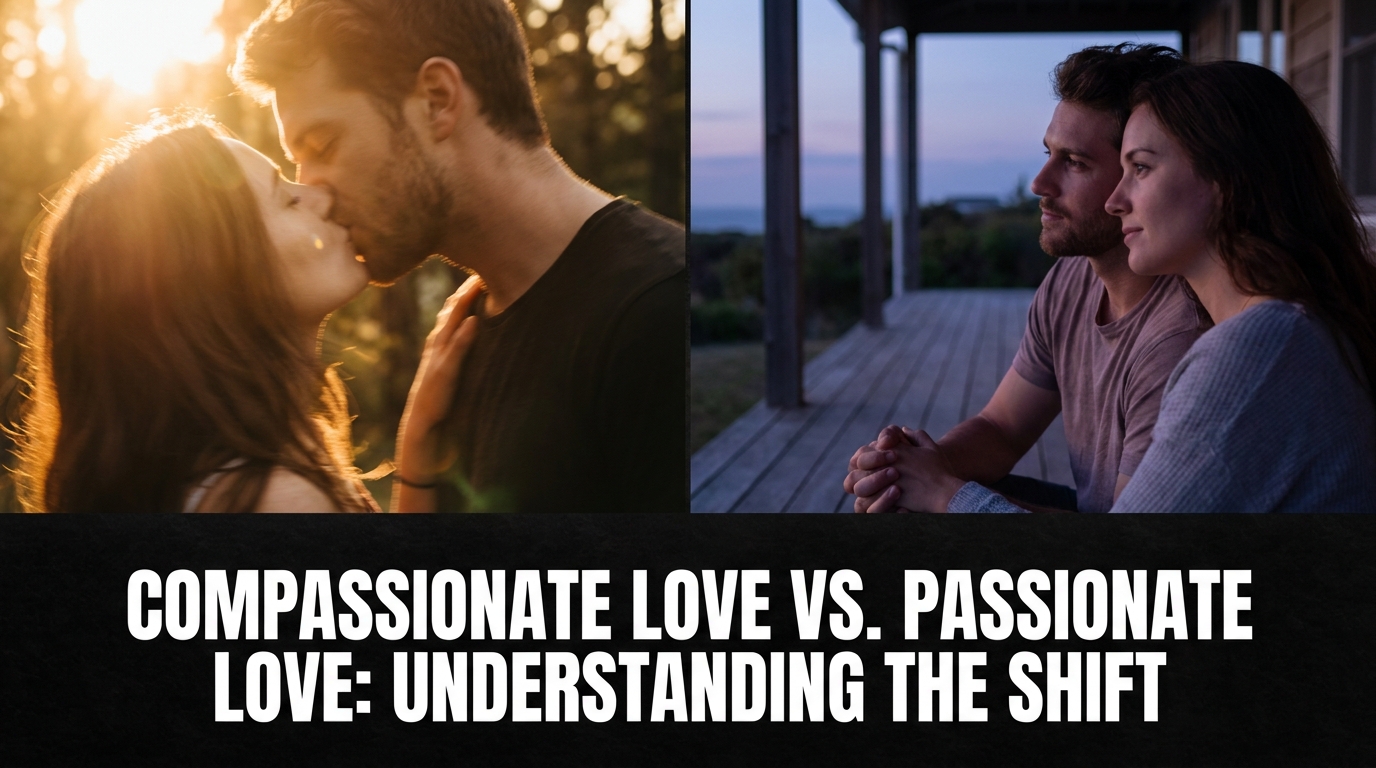
There was a time when you couldn’t keep your hands off each other. When a text from them made your whole body respond. When the anticipation of seeing them was almost unbearable — in the best possible way. And now you love them deeply, genuinely, completely — but the electricity has quieted into something softer. Something steadier. And you’re not sure whether that’s growth or loss.
You are not alone in asking that question. Research from Elaine Hatfield and Richard Rapson — two of the most cited psychologists in the study of romantic love — found that passionate love typically peaks in the early stages of a relationship and naturally transitions into what they term compassionate love over time, a shift that is neurologically predictable and psychologically universal. Yet despite how common this transition is, it remains one of the most misunderstood dynamics in long-term relationships — with many couples mistaking the shift from compassionate love vs. passionate love as evidence that something has gone wrong, when in fact it may signal that something has gone profoundly right.

What Is Passionate Love?
Passionate love is what most people mean when they say they are “falling in love.” It is the consuming, electric, all-encompassing state of early romantic attachment — characterized by intense longing, physical desire, intrusive thinking about the other person, and an emotional experience that oscillates wildly between euphoria and anxiety depending on how reciprocated the feelings appear to be.
Psychologically and neurologically, passionate love is a high-activation state. The brain during passionate love shows elevated activity in the dopamine reward system — the same circuitry activated by cocaine, according to Dr. Helen Fisher’s neuroimaging research. Norepinephrine floods the system, producing the physical symptoms most people associate with being in love: racing heart, loss of appetite, disrupted sleep, an almost painful awareness of the other person’s presence and absence.
Serotonin levels drop during passionate love — to levels similar to those observed in obsessive-compulsive disorder — which is why early romantic love has that compulsive, cannot-think-about-anything-else quality that is simultaneously exhilarating and slightly destabilizing.
Passionate love is also characterized by idealization. The prefrontal cortex — responsible for critical thinking and realistic assessment — shows reduced activity during passionate love. You are neurologically predisposed to see your partner in their best possible light, to minimize their flaws, and to interpret ambiguous signals generously. This is not delusion. It is biology serving the purpose of pair-bonding — creating enough initial attachment to give a relationship the chance to develop into something deeper.
What passionate love feels like: Urgent. Electric. Slightly anxious. Consuming. Physical. Obsessive in the most intoxicating way. The sense that this person is the most important thing in your world and that the feeling will last forever.

What Is Compassionate Love?
Compassionate love — sometimes called companionate love in psychological literature — is the deep, stable, enduring form of love that develops when two people have truly known each other over time. It is characterized not by intensity but by depth: by genuine knowledge of another person, consistent care for their wellbeing, emotional security in their presence, and a quiet but profound joy in the life built together.
Where passionate love is a high-activation neurological state, compassionate love is a regulated one. Oxytocin and vasopressin — the bonding hormones — take the lead. These chemicals produce the feelings most associated with compassionate love: warmth, safety, belonging, and the specific comfort of being fully known by someone who chooses to stay. Endorphins play an increasing role, creating a sense of ease and wellbeing in the presence of a long-term attachment figure that has no parallel in early romantic intensity.
Compassionate love is also more cognitively integrated — meaning it survives and deepens through full knowledge of a person, including their difficult qualities, their limitations, and their worst days. This is what distinguishes it most fundamentally from passionate love. Passionate love often loves an idealized version. Compassionate love knows the whole person — and loves them anyway.
What compassionate love feels like: Steady. Safe. Deeply familiar. The comfort of being completely known. Less electric — but more real. The quiet satisfaction of a life that includes this person rather than the urgent need to consume them entirely.
The Natural Shift: Why Passion Fades and Compassion Deepens
The transition from passionate to compassionate love is not a failure. It is a neurological necessity.
The high-activation state of passionate love — with its dopamine surges, its serotonin disruptions, and its norepinephrine-driven physical intensity — is metabolically expensive and neurologically unsustainable. The human brain cannot maintain that level of activation indefinitely any more than the body can maintain a sprint indefinitely. The shift to a more regulated neurochemical baseline is not the love ending. It is the love maturing into a form the brain and body can sustain across a lifetime.
Research from Stony Brook University found that long-term couples who reported high relationship satisfaction showed sustained activity in the brain’s dopamine reward centers when looking at photos of their partners — the same regions activated in early romantic love — alongside the oxytocin-mediated calm of deep attachment. In other words, the most successful long-term relationships are not ones where passion is replaced by compassion. They are ones where both coexist — passion in a more sustainable, chosen form, alongside the deep security of genuine attachment.
The shift typically begins around the 12 to 24 month mark in most relationships — though it varies significantly based on the individuals involved, the pace of the relationship’s development, and external circumstances. It is often experienced as a loss precisely because the transition happens gradually, without announcement, and in a culture that relentlessly glorifies passionate love while offering almost no language for the extraordinary beauty of its successor.

Why This Shift Gets Misread as a Problem
Despite being both universal and neurologically normal, the transition from passionate to compassionate love is one of the most common sources of relationship crisis — for several interconnected reasons.
Cultural messaging. Popular culture — film, music, social media — almost exclusively celebrates passionate love. The racing heart, the grand gesture, the overwhelming feeling. Compassionate love, by contrast, is almost invisible in the stories we tell about romance. The result is that when passion naturally softens, many people interpret it as a sign that they’ve chosen the wrong person — rather than recognizing it as the natural evolution of a deepening bond.
Comparison with new attraction. Encountering someone new — or noticing attraction to someone outside the relationship — during the compassionate phase produces the familiar neurochemical surge of passionate love. This contrast can be misread as evidence that the long-term relationship is lacking, when it is actually evidence of how passion works: it is always heightened by novelty and uncertainty. This contrast is not information about the relationship — it is information about brain chemistry.
Confusing depth with distance. The quieter emotional register of compassionate love can feel, from the inside, like emotional distance — particularly for people who associate love with intensity. The absence of anxiety is not the absence of love. The comfort of familiarity is not the absence of passion. But without a framework for understanding this, the shift can feel alarming.
Unaddressed relationship issues. It is also worth acknowledging that not every fading of passion is purely neurological. Sometimes the shift from passionate to compassionate love coincides with — or is accelerated by — unresolved conflict, emotional distance, or genuine incompatibility that has been quietly present all along. The neurological shift is normal; the question of whether it reveals something that needs attention is worth asking honestly.
Compassionate Love vs. Passionate Love: The Key Differences
| Passionate Love | Compassionate Love | |
|---|---|---|
| Emotional register | Intense, volatile, consuming | Steady, warm, regulated |
| Neurochemistry | Dopamine, norepinephrine, serotonin drop | Oxytocin, vasopressin, endorphins |
| Knowledge of partner | Idealized, partially constructed | Full, realistic, chosen |
| Source of joy | Anticipation, intensity, reciprocation | Presence, security, shared history |
| Relationship with flaws | Minimized or invisible | Known and accepted |
| Sustainability | Months to years | Decades, lifetime |
| Vulnerability | High — dependent on reciprocation signals | Lower — rooted in established trust |
| What it requires | Mostly chemistry and circumstance | Consistent choice and investment |
Can Passionate Love Be Sustained — Or Rekindled?
This is the question most people are really asking. And the answer is nuanced but genuinely hopeful.
Pure passionate love — in its early-stage, neurochemically-driven form — cannot be sustained indefinitely. Attempting to replicate the exact neurological state of early infatuation in a long-term relationship is not possible, and pursuing it as a goal often creates dissatisfaction with something that is, by any honest measure, far more valuable.
What can be sustained — and what can be rekindled after a period of drift — is a form of chosen passion: desire, novelty, physical intimacy, and emotional excitement that is deliberately cultivated rather than passively experienced. Research from Arthur Aron at Stony Brook University found that couples who regularly engage in novel, challenging, and exciting shared activities show significantly elevated relationship satisfaction and romantic intensity — suggesting that the brain’s novelty-seeking dopamine system can be reactivated within a long-term relationship through intentional experience.
The couples who maintain the richest combination of passionate and compassionate love are those who do several things consistently:
- They prioritize physical and emotional intimacy as something requiring active investment, not passive maintenance.
- They continue to introduce novelty — new experiences, new conversations, new shared challenges — rather than allowing the relationship to settle entirely into routine.
- They choose each other deliberately and visibly — through small acts of attention, expressed appreciation, and consistent prioritization.
- They maintain individual identities, friendships, and interests — because passion is sustained by two whole people encountering each other, not two people who have merged entirely.
- They address conflict and emotional distance promptly, rather than allowing grievances to accumulate into the kind of quiet resentment that passion cannot survive.

What Compassionate Love Offers That Passionate Love Cannot
Before ending on rekindling passion, it is worth pausing to genuinely honor what compassionate love offers — because it is not simply a consolation prize for faded intensity. It is, in many respects, the deeper gift.
Being fully known. Passionate love loves a version of you — the best-lit, most carefully presented version. Compassionate love has seen your worst days, your difficult moods, your fears and failures — and stays anyway. The experience of being genuinely known and genuinely chosen is one that passionate love, by its nature, cannot yet offer.
Nervous system safety. The regulated neurochemistry of compassionate love produces something the body cannot sustain during passionate love: genuine rest. Research has shown that long-term partners’ nervous systems actually co-regulate — each person’s calm presence can lower the other’s cortisol and heart rate in ways that improve physical health over time.
Depth of shared meaning. The history two people build — the experiences, losses, joys, and growth navigated together — creates a richness of shared meaning that is simply unavailable to passionate love’s early intensity. This shared narrative is one of the most profound sources of human belonging.
Love as a choice. Perhaps the most significant gift of compassionate love is that it is chosen. Every day, through the ordinary, unremarkable dailiness of a life shared — it is chosen again. That choice, made without the neurochemical compulsion of passionate love’s early stages, may be the most honest and beautiful form that love takes.

The Bottom Line
Compassionate love vs. passionate love is not a competition — and it is not a trajectory from better to worse. It is a natural, neurologically mapped evolution from one extraordinary form of love to another. The shift is not the relationship declining. It is the relationship deepening into something that passionate love, for all its electricity, could never fully offer.
The question to ask is not “where did the passion go?” but “are we choosing each other — actively, consistently, and with genuine care?” Because a relationship that asks and honestly answers yes to that question, across years and difficulties and ordinary Tuesdays, is not a lesser love. It is love in its most mature and most human form.
The butterflies were the beginning. The person still beside you after everything — that is the answer. Not to a question you asked in the beginning, but to every question that came after.
📌 Save, Share & Follow
💾 SAVE this article — share it with yourself for the next time the quieter love feels like it might not be enough. 📤 SHARE this with someone in a long-term relationship who might be mistaking depth for distance. 👉 FOLLOW TruthsInside.com for more honest, psychology-backed content on love, relationships, and the human experience.
❓ Frequently Asked Questions
Q1: Is it normal to miss passionate love when you’re in a compassionate relationship? Completely normal — and almost universal. The intensity of early passionate love is a genuinely extraordinary experience, and its natural softening can feel like something lost even when something richer has replaced it. What matters is whether the longing for passion is a signal to invest more actively in the relationship — or a signal that something important is genuinely missing and needs to be addressed.
Q2: Can you have both compassionate and passionate love at the same time? Yes — and this combination represents what relationship researchers consider the most fulfilling long-term romantic experience. Psychologist Robert Sternberg’s Triangular Theory of Love describes the coexistence of intimacy, passion, and commitment as “consummate love” — the fullest expression of romantic partnership. It requires active investment but is entirely achievable.
Q3: What if my partner seems satisfied with compassionate love but I still want more passion? This is a conversation worth having — directly and without blame. Differences in desire for romantic intensity are common and workable, but they require honest communication rather than silent resentment or resignation. A couples therapist can help navigate this difference in a way that honors both partners’ needs.
Q4: Does the shift from passionate to compassionate love happen at the same pace for everyone? No. The timeline varies significantly based on attachment style, relationship pace, individual neurochemistry, and external circumstances. Some people experience the shift gradually over years; for others it happens more abruptly. There is no correct pace — only the honest question of whether both people are moving through it together.
Q5: If the passion has been gone for years, can it come back? It can be rekindled — but it requires genuine investment from both partners and an honest assessment of what has created the distance. Passion in long-term relationships rarely returns on its own; it returns through new shared experiences, renewed emotional intimacy, physical reconnection, and the deliberate choice to prioritize each other again. Couples therapy can be enormously valuable when the distance feels too wide to bridge alone.
🎵 Music
Maren Lull is a singer-songwriter who writes from the places most people don’t talk about out loud.
Not the dramatic grief. Not the obvious heartbreak. The quiet kind — the ordinary Tuesday emptiness, the habit of reaching for someone who isn’t there anymore, the particular exhaustion of being strong for so long that the strength itself wears thin.
Her music lives at the intersection of emotional honesty and soft beauty — breathy vocals over gentle piano, slow tempos, lyrics that feel less like songs and more like something you wrote in a private notebook at two in the morning and never showed anyone.
Maren Lull writes for the people who feel everything deeply and say very little about it. For the ones who listen to sad music not because they want to feel worse — but because being understood, even by a song, makes the feeling easier to carry.
📱 Follow Maren Lull:
→ Spotify
→ Apple Music
→ Youtube
→ Audiomack