The emotion wheel and naming your feelings with precision are not just psychological tools. They are the foundation of one of the most transformative communication shifts available to anyone in a relationship — and they are almost entirely absent from how most people are taught to talk about their inner lives.
Think about the last time something happened in your relationship that genuinely affected you. Not a catastrophic event — just a moment. A comment your partner made. The way they responded when you needed something. The silence after a conversation that felt unfinished. Something small that somehow landed with a weight that surprised you.
Now think about what you said when they asked what was wrong.
“Nothing.” “I’m fine.” “I don’t know, I just feel off.” “I’m upset.” “I’m stressed.”
These are not dishonest answers. They are the answers of someone reaching into their emotional vocabulary and finding it significantly less equipped than their emotional experience actually requires. They are the answers of a person who has a rich, complex, highly specific inner experience and a limited set of linguistic tools with which to communicate it — and who, without realizing it, is asking the people they love to understand something that has not been given sufficient language to be understood.
This gap between the complexity of what we feel and the precision of what we can say is one of the most quietly consequential sources of relational misunderstanding, unresolved conflict, and felt disconnection in intimate relationships. And the emotion wheel is one of the most powerful tools available for closing it.
Research from the University of California, Berkeley, led by psychologist Lisa Feldman Barrett, found that people with higher emotional granularity — the ability to differentiate between specific emotional states with precision rather than lumping experiences into broad categories like “good” or “bad” — reported significantly better relationship quality, lower levels of interpersonal conflict, and greater capacity for emotional regulation than those with lower emotional granularity. They were also less likely to engage in aggressive or avoidant behaviors during conflict, and more likely to seek and provide effective social support.
The emotion wheel is a tool for building emotional granularity. And emotional granularity, the research tells us, transforms relationships.

What Is the Emotion Wheel?
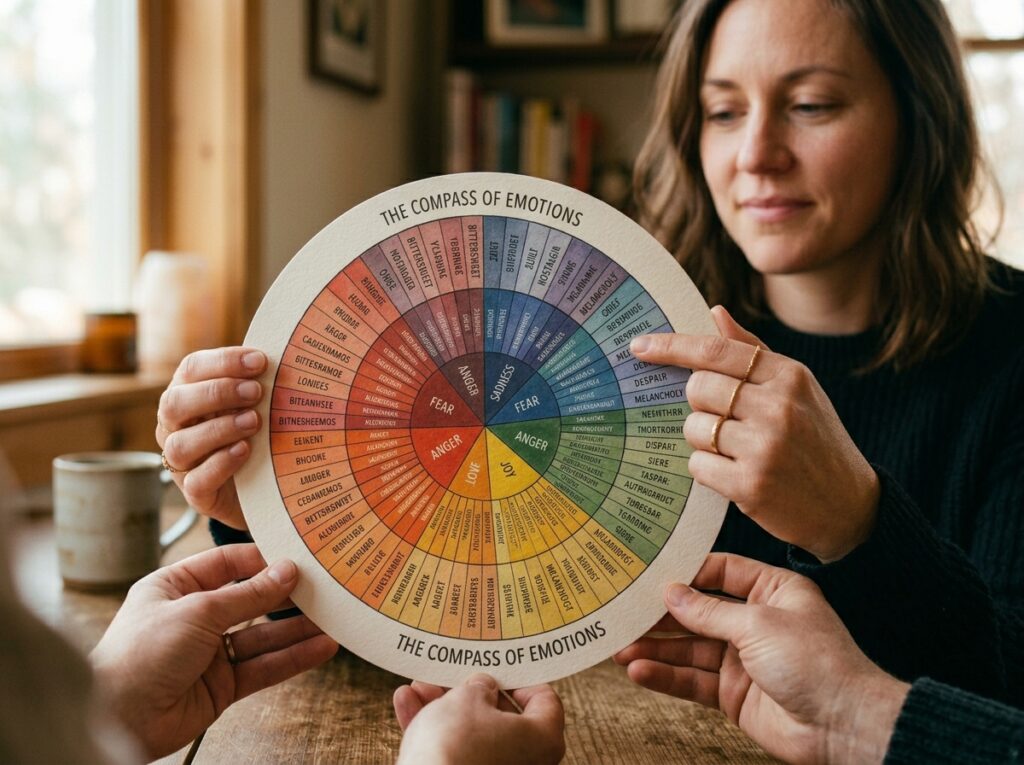
The emotion wheel is a visual tool developed by psychologist Robert Plutchik in 1980 as part of his broader psychoevolutionary theory of emotion. Plutchik identified eight primary, biologically primitive emotions — joy, trust, fear, surprise, sadness, disgust, anger, and anticipation — and arranged them in a wheel structure that illustrates both their relationships to each other and the spectrum of intensity through which each emotion can be experienced.
In Plutchik’s original model, the wheel has three concentric layers. The innermost layer contains the most intense expressions of each primary emotion. The middle layer contains the primary emotions at their characteristic intensity. The outer layer contains the mildest, most nuanced expressions of each emotion — the subtle variants that most people struggle to name because they exist at the edge of conscious awareness.
Between the primary emotions, the wheel also represents what Plutchik called dyads — combinations of two primary emotions that produce more complex emotional states. Love, for example, is represented as a combination of joy and trust. Contempt is a combination of disgust and anger. Optimism is a combination of anticipation and joy.
Since Plutchik’s original model, the emotion wheel has been developed and expanded by numerous researchers and clinicians. The most widely used contemporary version — often called the feelings wheel in therapeutic contexts — extends well beyond Plutchik’s original eight primaries to include hundreds of more specific emotional states arranged around and within the basic primary categories. This expansion is the source of its most powerful practical application: the ability to move from the broad, imprecise language of primary emotions into the specific, nuanced vocabulary of precise emotional experience.
When someone says they feel sad, the feelings wheel offers dozens of more specific alternatives: grief, disappointment, guilt, shame, remorse, regret, isolated, lonely, abandoned, bored, apathetic, despair. Each of these is a real, specific, phenomenologically distinct emotional state — and each one, when accurately identified and named, opens a different conversational door and requires a different relational response.
This is the power of the emotion wheel. Not as an academic classification system, but as a practical tool for the most consequential translation work available in human relationships: the translation of inner experience into shared language.
The Science of Emotional Granularity
The psychological concept that underpins the emotion wheel’s transformative potential in relationships is emotional granularity — a term coined by Lisa Feldman Barrett to describe the degree to which a person can differentiate between their emotional states with specificity and precision.
Research on emotional granularity is extensive and consistently points in the same direction: people who experience and report their emotions with greater specificity function significantly better across a wide range of psychological and interpersonal domains than those who experience their emotions in broad, undifferentiated categories.
In a landmark study, Barrett and colleagues had participants report their emotional states multiple times per day over several weeks. They found that individuals with high emotional granularity — those who consistently differentiated between specific emotional states rather than reporting only global positive or negative affect — showed measurably lower intensity of negative emotional experiences, faster emotional recovery from setbacks, and significantly better interpersonal functioning than those with low emotional granularity.
Critically for our purposes, the high emotional granularity group also showed dramatically different behavior during interpersonal conflict. They were less likely to respond to negative social experiences with aggressive behavior, less likely to engage in avoidance behaviors that perpetuate conflict, and more likely to engage in the kind of reflective, communicative responses that allow conflict to be resolved rather than repeated.
Barrett’s explanation for these differences is elegant and important: when you can differentiate between your emotional states with precision, you have more information about what you actually need. The person who knows they feel not just “bad” but specifically ashamed has a much clearer sense of what their emotional experience requires — the reassurance of being told they are not defined by the thing they feel ashamed about — than the person who can only access the broad category of feeling bad.
Precision of emotional naming is not just about communication with others. It is about the quality of information available to your own regulatory system. The more precisely you can name what you feel, the more precisely you can attend to what you need — and the more precisely you can communicate that need to the people who love you and want to respond.
“Naming what you feel with precision is not emotional indulgence. It is emotional intelligence in its most practical form — the act of making your inner world legible, first to yourself and then to the people who love you.”
Why Most People Have an Inadequate Emotional Vocabulary
Before exploring how the emotion wheel transforms relationships, it is worth understanding why most people arrive in their relationships with an emotional vocabulary that is significantly less developed than their emotional experience requires.
The Socialization of Emotional Suppression
Most people receive explicit or implicit socialization toward emotional minimization rather than emotional precision from early in life. “Don’t cry.” “Be strong.” “Don’t be so sensitive.” “You’re fine.” These messages, delivered with varying degrees of intention and consistency throughout childhood, communicate a clear cultural directive: emotional experience should be minimized, managed, and contained rather than identified, expressed, and communicated.
The consequence of this socialization is not the absence of emotional experience — emotions are neurobiologically generated processes that cannot be eliminated by cultural directive. The consequence is the absence of the vocabulary and the permission to articulate those experiences with specificity. The emotions exist. The language and the cultural safety for naming them precisely do not.
The Gender Dimension
Emotional vocabulary development has a significant gender dimension that is critical to understanding why many relationships experience the specific communication dynamics they do.
Research consistently documents that girls and women are socialized toward greater emotional expressiveness and greater emotional vocabulary development from early in childhood, while boys and men are socialized toward emotional suppression, minimization, and the specific restriction of permissible emotional expression to the narrower range of socially approved male emotional states — primarily anger and enthusiasm.
This socialization differential produces, in adult intimate relationships, a pattern that couples therapists encounter with remarkable consistency: one partner with a relatively developed emotional vocabulary and relative comfort with emotional expression, and one partner with a significantly more limited emotional vocabulary and significant discomfort with the vulnerability that emotional precision requires.
This is not a character deficit in either partner. It is the predictable product of differential socialization — and it is addressable through exactly the kind of intentional emotional vocabulary development that the emotion wheel facilitates.
The Absence of Emotional Education
Perhaps most fundamentally, the precision of emotional identification and naming is simply not taught — in most homes, in most schools, and in most cultural contexts. People learn academic vocabulary, mathematical vocabulary, scientific vocabulary. They are almost never taught the vocabulary of their own inner emotional lives with any comparable precision or intentionality.
The result is a population of emotionally complex adults who navigate their most significant relationships using the emotional vocabulary of elementary school children — a vocabulary that includes happy, sad, angry, scared, and not much else. And then we wonder why our most important conversations so consistently fail to accurately convey what we actually mean.
How Limited Emotional Vocabulary Damages Relationships
The consequences of limited emotional vocabulary in intimate relationships are specific, consistent, and well-documented in relationship research.
The Fundamental Attribution Error in Conflict
When someone cannot name their emotional experience with precision, they frequently externalize it — attributing the cause of their distress to the other person’s behavior rather than exploring the internal experience that the behavior triggered. “You made me feel bad” is the linguistic expression of someone who cannot yet say “what you said triggered the shame I carry about not being enough.”
The first framing — you made me feel bad — invites defensiveness, counter-accusation, and the cyclical conflict that resolves nothing. The second framing — specific, owned, emotionally precise — invites genuine understanding and the kind of relational response that actually addresses the underlying experience.
This is not a small difference. It is the difference between a conflict that escalates and one that transforms into genuine connection. And it is produced, entirely, by the precision of the emotional language available to the person experiencing the emotion.
The Withdrawal Dynamic
One of the most damaging conflict patterns in intimate relationships — identified by Gottman as part of his Four Horsemen research — is emotional stonewalling: the complete withdrawal of emotional engagement during conflict. Research consistently finds that stonewalling is more often an involuntary response to emotional overwhelm than a deliberate choice — the person who stonewalls is typically experiencing a level of emotional activation that exceeds their capacity for verbal engagement.
Emotional granularity — the ability to identify and name specific emotional states — is directly protective against this overwhelm dynamic. When you can name what you are experiencing — “I feel overwhelmed right now and I need fifteen minutes to regulate before I can continue this conversation” — you have transformed an involuntary shutdown into a communicative act. You have converted stonewalling into what Gottman calls a “physiological self-soothing break” — and you have done it in a way that keeps your partner informed and the connection intact.
Without the emotional vocabulary to make this conversion, the overwhelm produces the shutdown, the shutdown is experienced by the partner as abandonment, and the conflict escalates into the territory of relational injury that is far harder to repair.
The Invisible Need Problem
Perhaps the most quietly consequential consequence of limited emotional vocabulary in relationships is what might be called the invisible need problem. When you cannot name what you feel with precision, you cannot communicate what you need with clarity. And when you cannot communicate what you need with clarity, the people who love you — however willing they are to respond — are essentially working blind.
This produces the specific, painful experience of feeling deeply unmet in a relationship by a partner who is genuinely trying to meet you — and of them feeling perpetually inadequate because no matter what they offer, it is not quite right. The emotional need exists. The language to make it visible does not. And the relationship suffers in the gap.

Using the Emotion Wheel: A Practical Guide
The emotion wheel is not a passive educational resource. It is an active, usable tool — and understanding how to use it transforms it from an interesting piece of psychology into one of the most practically powerful relationship tools available.
Step 1: Start at the Center
When you are trying to identify what you are feeling, begin at the center of the emotion wheel — the primary emotion categories. Ask yourself which of the primary emotions most closely approximates your current experience. Are you in the territory of anger? Sadness? Fear? Joy? Disgust? Surprise? Trust? Anticipation?
Starting at the center is not about accepting the primary emotion as the complete description of your experience. It is about orienting yourself — getting your approximate location in the emotional landscape before beginning to navigate toward greater specificity.
Step 2: Move Outward Toward Greater Specificity
Once you have identified your primary emotional territory, move outward through the wheel’s concentric rings toward more specific emotional states. If you are in the territory of anger, the wheel offers more specific alternatives: annoyed, frustrated, hostile, irritated, exasperated, enraged. If you are in the territory of sadness, it offers: disappointed, lonely, abandoned, guilty, ashamed, bored, isolated, hopeless.
As you move outward, ask yourself which specific word most accurately captures the quality of your experience — not just its general direction but its specific texture, its specific flavor. The right word will often produce a small but distinct internal recognition — a sense of “yes, that is it” that is qualitatively different from settling for an approximation.
Step 3: Check the Intensity Dimension
Many emotion wheel versions include an intensity dimension — the recognition that the same emotional state can be experienced at different intensities that are themselves important information. The difference between feeling annoyed and feeling enraged is not just a difference of degree — it is information about how urgently the underlying need requires attention and what kind of relational response is most appropriate.
Identifying not just the specific emotional state but its intensity provides a more complete communication — “I feel deeply ashamed, not just a little embarrassed” conveys something both qualitatively and quantitatively different than the simpler version, and invites a correspondingly more attuned response.
Step 4: Look for Emotional Combinations
Following Plutchik’s original insight about dyadic emotions, many complex emotional experiences are not single emotions but combinations — and identifying the combination is often more accurate and more useful than trying to reduce the experience to a single term.
Feeling jealous, for example, typically involves a combination of fear — of loss — and anger — at the perceived threat — and sometimes sadness — at the felt inadequacy. Naming all three components, even approximately, communicates something significantly richer and more accurate than the single word jealous — and invites a correspondingly more nuanced and more genuinely responsive relational engagement.
Step 5: Share the Finding
The emotion wheel’s transformative potential in relationships is not activated until the identified emotion is shared — expressed to the partner in a way that makes the inner experience legible. This sharing is where the translation work completes itself: from internal experience, through the emotion wheel’s vocabulary, into shared relational language.
The format that tends to work most effectively is simple and direct: “I realized I’m not just upset — I’m feeling [specific emotion]. It’s about [the underlying experience or need].” This format does two things simultaneously: it demonstrates the emotional precision work you have done, and it opens the door for a genuinely responsive, specifically targeted relational exchange.
The Emotion Wheel in Practice: Real Relationship Scenarios
Understanding the theory of emotional granularity is one thing. Seeing it in the specific, practical context of real relationship dynamics brings its transformative potential to life in a way that makes it immediately usable.
Scenario 1: The Conflict That Goes Nowhere
A familiar pattern: your partner says something that affects you, you tell them you are upset, they explain themselves, you remain upset, they become frustrated that their explanation did not resolve things, you both feel worse than before the conversation started.
The emotion wheel intervention: before the next iteration of this conversation, use the wheel to identify what you are actually feeling. If the word is not upset but ashamed — if what you are feeling is not anger at what they said but shame triggered by what their words implied about your worth — then the conversation you need to have is completely different. It is not “what you said was wrong” but “what you said touched a shame I carry about [specific thing], and what I need from you is [specific response].”
That conversation does not go in circles. It goes somewhere.
Scenario 2: The Partner Who Says They Are Fine
The person who consistently responds to “are you okay” with “I’m fine” when they are clearly not fine is not necessarily being dishonest. They may simply not have access, in that moment, to a more specific answer — and the pressure to produce a specific answer they do not have may produce the closure of “fine” as a protective response.
The emotion wheel creates an alternative. When both partners have access to the tool, the conversation can shift: “I can see something is happening for you. Would it help to look at the wheel together and see if something on there is closer?” This approach removes the pressure of spontaneous emotional production and creates a collaborative, tool-supported space for the more specific answer to emerge without shame or urgency.
Scenario 3: The Recurring Argument
Most couples have at least one recurring argument — a conflict that revisits itself with depressing regularity, that each partner believes they have addressed, and that returns without apparent resolution or evolution.
Recurring arguments are almost always the surface expression of an underlying emotional experience that has not yet been accurately named or adequately responded to. The emotion wheel — used by both partners, ideally with a therapist’s facilitation — can be the tool that reveals what the argument is actually about beneath its recurring surface form.
When the person who becomes angry in the recurring argument discovers that what they are actually feeling is not anger but betrayal — when the person who withdraws recognizes that what is driving their withdrawal is not indifference but shame and overwhelm — the recurring argument has the opportunity to become a genuine, new conversation about something that actually requires resolution.
“The recurring argument in your relationship is not a character flaw on either side. It is an emotional experience that has not yet been named precisely enough to be genuinely heard — and a need that has not yet been communicated clearly enough to be genuinely met.”

How Emotional Naming Transforms Intimacy
Beyond conflict resolution, the practice of emotional naming with precision transforms the texture of everyday relational intimacy in ways that go well beyond the obvious communication benefits.
The Experience of Being Truly Known
In our exploration of mirror neurons, we identified the human longing to be truly known — not just liked or desired but genuinely, accurately, deeply understood in one’s inner experience. The emotion wheel supports this deepest form of relational intimacy by making the inner experience consistently more legible.
When you can tell your partner not just that you are happy but that you feel profoundly grateful and peacefully content — when you can tell them not just that something bothered you but that you feel specifically disappointed and slightly embarrassed — you are giving them access to your inner world with a precision that ordinary emotional language cannot provide.
And when they receive that precision with genuine attentiveness — when they respond to the specific emotion you have named rather than to their assumption of what you probably meant — the felt experience of being truly known becomes available in its fullest form. Not as an occasional peak experience but as the ordinary, daily texture of a relationship built on emotional precision and genuine mutual attunement.
The Building of Emotional Safety
Emotional safety in a relationship — the confidence that your inner experience will be received with care rather than judgment, minimization, or redirection — is one of the most foundational elements of secure attachment and long-term relationship quality.
The consistent practice of emotional naming — both sharing your own precise emotional states and responding to your partner’s with genuine, attentive recognition — builds emotional safety incrementally and sustainably. Each exchange in which a specifically named emotion is met with genuine, accurate responsiveness adds a layer to the foundation of emotional safety. Over time, that foundation becomes the bedrock of a relationship in which both people feel genuinely free to have their full inner life — not the edited, managed, “fine” version, but the actual one.
The Deepening of Physical Intimacy
The connection between emotional naming and physical intimacy is direct and documented. Research consistently finds that emotional intimacy — the felt sense of being genuinely known and genuinely understood — is one of the strongest predictors of sexual satisfaction and physical closeness in long-term relationships.
When both partners have the emotional vocabulary to name what they experience in their physical life together — not just “that was nice” but the specific, vulnerable, precisely named emotional experience of genuine physical closeness — the depth of that closeness increases correspondingly. Emotional precision in physical intimacy is not clinical or cold. It is the opposite — it is the vulnerability of being truly present and truly specific in the most intimate domain of a shared life.
Building Your Emotional Vocabulary: A Daily Practice
The emotion wheel is not a tool you use once and set aside. Its transformative potential is activated through regular, intentional practice — the gradual, sustained expansion of your emotional vocabulary as a living, daily habit.
The Daily Emotional Check-In
Establish a daily practice of consulting the emotion wheel for your own internal experience — not in crisis, not only when something has gone wrong, but as a regular, brief practice of emotional self-orientation. What am I actually feeling right now? What specific words from the wheel most accurately name what is present?
This practice, sustained over weeks and months, builds emotional granularity not as an emergency resource but as an ordinary capacity — available in the moments when you most need it because it has been consistently exercised in the moments when the stakes were lower.
The Partner Check-In Ritual
Many couples who incorporate the emotion wheel into their relational practice develop a specific ritual — a daily or several-times-weekly check-in in which both partners share not just the events of their day but the specific emotional experience of it. “The most specific emotion I felt today was [word from the wheel], because [brief context].”
This ritual does several things simultaneously. It exercises emotional vocabulary in both partners. It creates a regular, low-stakes space for emotional sharing that is protected from the urgency and reactivity of conflict. It builds the habit of genuine emotional communication as a normal feature of the relationship rather than a crisis-only resource. And it generates, over time, a shared emotional language — specific words and references that belong to the relationship’s particular emotional vocabulary in the way that inside jokes belong to a couple’s shared history.
The Emotion Wheel in Conflict
When conflict arises, the emotion wheel can be explicitly introduced as a tool — either by one partner reaching for it independently, or by both partners agreeing to pause and use it together before continuing a conversation that has become reactive.
The agreement might be simple: “When things get heated, either of us can call for a wheel pause — five minutes each to look at the wheel and identify more specifically what we are actually feeling before we continue.” This agreement transforms the emotion wheel from a self-help tool into a relational protocol — something the relationship itself has adopted as part of its conflict navigation resources.

The Emotion Wheel and Self-Understanding: Beyond Relationships
While this article has focused primarily on the emotion wheel’s transformative potential in intimate relationships, it is worth acknowledging that the practice of emotional naming with precision has profound individual benefits that extend beyond relational communication.
Research consistently links emotional granularity to improved individual mental health outcomes — including lower rates of depression and anxiety, greater psychological resilience, and more effective emotional regulation under stress. Barrett’s research found that people with high emotional granularity were better able to distinguish between states that require different regulatory responses — understanding, for example, that the racing heart and hypervigilance they feel before an important presentation is not the same emotional state as the racing heart and hypervigilance they feel when they sense genuine danger, and regulating each appropriately.
This self-regulatory precision is not incidental to relational wellbeing. It is one of its foundational supports. The person who can accurately name and regulate their own emotional experience brings a significantly more stable, more self-aware, and more genuinely available self to their relationships than the person who navigates their inner life in the broad, imprecise categories of generic emotional language.
Building your emotional vocabulary through the emotion wheel is not just relationship work. It is self-work — and the self that emerges from that work is a better partner, a more genuine friend, a more self-compassionate human being.
The Single Most Powerful Sentence You Can Learn
In all of the relationship advice, communication research, and psychological guidance that exists, there may be no single sentence more consistently transformative in intimate relationships than this one:
“I realized I’m not just [basic emotion] — I’m actually feeling [specific emotion from the wheel], because [the underlying experience it connects to].”
This sentence does several things simultaneously. It demonstrates self-awareness and emotional work. It communicates something precise and therefore more easily responded to. It invites the partner into the specific experience rather than leaving them to navigate a generic category. And it models the emotional vulnerability that, when consistently demonstrated by both partners, builds the emotional safety that is the foundation of genuine intimacy.
“I realized I’m not just upset — I’m feeling betrayed. Because what you did made me feel like I’m not a priority to you, and that touches something I’ve been afraid of in this relationship.”
“I realized I’m not just stressed — I’m feeling overwhelmed and ashamed. Because I feel like I’m failing at something I genuinely care about, and I haven’t known how to say that.”
“I realized I’m not just happy — I’m feeling deeply grateful and a little in awe. Because what you did for me today reminded me of exactly why I love being with you.”
Each of these sentences is possible when you have the vocabulary to produce it. The emotion wheel is where that vocabulary lives. And practicing with it — regularly, honestly, with the genuine intention of making your inner world more legible — is one of the most loving things you can do for the people who are trying to know you.
Frequently Asked Questions
Q1: Is the emotion wheel scientifically validated, or is it just a self-help tool?
The emotion wheel is grounded in Robert Plutchik’s psychoevolutionary theory of emotion, which is a scientifically developed framework with empirical support — though, like all models of complex psychological phenomena, it is not without its critics and limitations. More broadly, the practice of emotional granularity that the wheel facilitates is extensively supported by peer-reviewed research across multiple psychological domains, including the work of Lisa Feldman Barrett, James Gross, and numerous other emotion researchers. Whether or not Plutchik’s specific eight-primary-emotion model captures the full complexity of human emotional experience, the practical principle it supports — that naming emotions with greater specificity produces better individual and relational outcomes — is among the most robustly supported findings in emotion psychology.
Q2: What if my partner is resistant to using the emotion wheel or to emotional vocabulary work generally?
Resistance to emotional vocabulary development is common — particularly among individuals who were socialized toward emotional suppression or who have significant discomfort with emotional vulnerability. The most effective approach is rarely direct advocacy for the tool itself, but rather the modeling of its use in your own communication. When you consistently express your own emotional experiences with greater precision — when your partner repeatedly observes the specific relational benefits of emotional naming in your conversations — curiosity about the tool often develops naturally. Couples therapy with a therapist who incorporates emotional vocabulary work into their practice can also provide a structured, professionally supported context for introducing the tool in a way that feels collaborative rather than prescriptive.
Q3: Can the emotion wheel help with emotions that feel too big or overwhelming to name?
Yes — and this is one of its most valuable applications. When emotional experience feels too large, too complex, or too overwhelming for language, the structure of the emotion wheel can provide a scaffolding for approaching it gradually. Starting at the center — finding approximate primary emotional territory — and moving outward incrementally as tolerance permits, the wheel allows overwhelming emotional experience to be approached in manageable steps rather than having to be immediately and fully articulated. Many trauma therapists incorporate modified emotion wheel work into their practice precisely because of this capacity to make overwhelming emotional experience approachable through incremental, structured naming.
Q4: How long does it take to meaningfully expand emotional vocabulary through emotion wheel practice?
Research on emotional vocabulary development suggests that meaningful, measurable increases in emotional granularity are achievable within four to six weeks of regular, intentional practice — with more substantial development visible at three to six months. Like any vocabulary development, the timeline is significantly accelerated by frequency of practice and by the active use of newly acquired words in real communicative contexts rather than passive familiarity with them. The most effective development occurs when emotion wheel work is integrated into daily practice — both independently and in partnership — rather than reserved for crisis or conflict situations.
Q5: Are there different versions of the emotion wheel for different purposes or populations?
Yes — the emotion wheel has been adapted across numerous contexts and populations since Plutchik’s original model. The Geneva Emotion Wheel, developed by researchers at the University of Geneva, is specifically designed for research contexts and offers a different organizational structure. Gloria Willcox’s feelings wheel, which expands significantly beyond Plutchik’s original eight primaries, is widely used in therapeutic and educational contexts. Pediatric versions with simplified language and visual supports have been developed for use with children. And culturally adapted versions have been developed that incorporate emotional vocabulary specific to non-Western emotional frameworks — acknowledging that the full range of human emotional experience may not be perfectly captured by any single cultural or linguistic lens.
Save This. Share This. Follow For More.
💾 Save this article — and the next time you feel something you cannot name, come back to it. The word you need is in here, or it points you toward where to find it.
📤 Share this with someone who has ever said “I don’t know how I feel” or “I can’t explain it” — and who deserves the tools to finally find the words for what they have been carrying.
👉 Follow Truthsinside.com for more deeply researched, compassionately written content on love, emotions, relationship psychology, and the truths about human inner life that are most worth understanding clearly.
📃 Related article: The 5 Love Languages Explained: Which One Are You?
Because being truly known by the people you love begins with knowing — and naming — yourself.
🎵 Music
Maren Lull is a singer-songwriter who writes from the places most people don’t talk about out loud.
Not the dramatic grief. Not the obvious heartbreak. The quiet kind — the ordinary Tuesday emptiness, the habit of reaching for someone who isn’t there anymore, the particular exhaustion of being strong for so long that the strength itself wears thin.
Her music lives at the intersection of emotional honesty and soft beauty — breathy vocals over gentle piano, slow tempos, lyrics that feel less like songs and more like something you wrote in a private notebook at two in the morning and never showed anyone.
Maren Lull writes for the people who feel everything deeply and say very little about it. For the ones who listen to sad music not because they want to feel worse — but because being understood, even by a song, makes the feeling easier to carry.
📱 Follow Maren Lull:
→ Spotify
→ Apple Music
→ Youtube
→ Audiomack