
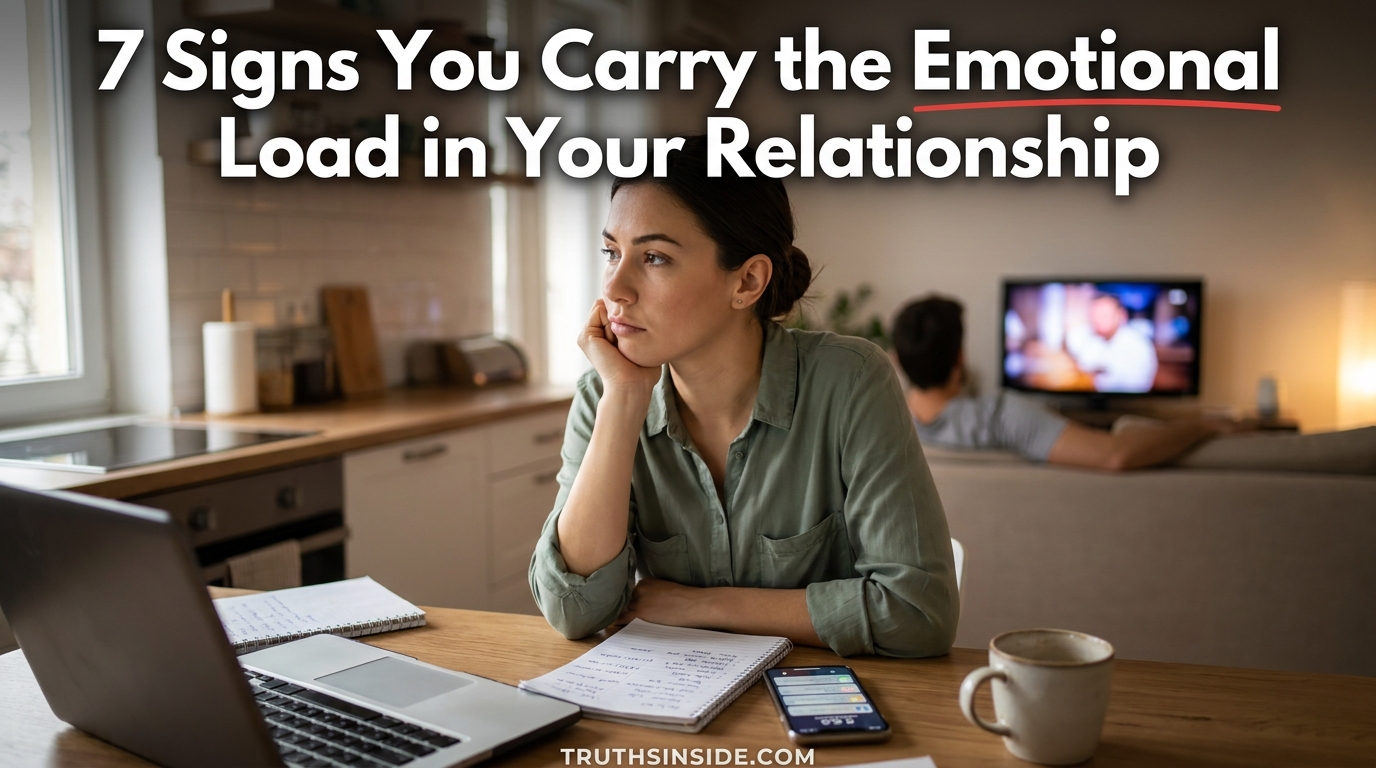
The emotional load in relationships is one of the most exhausting and least talked about imbalances in modern love — and if you have ever felt like you are the one holding everything together while your partner simply moves through the relationship without carrying the same invisible weight, you are far from alone.
Research published in the American Sociological Review found that even in relationships where both partners work full-time and consider themselves equals, women disproportionately carry the bulk of emotional and mental labor — tracking, planning, anticipating, and managing the emotional health of the relationship itself. But this is not exclusively a gendered issue. In relationships of all kinds, one partner frequently ends up shouldering far more than their share of the invisible work that keeps love alive and functioning.
What makes the emotional load so uniquely draining is that it is almost entirely invisible. Nobody sees it. Nobody thanks you for it. There is no finished product to point to at the end of the day — just the constant, relentless awareness of everything that needs to be felt, remembered, managed, and maintained. And because it is invisible, it is also easy for the partner who carries less of it to genuinely not realize how much the other is doing — which means the imbalance can persist for years without either person fully understanding why one of them is slowly burning out.
This article is for the partner who is tired. The one who always initiates the difficult conversations, who remembers every important date, who manages the emotional temperature of every room, who worries about the relationship even when everything seems fine on the surface. What you are experiencing has a name, it has research behind it, and there are real, meaningful ways to address it — without destroying the relationship in the process.
What Exactly Is the Emotional Load in a Relationship?
The term emotional load — sometimes called emotional labor or the mental load — refers to the invisible cognitive and emotional work required to keep a relationship and a household functioning smoothly. It is not just the tasks themselves. It is the awareness, the anticipation, the planning, the worrying, and the managing that precede and surround those tasks.
Sociologist Arlie Hochschild first introduced the concept of emotional labor in her 1983 book The Managed Heart, where she examined how certain workers — particularly women — were expected to manage their own emotions as part of their professional role. The concept has since been widely applied to intimate relationships, where one partner frequently takes on the invisible role of emotional manager for the entire partnership.
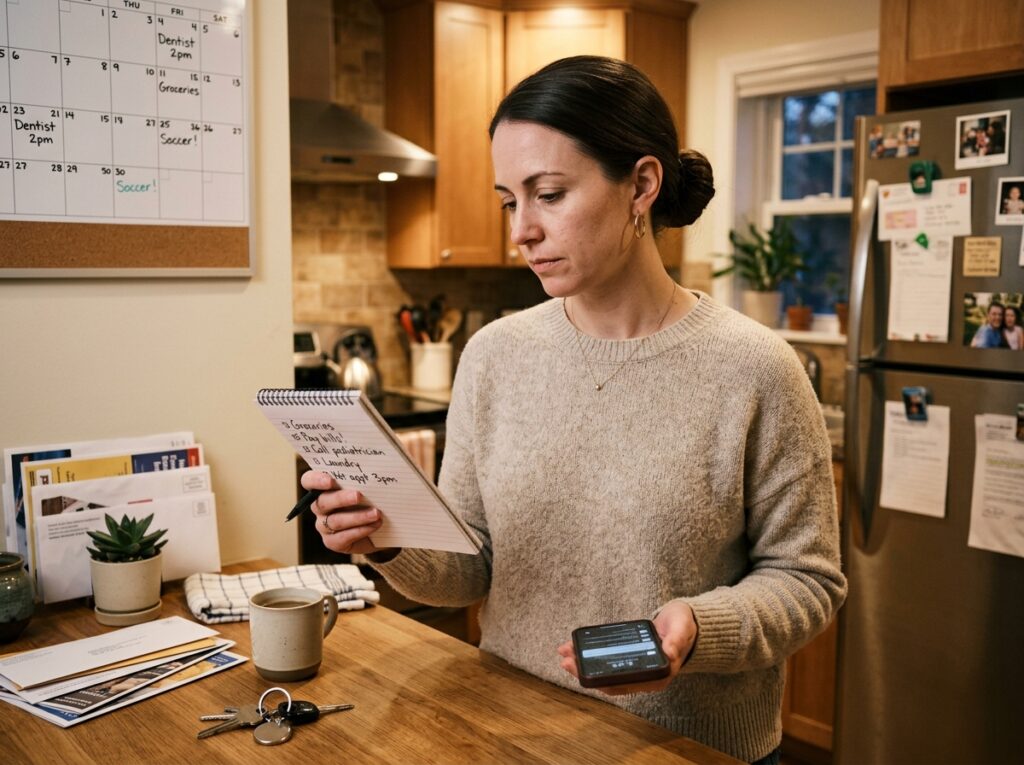
In a relationship context, the emotional load includes things like: being the one who always notices when the relationship needs a serious conversation, being the partner who tracks the emotional needs of both people, being the person who plans connection — date nights, check-ins, quality time — because if you did not, it simply would not happen. It includes managing conflict with emotional intelligence, holding space for your partner’s struggles while simultaneously managing your own, and carrying the ongoing awareness of where the relationship stands emotionally at any given moment.
It is important to understand that emotional load is distinct from practical tasks — though the two frequently overlap. The mental load of a relationship is not just who does the dishes. It is who notices that the relationship has felt distant lately and initiates a conversation about it. It is who remembers that your partner has a difficult work meeting and checks in afterward. It is who holds the emotional continuity of the partnership in their mind, every single day, whether or not they want to.
Why Does One Partner Always End Up Carrying More?
Understanding why emotional imbalance develops in relationships is not about assigning blame — it is about identifying the patterns so that something can actually change. There are several deeply rooted reasons why one partner consistently ends up carrying the heavier emotional load.
Socialization and Gender Conditioning
From an early age, many people — particularly girls — are socialized to be emotionally attuned, relationally responsible, and caretaking in their orientation toward others. Boys, in many cultural contexts, are socialized toward emotional independence and are less frequently taught to track relational needs or manage the emotional dynamics of a group. These early lessons do not disappear when people enter adult relationships. They show up as deeply ingrained default patterns — one partner automatically reaches for the emotional work, the other assumes it will be handled.
This does not mean people cannot change. It means the starting point is not neutral, and changing it requires conscious, deliberate effort rather than simply good intentions.
Attachment Style Differences
Partners with anxious attachment styles often take on a disproportionate share of the emotional load because their attachment system is constantly scanning the relationship for signs of disconnection or threat. They manage the emotional climate of the relationship not just out of love but out of anxiety — because if they do not, the uncertainty of what might happen feels unbearable.
Partners with avoidant attachment styles, on the other hand, tend to be less emotionally tracking by nature — their internal wiring moves them toward independence and emotional self-sufficiency, which can look to the anxious partner like a complete absence of relational awareness. The result is a dynamic where one person carries far more simply because their attachment system demands more vigilance.
Learned Helplessness and Passive Delegation
Sometimes emotional load imbalance is not about socialization or attachment — it is about a pattern that developed early in the relationship and was never consciously interrupted. If one partner stepped into the role of emotional manager in the beginning and the other allowed it, the relationship can calcify around that dynamic. The partner who carried less begins to rely on the other to manage emotional needs, sometimes without even realizing it. Over time they may become what psychologists call passively dependent — not through malice, but through the path of least resistance.
Differences in Emotional Awareness
Some people are simply less naturally attuned to emotional undercurrents — less likely to notice when a relationship needs attention, less able to read subtle signals of distress or disconnection. This is not always a character failing. For some, it reflects a genuinely different level of emotional awareness that can be developed with effort and intention. For others, it reflects a deeper pattern of avoidance. The distinction matters when deciding how to address the imbalance.
7 Signs You Are Carrying the Emotional Load Alone
Recognizing the signs is the first step toward being able to name the imbalance clearly — to yourself and to your partner.
Sign 1: You Are Always the One Who Initiates Difficult Conversations
Every time something important needs to be discussed — a recurring conflict, a concern about the relationship’s direction, a boundary that has been crossed — it is you who brings it up. Your partner rarely if ever initiates these conversations independently. This means you carry not only the discomfort of the conversation itself but also the full weight of the decision to have it, the timing, the framing, and the emotional preparation for how it might go.
Sign 2: You Track the Relationship’s Emotional Health So Your Partner Does Not Have To
You are always aware of how the relationship feels — whether there has been enough closeness lately, whether tension has been building, whether your partner seems happy or withdrawn. You carry this awareness constantly, like a background program that never fully closes. Your partner moves through the relationship largely unaware of this tracking because you have always done it for both of you.
Sign 3: You Remember Everything That Matters — And They Remember Very Little
You remember the anniversary. You remember what they said last month about that situation at work. You remember their mother’s birthday, the thing that hurt them three years ago, the preference they mentioned once in passing. They frequently forget things you have told them are important to you. This asymmetry in emotional memory is one of the clearest signs of an unequal emotional load.
Sign 4: Connection and Quality Time Only Happen When You Plan Them
If you stopped initiating date nights, check-in conversations, and intentional connection — how long would it be before your partner noticed and did something about it? If the honest answer is “a very long time” or “I am not sure they ever would” — that tells you who is responsible for maintaining the relational bond between you.
Sign 5: You Manage Your Partner’s Emotions as Well as Your Own
When your partner is stressed, you adjust your behavior to accommodate it. When they are upset, you provide comfort, regulate the emotional atmosphere, and often set aside your own needs to help them through it. But when you are struggling, you frequently find yourself managing your own emotions largely alone — or even managing your partner’s reaction to your struggle on top of your own distress.
Sign 6: You Feel Chronically Exhausted in the Relationship Despite Nothing Being “Wrong”
From the outside, your relationship may look fine. There is no dramatic conflict, no obvious dysfunction. But you are tired in a way that is hard to explain — not just physically, but emotionally. A tiredness that comes from always being the one who notices, who cares, who manages, who holds. This chronic emotional fatigue is one of the most reliable signs that you are carrying significantly more than your share.
Sign 7: You Have Begun to Feel More Like a Manager Than a Partner
Perhaps the most painful sign of all. The relationship has begun to feel less like a partnership between two equals and more like a project you are managing — where you are responsible for the outcomes, aware of every moving part, and doing so largely without acknowledgment or shared ownership. The romance has not just faded. The fundamental dynamic of the relationship has shifted into something that does not feel like love between equals.
“The emotional load is not just what you do. It is everything you notice, anticipate, and carry — invisibly, tirelessly, and almost always alone.”
The Real Cost of Carrying the Emotional Load Alone
The consequences of sustained emotional load imbalance are not abstract. They are real, measurable, and serious — for both the individual and the relationship.
For the partner carrying the load, the most immediate cost is chronic emotional exhaustion — a form of burnout that does not respond to a good night’s sleep because the source is relational, not physical. Research from the University of Pennsylvania found that chronic emotional labor significantly increases rates of anxiety, depression, and physical health complaints including fatigue, headaches, and immune suppression.
Over time, emotional exhaustion transforms into resentment. This is almost inevitable when an imbalance goes unaddressed — not because the carrying partner is bitter by nature, but because resentment is the natural emotional response to consistently giving more than you receive without acknowledgment. Resentment does not announce itself loudly. It accumulates quietly, showing up as irritability, emotional withdrawal, diminished affection, and a growing sense of distance that neither partner can quite explain.
For the relationship itself, sustained emotional load imbalance erodes the sense of partnership that is foundational to a healthy, lasting bond. When one partner feels more like a caretaker than a co-equal, the relational dynamic shifts in ways that affect intimacy, attraction, and the fundamental sense of being a team. Couples who do not address this imbalance frequently find that it becomes the unspoken core of a slow, painful disconnection — one that is often only fully named when the relationship is already in serious trouble.

How to Address the Emotional Load Imbalance — Without Burning the Relationship Down
Addressing this imbalance is not about building a court case against your partner. It is about creating the conditions for a more honest, more equitable, and ultimately more intimate partnership. Here is how to do that in a way that opens doors rather than triggers defensive shutdown.
Step 1: Name It Before You Blame It
The first and most important step is being able to articulate what you have been experiencing clearly and without accusation. This is harder than it sounds, because by the time most people are ready to address the emotional load, they are already carrying a backlog of resentment that can make the conversation come out much harder than intended.
Before you speak to your partner, take time to identify specifically what the imbalance looks like in your relationship. Write it down if it helps. Be concrete: “I am always the one who brings up issues in our relationship.” “I plan every piece of quality time we have.” “When something is wrong between us, I am the one who notices and addresses it.” Specific observations are far less triggering than global accusations — and far more useful for actually solving the problem.
Step 2: Choose the Right Moment and Approach
This conversation cannot happen mid-conflict, in the car on the way to an event, or when either of you is already stressed or emotionally depleted. Choose a calm, unhurried moment when you both have the emotional bandwidth to genuinely engage. Frame the conversation as coming from love and a desire to feel more like partners — because that is exactly what it is.
Step 3: Make the Invisible Visible
One of the most powerful things you can do is help your partner actually see the invisible work you have been doing. Walk them through what a typical week looks like from your emotional vantage point — the tracking, the anticipating, the managing, the noticing. Many partners who carry less of the emotional load genuinely do not see what they are not doing, because the nature of invisible labor is that it disappears the moment it is performed. Making it visible is the prerequisite for making it shared.
Step 4: Ask for Specific Changes, Not General Effort
“I need you to carry more of the emotional weight in our relationship” is too abstract to act on. “I would like you to be the one who plans our next date night — from the idea through to the execution, without me being involved in any step” is concrete, doable, and measurable. Specificity is kindness in this context. It gives your partner a clear path toward showing up differently rather than a vague sense of inadequacy.
Step 5: Allow Them to Do It Imperfectly
This is where many carrying partners inadvertently undo the progress they have made. When a partner who has never managed emotional or mental labor takes it on for the first time, they will often do it differently than you would — less thoroughly, with different priorities, or with mistakes you would not have made. Resist the urge to take it back, correct every detail, or communicate — verbally or nonverbally — that they have not done it well enough.
Allowing imperfect effort is how you create the conditions for growth. Reclaiming the task every time it is not done to your standard is how you ensure the imbalance never actually changes.
Step 6: Revisit and Recalibrate Regularly
The emotional load is not a problem you solve once. It is a dynamic that requires ongoing attention and honest conversation — which is, ironically, itself a form of emotional labor. Try establishing a regular relationship check-in: a brief, intentional conversation each week where both partners have equal space to share how they are feeling about the relationship. Over time, this shared ritual begins to distribute the emotional awareness more evenly, because both people are actively participating in tracking how things are going.
When the Imbalance Goes Deeper Than Habit
Sometimes the emotional load imbalance in a relationship is not just a matter of unconscious habit or socialized default — it is a symptom of something deeper. If your partner consistently refuses to engage with the emotional dimension of the relationship, if they show no willingness to acknowledge the imbalance even when it has been clearly named, if every attempt to redistribute the load is met with defensiveness, dismissal, or retaliation — the issue may go beyond what communication and effort alone can fix.
In these situations, couples therapy can be transformative. A skilled therapist provides the neutral, structured space that makes it possible to have the conversations that have been impossible to have alone — and to hear each other in ways that the weight of accumulated resentment often makes impossible without support.
Individual therapy is equally valuable for the partner who has been carrying the load. Processing the exhaustion, rebuilding the self-worth that chronic invisible labor can quietly erode, and developing clarity about what you need and what you are willing to accept is work that is best done with professional support.
“A relationship is not a solo performance. It is a duet — and both people have to sing.”
You Deserve a Partnership, Not a Project
Carrying the emotional load alone is not love. Or rather — it is love, but it is love without reciprocity, and love without reciprocity is one of the loneliest experiences a person can have. The fact that you have been doing it, often for a long time, without acknowledgment or relief says something profound about your capacity for care and your commitment to the relationship.
But you are allowed to put some of it down. You are allowed to ask for your partner to meet you in the middle — not someday, not when they figure it out on their own, but now. A real partnership does not require one person to hold everything while the other simply arrives. It requires two people who are both paying attention, both invested, and both willing to do the invisible work of keeping love alive.
You deserve that partnership. Not a version of it. The real thing.
CTA
💾 Save this article — the next time you feel the exhaustion of carrying everything alone, come back to this and remember that what you are feeling has a name and a solution.
📤 Share it with someone who needs to finally put words to what they have been living. This might be the article that starts the conversation they have been afraid to have.
👣 Follow Truthsinside.com for more honest, research-backed content about love, emotions, and the relationships that shape who we become.
📃 Related article: Gaslighting in Relationships: How to Recognize, Name, and Leave It
FAQ: Emotional Load in Relationships
Q1: Is the emotional load always carried by women in relationships?
Research does show that women disproportionately carry the emotional and mental load in heterosexual relationships — but this is not an absolute rule, and it is not exclusively a gendered phenomenon. In same-sex relationships and in many heterosexual partnerships, the imbalance can fall along lines of personality, attachment style, or simply who stepped into the role early in the relationship and was never asked to step back. The emotional load is a relational dynamic, and it can affect any partner regardless of gender.
Q2: What if my partner genuinely does not realize they are carrying less?
This is actually one of the most common situations — and in many ways it is the most hopeful one, because unawareness is far more workable than unwillingness. The nature of invisible labor is that it is invisible — particularly to the person who is not doing it. A calm, specific, compassionate conversation that makes the invisible work visible is often genuinely eye-opening for partners who have simply never had the imbalance named and shown to them clearly.
Q3: Can couples therapy really help with emotional load imbalance?
Yes — significantly. Couples therapy is particularly effective for this issue because the therapist can help both partners articulate their experience in a space where defensive reactions are less likely to derail the conversation. A good therapist can also help identify the underlying patterns — attachment dynamics, socialized defaults, unconscious agreements — that are maintaining the imbalance, and work with both partners on concrete strategies for redistribution.
Q4: What if I try to redistribute the emotional load and my partner reverts to old patterns?
Changing deeply ingrained relational dynamics takes time and consistent effort from both people. Regression is normal — it does not necessarily mean the change is impossible. What matters is whether your partner is aware of the regression, willing to acknowledge it, and recommitted to doing better. If regression happens repeatedly without acknowledgment or effort to course-correct, that is meaningful information about your partner’s actual level of investment in the change.
Q5: How do I stop carrying the emotional load without the relationship falling apart?
The fear that the relationship will fall apart if you stop managing everything is itself a symptom of how deeply you have taken on the caretaker role. The truth is that a healthy relationship does not depend on one person holding it together. If the relationship genuinely cannot function when you stop carrying more than your share — that is critical information about the relationship’s foundation, not a reason to keep carrying it alone. Begin by redistributing gradually and specifically, with honest communication. If the relationship is solid at its core, it can absolutely survive and thrive through that transition.
🎵 Music
Maren Lull is a singer-songwriter who writes from the places most people don’t talk about out loud.
Not the dramatic grief. Not the obvious heartbreak. The quiet kind — the ordinary Tuesday emptiness, the habit of reaching for someone who isn’t there anymore, the particular exhaustion of being strong for so long that the strength itself wears thin.
Her music lives at the intersection of emotional honesty and soft beauty — breathy vocals over gentle piano, slow tempos, lyrics that feel less like songs and more like something you wrote in a private notebook at two in the morning and never showed anyone.
Maren Lull writes for the people who feel everything deeply and say very little about it. For the ones who listen to sad music not because they want to feel worse — but because being understood, even by a song, makes the feeling easier to carry.
📱 Follow Maren Lull:
→ Spotify
→ Apple Music
→ Youtube
→ Audiomack