
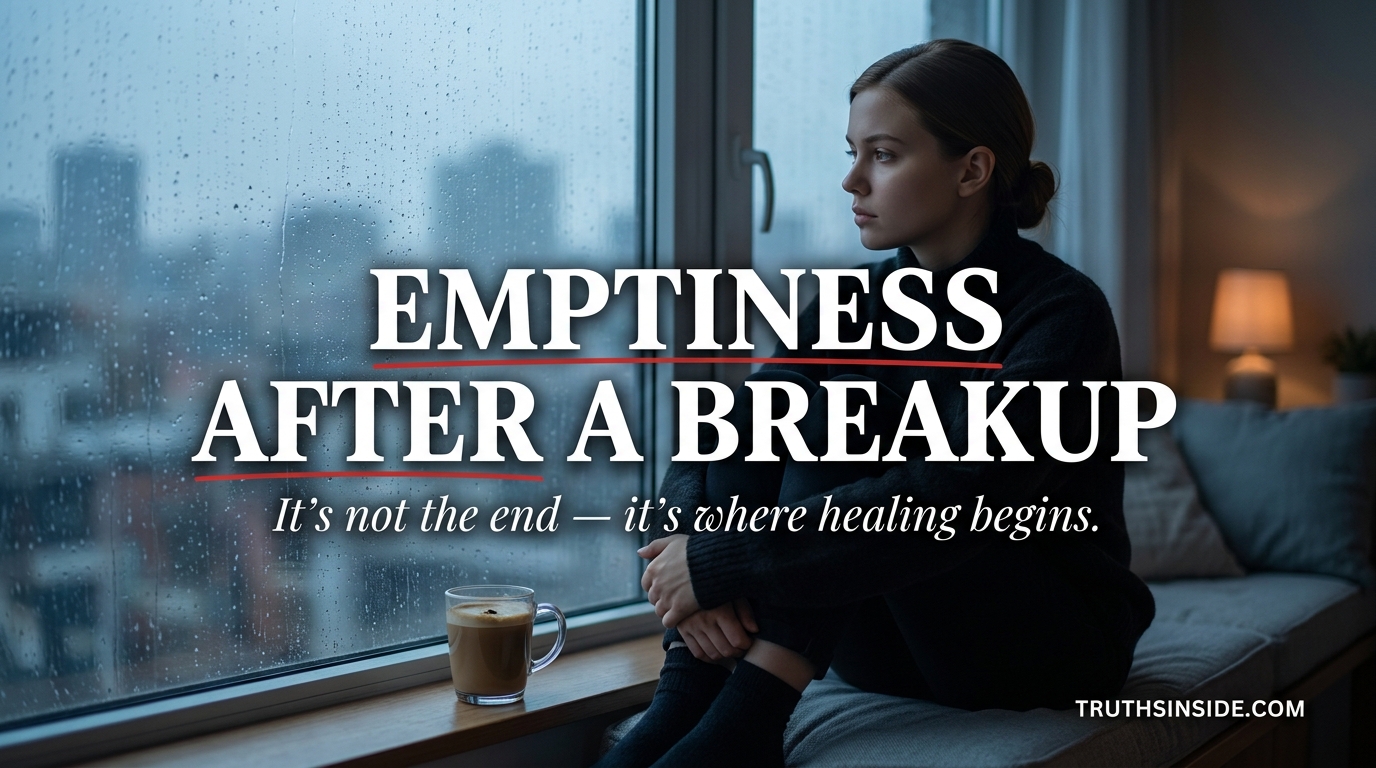
The emptiness after a breakup is one of the most disorienting feelings a human being can experience — and if you are sitting inside it right now, you should know that what you are feeling is not weakness. It is not dramatic. It is not something you need to suppress or rush through. It is a profound psychological and neurological response to the loss of something that mattered deeply. And it deserves to be treated with that level of seriousness and compassion.
Research from Columbia University using neuroimaging found that the emotional pain of romantic rejection activates the same regions of the brain as physical pain — specifically the secondary somatosensory cortex and the dorsal posterior insula. In other words, a breakup does not just feel like it hurts. It actually hurts — in measurable, physical, documented ways. A study published in the Journal of Neurophysiology further found that the longing associated with lost love activates the brain’s reward circuitry in patterns nearly identical to addiction withdrawal.
This article is for anyone sitting in that hollow, untethered space that follows the end of a relationship. Not to tell you to get over it faster. But to offer eight grounded, psychology-backed ways to fill the emptiness healthily — so that what comes next is not just recovery, but genuine growth.
1. Understand What the Emptiness After a Breakup Actually Is
Before you can fill the emptiness after a breakup, you need to understand what it actually consists of. The emptiness is not simply missing one person. It is the simultaneous loss of multiple things at once — a daily routine built around another person, a shared identity, a imagined future, a sense of security, and the neurochemical comfort of consistent emotional bonding.
When a relationship ends, the brain is essentially going through withdrawal. During a relationship, the brain releases consistent doses of oxytocin, dopamine, and serotonin — the neurochemicals of bonding, reward, and emotional stability. When the relationship ends, those chemical inputs stop abruptly. The brain — accustomed to those regular doses — experiences their absence as a deficit. That deficit is what the emptiness actually feels like from the inside.
Understanding this is not just intellectually interesting — it is actively healing. It removes the shame from the experience. You are not weak for feeling this way. You are not broken. You are a neurological being experiencing a documented biological withdrawal from something your brain had learned to depend on. That is both entirely normal and entirely survivable.
“The emptiness after a breakup is not the absence of a future. It is the space where a better one is being built.”

2. Allow Yourself to Grieve Without a Timeline
One of the most damaging things a person can do in the aftermath of a breakup is attempt to rush their own grief. Modern culture sends a relentless message that recovery should be fast, visible, and followed immediately by a glow-up. That message is not just unhelpful — it is psychologically harmful. Grief that is suppressed does not disappear. It goes underground, and it surfaces later in ways that are harder to manage and harder to trace.
Psychologist Elisabeth Kübler-Ross’s grief model — originally developed for bereavement — has been widely applied to relationship loss, encompassing stages of denial, anger, bargaining, depression, and acceptance. These stages are not linear, and they do not arrive on a predictable schedule. Some days you will feel acceptance and the next day will bring anger back to the surface. This is not regression. This is grief doing exactly what grief is supposed to do.
Give yourself explicit permission to feel what you feel — without judgment, without a deadline, and without comparing your timeline to anyone else’s. The goal is not to grieve faster. The goal is to grieve honestly, so that the healing that follows is built on real emotional ground rather than unprocessed pain wearing a functional mask.
📃 Related article: Nostalgia and Love: 7 Reasons We Romanticize the Past
3. Rebuild Your Individual Identity
One of the most profound losses inside a long relationship is the quiet erosion of individual identity. Over time, couples develop a merged sense of self — shared routines, shared social circles, shared ways of spending time, shared definitions of the future. When the relationship ends, that merged identity fractures — and one of the most disorienting aspects of post-breakup emptiness is not knowing clearly who you are outside of that partnership.
Rebuilding individual identity is not a luxury in the healing process — it is a necessity. Start by reconnecting with the things that were yours before the relationship. Interests you set aside. Friendships that drifted. Personal goals that got quietly deprioritized. These are not small indulgences — they are the raw materials of a self that exists independently of any relationship.
Research in self-concept theory suggests that the more distinct and defined a person’s individual identity, the more resilient they are to relationship loss. Building that identity is therefore both a healing practice and a protective investment. You are not just filling empty time. You are rebuilding the architecture of a self — and that is some of the most important work any person can do.
4. Resist the Urge to Fill the Emptiness With the Wrong Things
The emptiness after a breakup creates a psychological vacuum — and vacuums pull in whatever is available. For many people, what is immediately available are the wrong things: excessive alcohol, compulsive rebound relationships, hours of mindless scrolling, obsessive checking of the ex’s social media, and behaviors that provide short-term numbness at the cost of long-term healing.
These are understandable impulses. The brain is seeking dopamine through whatever familiar channels are accessible. But these behaviors do not fill the emptiness — they only delay the honest confrontation with it. And the longer that confrontation is delayed, the more entrenched and complicated the emptiness becomes.
Psychologist Guy Winch, author of Emotional First Aid, notes that the behaviors most commonly used to cope with heartbreak are often the ones most likely to sustain it. Checking an ex’s social media, for instance, functions identically to picking at a wound — it prevents healing while creating the illusion of engagement. Recognizing the difference between numbing and healing is one of the most critical distinctions the post-breakup period demands.
5. Invest in Physical Movement and Your Body
The connection between physical movement and emotional healing is one of the most well-documented relationships in psychological research — and it is particularly powerful in the context of heartbreak and post-breakup recovery. Exercise releases endorphins, stimulates dopamine and serotonin production, reduces cortisol levels, and provides the brain with a non-relational source of neurochemical reward at precisely the moment when its primary source has been removed.
You do not need to become a fitness enthusiast overnight. The evidence supports even modest, consistent physical activity — a daily thirty-minute walk, a weekly yoga class, a few sessions of dancing alone in your kitchen. The form matters far less than the consistency. What matters is that your body is moving, your nervous system is being regulated, and your brain is receiving the chemical inputs it is currently missing from a non-destructive source.
Additionally, the physical discipline of showing up for your body — eating nourishing food, sleeping consistently, moving intentionally — sends a powerful message to your own nervous system: you are safe, you are cared for, and the person responsible for your care is you. That message, repeated through daily physical action, is one of the foundational rebuilding blocks of post-breakup self-worth.
“Healing is not a straight line. It is a daily decision — made imperfectly, made bravely, made again tomorrow.”

6. Reconnect With Your People
Isolation is one of the most common — and most damaging — responses to post-breakup pain. The combination of social withdrawal, shame about the relationship ending, and the simple exhaustion of heartbreak makes pulling away from friends and family feel like the path of least resistance. But research consistently shows that social connection is one of the most powerful predictors of emotional recovery after loss.
A landmark study by researchers at the University of Virginia found that social support directly buffers the neurological impact of rejection — literally reducing the brain’s pain response when emotional support is present and consistent. Human beings are neurologically wired for connection. When romantic connection is removed, platonic and familial connection becomes not just comforting but biologically necessary for healing.
Reach out to the people who knew you before the relationship. Let yourself be seen in your messiness by the people who are safe enough to see it. You do not need to perform recovery or pretend to be doing better than you are. You need to let people who love you sit beside you in the hard part — because that proximity is actively healing in ways that solitude simply cannot replicate.
📃 Related article: What Does It Actually Feel Like to Fall in Love? Science + Real Stories
7. Create New Experiences and Memories
One of the subtle psychological mechanisms that sustains post-breakup emptiness is the dominance of shared memories. The places you went together, the songs you listened to, the restaurants you loved, the rituals you built — they all carry emotional associations that can make ordinary daily life feel saturated with the ghost of the relationship. Creating new experiences is not about erasing the past. It is about expanding the present so it can eventually outweigh it.
Try something you have never done before — a class, a trip, a creative project, a new route home. The novelty itself is healing. New experiences create new neural pathways and new memories that belong entirely to you — to the person you are becoming rather than the person you were inside that relationship.
Research on post-traumatic growth suggests that individuals who actively engage with new experiences following significant loss report higher levels of personal meaning, self-discovery, and long-term life satisfaction than those who retreat into familiar comfort. The new experience does not need to be dramatic or expensive. It needs to be yours — chosen freely, experienced fully, and remembered as the beginning of something new.
8. Consider Therapy or Structured Emotional Support
There is a persistent cultural mythology that seeking professional support after a breakup is an overreaction — that therapy is reserved for more serious psychological crises and that heartbreak should simply be endured and walked through. This mythology is both inaccurate and harmful. Therapy after a significant relationship ending is not an overreaction. It is one of the smartest investments a person can make in their own healing.
A skilled therapist provides something that friends and family — no matter how loving — cannot always offer: a completely objective, professionally trained perspective on the patterns, wounds, and emotional dynamics that contributed to the relationship and its ending. This insight is not just comforting — it is transformative. It prevents the same patterns from quietly reappearing in the next relationship.
If traditional therapy feels inaccessible, structured alternatives provide meaningful support — grief support groups, evidence-based self-help resources, journaling practices, and mindfulness-based programs all carry documented effectiveness in emotional recovery research. The most important principle is this: do not white-knuckle your way through post-breakup pain alone when real support exists. Asking for help is not weakness. It is the wisest thing a hurting person can do.
FAQ
Q1: How long does the emptiness after a breakup last?
There is no universal timeline — and anyone who gives you one is oversimplifying a deeply individual process. Research suggests that the most acute phase of heartbreak pain typically peaks within the first few weeks and gradually decreases over several months. However, the length of the relationship, the depth of emotional investment, and the circumstances of the ending all significantly influence the timeline. The most important thing is to measure your progress not in time but in the quality of your daily emotional experience.
Q2: Why does the emptiness feel worse at night?
At night, the distractions of daily life fall away and the mind is left alone with itself. This is when the brain’s default mode network — responsible for self-referential thinking and emotional processing — becomes most active. Additionally, the absence of a partner is felt most acutely in the quiet and stillness of nighttime, which was likely when intimacy and closeness were most present during the relationship. This is normal and documented. Night-time rituals — journaling, reading, gentle movement — can help regulate this predictably difficult window.
Q3: Is it normal to feel relieved and empty at the same time after a breakup?
Completely normal — and more common than most people admit. When a relationship was difficult, draining, or long overdue to end, relief is an entirely valid emotional response. Relief and grief are not mutually exclusive. The brain can simultaneously register the removal of a stressor and mourn the loss of connection and familiarity. Both feelings are honest. Both deserve acknowledgment without one canceling out the other.
Q4: Should I stay in contact with my ex to ease the emptiness?
In most cases, maintaining contact in the immediate aftermath of a breakup significantly prolongs the emptiness rather than easing it. Contact with an ex re-activates the neurochemical reward pathways associated with the relationship — creating a cycle of temporary comfort followed by deeper withdrawal. Unless there are practical necessities such as shared children or living arrangements, a period of genuine no-contact gives the brain the space it needs to begin recalibrating without repeated disruption.
Q5: How do I know if I need professional help after a breakup?
Seek professional support if the emotional pain is significantly interfering with your ability to function — work, eat, sleep, or maintain basic daily responsibilities. Also seek support if you are experiencing persistent thoughts of self-harm, if the emptiness has lasted many months without any improvement, or if you find yourself using alcohol or other substances heavily to cope. These are not signs of weakness — they are signals that the pain has moved beyond what should be managed alone.
Closing CTA
The emptiness after a breakup is real, it is painful, and it is also — with time and the right support — entirely survivable. More than survivable. Transformable. Some of the most profound personal growth a human being ever experiences happens in the quiet, difficult space after a significant loss. If this article helped you feel less alone in what you are carrying, save it for the harder days when you need the reminder. Share it with someone you know is hurting right now and needs to hear that there is a healthy way through. And follow Truthsinside.com for honest, deeply human content about love, emotion, and healing — written for real people navigating real pain.
🎵 Music
Maren Lull is a singer-songwriter who writes from the places most people don’t talk about out loud.
Not the dramatic grief. Not the obvious heartbreak. The quiet kind — the ordinary Tuesday emptiness, the habit of reaching for someone who isn’t there anymore, the particular exhaustion of being strong for so long that the strength itself wears thin.
Her music lives at the intersection of emotional honesty and soft beauty — breathy vocals over gentle piano, slow tempos, lyrics that feel less like songs and more like something you wrote in a private notebook at two in the morning and never showed anyone.
Maren Lull writes for the people who feel everything deeply and say very little about it. For the ones who listen to sad music not because they want to feel worse — but because being understood, even by a song, makes the feeling easier to carry.
📱 Follow Maren Lull:
→ Spotify
→ Apple Music
→ Youtube
→ Audiomack