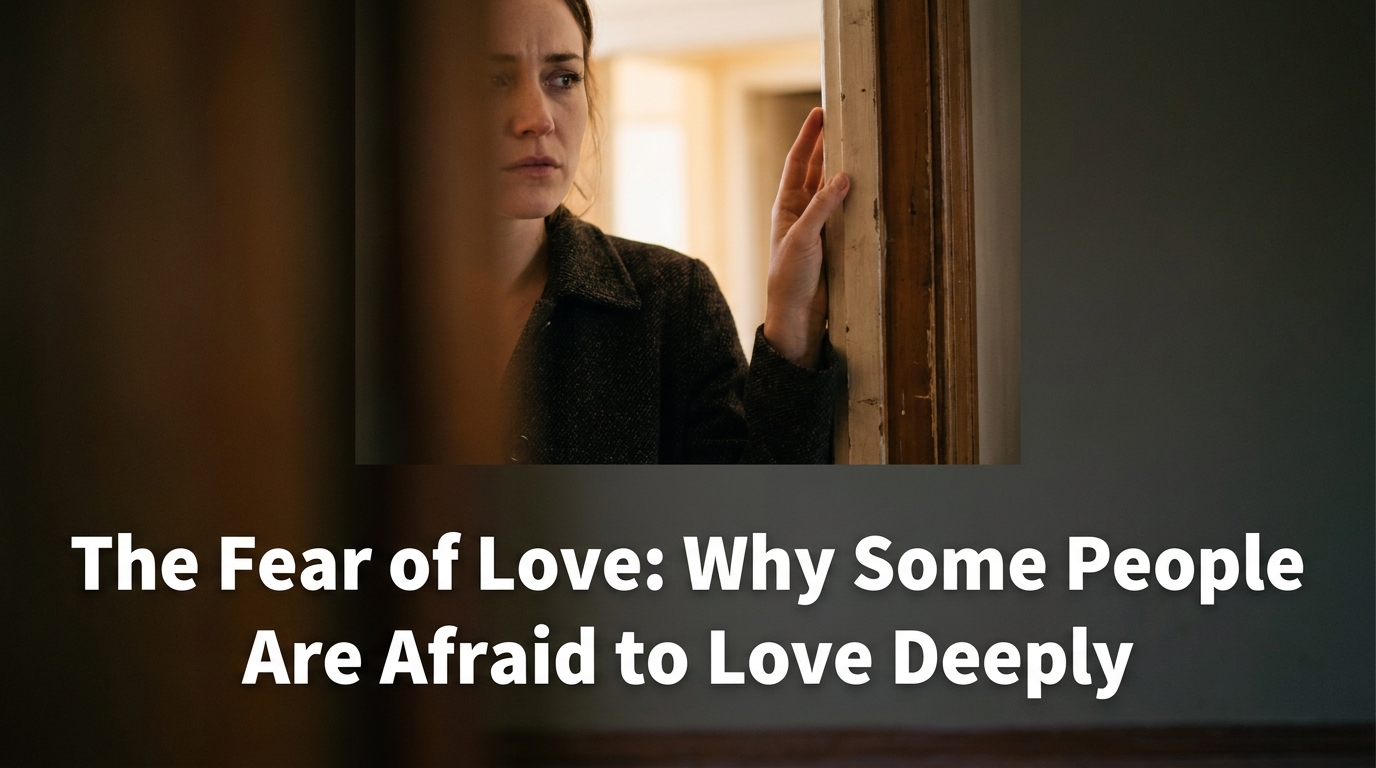
You know what it feels like when it starts. The pull toward someone that is both exciting and quietly terrifying. The moment when the connection deepens past a certain point and something in you — beneath the warmth, beneath the wanting — sounds an alarm. Not because anything has gone wrong. Because something has gone right. Because this is real, and real means it could hurt, and hurt is something you have already learned to survive once — or more than once — and are not sure you can survive again.
The fear of love is not the absence of love. It is love’s shadow — the specific dread that arrives alongside genuine feeling and whispers that everything that is beginning to matter is everything that could be taken away. According to attachment researchers at the University of California, an estimated 25 percent of adults exhibit avoidant attachment patterns — a primary driver of love avoidance — which means that roughly one in four people navigate their most intimate relationships from a place of genuine, often unexamined fear of love.
Understanding that fear — where it comes from, what it produces, and how it can change — is one of the most important acts of self-knowledge a person can undertake. Not just for the sake of love. For the sake of everything love makes possible.

What the Fear of Love Actually Is
The fear of love — sometimes called philophobia in clinical literature — is not a single, uniform experience. It is a family of related fears, all centered on the specific vulnerability that genuine romantic love requires.
At its core, the fear of love is the fear of what love costs. Not financial cost. The cost of exposure — of being seen fully, of having your wellbeing become genuinely dependent on another person’s presence and choices, of investing something irreplaceable in an outcome you cannot control. For someone who has experienced significant relational pain — abandonment, betrayal, loss, or simply the accumulated weight of love that didn’t last — the prospect of that investment feels less like opportunity and more like risk.
The fear expresses itself differently in different people. For some it is the avoidance of commitment — the relationship that stays perpetually undefined, the partner who is warm in the present and evasive about the future. For others it is the sabotage of things that are going well — the unconscious creation of distance or conflict at the precise moment the connection deepens past the point of comfortable safety. For others still it is the simply the inability to fall — the heart that remains carefully uninvested no matter how suitable or how genuinely caring the person in front of them is.
In all its forms, the fear of love produces the same essential result: a life in which love is wanted but not fully allowed. A person who stands at the threshold of genuine connection and finds, every time, that something holds them back.
Where the Fear of Love Comes From
Understanding the roots of love fear is not about assigning blame to a past or a person. It is about understanding the specific learning that produced the fear — because learning is something that can be unlearned, if the conditions are right.
Early Attachment Experiences
Attachment theory — developed by John Bowlby and extended by researchers including Mary Ainsworth and Sue Johnson — is the most robust framework available for understanding the fear of love. In early childhood, the brain develops working models of relationship based on the consistency and responsiveness of primary caregivers. These models become the template through which all subsequent intimate relationships are interpreted.
A child whose caregivers were consistently unavailable, dismissive of emotional needs, or unpredictable in their warmth develops an avoidant attachment style — learning that emotional needs are not reliably met and that self-sufficiency is the safest available strategy. In adult romantic relationships, this learning produces exactly the fear of love described above: the instinctive withdrawal from intimacy when it deepens, the preference for independence over interdependence, the discomfort with the specific vulnerability that real love requires.
Past Relational Trauma
Beyond early attachment, significant relational experiences — a devastating betrayal, an abandonment that arrived without warning, a love that ended in profound grief — can produce an acquired fear of love that was not originally present. The nervous system learns, from direct experience, that the specific investment of loving someone deeply produces a specific category of pain. And having learned that lesson, it works to prevent the conditions that would produce it again.
This acquired love fear is often more conscious and more narratively accessible than attachment-based fear — the person can often identify the experience that taught them to be afraid, even if they cannot always identify the specific ways that fear is shaping their current behavior.
Loss and Grief
For some people, the fear of love is specifically the fear of loss — the understanding, built from experience, that everything loved can be taken away. People who have experienced the loss of a parent, a significant partner, or another primary attachment figure can develop a specific reluctance to love deeply again — not because they don’t want to, but because the prospect of that loss recurring feels genuinely unbearable. The love is possible. The loss, felt in advance, makes the love feel too costly to begin.
Cultural and Familial Messaging
Some fear of love is transmitted rather than experienced. Families where emotional expression was discouraged, where love was conditional or transactional, or where intimate relationships were consistently modeled as sources of pain rather than sustenance produce adults who have learned — without any single devastating experience — that love is not safe. This transmitted learning is often the hardest to identify precisely because it feels like simply how things are rather than something that was taught.

How the Fear of Love Shows Up in Relationships
Pulling Away When Things Get Good
The relationship is going well — genuinely well, in the specific way that means something real is developing. And then something shifts. A subtle withdrawal. An increase in emotional distance. The creation of conflict or criticism where none was warranted. The fear of love is not triggered by things going badly — it is triggered by things going right. Because things going right means investment is increasing, and investment increasing means the potential cost of loss is increasing, and that cost, felt in advance, is what the fear is trying to prevent.
Staying Just Below the Threshold
Some people with fear of love manage it by maintaining relationships at a specific level of depth — close enough to feel connected, carefully managed to stay just below the threshold where the vulnerability becomes genuinely uncomfortable. The relationship has warmth, has history, has many of the features of genuine partnership. But it has a ceiling. And every time the ceiling is approached, something — a withdrawal, a deflection, a sudden reevaluation of the relationship — brings things back to the manageable level.
Choosing Unavailable Partners
One of the most consistently observed patterns in people with fear of love is the specific attraction to partners who are unavailable — emotionally, practically, or circumstantially. An unavailable partner provides the warmth of connection without the full risk of genuine intimacy. The love can exist in a space that is structurally protected from the depth that would require genuine vulnerability. The attraction is not random — it is the fear finding exactly the situation in which love can be felt while being kept at a safe distance from its full expression.
Self-Sabotage at the Point of Deepening
Something good is happening. The connection has reached a point of genuine mutual investment. And then — a fight that didn’t need to happen, a complaint about something that would normally be tolerated, a sudden re-emergence of doubt about the relationship’s suitability. Self-sabotage in love is the fear’s most direct expression — the unconscious creation of the distance that the conscious mind hasn’t decided to create. It is the nervous system acting before the rational mind has a chance to override it.

The Inability to Say “I Love You” First
For many people with fear of love, the declaration itself — the specific act of naming the feeling out loud, without guarantee of reciprocation — is one of the most frightening things available. Saying it first requires accepting that the vulnerability of the feeling is now visible to another person, that the exposure is complete, and that the response — whatever it is — cannot be controlled. The words sit unspoken, sometimes for months, not because the feeling isn’t present but because saying it out loud makes it real in a way that cannot be taken back.
Ending Relationships Before They Can End Themselves
Some people with fear of love develop a specific pattern of ending relationships that are going well — not because the relationship has failed, but because the relationship is succeeding. The logic of the fear is straightforward: if I leave before I am left, I control the ending. I protect myself from the specific, devastating surprise of abandonment. The ending I choose hurts less than the ending I would not choose. This preemptive leaving is one of the most self-defeating expressions of love fear — because it produces exactly the relational outcome it was trying to prevent, just with the person leaving instead of the person left.
What the Fear of Love Costs
This is worth sitting with honestly — not to induce guilt but to make visible what the fear is actually protecting against and what it is actually producing.
The fear of love protects against the pain of loss, betrayal, and grief. These are real pains. They are worth protecting against.
What the fear of love costs is this: the specific experience of being genuinely loved. Not admired, not appreciated, not found attractive or useful or enjoyable company. Genuinely loved — seen fully, chosen freely, held with the specific warmth of someone who knows you completely and remains present anyway.
That experience — one of the most profound available to a human being — is structurally inaccessible to someone governed by the fear of love. Because it requires exactly what the fear prevents: full exposure, full investment, full presence in a connection whose outcome cannot be guaranteed.
The fear protects against one kind of pain. It produces another — the quieter, more chronic pain of a life in which the deepest love available is always kept just out of reach.
How to Begin Healing the Fear of Love
Name It Honestly
The first and most important step is calling the fear what it is — not “I’m just not ready,” not “I haven’t met the right person,” not “I value my independence.” These are true as far as they go. They are also, in many cases, the rationalized surface of something deeper. Naming the fear directly — “I am afraid of loving someone because I am afraid of what loving someone costs” — is the beginning of the relationship with it that makes change possible.
Understand Where It Came From
Not to excuse the behavior the fear produces, but to understand the specific learning that created it. What experience — or accumulated experiences — taught you that loving deeply is dangerous? When was that lesson learned? Is it still applicable to the present, or is it a past-context teaching being applied to a present that is actually different? This inquiry, done honestly and ideally with therapeutic support, is the beginning of separating the fear from the facts of the current situation.
Build the Experience of Safety Gradually
The fear of love is a nervous system response to a perceived threat. It responds to evidence — the accumulated experience of safe, consistent, reciprocal connection that gradually teaches the nervous system that this specific context is different from the one that originally produced the fear. This cannot be rushed. It cannot be argued away. It can, with time and genuine consistent safety, be slowly, genuinely changed.
Work With a Therapist
The fear of love — particularly when it is rooted in early attachment experiences or significant relational trauma — is one of the patterns most amenable to therapeutic intervention and least accessible to self-help alone. Approaches including Emotionally Focused Therapy, Attachment-Based Therapy, and Somatic therapies have strong evidence for helping people understand, work with, and gradually transform the fear of love from a governing force into a manageable presence.
Choose the Risk — Incrementally
Healing the fear of love does not require a single grand act of courage. It requires a series of small ones — the disclosure that is slightly more honest than usual, the moment of staying present when the instinct is to withdraw, the choice to say the thing that is true rather than the thing that is safe. Each small act of chosen vulnerability that is met with care builds the specific experience that the fear has been trying to prevent from accumulating: the experience of being genuinely known and not abandoned for it.

The Bottom Line
The fear of love is not a character flaw. It is not evidence of being broken, damaged, or incapable of genuine connection. It is a learned response — built from real experiences, real losses, and real pain — that has been doing its best to protect you from a specific category of hurt.
But it has been protecting you at a cost that is worth examining honestly. The love it has been keeping out is also the love that makes a human life most fully felt. The vulnerability it has been preventing is also the path to the only genuine connection available.
You are not required to be fearless. You are simply invited — gradually, with support, in conditions of genuine safety — to choose the risk. Not recklessly. Not without discernment. But honestly, and with the knowledge that the fear is not the truth about what love will cost you. It is the story written by the past. The present, chosen carefully, can be different.
The fear of love is not proof that you cannot love. It is proof that you have loved — and that it cost you something real. That cost is not a reason to stop. It is the reason that choosing to love again, despite knowing the cost, is the bravest and most human thing you will ever do.
📌 Save, Share & Follow
💾 SAVE this article — return to it when the pull toward someone is accompanied by the instinct to run, and you need a reminder of what the fear is really about. 📤 SHARE this with someone who keeps ending things that are good or choosing people who are unavailable — and doesn’t quite understand why. 👉 FOLLOW TruthsInside.com for more honest, psychology-backed content on love, fear, and what it takes to finally let someone in.
❓ Frequently Asked Questions
Q1: Is the fear of love the same as commitment phobia? They overlap significantly but are not identical. Commitment phobia is specifically the fear of the formal, binding aspects of commitment — labels, exclusivity, long-term planning. The fear of love is broader — it encompasses not just the fear of commitment but the fear of genuine emotional investment itself, including the vulnerability, dependency, and potential loss that deep love requires. Someone can commit formally while still guarding against the deeper emotional exposure that genuine love involves.
Q2: Can the fear of love coexist with genuine feelings for someone? Yes — and this coexistence is the source of some of the most painful dynamics in romantic relationships. A person can feel genuine, deep love for someone and simultaneously be governed by a fear that prevents them from fully expressing or acting on that love. The feeling and the fear are not mutually exclusive. They are often present simultaneously — which is why love-avoidant people can seem genuinely warm and genuinely unavailable at the same time.
Q3: How do I help a partner who has fear of love? With patience, consistency, and the refusal to take their fear personally. The most healing thing you can offer someone with fear of love is the consistent experience of being genuinely safe — of your warmth remaining present when they withdraw, of your care not being weaponized when they are vulnerable, of your presence being reliable across a sustained period of time. That consistency is what the nervous system needs to accumulate enough counter-evidence to begin trusting. It cannot be rushed. It also cannot be your entire responsibility — your partner must be willing to recognize the fear and do their own work alongside your support.
Q4: How do I know if my fear of love is healing? The signs are usually gradual and not dramatic. You notice that you stayed present in a conversation that would previously have produced withdrawal. You offered something honest that you would previously have kept back. You felt the fear — and chose toward the relationship anyway. The fear doesn’t disappear suddenly. It becomes, with time and consistent safe experience, a presence you can feel and move through rather than a force that automatically governs your behavior. That shift — from governed to moving through — is the healing.
Q5: Is it possible to fully overcome the fear of love? Fully overcome may be too absolute a standard. What is genuinely possible — and what research supports — is a significant transformation of the fear’s role and power. A person who began with profound love avoidance can develop, through genuine therapeutic work and safe relational experience, the capacity for deep, sustained, genuinely vulnerable love. The neural pathways of attachment are plastic — they respond to consistent new experience. The fear may remain, in some form, as a memory of what it once cost to love. But it need not remain as the governing principle of how love is approached.
🎵 Music
Maren Lull is a singer-songwriter who writes from the places most people don’t talk about out loud.
Not the dramatic grief. Not the obvious heartbreak. The quiet kind — the ordinary Tuesday emptiness, the habit of reaching for someone who isn’t there anymore, the particular exhaustion of being strong for so long that the strength itself wears thin.
Her music lives at the intersection of emotional honesty and soft beauty — breathy vocals over gentle piano, slow tempos, lyrics that feel less like songs and more like something you wrote in a private notebook at two in the morning and never showed anyone.
Maren Lull writes for the people who feel everything deeply and say very little about it. For the ones who listen to sad music not because they want to feel worse — but because being understood, even by a song, makes the feeling easier to carry.
📱 Follow Maren Lull:
→ Spotify
→ Apple Music
→ Youtube
→ Audiomack