
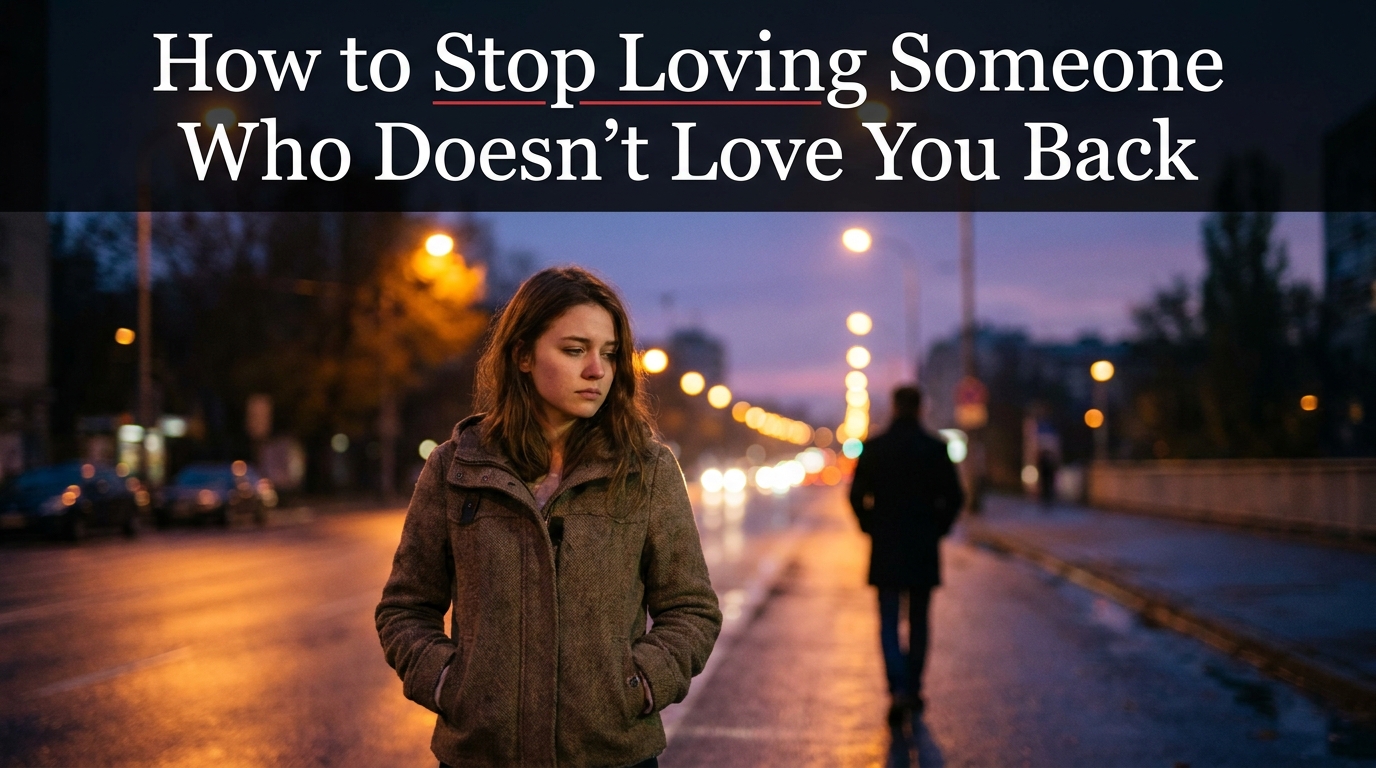
Nobody chooses unrequited love. It arrives uninvited, settles in without permission, and refuses to leave simply because you have decided it is inconvenient or painful. If you are searching for how to stop loving someone who does not love you back, you are likely already exhausted — exhausted from hoping, from analyzing every interaction for hidden meaning, from loving someone at full volume while they love you at silence.
Research from the University of Michigan found that the pain of social rejection activates the same neural pathways as physical pain — meaning the ache of loving someone who does not return it is not a weakness, not an overreaction, and not something you should be able to simply think your way out of. It is real. It is neurological. And it deserves a real, honest answer.
This article is that answer. Not the kind that tells you to delete their number and take up running. But the kind that actually goes somewhere — that examines why unrequited love holds on so tightly, what is genuinely happening in you when it does, and what the steps toward release actually look like when you take them seriously. Because stopping loving someone who does not love you back is not a decision you make once. It is a practice you commit to — imperfectly, repeatedly, and ultimately, successfully.
Why Unrequited Love Holds On So Hard
Before addressing how to stop loving someone, it is worth understanding why it is so extraordinarily difficult to do so. Because if you understand the mechanism, you stop blaming yourself for struggling with it.
The Brain Treats Rejection Like a Wound
As noted above, neuroimaging studies have confirmed that romantic rejection activates the anterior cingulate cortex — the same brain region involved in processing physical pain. But there is a second layer to this. Research by Helen Fisher and colleagues at Rutgers University scanned the brains of people who had recently experienced romantic rejection and found that the reward centers — the dopamine-rich regions associated with craving and motivation — remained highly active.
What this means is that rejection does not switch off the love response. It intensifies the craving. The brain goes into a wanting state — the same neural state as addiction withdrawal — specifically because the desired person has become unavailable. Unavailability, neurologically, increases desire rather than extinguishing it.
This is why logic does not work. You can know, completely and clearly, that this person does not love you — and still find yourself checking their social media, replaying conversations, and dreaming about them. The knowing and the feeling operate in different brain systems. The knowing is in the prefrontal cortex. The craving is in the limbic system. And in this particular battle, the limbic system has significant home-field advantage.
The Intermittent Reinforcement Trap
Unrequited love is often complicated by the presence of some positive signal from the other person — not love, but not nothing either. Friendship, warmth, occasional moments of what feels like closeness, mixed signals that keep hope alive just enough to sustain the attachment.
Psychologists recognize this as intermittent reinforcement — the most potent reinforcement schedule known to behavioral science. Random, unpredictable rewards produce stronger and more resistant behavioral patterns than consistent ones. This is the same mechanism that makes gambling addictive. When you cannot predict when the positive signal will come, you stay in the game indefinitely, waiting for the next one.
If the person you love gives you nothing — absolute, clear, consistent nothing — unrequited love would be significantly easier to release. It is the inconsistency, the ambiguity, the occasional warmth that makes it feel impossible to let go.
The Projection Problem
Here is the uncomfortable truth at the heart of most unrequited love: a significant portion of what you love is not the actual person. It is the person you have constructed from the available material — filled in with your hopes, your projections, your imagination of who they are in the spaces where you do not actually know them.
Real knowledge of someone requires time, reciprocity, and genuine mutual disclosure. Unrequited love rarely has access to those things. What it has instead is intense observation of a person from a limited angle, combined with the brain’s extraordinary capacity for narrative completion — filling the gaps with whatever the heart most wants to believe is there.
This does not mean your feelings are not real. It means the object of those feelings is, to a significant degree, a construction. And constructions, when you begin to see them clearly, are easier to release than real, fully known people.

Step 1: Stop Calling It “Just Feelings” and Name What This Actually Is
The first genuine step toward releasing unrequited love is stopping the minimization of it.
Most people who are loving someone who does not love them back are simultaneously engaged in an internal argument about whether their pain is legitimate. They tell themselves it is silly to be this affected by someone who was never even their partner. They feel embarrassed by the intensity of what they feel. They minimize it to others — and to themselves — as “just a crush” or “just something they will get over.”
This minimization does not reduce the pain. It adds shame to pain, which is considerably worse than pain alone.
What you are experiencing has a name: unrequited love. It is one of the most widely documented, most universally human emotional experiences in existence. Every culture, every era of human history, every form of literature and music has grappled with it. You are not unusual for feeling it. You are not weak for struggling with it. You are human in the most ordinary and most profound sense.
Naming it accurately — allowing it to be what it is, with the full weight it carries — is the foundation of releasing it. You cannot grieve what you will not acknowledge. And this experience, in its honest form, is a grief.
Step 2: Get Radically Honest About What You Are Actually Loving
This is the step most people skip — and its absence is precisely why their process stalls.
Ask yourself, with genuine ruthlessness: What do I actually know about this person? Not what I believe about them. Not what I have imagined about them. What do I actually, verifiably know — based on direct observation and genuine interaction rather than projection and hope?
Write it down if that helps. Two columns. What you know. What you have assumed, projected, or hoped.
For most people in unrequited love, the second column is considerably longer than the first.
This is not about diminishing the other person. It is about clearly seeing where your love has been directed — at a real person and at a construction you have built around them. The construction is what carries most of the emotional weight. And the construction is yours. It lives in you, not in them.
The reason this matters practically is this: when you begin to disentangle the real person from the constructed one, you also begin to identify what the construction represents — what qualities, what feelings, what version of love you were actually hungry for. That hunger is real and legitimate. It just found the wrong address.
Understanding what you were truly looking for — in yourself and in love — is more useful than any amount of analyzing the person who did not want you back.
Step 3: Accept the Reality Without Negotiating With It
This step sounds simple. It is not.
Accepting that someone does not love you back — genuinely accepting it, not intellectually acknowledging it while emotionally holding it in negotiation — requires sitting with a loss that the heart keeps trying to refuse.
The mind has a remarkable capacity for loophole-finding. “Maybe they are just scared.” “Maybe the timing is wrong.” “Maybe if I were different.” “Maybe if they saw me in a different context.” Each of these thoughts is the bargaining stage of grief — the mind’s attempt to keep the door open on a reality it cannot yet accept as closed.
Acceptance does not require you to stop caring about the person. It does not require you to become indifferent or cold. It only requires you to stop living in the maybe — to close the negotiation and allow the loss to be real.
One way to support this step is to stop looking for evidence that contradicts the reality. If the person has communicated — through words or consistent action — that they do not love you back, that is the reality. A friendly text, a warm moment, a lingering glance is not evidence to the contrary. It is what being a normal human being looks like. Receiving ordinary human warmth as evidence of hidden romantic feeling is one of the most reliable ways to sustain unrequited love indefinitely.
“Acceptance is not agreement. You do not have to think it is okay that this person does not love you. You only have to stop living as though the reality might still change — because it cannot, if it has not.”

Step 4: Create Real, Structural Distance
The nervous system cannot begin the process of detachment while it is continuously being re-exposed to the attachment cue. This is not a metaphor — it is neuroscience.
Every time you see this person, interact with them, check their profile, re-read old messages, or listen to the song that reminds you of them, you are reactivating the neural pathways associated with the attachment. You are resetting the process. The detachment cannot consolidate while the stimulus is continuously present.
This means that creating structural distance — real, deliberate, consistent distance — is not a dramatic gesture. It is a neurological necessity.
What structural distance looks like will depend on your situation:
If this is someone in your immediate social circle or workplace, complete absence may not be possible. In that case, minimize unnecessary interaction. Stop seeking opportunities to be near them. Stop engineering situations where you will see them. Behave pleasantly when contact is unavoidable, then deliberately redirect your attention elsewhere.
If this is someone you can remove from your digital environment, do so. Unfollow, mute, or if necessary, block. Not as punishment. As self-protection. You cannot heal a wound you keep reopening.
If you have been maintaining a friendship that is emotionally sustaining the attachment — where the friendship exists primarily as a vehicle for continued hope rather than genuine mutual care — that requires the most honest examination of all. Sometimes the most caring thing for both people is to create space rather than maintain a connection that is costing one person their peace.
Step 5: Redirect the Energy Toward Yourself — Specifically
The energy that unrequited love consumes is extraordinary. The mental bandwidth devoted to thinking about this person, analyzing their behavior, rehearsing imagined conversations, and managing the emotional aftermath of every interaction is energy that belongs to you — and that you have effectively given away to someone who has not asked for it and cannot return it.
Redirecting that energy is not about distraction. Distraction is avoidance with better branding. This is about genuine redirection — taking what has been pouring outward and turning it back toward your own life, your own development, your own becoming.
Specifically, this means identifying what has been neglected while this love has been occupying so much of your internal space. Friendships that have grown thin. Creative interests that have sat dormant. Professional goals that have stalled. Physical health that has been deprioritized. The parts of your life that are fully yours — that no one’s reciprocation or lack of it can touch — deserve the attention that has been diverted toward someone who is not investing it back.
This is not about staying busy to avoid feeling. It is about consciously rebuilding a life that is rich enough in its own right that the absence of this one person’s love — however real and however painful — does not hollow it out.

Step 6: Feel the Grief Without Living in It
There is a difference between feeling grief and residing in it.
Feeling the grief of unrequited love — the genuine sadness of wanting something you cannot have, of loving someone who cannot meet you there — is necessary and healthy. It is the emotional equivalent of cleaning a wound. It has to happen for healing to occur.
Residing in the grief — returning to it compulsively, refreshing it through rumination and romantic fantasy, keeping it alive through the consumption of sad music and old photographs — is something different. It is a way of maintaining the emotional state of being in love without the person. A way of keeping the connection alive in the only space available: inside yourself.
The practice of feeling without residing looks like: allowing the grief to come when it arrives, sitting with it for a defined period without immediately suppressing it or extending it, and then deliberately returning to the present moment and your actual life.
Grief that is felt moves. Grief that is performed stays.
Step 7: Examine What This Love Was Telling You About Your Needs
Every powerful attachment — including unrequited ones — carries information. Not about the other person. About you.
What specifically did you feel in the presence of this person — or in the fantasy of them — that you have been hungry for? Seen? Chosen? Intellectually matched? Physically safe? Genuinely admired?
The particular quality of what you longed for in this person is a map to what you most need in love. And that map is useful regardless of where you found it or what it cost you.
Understanding what you were truly seeking — and recognizing that the need itself is valid and real even when the specific person cannot meet it — shifts the entire internal narrative. You are not someone who loved the wrong person. You are someone with real, legitimate needs for love and connection who directed those needs toward someone unavailable.
The need does not go away when the person does. But when you see it clearly, you can begin directing it toward places and people where it has a genuine chance of being met.
“The love you gave to someone who could not receive it was not wasted. It was a demonstration of your capacity. And that capacity, turned toward someone who can meet it — changes everything.”
Step 8: Be Patient With the Non-Linear Timeline
Healing from unrequited love does not move in a straight line. You will have days where the release feels genuinely complete — where you think of them without the ache, where your own life feels full and sufficient and forward-moving.
And then you will have a day — triggered by a song, a place, a mutual friend’s offhand comment — where it comes back with what feels like its original force.
This is not regression. This is how grief moves — in waves rather than stages, nonlinearly rather than progressively. The waves get less frequent. They get less high. And eventually, though it is impossible to believe from inside the early pain, they become manageable.
What makes this non-linearity bearable is not denying it or being surprised by it — it is expecting it. Building a life stable enough that a bad day does not erase the progress of the good ones. Having support structures that can hold you on the wave days without either dismissing the pain or encouraging you to drown in it.
The timeline is yours. It does not need to satisfy anyone else’s expectations of how long this should take.

What Does Not Help — And Why People Do It Anyway
Staying friends to stay close. The impulse to maintain friendship when you are still in love is almost always about keeping the door open rather than genuine care for the other person. It keeps you in the emotional orbit of someone your nervous system is trying to detach from — and it prevents the structural distance your brain needs to begin the detachment process.
Seeking closure from the person who does not love you. Closure is not something another person gives you. It is something you construct for yourself through honest processing of the experience. Returning to the person for a final conversation that explains everything is almost always an attempt to re-enter the dynamic rather than close it.
Making yourself more loveable for them. Changing your appearance, your personality, your social circle in the hope of becoming what this person would want — this is perhaps the most painful of the avoidance strategies because it inverts everything. It puts your development in service of their approval rather than your own becoming.
Romanticizing the pain. There is a cultural narrative — particularly well-developed in music, film, and literature — that makes unrequited love beautiful. Transcendent. The purest form of love because it asks nothing in return. This narrative is seductive and it is harmful. It turns a genuine wound into an aesthetic and makes choosing to remain in it feel like a virtue. It is not. It is a way of avoiding the harder, less romantic work of actual healing.
A Final Word on What You Deserve
Learning how to stop loving someone who does not love you back is, at its deepest level, a practice of self-respect. Not the performative kind — the real kind. The kind that says: my love is not an endless resource to be poured into places that cannot hold it. My love deserves a recipient. My life deserves to be inhabited by me, not lived in the shadow of someone else’s indifference.
You are not less valuable because this person did not choose you. Their capacity for love — or their capacity for love toward you specifically — is not the measure of your worth. It never was.
The love you are capable of — the depth of it, the realness of it, the evidence of your capacity for full, unguarded feeling — is not a liability. It is one of the most important things about you. It belongs somewhere it can be received.
Go find that somewhere. Not quickly. Not painlessly. But genuinely, deliberately, and on your own terms.
Save this article — for the days when the process feels impossible.
Share it with someone who is quietly loving someone who will not love them back, and needs to know there is a way through.
Follow Truthsinside.com for more honest, psychologically grounded writing on love, emotions, and the hard, necessary work of healing.
Related article: Signs He Likes You But Is Scared: 18 Behaviors Men Show When Afraid to Commit
Frequently Asked Questions
Q1: How long does it take to stop loving someone who doesn’t love you back?
There is no fixed timeline — and anyone who gives you one is not being honest with you. Duration depends on the length and intensity of the attachment, whether the person is still in your environment, your attachment style, your support system, and whether you are genuinely engaging with the process or avoiding it. What research does support is that active engagement — processing the grief, creating structural distance, investing in your own life — meaningfully shortens the timeline compared to passive waiting or active avoidance.
Q2: Is it possible to remain friends with someone you have unrequited feelings for?
Rarely, and almost never immediately. Genuine friendship — in which both people are equally invested and neither is secretly hoping for something more — can sometimes develop after a significant period of distance and genuine emotional processing. But attempting to maintain friendship while actively in love with someone who does not reciprocate is not friendship. It is hope wearing friendship’s clothes, and it prevents the very healing it claims to support.
Q3: Why do I keep loving someone even when I know they don’t love me back?
Because love and knowledge operate in different brain systems. Knowing something is processed in the prefrontal cortex. Feeling something is generated in the limbic system. The limbic system — where attachment and craving live — does not update its programming based on rational information. It updates through time, structural distance, and the gradual consolidation of new emotional experiences. This is why you can completely know someone does not love you and still completely feel that they do. Both are real. They are just operating in different neurological territories.
Q4: What if the other person gives me mixed signals — sometimes warm, sometimes distant?
Mixed signals are one of the most powerful sustainers of unrequited love, because intermittent positive reinforcement is the most addictive reinforcement schedule known to psychology. If someone consistently gives you mixed signals, the most honest interpretation is not “they love me but are confused” — it is “they are not choosing me, and the warmth you receive is not equivalent to the love you are seeking.” Acting on the warmer signals while ignoring the distance keeps you in the attachment cycle indefinitely.
Q5: Can therapy help with unrequited love?
Yes — particularly when the unrequited love pattern is recurring, when it is significantly impairing your daily functioning, or when it seems connected to deeper attachment wounds or self-worth issues. A therapist can help you understand what the attachment is carrying — what needs, what fears, what patterns from earlier in your life are being activated — in ways that make the healing process both faster and more durable. You do not have to be in crisis to deserve support with something this painful.
🎵 Music
Maren Lull is a singer-songwriter who writes from the places most people don’t talk about out loud.
Not the dramatic grief. Not the obvious heartbreak. The quiet kind — the ordinary Tuesday emptiness, the habit of reaching for someone who isn’t there anymore, the particular exhaustion of being strong for so long that the strength itself wears thin.
Her music lives at the intersection of emotional honesty and soft beauty — breathy vocals over gentle piano, slow tempos, lyrics that feel less like songs and more like something you wrote in a private notebook at two in the morning and never showed anyone.
Maren Lull writes for the people who feel everything deeply and say very little about it. For the ones who listen to sad music not because they want to feel worse — but because being understood, even by a song, makes the feeling easier to carry.
📱 Follow Maren Lull:
→ Spotify
→ Apple Music
→ Youtube
→ Audiomack