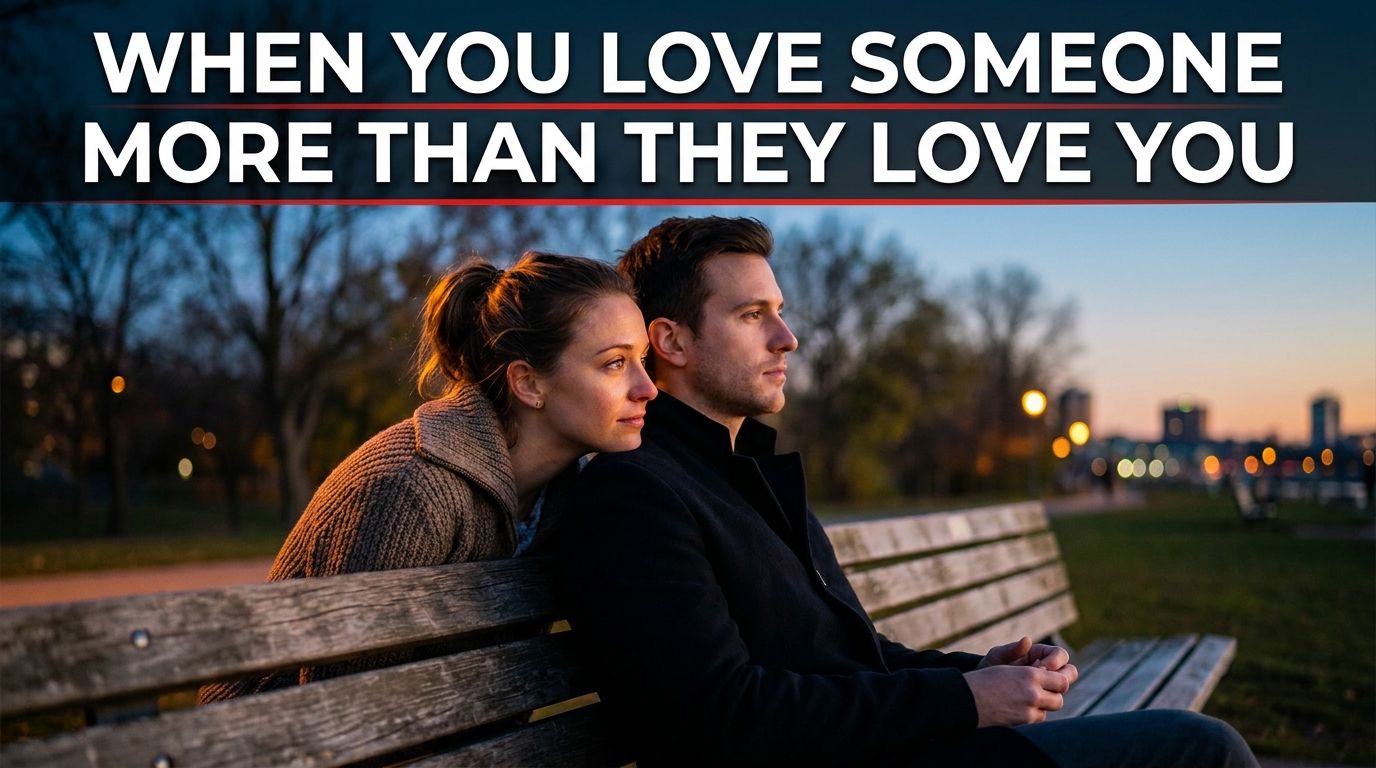
You feel it in the small things. The way you light up when their name appears on your phone, while their response comes hours later — casual, unhurried. The way you replay conversations they have already forgotten. The way you would rearrange your entire day for them, and they would not think twice about canceling yours. You know, somewhere beneath all the hoping and the rationalizing, that the love between you is not equal — and that knowledge lives in your chest like something quietly breaking. When you love someone more than they love you, it is one of the most isolating emotional experiences a person can carry, because the pain is invisible. The relationship exists.
They have not left. There has been no dramatic rupture to point to. And yet you are grieving something every single day — the version of this love you imagined, the reciprocity you keep waiting for, the feeling of being chosen with the same fullness with which you choose them. Psychologists who study attachment and relationship satisfaction consistently identify love imbalance — where one partner is significantly more emotionally invested than the other — as one of the strongest predictors of long-term relational dissatisfaction, emotional burnout, and loss of individual identity.
This article is not going to tell you to simply love yourself more or walk away without understanding why you stayed. It is going to go deeper — into what this experience actually does to you, why it happens, and what it genuinely takes to find your way through it.
Why Love Is So Rarely Perfectly Equal — The Psychology
Before anything else, it is worth saying clearly: perfectly equal love, at every moment, in every relationship, does not exist. Feelings ebb and flow. People go through seasons of emotional availability and seasons of withdrawal. One partner may be more demonstrative while the other expresses love through action. These variations are normal and do not constitute a love imbalance in the meaningful, painful sense.
The kind of imbalance this article addresses is different. It is sustained, structural, and felt deeply by the person on the giving end. It is the experience of consistently being more invested — emotionally, energetically, and in terms of conscious commitment — than the other person. Of always being the one who cares more about whether the relationship survives a hard week. Of loving in a direction that does not come back to you with the same force.
Psychologists have studied this imbalance extensively, and the findings are both illuminating and, in some ways, uncomfortable. Research by Roy Baumeister and colleagues on what they call the “principle of least interest” in relationships — first articulated by sociologist Willard Waller in the 1930s and repeatedly validated since — describes a consistent dynamic: the partner who is less emotionally invested holds more power in the relationship. Not because they are deliberately wielding it, but because indifference, in the architecture of romantic attachment, functions as leverage. The person who cares more is the person who has more to lose — and both people, consciously or not, feel that asymmetry.
This is not a personal failing. It is a psychological reality. And understanding it is the beginning of understanding why loving someone more than they love you feels so persistently diminishing — even when nothing overtly wrong is happening.

What It Actually Feels Like — Naming the Experience Honestly
One of the reasons loving someone more than they love you is so hard to process is that it resists easy naming. It does not feel like a single emotion — it feels like several contradictory ones occurring simultaneously.
There is love, which is real and full and not diminished by the imbalance. There is hope, which keeps you in the dynamic even when your experience tells you something is wrong. There is anxiety — the constant, low-level monitoring of their emotional temperature, their level of engagement, whether today they seem closer or further away. There is gratitude for the moments of warmth, which feel disproportionately significant because they are not consistent. And underneath all of it, there is grief — quiet, unacknowledged, socially invisible grief for a reciprocity that has not materialized.
People in this experience frequently describe a particular kind of loneliness that is harder to bear than being alone. You are not alone — you have a relationship, a person, a shared context. And yet you feel profoundly unseen. Because being with someone who loves you less than you love them is, in a specific and painful way, a form of not being fully met. You show up entirely, and only part of you is received.
There is also shame — the shame of caring too much in a culture that valorizes being the one who cares less. The shame of needing more than you are getting. The shame of knowing, intellectually, that the dynamic is not healthy, while being unable to stop loving the way you love.
That shame is not earned. It is a cultural artifact — the result of a script that treats emotional vulnerability as weakness and detachment as strength. Your capacity for love is not the problem. The mismatch is.
Why You Stay — The Psychology of Unequal Attachment
Understanding why people stay in relationships where they love more than they are loved is essential — not to judge the choice, but to see it clearly.
The first reason is intermittent reinforcement — the same neurological mechanism that makes gambling so difficult to stop. When affection is inconsistent, when warmth appears and then retreats, the brain’s dopamine system becomes hyperactivated in pursuit of the next reward. The good moments — when they are present, when they are warm, when they look at you the way you have been hoping they would — produce a neurological high that is more intense than it would be in a consistently loving relationship. The inconsistency does not reduce your attachment. It deepens it.
The second reason is the investment trap — what behavioral economists call the sunk cost fallacy. The longer you have loved this person, the more you have given, the more of your emotional life has been organized around them — the harder it becomes to walk away. Leaving begins to feel like admitting that all of that investment was wasted. It was not. But the feeling is real and powerful enough to keep people in painful dynamics long past the point of clarity.
The third reason is the belief — often unconscious, often rooted in early attachment experiences — that love requires earning. That if you love enough, give enough, are patient enough, eventually they will love you back with the fullness you deserve. This belief is rarely examined directly, because examining it requires confronting a deeply uncomfortable possibility: that the amount or quality of your love cannot determine how much someone else is capable of offering.
“You cannot love someone into loving you back. And the trying — the endless, devoted, exhausting trying — is the thing that costs you most.”
The fourth reason is genuine love. It would be easier if you did not actually love them — if this were purely about habit or fear or investment. But often, you do love them. Fully, specifically, with the kind of care that knows their particularities and chooses them anyway. That love is real. And real love is not something the mind can simply switch off because the logic says it should.

What Loving More Than You Are Loved Does to You Over Time
This is the part of the conversation that most people avoid — because acknowledging it requires accepting that the current dynamic has a cost, and accepting that cost makes staying a more conscious, more uncomfortable choice.
Loving someone more than they love you, sustained over months or years, produces specific and well-documented psychological effects.
Erosion of self-worth. When your love is not returned with equivalent investment, the human mind — particularly one conditioned by anxious attachment — tends to locate the problem in itself. There must be something about you that is not enough. Something that explains why they do not love you the way you love them. This self-blame is almost never accurate, but it is almost always present. And over time, it quietly restructures the way you see yourself — not just in this relationship, but in all of them.
Chronic emotional exhaustion. Loving someone who does not love you equally requires a continuous expenditure of emotional energy with insufficient return. You give — attention, care, effort, presence — and receive back something less. That imbalance is draining in the way that any sustained asymmetrical exchange is draining. People in this dynamic frequently describe feeling tired in a way that sleep does not fix — a bone-deep relational exhaustion that accumulates quietly over time.
Shrinking of the self. Many people in love imbalances unconsciously begin to make themselves smaller — to need less, ask for less, express less — in an attempt to make the dynamic feel more manageable. If I need less, the gap between what I need and what I receive will hurt less. This shrinking is a form of self-protection that costs enormously: it requires you to become a diminished version of yourself in order to survive a relationship that should be expanding you.
Loss of connection to your own emotional truth. Over time, the practice of managing your feelings — of tamping down needs, rationalizing disappointments, and coaching yourself not to read too much into things — can produce a significant disconnection from your own emotional experience. People in this situation sometimes describe feeling numb, or uncertain about what they actually feel beneath the management.
Normalized deprivation. Perhaps the most lasting consequence: the longer you experience love imbalance as normal, the more it recalibrates your baseline expectations. What you would have once recognized clearly as insufficient begins to feel like simply how things are. This recalibration makes it harder to recognize healthy love when it is available — and harder to trust that you deserve it.
The Hardest Question — Do They Know?
Most people in this situation have asked themselves, at some point, whether their partner is aware of the imbalance. The answer is usually more complicated than yes or no.
Some partners are fully aware and are in the relationship largely because the convenience and emotional benefits of being loved so fully outweigh their discomfort with the imbalance. This is not always a deliberate calculation — it can be a passive one. They do not love you the way you love them, but being loved that way feels good, and ending the relationship would require a confrontation with something they would rather not examine.
Some partners are genuinely unaware — not because they are dishonest, but because the person who loves more has become so skilled at managing the dynamic that the imbalance is invisible. They show up. They accommodate. They give generously without flagging the gap. The less-invested partner never has to reckon with the cost because it has been quietly absorbed.
And some partners are aware in the way that people are aware of things they prefer not to confront directly — a peripheral knowledge that exists but is not examined, not named, not addressed.
In any of these cases, the conversation that needs to happen is the same: honest, direct, and without the softening that has been protecting both people from the discomfort of reality.

What to Do When You Love More — A Grounded Guide
There is no script for this that works for everyone. But there are practices — grounded in relationship psychology and emotional honesty — that consistently move people toward greater clarity, regardless of where the relationship ultimately goes.
Name it to yourself first. Before anything else, allow yourself to say it plainly — to yourself, without softening. I love this person more than they love me. The imbalance is real. I have been absorbing the cost of it. This is not catastrophizing. This is the beginning of honest self-regard.
Have the conversation — clearly and without apology. Not accusatory, not ultimatum-laden, but honest. Tell your partner what you have noticed and what you need. Not “I feel like sometimes you don’t really seem that into it” — something clearer. “I have been feeling like our investment in this relationship is not equal, and I need to understand what this is for you.” Watch what happens next. Not just the words — the follow-through. The change in behavior, or the absence of it.
Stop performing contentment you do not feel. One of the most common and most costly behaviors in love imbalances is pretending to need less than you do — acting unbothered when you are bothered, expressing gratitude for scraps, minimizing your own experience to keep the peace. Every performance of false contentment is a communication to yourself that your real needs do not deserve to be expressed. They do.
Reconnect with who you are outside this relationship. Love imbalances have a way of colonizing a person’s entire interior life. Reclaiming your friendships, your interests, your sense of self outside the relationship is not a betrayal of your love. It is the most important act of self-preservation available to you — and it is often the first step toward genuine clarity about whether this relationship is serving you.
Consider what you would advise a friend. This reframe — deceptively simple and genuinely powerful — was identified by Dr. Kristin Neff’s research on self-compassion as one of the most effective tools for accessing emotional clarity. If your closest friend described to you exactly what you are living, what would you tell them? The answer to that question is almost always the answer you already know but have been unable to apply to yourself.
“You have been so devoted to understanding why they cannot love you the way you need to be loved. Give some of that same devoted attention to yourself.”
Give yourself a real timeline. Not an indefinite waiting period dressed up as patience — a real, honest, internally committed window of time within which you will observe whether anything genuinely changes. If nothing changes within that window, make a decision. Not from anger, not from desperation — from the calm, self-respecting recognition that indefinite hope in the absence of change is not love. It is waiting. And waiting has a cost.
When Leaving Is the Answer — And What That Actually Takes
Sometimes — often — the most loving thing you can do for yourself is to stop. To stop waiting. To stop giving more than you receive. To stop building a life inside a love that has not chosen to hold the full weight of yours.
Leaving a relationship where you love more than you are loved is not straightforward — because you do genuinely love this person, and the love does not disappear when the decision is made. You may leave and still love them. You may grieve them for longer than you expect. You may find yourself wondering, for a while, whether you made the right choice.
But here is what the research on post-relationship recovery consistently shows: people who leave love imbalances — particularly sustained ones — report, over time, a significant restoration of self-worth, emotional energy, and genuine openness to reciprocal love. The period immediately after is hard. The period that follows it is often profoundly clarifying.
You will not miss the dynamic. You will not miss the anxiety, the monitoring, the shrinking, the rationalizing. You will miss them — specifically, personally, really. And that grief is legitimate and deserves space.
But you will also — and this is the thing that is hard to believe from inside the imbalance — begin to remember what it feels like to have emotional energy available for your own life. To not spend the majority of your interior resources managing a love that does not manage you back.
That recovery is not instant. But it is real. And it begins the moment you decide that you matter enough to stop settling for almost.

What Reciprocal Love Actually Feels Like — So You Know What You Are Looking For
One of the most important things to understand after living inside a love imbalance is what healthy, reciprocal love actually feels like — because for many people, the imbalance has been going on long enough that they have lost their reference point.
Reciprocal love does not mean equal love at every moment. It means that over time, both people are consistently showing up for the relationship with genuine investment. It means that your excitement about them is met with their excitement about you — not identically, not performatively, but really. It means that you do not spend the majority of your emotional energy monitoring the relationship for signs that it is still okay.
Reciprocal love feels like rest. Not the absence of challenge — relationships are always challenging — but a baseline of security that means you are not always bracing for something. You know they want to be there. You do not have to earn it today. You do not have to be smaller or quieter or more convenient.
It feels like being known — fully, specifically, with the same attentiveness you bring to knowing them. It feels like your needs being welcomed rather than tolerated. It feels like someone choosing you — not as a default, not as a convenience, but as a conscious, specific, repeated decision.
You deserve that. Not as a consolation prize. Not as something you have to earn or wait long enough for. As the baseline standard for what love in your life should feel like.

The Bottom Line — You Deserve a Love That Comes Back
When you love someone more than they love you, the experience teaches you things about yourself that nothing else could — your capacity for devotion, the depth of your emotional life, how much you are willing to endure in the name of love. Those are not small things. They are part of who you are.
But they are not reasons to stay in a dynamic that is slowly spending you.
You are allowed to want reciprocity. You are allowed to need it. You are allowed to decide, at some point, that loving someone is not enough if they are not loving you back — that the fullness of what you have to offer deserves to go somewhere it will be received with the same fullness.
The love you are capable of is not a problem. Directed at the right person — someone who recognizes it, matches it, and chooses you the way you choose them — it is one of the most beautiful things you will ever experience.
Do not let the experience of loving someone who cannot meet you make you love less deeply. Let it make you more clear about where your love deserves to go.
You are worth being loved back — completely, consistently, and without having to ask.
FAQ
Q: Can a love imbalance fix itself over time? A: Sometimes. There are relationships where one partner is temporarily less available due to stress, personal struggle, or emotional difficulty — and where investment rebalances as those circumstances change. But when the imbalance is structural and sustained, and when the less-invested partner shows no awareness of or concern about the gap, it rarely self-corrects. The key question is whether both people are aware of the imbalance and whether the less-invested partner is actively working to change it.
Q: Is it possible to love someone too much? A: The amount you love someone is rarely the problem. What can become problematic is what you do with that love — particularly if it involves self-abandonment, the suppression of your own needs, or remaining in a dynamic that consistently diminishes you. Loving deeply is not a flaw. Sacrificing your wellbeing indefinitely for a love that does not return is where the cost becomes unsustainable.
Q: How do you bring up a love imbalance without seeming needy or insecure? A: Naming a genuine experience clearly is not neediness — it is emotional honesty. Frame the conversation around your experience rather than accusations about theirs: “I have been feeling like we are not equally invested in this relationship, and I would like to talk about it honestly.” You are not asking to be loved more on command. You are asking for an honest conversation about the reality of what you are both experiencing.
Q: What if they say they love me — but their actions suggest otherwise? A: Believe the actions. Love is not primarily a feeling — it is a behavior, expressed through presence, effort, consistency, and genuine care for another person’s experience. Words are easy to produce. The behavioral reality of the relationship is the most accurate measure of how someone actually feels. When words and actions are consistently misaligned, the actions are the truth.
Q: How do you stop loving someone who does not love you back the same way? A: You usually cannot stop all at once — and trying to force it often creates more suffering. What helps is gradually shifting the focus of your emotional energy back toward yourself and your own life, reducing the amount of space the relationship occupies in your daily thoughts, increasing connection with your own identity outside the relationship, and — where possible — creating physical distance that gives the attachment room to loosen. Grief is part of this process, and it is not something to rush.
Something Brought You to This Article. Listen to That.
You did not find this by accident. Something in you already knows what it needs — and reading this was part of beginning to honor it.
💾 Save this article somewhere you will find it on the hard nights — when you are making excuses for them again, when the doubt creeps back in, when you need a voice that tells you the truth instead of what is comfortable.
📤 Share it with someone you love who keeps giving everything to someone who gives back almost nothing. You might not be able to say it out loud — but sharing this says it for you.
💬 Leave a comment — where are you in this right now? Beginning to see it? In the middle of deciding? Already on the other side? Every part of that journey deserves to be witnessed, and this community is a real one.
🔁 Tag someone who needs to be reminded that loving deeply is not a flaw — but loving someone who does not choose you back is not something anyone should carry indefinitely.
➕ Follow Truthsinside.com for love and relationship content that does not tell you what you want to hear — it tells you what you need to hear, with the care and honesty you deserve.
📖 Read next: How to Love Without Losing Yourself — because the people who love more than they are loved are often the same people who have given themselves away entirely in the process.
📃 Related article: What Does It Actually Feel Like to Fall in Love? Science + Real Stories
You are not too much. You have simply been in the wrong place for the size of your love.
🎵 Music
Maren Lull is a singer-songwriter who writes from the places most people don’t talk about out loud.
Not the dramatic grief. Not the obvious heartbreak. The quiet kind — the ordinary Tuesday emptiness, the habit of reaching for someone who isn’t there anymore, the particular exhaustion of being strong for so long that the strength itself wears thin.
Her music lives at the intersection of emotional honesty and soft beauty — breathy vocals over gentle piano, slow tempos, lyrics that feel less like songs and more like something you wrote in a private notebook at two in the morning and never showed anyone.
Maren Lull writes for the people who feel everything deeply and say very little about it. For the ones who listen to sad music not because they want to feel worse — but because being understood, even by a song, makes the feeling easier to carry.
📱 Follow Maren Lull:
→ Spotify
→ Apple Music
→ Youtube
→ Audiomack