
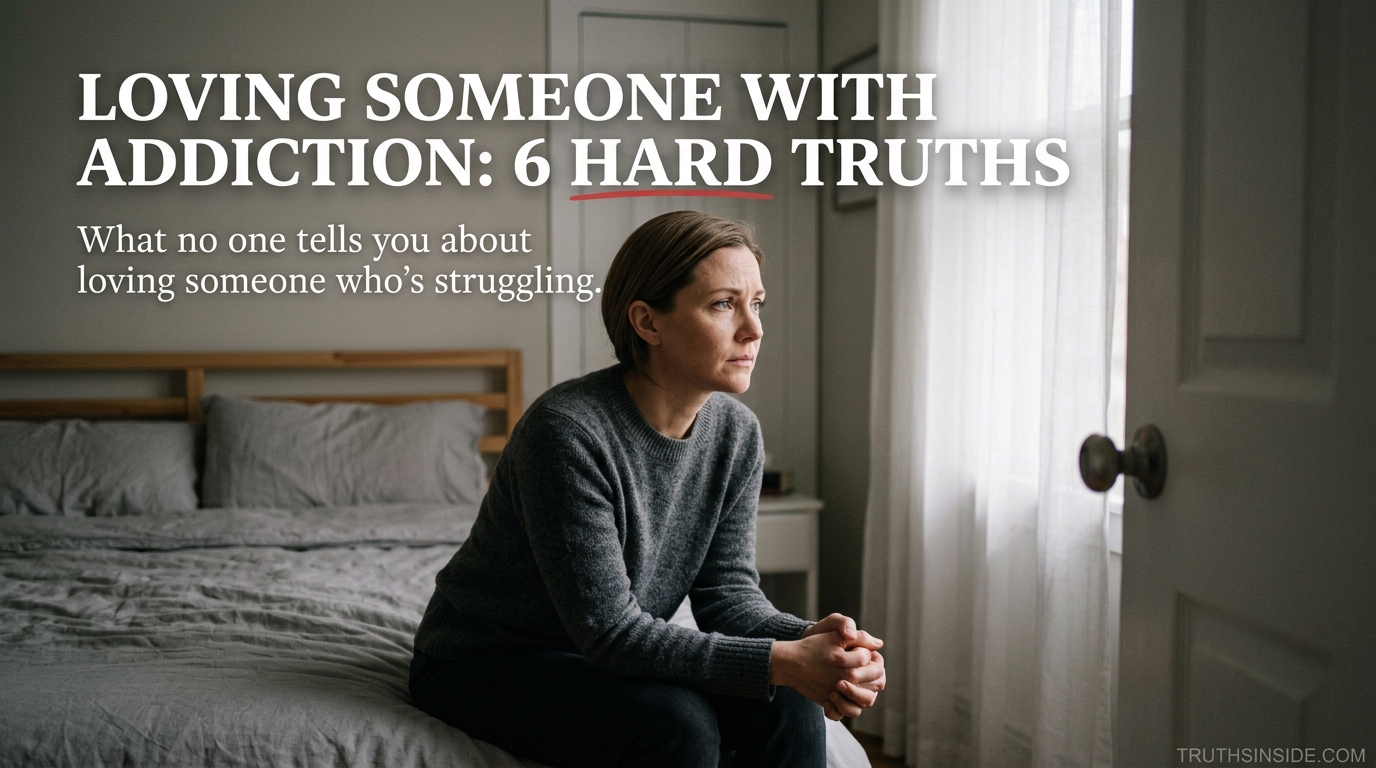
Rachel still remembers the exact moment she realized her love wasn’t enough to fix what was happening to her husband. She had tried patience, ultimatums, silence, and pleading — and none of it changed the pattern. What she was living through had a name that finally made sense of her exhaustion: loving someone with addiction, an experience that mental health researchers describe as one of the most emotionally complex forms of caregiving a person can go through.
According to the National Institute on Drug Abuse, addiction is recognized as a chronic brain disease that affects behavior, decision-making, and impulse control — not a matter of willpower or love alone. Loving someone with addiction means holding two truths at once: the person you love is still there, and the disease is actively reshaping how they think, act, and relate to the people closest to them. That tension is often what makes this experience so uniquely painful.
This article explores what loving someone with addiction really involves, the emotional patterns that commonly develop, the psychology behind those patterns, and how to protect your own well-being while still showing up with care.
WHAT DOES LOVING SOMEONE WITH ADDICTION ACTUALLY MEAN?
Loving someone with addiction means navigating a relationship where a substance or behavior has taken priority over commitments, honesty, and emotional presence — not because love has disappeared, but because addiction fundamentally alters brain chemistry related to reward and impulse control. This distinction matters because it reframes confusing or hurtful behavior as a symptom of illness rather than a simple reflection of how much someone cares.
This experience often includes cycles of hope and disappointment. A partner may show real effort, improvement, or sobriety for a period, only to relapse, which can feel more devastating than if things had never improved at all. Loving someone with addiction frequently means learning to hold both grief and hope simultaneously, often without a clear timeline for how or when things will change.
It’s also an experience that reshapes identity. Partners, family members, and close friends of someone struggling with addiction often describe feeling like they’ve become a manager, monitor, or rescuer rather than an equal partner. Recognizing this shift is often the first step toward reclaiming a healthier role within the relationship, one that doesn’t require sacrificing your own well-being to sustain the connection.
📃 Related article: Love Maps: 5 Ways They Predict Lasting Love
THE PSYCHOLOGY BEHIND LOVING SOMEONE WITH ADDICTION
Why Codependent Patterns Develop
Many people loving someone with addiction unintentionally develop codependent patterns — prioritizing another person’s needs, moods, and behavior so consistently that their own needs become secondary. Psychologists note that codependency often develops gradually, as a natural response to chaos: managing a partner’s crises can feel like the only way to maintain a sense of stability and control.
Over time, this pattern can create an exhausting cycle. Covering for a partner’s behavior, managing consequences, or making excuses to others may temporarily reduce conflict, but it often reinforces the addictive pattern rather than interrupting it. This isn’t a reflection of weakness — it’s a well-documented psychological response to sustained relational stress, and it’s one that many people don’t recognize while they’re inside it.
The Grief of Loving an Active Addiction
Loving someone with addiction often involves a specific, disenfranchised form of grief — mourning the version of a person who existed before addiction took hold, while that person is still physically present. Grief researchers note that this “ambiguous loss” is uniquely difficult to process because there’s no clear ending to grieve, only an ongoing, unpredictable change.
“You can grieve someone who is still alive. Loving someone with addiction often means mourning a person while still hoping for them, sometimes in the very same moment.”
SIGNS YOU MAY BE STRUGGLING WITH THIS DYNAMIC
Loving someone with addiction can shift a person’s own behavior and mental health in ways that aren’t always obvious from the inside. Below are common signs worth recognizing.
1. Constantly Managing or Covering for Their Behavior
Making excuses to family, employers, or friends, or consistently managing the consequences of a partner’s choices, is a common sign of codependent patterns forming.
2. Losing Sight of Your Own Needs
If your daily emotional state consistently depends on your partner’s behavior that day, your own well-being has likely taken a back seat.
3. Chronic Hypervigilance
Constantly monitoring a partner’s mood, whereabouts, or behavior for signs of relapse or crisis often reflects sustained anxiety shaped by the unpredictability of addiction.
4. Isolation From Support Systems
Withdrawing from friends or family, either from exhaustion or shame, is a common but harmful pattern that increases emotional strain over time.
5. Difficulty Setting or Holding Boundaries
Repeatedly abandoning limits you’ve set for yourself — around communication, finances, or acceptable behavior — often signals a boundary pattern that needs outside support to shift.
HOW LOVING SOMEONE WITH ADDICTION AFFECTS YOUR OWN WELL-BEING
The emotional toll of loving someone with addiction extends well beyond the immediate relationship. Chronic stress from unpredictability, broken trust, and cyclical hope and disappointment can contribute to anxiety, depression, and physical health symptoms in partners and family members over time. Many people in this position describe a persistent sense of walking on eggshells, unsure which version of their partner they’ll encounter on any given day.
Research on families affected by addiction consistently shows that support specifically designed for loved ones — not just the person struggling — significantly improves emotional outcomes. Programs like Al-Anon and family-focused therapy exist precisely because loving someone with addiction requires its own support system, separate from whatever recovery process the addicted individual may or may not be engaged in.
It’s also important to recognize that your well-being is not conditional on your partner’s recovery. Many people mistakenly believe they must wait until their partner gets better before addressing their own mental health, when in reality, building your own support and boundaries often has to happen regardless of whether or when your partner chooses recovery.

HOW TO PROTECT YOURSELF WHILE STILL SHOWING UP WITH LOVE
Loving someone with addiction doesn’t require abandoning boundaries, nor does protecting yourself mean abandoning care. Both can coexist with intention.
Separate love from responsibility for their recovery. You can love someone deeply and still recognize that their recovery is ultimately their responsibility, not something you can control or force.
Set boundaries around specific behaviors, not the relationship as a whole. Clear limits — such as not covering for missed responsibilities or not providing money that enables substance use — protect you without requiring you to withdraw love entirely.
Seek support designed specifically for loved ones. Programs like Al-Anon, Nar-Anon, or therapy focused on families affected by addiction provide space to process this experience without judgment.
Watch for signs of codependency in yourself. Regularly checking whether your own needs, friendships, and mental health are being maintained helps prevent the relationship from consuming your entire identity.
Accept that you cannot love someone out of addiction. As painful as it is, care and affection alone cannot override the neurological and psychological grip of addiction — recovery requires the individual’s own engagement, often alongside professional treatment.
“Loving someone with addiction means learning where your love ends and their recovery begins — and protecting yourself in that space is not abandonment. It’s survival.”

FREQUENTLY ASKED QUESTIONS
Is it possible to help someone recover just by loving them enough?
No. While love and support can be meaningful parts of someone’s recovery journey, addiction is a medical condition that typically requires professional treatment, and recovery ultimately depends on the individual’s own engagement.
How do I know if I’ve become codependent while loving someone with addiction?
Common signs include consistently prioritizing their needs over your own, covering for their behavior, and feeling emotionally dependent on their daily mood or choices.
Should I stay in a relationship with someone struggling with addiction?
This is a deeply personal decision that depends on safety, the presence of abuse, willingness to seek treatment, and your own capacity to maintain well-being. Speaking with a therapist can help clarify this decision.
What support exists specifically for partners and family members?
Programs like Al-Anon and Nar-Anon, along with therapists specializing in family and addiction dynamics, offer support specifically for loved ones navigating this experience.
Is it normal to feel both love and resentment at the same time?
Yes. Holding conflicting emotions — deep love alongside frustration, grief, or resentment — is an extremely common experience when loving someone with addiction, and it doesn’t diminish the love itself.
If you or someone you love is struggling with addiction, resources like SAMHSA’s National Helpline (1-800-662-4357) offer free, confidential support and treatment referrals.
If this article helped you feel a little less alone, save it to revisit later, share it with someone walking a similar path, and follow Truthsinside.com for more research-backed relationship and psychology content.
🎵 Music
Maren Lull is a singer-songwriter who writes from the places most people don’t talk about out loud.
Not the dramatic grief. Not the obvious heartbreak. The quiet kind — the ordinary Tuesday emptiness, the habit of reaching for someone who isn’t there anymore, the particular exhaustion of being strong for so long that the strength itself wears thin.
Her music lives at the intersection of emotional honesty and soft beauty — breathy vocals over gentle piano, slow tempos, lyrics that feel less like songs and more like something you wrote in a private notebook at two in the morning and never showed anyone.
Maren Lull writes for the people who feel everything deeply and say very little about it. For the ones who listen to sad music not because they want to feel worse — but because being understood, even by a song, makes the feeling easier to carry.
📱 Follow Maren Lull:
→ Spotify
→ Apple Music
→ Youtube
→ Audiomack