
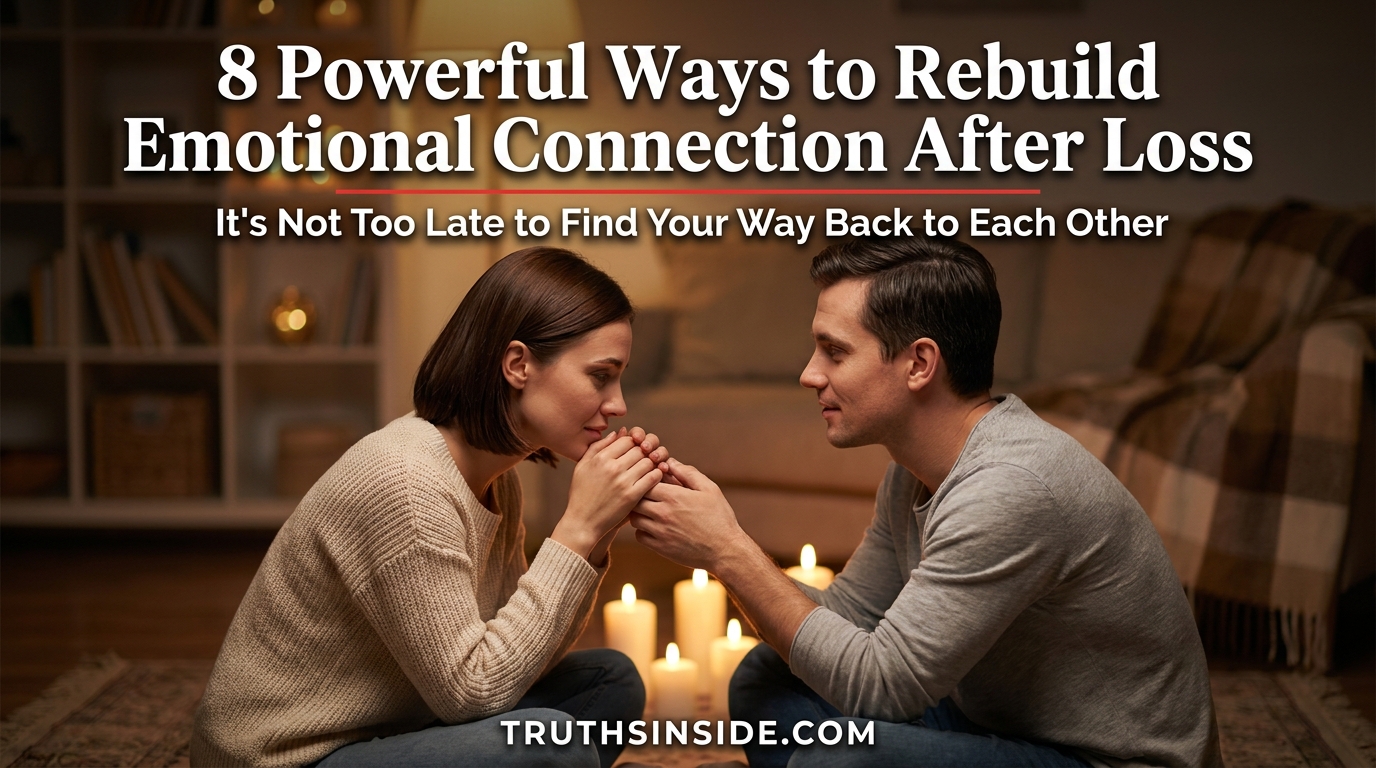
There is a particular loneliness that doesn’t come from being alone — it comes from lying next to someone you love and feeling like a stranger to them. No dramatic falling out. No single catastrophic moment. Just a slow, almost imperceptible drift that one day you wake up and realize has carried you further from each other than you ever intended to go.
If that sounds familiar, know this: you are not the first couple to find themselves here, and the fact that you are still looking for a way back is itself a form of love worth honoring. The desire to rebuild emotional connection is not weakness — it is one of the most courageous things two people can choose to do together.
Research from the Gottman Institute — one of the most respected relationship science organizations in the world — found that emotional disconnection, not conflict, is the primary predictor of relationship dissolution. In a study of over 3,000 couples across 16 years, the consistent presence of emotional distance and the absence of genuine bids for connection were stronger predictors of breakup than fighting, financial stress, or incompatibility. In other words, it is not the arguments that end relationships. It is the quiet drift into emotional silence that does.
And yet, that same body of research confirms something equally powerful: emotional connection, even when severely damaged, can be rebuilt. The brain is neuroplastic — it rewires itself through repeated experience. Which means that with the right intention, the right understanding, and the right tools, two people who have grown apart can genuinely grow back toward each other. This article is your roadmap. Not a guarantee — but a real, research-informed, honest guide to finding your way back to the person you chose.
Why Emotional Connection Fades in the First Place
Before you can rebuild emotional connection, it helps to understand how it was lost — because the answer is almost never dramatic, and almost always deeply human.
Emotional connection erodes through what relationship researchers call “accumulated micro-disconnections.” These are the small moments — the bid for attention that went unacknowledged, the vulnerability that was met with distraction, the conversation that got interrupted by a screen, the need that was expressed and quietly dismissed — that stack up over time into a wall neither partner fully remembers building.
Life accelerates. Careers demand. Children arrive. Grief happens. Stress compounds. And in the middle of all of it, the relationship — the thing that was supposed to be the anchor — quietly gets moved to the bottom of the priority list. Not out of malice. Out of overwhelm. Out of the assumption that it will still be there when things calm down.
The tragedy is that emotional connection does not maintain itself on assumption. It requires active investment. And when that investment stops — even for understandable reasons — the connection begins to thin. What was once effortless and alive becomes strained and unfamiliar. Two people look at each other across the dinner table and realize they haven’t truly seen each other in a very long time.
Understanding this removes the blame from both partners and places it where it belongs — on the gap in attention and intention that let the distance grow. That reframing is not just emotionally kinder. It is strategically important. Because you cannot rebuild something together while you are still assigning fault for who broke it.
8 Powerful Ways to Rebuild Emotional Connection
1. Start With Radical Honesty — Together
The very first step in any genuine reconnection is naming what is real. Not the polished, conflict-avoiding version. The actual truth: “I feel like we’ve lost something. I miss you even when you’re right here. I want us back, and I’m scared we don’t know how to get there.”
That kind of honesty is terrifying. It requires vulnerability at a moment when the relationship doesn’t yet feel safe enough to hold it. But it is also the only real starting point. Surface-level attempts to reconnect — more date nights, more physical affection — without first acknowledging the emotional reality underneath, tend to feel hollow and forced to both partners.
Sit with each other — not over dinner, not during a rushed weekday — and be honest. Not about what the other person did wrong. About how you feel and what you want. That conversation, even if it is awkward and imperfect and emotional, is the crack in the wall where light gets back in.
2. Rebuild the Habit of Being Curious About Each Other
One of the earliest casualties of emotional disconnection is curiosity. In the early stages of a relationship, partners are endlessly fascinated by each other — they ask questions, they listen with full attention, they want to know everything. Over time, that curiosity is often replaced by assumption. You think you already know who this person is, what they think, what they want.
But people change. Constantly, quietly, profoundly. The person sitting across from you has had thoughts, fears, dreams, and realizations since the last time you truly asked. Research by psychologist Arthur Aron found that asking each other deep, progressively personal questions — his famous “36 Questions” study — could generate significant feelings of closeness between strangers and rekindle intimacy between partners who had grown distant.
Start asking questions again. Real ones. “What’s something you’ve been thinking about lately that you haven’t told me?” “What do you wish I understood about how you’re feeling right now?” “What are you most afraid of this year?” Curiosity is not just the language of new love. It is the medicine of lasting love.

3. Create Consistent, Screen-Free Presence
To rebuild emotional connection, you must first reclaim time and attention from the forces that have been slowly consuming both. The modern relationship’s greatest enemy is not another person. It is distraction — specifically, the normalized and relentless presence of screens in every moment that could otherwise be connection.
Research from the University of Essex found that the mere presence of a phone on the table during a conversation — even if neither person touches it — significantly reduces the quality of connection, empathy, and the sense of being understood between two people. The phone doesn’t have to be in use to do damage. Its presence signals that you could leave this moment at any time.
Designate protected time together where phones are physically in another room. Not silenced — removed. One hour per evening. Sunday mornings. Whenever it is — make it real and make it consistent. Presence is not the absence of distraction. It is the active choice to be fully where you are, with whom you are with. That choice, made repeatedly, is the foundation of emotional reconnection.
4. Re-Learn Each Other’s Love Language — They May Have Changed
You may have known your partner’s love language at the beginning of the relationship. But love languages evolve. Life circumstances shift what a person needs most. Someone who once craved physical touch may now be starved for words of affirmation after years of feeling unseen. Someone who valued gifts may now desperately need quality time after years of feeling deprioritized.
If you are still giving love in the same way you did five years ago without checking whether that is still what your partner needs, you may be putting energy into a channel that is no longer receiving.
Have the conversation explicitly. “What makes you feel most loved right now? What do you need from me that you haven’t been getting?” And then listen without defensiveness. What you hear may surprise you. What it opens up between you will be worth it.
5. Return to Physical Affection — Without Agenda
Non-sexual physical touch is one of the most powerful and most underutilized tools for emotional reconnection. Touch releases oxytocin — often called the bonding hormone — which directly promotes feelings of trust, safety, and closeness. When emotional distance has set in, physical affection often decreases simultaneously, creating a compounding cycle of disconnection.
Returning to touch must be gradual and pressure-free. A hand on the shoulder when walking past. A longer hug at the end of the day. Sitting close enough that your arms touch. Holding hands during a walk. These are not performances of intimacy — they are physiological bridges back to it.
The research is clear: couples who maintain regular non-sexual physical affection report significantly higher relationship satisfaction, greater emotional security, and stronger resilience during conflict. Touch communicates what words sometimes cannot — I am still here, I still choose you, you are still safe with me.
“Emotional connection is not reignited in grand gestures. It is rebuilt in the quiet, consistent choice to show up fully — in a longer hug, an honest question, a phone placed face-down, a moment where you choose each other over everything else competing for your attention.”
6. Process Unresolved Resentments — Carefully and Together
One of the most common reasons emotional connection cannot be rebuilt despite genuine effort is that unresolved resentment is sitting beneath the surface of every attempt. Resentment is like static in a communication channel — it doesn’t stop transmission entirely, but it corrupts everything that passes through it.
If there are things that have never been fully addressed — old wounds, repeated patterns, moments that left one or both partners feeling unseen, dismissed, or unfairly treated — those things must be processed before true reconnection is possible. Not necessarily resolved in the sense of complete closure, but genuinely acknowledged, heard, and worked through.
This is often where a couples therapist becomes invaluable. Not because the relationship is broken beyond repair, but because having a trained, neutral third party creates the structure and safety necessary to surface these conversations without them collapsing into defensiveness or shutdown. Therapy is not a last resort. It is a tool — one of the most effective ones available for exactly this kind of work.

7. Create New Shared Experiences and Memories
Long-term couples often stop creating together. Life settles into maintenance mode — the same restaurants, the same routines, the same conversations about the same responsibilities. Comfort is not the enemy, but stagnation is.
Neurological research shows that novel shared experiences trigger the same dopamine response as early romantic love — the brain associates new, exciting experiences with the person you are with, reinforcing feelings of attraction and closeness. This is why travel, new activities, and breaking routine together have a measurable positive effect on relationship satisfaction.
You don’t need an expensive vacation. You need novelty and togetherness. Cook a cuisine you’ve never tried. Take a dance class. Drive somewhere neither of you has been and wander without a plan. The goal is not the activity itself — it is the experience of being adventurous together. Of being a team exploring something unknown. That experience quietly reminds both of you of who you are when you are at your best together.
8. Choose Each Other — Actively, Visibly, Daily
Perhaps the most important and most overlooked way to rebuild emotional connection is also the simplest: make the choice to choose your partner, visibly and repeatedly, every single day.
Not in the abstract. In the specific. Tell them what you appreciate. Acknowledge them in front of others. Prioritize them when it would be easier not to. Show up for the small things — the hard day at work, the worry they mentioned in passing, the anniversary of something that matters to them. These are not grand romantic gestures. They are daily acts of deliberate love.
Relationship researcher Dr. John Gottman calls these “bids for connection” — small moments where one partner reaches toward the other emotionally, and the other partner has the choice to turn toward them or away. Couples who consistently turn toward each other’s bids — even imperfectly — build what Gottman calls “emotional bank accounts” that sustain them through difficulty and deepen their bond over time.
Every time you choose to be fully present with your partner — every time you put the phone down, ask the real question, offer the longer hug, say the honest thing — you are making a deposit. And those deposits, accumulated over days and weeks and months, are what emotional connection is actually made of.
“You don’t fall back in love in one conversation or one perfect evening. You fall back in love in a hundred small moments of choosing to see each other clearly — and deciding, again and again, that what you see is worth staying for.”

When Reconnection Feels One-Sided
It is important to name something that this article cannot fix: emotional reconnection requires two willing participants. If you are the only one reaching toward the other — consistently, over time, without reciprocation — that is critical information.
One partner doing all the emotional labor while the other remains disengaged, dismissive, or uninterested is not reconnection. It is depletion. And while a temporary imbalance during a difficult season is normal and workable, a chronic one is a different conversation entirely.
If your partner is unwilling to acknowledge the distance, unwilling to seek support, and consistently unavailable for the kind of honest engagement that reconnection requires — the question shifts from “how do we rebuild this?” to “what am I willing to accept, and for how long?” That question is not a failure. It is a necessary act of self-honesty.
You deserve a partner who meets your effort with effort. Who shows up imperfectly but genuinely. Who chooses you not because you have made it impossible to leave, but because they actually want to stay.
FAQ Section
Q1: How long does it take to rebuild emotional connection in a relationship?
There is no universal timeline, but research suggests that consistent, intentional effort over 3 to 6 months produces measurable improvements in relationship satisfaction and emotional closeness. Couples who incorporate therapy alongside personal effort tend to see faster and more stable progress. The key variable is not time — it is consistency and genuine mutual investment.
Q2: Can emotional connection be rebuilt after a betrayal like cheating?
Yes — though it requires significantly more deliberate work, professional support, and sustained accountability from the partner who caused the breach. Studies show that couples who commit to structured post-infidelity therapy have measurable success rates of reconnection and report high relationship satisfaction years after the event. Healing is possible, but it is not linear and cannot be rushed.
Q3: What if we try everything and still feel disconnected?
This is a signal — not necessarily that the relationship is over, but that deeper work is needed than self-guided effort can provide. A licensed couples therapist, particularly one trained in Emotionally Focused Therapy (EFT) or the Gottman Method, can help identify the specific attachment patterns and communication breakdowns that are preventing reconnection. What feels like “tried everything” is often “tried several things without the right framework.”
Q4: Is it normal to feel nervous or awkward when trying to reconnect?
Completely and entirely. After a period of emotional distance, vulnerability feels risky — because the relationship has not yet re-established the safety net that makes openness feel natural. That awkwardness is not a sign that reconnection isn’t possible. It is a sign that you are attempting something real and brave in a space that needs to be rebuilt. Lean into it rather than waiting for it to feel comfortable first.
Q5: How do we rebuild emotional connection when we have kids and almost no time alone?
Connection does not require hours. It requires intention. Even 10 to 15 minutes of genuine, undivided, screen-free presence daily has been shown to meaningfully impact relationship satisfaction. Prioritize it as non-negotiably as any other essential in your family’s life. Schedule it if necessary. And communicate to each other that the relationship — not just the family logistics — is something you are actively choosing to protect.
Final Thoughts
To rebuild emotional connection is to make one of the most courageous choices available to a human being in love — to look at a relationship that has grown quiet and cold, and decide it is worth the work of warming it back up. It will not happen overnight. It will require honesty that feels uncomfortable, presence that requires sacrifice, and patience with a process that is rarely linear.
But the couples who make it — who find their way back from disconnection to genuine, deep, alive intimacy — consistently report that what they built the second time was stronger, more conscious, and more profoundly satisfying than what they had before the distance. Because this time, they chose each other with full awareness of what it costs and what it is worth.
That knowledge changes love. It makes it less of a feeling that happens to you and more of a practice you return to, every single day, because you understand what you are protecting.
Save this article and come back to it on the hard days when effort feels pointless.
Share it with someone whose relationship deserves a fighting chance.
Follow Truthsinside.com for more honest, research-backed content on love, emotions, and the psychology of real relationships.
Related article: What Does It Actually Feel Like to Fall in Love? Science + Real Stories
🎵 Music
Maren Lull is a singer-songwriter who writes from the places most people don’t talk about out loud.
Not the dramatic grief. Not the obvious heartbreak. The quiet kind — the ordinary Tuesday emptiness, the habit of reaching for someone who isn’t there anymore, the particular exhaustion of being strong for so long that the strength itself wears thin.
Her music lives at the intersection of emotional honesty and soft beauty — breathy vocals over gentle piano, slow tempos, lyrics that feel less like songs and more like something you wrote in a private notebook at two in the morning and never showed anyone.
Maren Lull writes for the people who feel everything deeply and say very little about it. For the ones who listen to sad music not because they want to feel worse — but because being understood, even by a song, makes the feeling easier to carry.
📱 Follow Maren Lull:
→ Spotify
→ Apple Music
→ Youtube
→ Audiomack