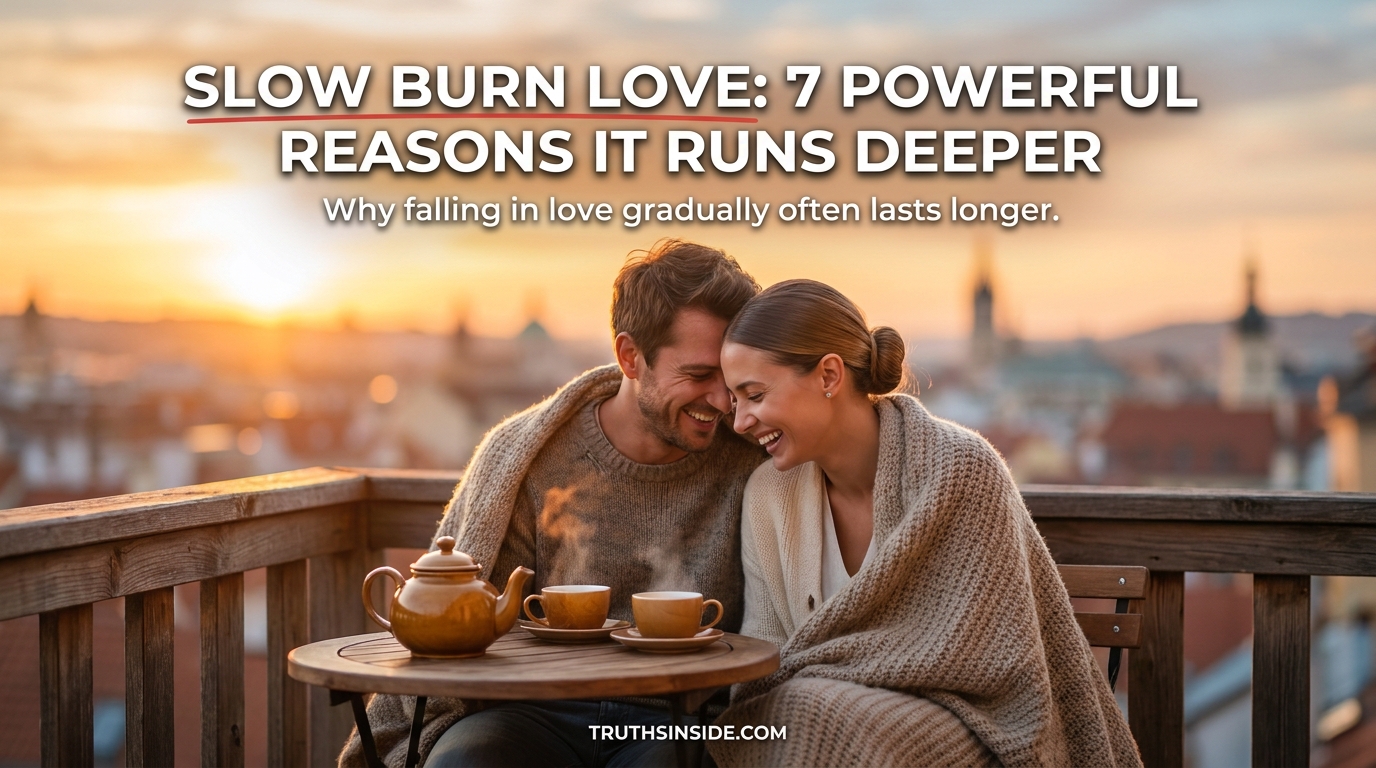
The Slow Burn: Why Falling in Love Gradually Is Often Deeper
There was no lightning bolt. No dramatic first kiss, no sudden certainty. Instead, there were small things: a text that made you smile, a conversation that ran three hours too long, a moment when you realized their name had become the first one you wanted to share good news with. Then, almost without noticing, you were in love. This is the slow burn, and it may be the most underrated way to fall.
Psychology suggests that gradual love has real strengths. Researchers who study the mere exposure effect, beginning with Robert Zajonc’s classic work, have found that repeated, safe contact tends to increase liking. And studies on friendship-based love, such as work by Grote and Frieze, suggest that couples who build closeness gradually often report strong trust and satisfaction.
This guide explores what a slow burn is, seven powerful reasons it often runs deeper, the risks to watch for, and how to nurture it.

What Is a Slow Burn Relationship?
A slow burn is a romance that develops gradually. Instead of an intense rush of attraction, the feelings build over weeks, months, or even years through shared time, conversation, and trust. Many slow burns begin as friendships, acquaintanceships, or work relationships that quietly deepen.
The term is borrowed from storytelling, where a slow burn romance lets tension and affection accumulate before characters finally come together. In real life, it often looks like this: you know someone, you like them, you start noticing little things, and then one day the feeling becomes impossible to ignore.
A slow burn is not the same as a stalled relationship or a situationship. In this kind of romance, the connection is moving forward, even if gently. In a stalled situation, someone is stuck, avoiding, or keeping the other person waiting.
📃 Related article: Emotional Connection or Attraction? 7 Hard Truths
Slow Burn vs. Love at First Sight
Neither path is “right.” Some people fall fast and build wonderful lives together. But the two styles tend to work differently.
| Love at First Sight | Slow Burn | |
|---|---|---|
| Starts with | Attraction, excitement | Friendship, trust, familiarity |
| Feels like | A rush, fireworks | Warmth, comfort, growing certainty |
| Strengths | Passion, momentum | Knowledge, stability, emotional safety |
| Risks | Idealization, surprises later | Ambiguity, hesitation, missed timing |
| Key question | “Do we really know each other?” | “Are we moving forward?” |
Each has its own challenges, and many couples blend both.
Fireworks light up the sky in seconds. A slow burn warms a home for years.
7 Powerful Reasons a Slow Burn Often Runs Deeper
1. Trust Is Built Before Passion Takes Over
Here, trust grows through repeated experience. You see how they act when they are tired, stressed, or disappointed. You watch whether they keep promises, handle conflict with respect, and treat others kindly.
This gradual process mirrors what relationship scientists describe as the foundation of emotional intimacy. Psychologists Harry Reis and Phillip Shaver proposed that intimacy grows when one person shares something personal and the other responds with understanding and care. Over time, repeated responsive moments create deep closeness.
2. You See the Real Person
When feelings develop quickly, early excitement can blur reality. People often show their best selves at the beginning. With gradual love, there is more time for the whole person to appear: their humor and moods, strengths and flaws.
By the time deep feelings arrive, you are not in love with an idea. You are in love with someone you actually know. This can reduce the shock that sometimes follows a whirlwind romance.
3. Attraction Can Grow Through Familiarity
Many people assume that attraction must be instant. But research on the mere exposure effect and on propinquity suggests that familiarity and repeated contact can increase liking and attraction. People often become more attractive to us as we get to know their kindness, humor, and character.
This is why many people in slow burn relationships say, “I did not notice him at first, and then I could not stop noticing him.” The attraction was not missing. It was growing.
4. A Strong Friendship Becomes the Foundation
John Gottman, who has studied couples for decades, has argued that friendship is at the heart of lasting relationships. He describes how happy couples know each other’s worlds, including their fears, dreams, and daily lives, a concept he calls “love maps.”
Gradual love naturally builds these maps. You know their favorite coffee, their family stories, their worries. When romance blooms, it rests on a rich friendship rather than replacing it.
5. There Is Less Idealization and Fewer Illusions
Early passion can make us project fantasies onto a partner. Researchers who study relationship pace have noted that rapid intensity can mask differences in values, goals, and communication styles.
Taking time lets differences surface early, while you still feel free to talk about them. You can learn whether you agree on key issues like family, money, and lifestyle before you are deeply entangled.
6. Conflict Skills Are Tested Early
In a gradual romance, you often face small disagreements long before you are “official.” You learn how you each handle misunderstandings, apologies, and repair.
This is valuable information. Gottman’s research suggests that how couples handle conflict, including whether they can repair after arguments, is more important than whether they argue. Gradual love gives you early data about those skills.
7. Commitment Is Chosen, Not Swept
In a whirlwind, commitment can feel like something that happens to you. Here, commitment is usually a series of conscious choices: to spend time, to be honest, to be exclusive, to stay. Researchers describe commitment as a key ingredient of lasting love, and Robert Sternberg’s triangular theory highlights how intimacy, passion, and commitment work together.
When you choose someone repeatedly over time, your commitment is built on experience rather than only on excitement.
Signs You Are in a Slow Burn Romance
How do you know whether you are in a real slow burn or just drifting? Look for these signs:
- You think of them first. Their opinion, humor, and presence matter to you more and more.
- You look for reasons to talk. You send small messages, share jokes, and plan casual meetups.
- You feel comfortable and a little nervous. There is ease, but also a flutter of anticipation.
- You notice small details. You catch how they laugh, how they listen, what they care about.
- There is increasing vulnerability. You share fears, hopes, and stories you do not tell everyone.
- Silence feels comfortable. You do not need constant entertainment.
- Tension builds gently. Eye contact lingers, touches last a bit longer, and conversations carry subtext.
- You miss them. Their absence is felt, even when you are not “together.”
If most of these ring true, a slow burn may be underway.
The Science of Slowly Falling in Love
Several areas of psychology help explain why gradual love can be deep.
Mere exposure. Robert Zajonc showed that repeated exposure to something neutral or pleasant can increase liking. In relationships, repeated positive contact increases comfort and attachment.
Self-disclosure. Research on intimacy shows that when people share personal information gradually and receive supportive responses, closeness grows. Gradual love naturally gives this process time.
Companionate love. Elaine Hatfield and colleagues distinguish passionate love from companionate love, the deep affection based on trust and shared life. Slow burn relationships often begin in companionate territory, with passion arriving later or growing alongside it.
Attachment security. Attachment researchers suggest that consistent, responsive relationships help people feel safe. Gradual relationships can allow more time for that security to develop, especially for people who feel anxious about moving too fast.
These findings do not mean that fast relationships fail. They simply show why slow ones can feel stable.
The Risks of a Slow Burn
It is not automatically better, and it has its own pitfalls.
Ambiguity. When feelings grow gradually, it can be hard to know whether the other person feels the same. One person may fall faster, leading to confusion and hurt.
Missed timing. Waiting too long to express interest can mean losing the chance. Life changes, and so do people.
The friend zone. If a friendship settles into a comfortable pattern, shifting to romance can feel risky and awkward.
Hiding behind “slow.” Some people use “taking it slow” as a cover for avoidance, fear of commitment, or keeping options open.
Stalling. A relationship can plateau, with no movement toward clarity or commitment.
Awareness of these risks helps you keep the burn glowing instead of letting it fade.
Slow Burn or Slow Excuse? How to Tell the Difference
Ask yourself these questions:
- Is the connection deepening, or just continuing?
- Do we talk about feelings, even indirectly?
- Do we make plans and follow through?
- Are we both moving toward clarity?
- Do I feel safe, or anxious and confused?
- Is someone being kept waiting?
A true slow burn has momentum. If you are stuck in a pattern of mixed signals, canceled plans, and vague answers for months, it may not be a slow burn at all. It may be a situationship, and you deserve clarity.
How to Nurture a Slow Burn
If you are in one, here is how to help it grow without rushing it or letting it stall.
Show up consistently. Reliability builds trust faster than grand gestures.
Share gradually. Reveal more of yourself over time, and notice whether they respond with care.
Stay curious. Ask questions, remember details, and explore their inner world.
Create shared experiences. New activities, trips, and rituals build a common story.
Let the tension exist. Enjoy the anticipation of growing closeness.
Be honest about your feelings when you are ready. Letting someone know you are interested does not ruin the connection. It lets it become a flame.
Respect each other’s pace, but keep communicating. Pace is fine. Silence about direction is not.
When and How to Make the Move
At some point, gradual love needs a spark. If you feel the connection is growing and want to explore more, consider these steps.
Increase one-on-one time. Suggest a dinner, a walk, or a trip that feels more like a date.
Use clear but gentle language. “I really enjoy our time together, and I would like to see where this goes.”
Give them room to respond. A respectful question allows an honest answer.
Accept the answer. If they are not interested, thank them for their honesty and give yourself space to process.
Courage matters here. Many of these romances end quietly because both people waited for the other to speak first.
Famous Slow Burn Stories and What They Teach Us
Slow burn romances are everywhere in fiction because they mirror something true about human connection. Readers love the friends who slowly realize they are meant for each other, the rivals who gradually soften, the coworkers whose glances linger a little longer each week.
These stories resonate because they show love as a process rather than a moment. They remind us that attention, respect, and shared experience can be as powerful as sudden attraction. Of course, real life is messier than fiction, and no story guarantees a happy ending. But the pattern of closeness building over time is one that many couples recognize in their own lives.
What Slow Burn Couples Often Say
When people who fell gradually describe their relationships, a few themes appear again and again. They say they felt safe early. They say they knew each other deeply before romance began. They say there was less drama and more conversation. Many describe a sense that the relationship simply “made sense.”
These are personal accounts, not scientific proof. Still, they echo what researchers find about friendship-based love: it tends to be stable, warm, and resilient. If you recognize your story here, you may be building something strong.
Slow Burn Romance and Healing
For people who have been hurt, gradual love can feel safer. It allows time to test trust, set boundaries, and heal at your own pace. If you have experienced betrayal, toxic relationships, or fast-moving romances that burned out, gradual love can be a corrective experience.
That said, healing does not require slowness forever. If your caution prevents you from ever letting anyone close, talking with a therapist can help you tell the difference between wise pacing and fear.
A Gentle Reminder About Pace
Whatever pace you choose, pay attention to how you feel. Gradual love should leave you feeling calmer, more yourself, and more supported, not more confused or more anxious. If you find yourself constantly guessing, shrinking, or waiting for crumbs of attention, the speed is not the issue. The dynamic is. Trust your own sense of safety, and do not be afraid to ask for clarity.
📃 Related article: Falling in Love: 8 Amazing Changes in Your Body
Can a Slow Burn Turn Into Lasting Love?
Yes, and many do. Couples who start as friends often describe their relationship as comfortable, honest, and stable. Passion may grow gradually, and the intimacy built over time can carry them through hard seasons.
Of course, no pace guarantees success. What matters most is how both people treat each other, communicate, and handle challenges. This pace offers a strong start, but love is sustained by daily choices.

Frequently Asked Questions About a Slow Burn Romance
What is a slow burn relationship?
A slow burn relationship is a romance that develops gradually through friendship, trust, and shared experiences, rather than through sudden, intense attraction.
Are slow burn relationships better?
Not always, but they often build a strong foundation of trust and friendship. Fast relationships can also succeed. What matters is communication, respect, and commitment.
How long does a slow burn take?
There is no set timeline. It can take weeks, months, or years. The key sign is steady growth in closeness.
How do I know if it is a slow burn or just friendship?
Look for increasing vulnerability, anticipation, small signs of romantic interest, and a feeling that the connection is moving toward something more. If you are unsure, an honest conversation can help.
Can a slow burn fail?
Yes. It can stall, become one-sided, or fade if no one acts. Clear communication and mutual effort keep it moving.
Final Thoughts
A slow burn does not need to prove itself with fireworks. It builds quietly, in conversations, in small kindnesses, in the way someone becomes familiar and then essential. If you are falling gradually, trust the process, but do not let patience turn into silence. Stay curious, stay honest, and be willing to say what you feel when the time is right. Deep love is rarely rushed, but it also needs a brave voice to make it real.
💾 Save this guide for the next time you wonder if slow love is real love.
📤 Share it with someone who is falling slowly and wondering what it means.
➕ Follow Truthsinside.com for more honest relationship and psychology insights every week.
🎵 Music
Maren Lull is a singer-songwriter who writes from the places most people don’t talk about out loud.
Not the dramatic grief. Not the obvious heartbreak. The quiet kind — the ordinary Tuesday emptiness, the habit of reaching for someone who isn’t there anymore, the particular exhaustion of being strong for so long that the strength itself wears thin.
Her music lives at the intersection of emotional honesty and soft beauty — breathy vocals over gentle piano, slow tempos, lyrics that feel less like songs and more like something you wrote in a private notebook at two in the morning and never showed anyone.
Maren Lull writes for the people who feel everything deeply and say very little about it. For the ones who listen to sad music not because they want to feel worse — but because being understood, even by a song, makes the feeling easier to carry.
📱 Follow Maren Lull:
→ Spotify
→ Apple Music
→ Youtube
→ Audiomack