
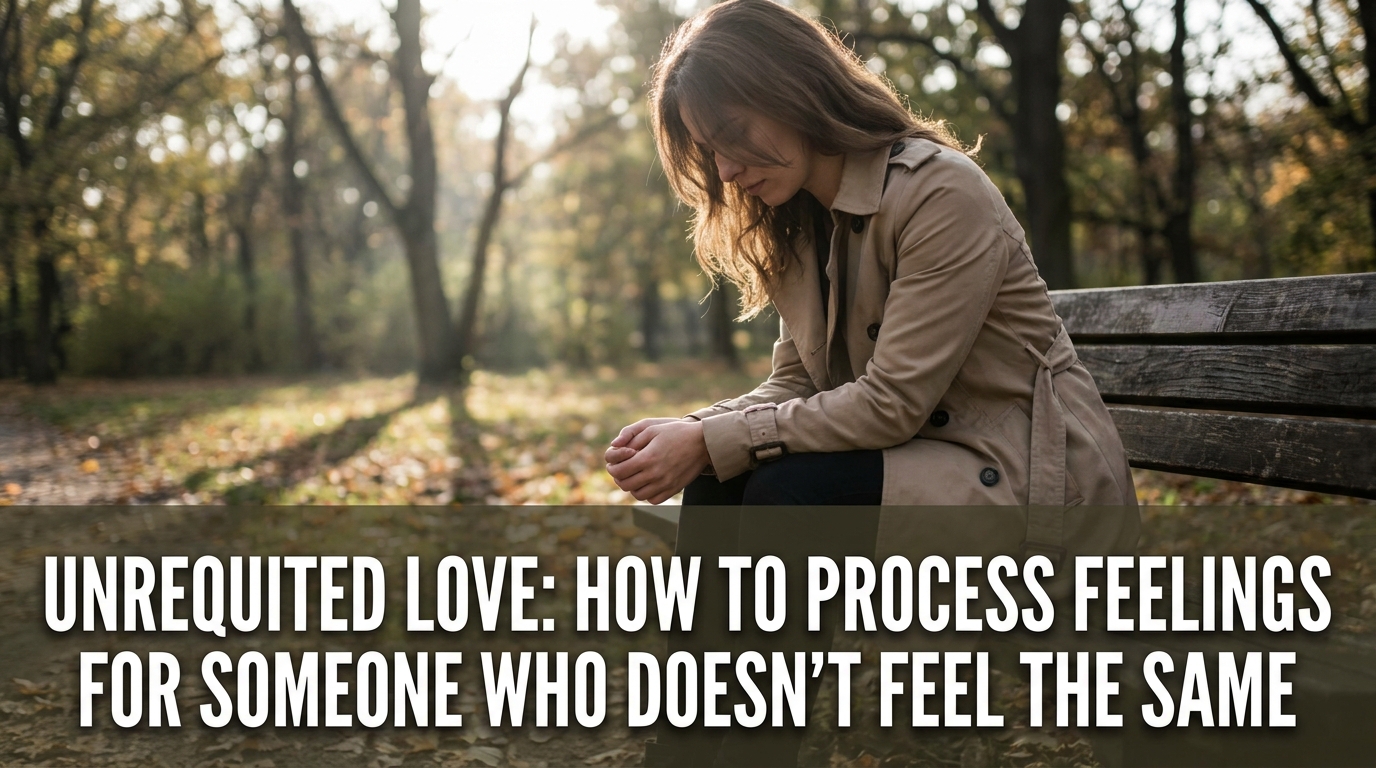
You didn’t choose to feel this way. You didn’t decide one morning to love someone who would never love you back. It arrived quietly — in a laugh, a conversation, a moment that meant everything to you and probably nothing to them. And now you’re carrying something heavy and invisible that nobody around you fully understands.
Unrequited love is one of the most universally human experiences — and one of the least talked about with honesty. A study published in the Journal of Personality and Social Psychology found that nearly 98% of people report experiencing unrequited love at least once in their lifetime, and that the pain it produces activates the same neural regions as physical injury. You are not being dramatic. You are not weak. Your brain is processing a genuine loss — for something that never fully existed, which in many ways makes it harder, not easier, to grieve.
This article is a honest, psychology-backed guide to understanding what unrequited love actually is, why it hurts the way it does, and how to move through it — not by forcing yourself to stop feeling, but by giving those feelings the space and structure they need to finally release.

Why Unrequited Love Hurts So Much
Before anything else, it helps to understand why this specific pain is so overwhelming — because understanding it removes a significant layer of shame from it.
When you develop feelings for someone, your brain begins releasing dopamine in anticipation of potential reward — the possibility of reciprocation, connection, and intimacy. This reward circuitry activates powerfully even when the reward is uncertain or unlikely. In fact, uncertainty intensifies the dopamine response — the brain becomes more activated, not less, by the possibility of something it hasn’t yet received.
When those feelings are not returned, the brain experiences something neurologically similar to withdrawal. The anticipated reward is removed. The dopamine system, which had oriented itself around this person, loses its expected source. The result is genuine grief — compounded by the specific shame that comes from loving someone who doesn’t love you back, and the particular loneliness of carrying feelings you cannot fully express or be comforted about.
There is also what psychologists call the fantasy bond component of unrequited love. Over time, the person you love in your mind becomes increasingly idealized — a constructed version of them that is assembled from selective memory, projection, and longing. You are not only grieving a person. You are grieving a relationship that existed only in your imagination but felt completely real from the inside. That is a legitimate and significant loss.
The Specific Pain Points of Unrequited Love
Unrequited love is not one feeling — it is several, often experienced simultaneously:
Hope. The most persistent and painful element. As long as there is any ambiguity — any warmth, any moments that could be interpreted as interest — hope keeps the neurochemical cycle running. Hope is the thing that makes unrequited love so difficult to release, because releasing it feels like choosing grief when there might still be a reason to wait.
Shame. The quiet, corrosive belief that loving someone who doesn’t love you back reflects something wrong with you — that you are too much, not enough, or simply not the kind of person who gets chosen. This is not true. But it is extraordinarily common, and it adds a layer of self-directed pain to an already difficult experience.
Grief. For the relationship that won’t happen. The future that won’t exist. The version of yourself that exists inside that imagined love story. This grief is real and deserves to be honored — not rushed or rationalized away.
Anger. Sometimes at them, for not feeling what you feel. Sometimes at yourself, for continuing to feel it. Sometimes at the unfairness of an experience that nobody consented to and nobody can fully control.
Longing. Perhaps the most distinctive quality of unrequited love — the sustained, aching pull toward someone you cannot have, that doesn’t simply stop when you decide it should.
All of these are valid. None of them require fixing immediately. They require acknowledgment first.

How to Process Unrequited Love: A Genuine Path Forward
Processing unrequited love is not the same as getting over it quickly. It is the slower, more honest work of moving through it in a way that leaves you more self-aware and more whole — rather than more defended and more closed.
Step 1: Stop Feeding the Fantasy
The fantasy is the central engine of unrequited love. Every time you replay a conversation, reread old messages, check their social media, or construct elaborate scenarios about what could happen, you are adding fuel to a fire that needs to be starved, not fed.
This is not about pretending you don’t feel what you feel. It is about recognizing that every deliberate return to the fantasy resets the neurochemical cycle and extends the pain. Interrupting the loop — even imperfectly, even repeatedly — is the first and most important practical step.
This means removing or muting them on social media if necessary. It means resisting the urge to analyze their behavior for hidden signals. It means choosing, consciously and repeatedly, to redirect your attention when your mind drifts back to them — not because the feelings aren’t real, but because feeding them is keeping you stuck.
Step 2: Name It for What It Is
There is something quietly powerful about calling unrequited love by its name — rather than dressing it up as something more ambiguous or more hopeful. They don’t feel the same way. This is not a temporary state waiting for the right conditions. It is the reality of this situation right now.
Naming it clearly does not mean it stops hurting. But it does close the door on the particular kind of suffering that comes from sustained ambiguity — the exhausting, endless reinterpretation of every interaction through the lens of hope. Clarity, even painful clarity, is a foundation. Ambiguity is a trap.
Step 3: Allow the Grief Without Judgment
You are allowed to grieve something that never fully existed. The relationship you imagined was real to your nervous system — the anticipation, the investment, the emotional architecture you built around this person. Losing it is a loss, and loss deserves grief.
Give yourself permission to feel it without the additional burden of telling yourself you shouldn’t be this upset, it wasn’t even real, or you need to get over it faster. Those judgments don’t accelerate healing — they just add self-criticism to an already heavy experience.
Grief has its own timeline. It moves in waves. Some days will feel like progress; others will feel like being back at the beginning. This is not regression — it is the honest, nonlinear shape of emotional processing.

Step 4: Examine What You Were Really Seeking
This step requires honesty — the kind that is uncomfortable but ultimately liberating. Ask yourself: what specifically drew you to this person? What need or longing did they represent for you?
Often, unrequited love is not only about the specific person. It is also about what they seemed to offer — safety, excitement, validation, the feeling of being chosen by someone you admire. Understanding what you were seeking helps you recognize that those needs are real and legitimate — and that they can be met, just not by this particular person.
This is not about diminishing your feelings or suggesting they weren’t genuine. It is about expanding your self-knowledge in a way that protects you in the future and helps you understand your own emotional landscape more clearly.
Step 5: Rebuild Investment in Your Own Life
Unrequited love tends to quietly colonize your mental and emotional bandwidth. An enormous amount of energy — creative, emotional, cognitive — gets redirected toward someone who doesn’t know they’re receiving it. Reclaiming that energy is both a practical necessity and a profound act of self-respect.
This means actively reinvesting in the parts of your life that exist completely independently of this person. Friendships that have been slightly neglected. Creative projects that have been on hold. Physical routines that ground your nervous system. Ambitions that deserve your full attention.
This is not distraction for its own sake. It is the deliberate reclamation of a life that belongs to you — not to your feelings for someone who doesn’t share them.
Step 6: Create Real Distance
If you are in regular contact with this person — as a friend, a colleague, or someone in your social circle — genuine healing requires some form of real distance. This is one of the most difficult steps, particularly when the person is someone you genuinely care about beyond the romantic feelings.
But proximity to the person you have unrequited feelings for keeps the neurochemical cycle active regardless of your intentions. You cannot simultaneously be healing from feelings for someone and spending regular time with them — at least not in the early stages of that healing. Distance is not permanent. But it is, for a period, necessary.

Step 7: Be Honest About the Idealization
At some point in the processing of unrequited love, it is worth asking a genuinely difficult question: how much of what you feel is about who this person actually is — and how much is about who you have constructed them to be?
The person you love in your imagination has been assembled from selected moments, interpreted signals, and projected qualities. They don’t exist in quite the way your feelings have built them. The real person — with their full complexity, their limitations, their ordinariness — is almost certainly more complicated and less ideal than the version living in your mind.
This is not cynicism. It is not a way of telling yourself your feelings weren’t real. It is a gentle invitation to redirect some of the love and attention you have been pouring into a constructed image — back toward yourself, and toward the real people who are actually present in your life.
Step 8: Resist the Urge to Seek Closure From Them
One of the most common impulses in unrequited love is the desire for a conversation that will provide closure — an explanation, a final honest exchange, something that makes the feelings make sense or officially end. In most cases, this impulse is better understood as one more expression of the longing itself rather than a genuine practical need.
Seeking closure from the person who doesn’t share your feelings usually prolongs the pain rather than resolving it. It re-engages the neurochemical cycle. It places your healing in someone else’s hands. And it rarely produces the clarity it promises — because the closure you’re looking for is something only you can give yourself.
When Unrequited Love Becomes Something to Take Seriously
Most experiences of unrequited love, while genuinely painful, resolve with time, distance, and intentional healing. But there are circumstances where the pain becomes something worth addressing with professional support:
- When feelings persist intensely for a year or more without meaningful change despite genuine effort to move forward
- When the feelings begin to significantly interfere with daily functioning, work, or other relationships
- When the experience triggers or deepens patterns of depression, anxiety, or disordered thinking
- When the unrequited feelings are for someone unavailable by circumstance — married, in a committed relationship — and you find yourself unable to redirect despite understanding the situation clearly
None of these make you broken or beyond healing. They make you human — with an attachment system that sometimes needs more support than self-help can provide.

The Bottom Line
Unrequited love is not a failure. It is not evidence that you are too much, not enough, or fundamentally unlovable. It is evidence that you are capable of deep feeling — and that is not a flaw, no matter how much it hurts right now.
The path through it is not to stop feeling. It is to redirect feeling — away from someone who cannot receive it, and back toward yourself, your life, and the people who are genuinely present. That redirection is slow. It is imperfect. It requires more patience with yourself than most people are willing to extend.
But it leads somewhere real. And what waits on the other side — a clearer sense of who you are, what you need, and what you deserve — is worth every difficult step of the journey.
The love you’ve been giving to someone who can’t receive it has always belonged to you first. Reclaiming it — slowly, honestly, completely — is not giving up on love. It is finally giving it to someone who deserves it.
📌 Save, Share & Follow
💾 SAVE this article — return to it on the days when the feelings come back and you need a reminder that you are moving forward even when it doesn’t feel like it. 📤 SHARE this with someone carrying something heavy and invisible that they haven’t been able to talk about yet. 👉 FOLLOW TruthsInside.com for more honest, psychology-backed content on love, emotions, and healing.
❓ Frequently Asked Questions
Q1: How long does it take to get over unrequited love? There is no universal timeline — and anyone who gives you one is oversimplifying. The duration depends on the intensity of the feelings, the length of time they’ve been carried, the amount of contact maintained with the person, and the quality of support available. What research does suggest is that active, intentional processing — rather than suppression or distraction — significantly shortens the duration of acute pain.
Q2: Is it possible to stay friends with someone you have unrequited feelings for? Sometimes — but almost never immediately, and never without genuine healing first. Attempting friendship while still carrying significant feelings almost always prolongs the pain and makes genuine recovery harder. If a friendship is to eventually be possible, it requires a period of real distance, followed by honest self-assessment about whether the feelings have genuinely shifted — not just been managed or suppressed.
Q3: Should I tell them how I feel? In some circumstances, expressing feelings — once, clearly, without expectation — can provide relief and genuine closure. But it is worth being honest about your motivation: are you expressing for your own clarity, or are you hoping to change their feelings? If it is the latter, the conversation is unlikely to produce what you’re hoping for. Whatever you decide, expressing feelings should be a choice made for your own peace — not a strategy for changing the outcome.
Q4: Why do I keep falling for unavailable people? This is one of the most important questions you can ask yourself — and one worth exploring with a therapist. Patterns of attraction to unavailable people are often rooted in early attachment experiences, where love felt conditional, inconsistent, or something that had to be earned. The pursuit of someone unavailable can feel familiar in a way that available, reciprocal love does not — and understanding that pattern is the beginning of changing it.
Q5: Does unrequited love ever turn into reciprocated love? Occasionally — but far less often than hope suggests. When it does, it is usually because circumstances or the other person’s emotional availability genuinely change — not because sustained patience eventually convinces them to feel something they didn’t. Building your life and healing around the possibility that they will eventually reciprocate is a strategy that sacrifices your present for an uncertain future. It is worth examining honestly whether hope is serving you — or holding you in place.
🎵 Music
Maren Lull is a singer-songwriter who writes from the places most people don’t talk about out loud.
Not the dramatic grief. Not the obvious heartbreak. The quiet kind — the ordinary Tuesday emptiness, the habit of reaching for someone who isn’t there anymore, the particular exhaustion of being strong for so long that the strength itself wears thin.
Her music lives at the intersection of emotional honesty and soft beauty — breathy vocals over gentle piano, slow tempos, lyrics that feel less like songs and more like something you wrote in a private notebook at two in the morning and never showed anyone.
Maren Lull writes for the people who feel everything deeply and say very little about it. For the ones who listen to sad music not because they want to feel worse — but because being understood, even by a song, makes the feeling easier to carry.
📱 Follow Maren Lull:
→ Spotify
→ Apple Music
→ Youtube
→ Audiomack