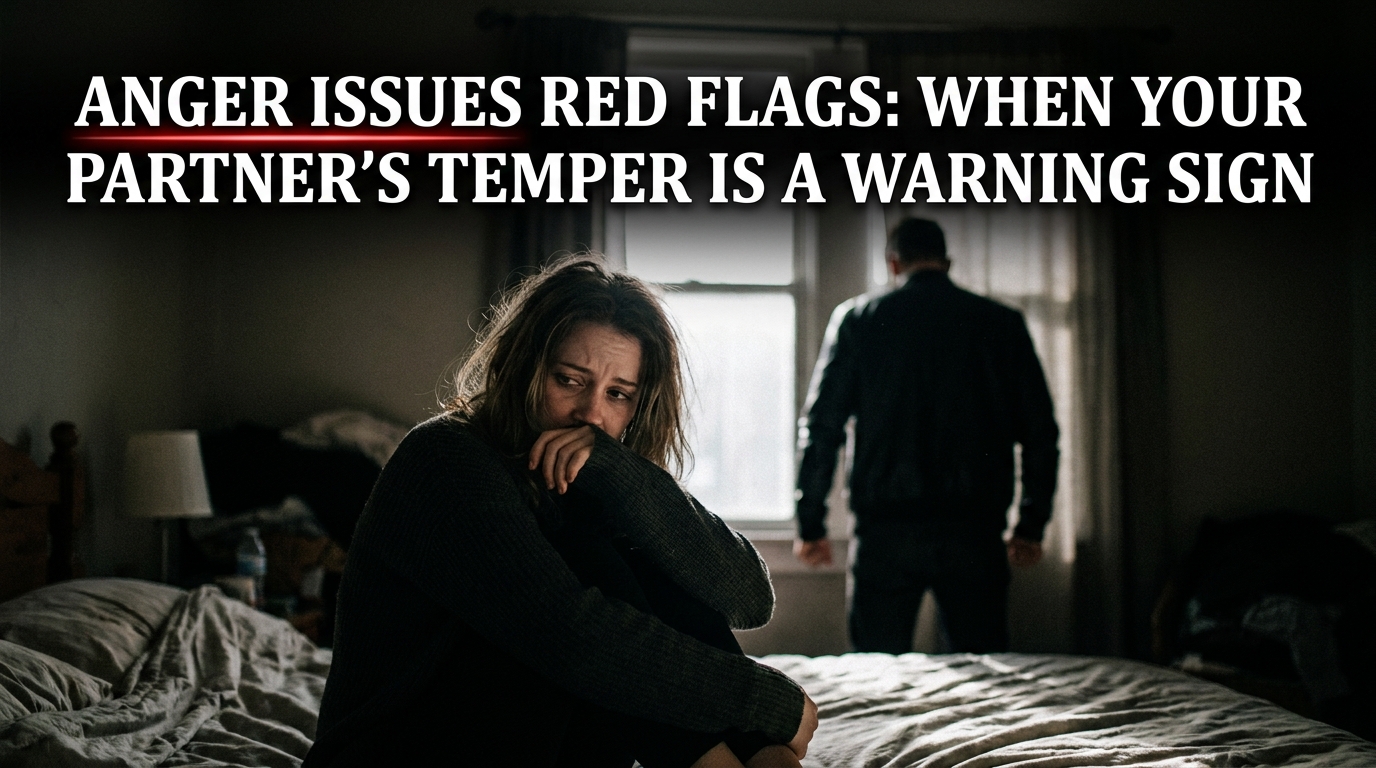
There is a version of this story you may already know from the inside. Everything feels fine — until it does not. A small disagreement, a minor inconvenience, a moment that should pass in seconds — and suddenly the temperature in the room shifts entirely. The voice gets louder. The energy becomes something you can feel in your chest before you can name it in your mind. And without fully understanding why, you find yourself shrinking, calculating, managing — doing everything in your power to make the storm pass as quickly as possible.
If that scenario feels familiar, you are not alone. According to the American Psychological Association, approximately 1 in 3 people in relationships report experiencing a partner’s anger as a consistent source of stress and fear. A 2020 study published in the Journal of Family Violence found that chronic anger expression in intimate partnerships — even in the absence of physical violence — is strongly associated with psychological harm, diminished self-worth, and long-term anxiety disorders in the non-angry partner. Anger issues red flags are not always loud and obvious. Sometimes they are quiet, patterned, and deeply normalized before anyone thinks to call them what they are.
This article exists to help you see the pattern clearly — and to give you the language, the psychology, and the tools to respond to it with your eyes fully open.

What Anger Issues Red Flags Actually Look Like in a Relationship
The phrase “anger issues” often conjures a very specific image — someone screaming, throwing objects, or becoming physically threatening. And while those extreme expressions absolutely qualify, the anger issues red flags that psychologists identify in relationships are frequently far more subtle, far more socially acceptable on the surface, and for that reason, far more dangerous.
Understanding what these red flags actually look like in daily relationship life is the first and most essential step toward recognizing whether you are dealing with a difficult personality trait or a genuine pattern of emotional harm.
Disproportionate Reactions
One of the clearest early indicators of problematic anger in a partner is the consistent mismatch between the trigger and the response. When a minor inconvenience — a delayed meal, a forgotten errand, a difference of opinion — produces a reaction that feels catastrophically outsized, that disproportion is telling you something important.
Healthy anger is proportionate. It rises in response to genuine threats or significant injustices, and it returns to baseline relatively quickly. When a partner’s anger regularly detonates at a magnitude that makes no logical sense given the situation, it signals that something beneath the surface — unresolved trauma, deeply buried shame, an internal emotional dysregulation — is driving the response far more than the surface trigger is.
The Cycle of Explosion and Remorse
Many people in relationships with an anger-prone partner describe a recognizable emotional cycle that psychologists refer to as the “tension-explosion-honeymoon cycle.” Tension builds, often over days or weeks. The explosion occurs — an outburst, an attack, a period of sustained coldness or cruelty. And then, almost without fail, the remorse phase follows.
During the remorse phase, the angry partner becomes intensely loving, apologetic, attentive, and tender. They promise it will not happen again. They may cry. They may be extraordinarily kind. And this phase — this relief after the storm — is precisely what makes leaving feel so impossible and what makes staying feel so confusing. Because the person standing in the remorse phase genuinely feels like the person you fell in love with. And the brain, flooded with relief, bonds to that person all over again.
Using Anger as a Control Mechanism
Not all anger in relationships is uncontrolled. Some of it is very deliberately deployed. One of the most significant anger issues red flags is the pattern of a partner using anger — consciously or not — as a tool to control behavior, silence disagreement, or establish dominance within the relationship dynamic.
If your partner’s anger consistently appears at moments when you assert independence, disagree with them, spend time away from them, or attempt to have a conversation they find uncomfortable — and if their anger reliably results in you backing down, apologizing, or changing your behavior — that is not an emotion they cannot control. That is a function that their anger is performing, and it is working exactly as it is intended to.
Blaming You for Their Emotional State
“You made me do this.” “If you hadn’t pushed me, I wouldn’t have reacted that way.” “You know how I get — why do you always provoke me?” These statements are not just deflections. They represent a specific and deeply harmful psychological pattern in which the angry partner refuses all ownership of their emotional responses and transfers full responsibility for their behavior onto you.
This pattern — known clinically as externalization of blame — is both a red flag in itself and a significant obstacle to change. A person who genuinely believes that their anger is entirely caused by someone else’s behavior has no internal motivation to regulate it. Why would they? In their psychological model, the solution is not for them to change — it is for you to stop provoking them.

The Psychology Behind Explosive Anger in Relationships
To fully understand anger issues red flags, you need to understand what is happening psychologically — and sometimes neurologically — inside the person who cannot seem to control their temper. This understanding is not offered as an excuse. It is offered as a map, because you cannot navigate terrain you cannot see.
Emotional Dysregulation and the Nervous System
At its most fundamental level, explosive anger is often a symptom of emotional dysregulation — the inability to manage and modulate emotional responses within a healthy range. Emotional dysregulation is not a character flaw, though its consequences can be devastating. It is frequently the result of early developmental experiences — specifically, growing up in an environment where emotions were either never modeled healthily, were consistently suppressed, or were expressed exclusively through aggression and volatility.
When the nervous system never learns to process emotional discomfort in constructive ways during childhood, it defaults in adulthood to the only strategy it knows — escalation. The prefrontal cortex, responsible for impulse control and emotional reasoning, essentially gets bypassed by the amygdala’s alarm response. The result is an adult who, when emotionally triggered, temporarily loses access to the rational, regulated part of their brain — and acts from pure reactive instinct.
Shame as the Root of Rage
Psychologist Dr. Brené Brown and other shame researchers have identified a powerful and counterintuitive relationship between shame and anger. For many individuals — particularly men who were socialized to suppress vulnerability — shame does not present as sadness, withdrawal, or self-reflection. It presents as rage.
When a person who carries deep unprocessed shame is challenged, criticized, embarrassed, or made to feel inadequate — even in small, unintentional ways — the shame response triggers immediately. And because shame is unbearable to sit with, it is instantly converted into outward aggression. The anger says: “You are the problem.” The shame underneath says: “I am terrified that I am.”
Understanding this dynamic does not mean you should accept being the target of someone’s externalized shame. But it does explain why the partners of chronically angry people so often describe the feeling of being punished for things that seem objectively minor — because they are not being punished for the surface offense. They are being punished for touching something much deeper and much older.
Trauma and the Angry Partner
A significant number of individuals who display chronic anger issues in romantic relationships are carrying unresolved trauma — whether from childhood abuse, neglect, abandonment, or traumatic adult experiences. Trauma fundamentally alters the threat-detection system, causing the brain to perceive danger in situations that objectively pose no real threat.
A partner with unresolved trauma may respond to a gentle question as though it is an interrogation. They may interpret a partner’s emotional independence as abandonment. They may experience disagreement as attack. And their anger — disproportionate, sudden, seemingly irrational — is the nervous system’s automatic response to a perceived danger that only they can feel.
This does not make their behavior acceptable. It makes it explicable. And it raises a critically important question that every person in this situation must eventually ask themselves: Is my partner actively working to heal their trauma and develop healthier responses? Or are they using their history as a permanent exemption from accountability?
“Walking on eggshells in your own home is not love. It is fear with a familiar face. And you deserve to know the difference.”
Specific Anger Issues Red Flags You Should Never Dismiss
Beyond general patterns, there are specific behaviors that function as clear and urgent warning signs — anger issues red flags that should never be rationalized, minimized, or explained away, regardless of how much you love the person displaying them.
Intimidation Without Physical Contact
Many people operate under the assumption that if no one has been touched, no line has been crossed. This is dangerously incorrect. Intimidation — standing over someone, blocking their exit, invading personal space during an argument, throwing or breaking objects near them, punching walls — is a form of emotional and psychological abuse whether or not physical contact is made. Its purpose is to instill fear, and it succeeds whether or not a hand is raised.
Public Humiliation or Sudden Hostility in Social Settings
A partner who reserves their anger exclusively for private moments may still be demonstrating a significant red flag. But a partner who allows their anger to surface in public — who humiliates you in front of friends, who makes cutting remarks at family gatherings, who creates scenes in restaurants or social settings — is demonstrating a level of disregard for your dignity that crosses an important line. The absence of shame about displaying anger publicly often signals that the anger has become fully normalized — to them, if not yet to you.
Anger Directed at Children, Animals, or Service Workers
How a person expresses anger toward those they perceive as having less power than themselves is one of the most revealing behavioral indicators available. A partner who is explosive or cruel toward children, who mistreats animals, or who consistently degrades and intimidates service workers is showing you something essential about their anger — specifically, that it is not situational. It is characterological. And you are not immune simply because they have not yet directed that same energy toward you with the same intensity.
Threats — Even “Joking” Ones
“I swear, if you do that again…” “You don’t want to know what I’ll do.” “I’m just saying, you should be careful.” Threats delivered in the context of anger — even when framed as jokes, as hyperbole, or as expressions of frustration — are not acceptable communication between partners. They are psychological warnings designed to produce fear and compliance, and they should be treated as exactly that.
Monitoring and Explosive Reactions to Normal Behavior
When a partner becomes explosively angry in response to things that are objectively normal — you spending time with friends, you arriving home later than expected, you receiving a message from someone they do not know — their anger is not about the specific behavior. It is about control. This intersection of anger and jealousy is one of the most reliable predictors of escalating relationship danger identified in domestic violence research.

The Impact of Living With an Angry Partner on Your Mental Health
The consequences of sustained exposure to a partner’s uncontrolled anger extend far beyond the moments of conflict themselves. Research in relationship psychology and trauma studies has consistently documented a specific and serious set of mental health outcomes for people who live inside this dynamic over extended periods of time.
Hypervigilance and Chronic Anxiety
When you live with someone whose emotional state is unpredictable, your nervous system adapts — and not in a healthy direction. You become hypervigilant: constantly scanning the environment for early warning signs of an incoming explosion. The tone of voice. The way they close the car door. The look on their face when they walk through the front door. You become extraordinarily attuned to micro-signals of danger, because your survival has depended on detecting them early.
This state of chronic alertness keeps the body’s stress response system — cortisol, adrenaline, the fight-flight-freeze mechanism — in a near-constant state of low-level activation. Over time, this contributes to generalized anxiety disorder, sleep disruption, chronic fatigue, digestive problems, and a significantly weakened immune system. The body pays for the relationship’s toxicity in very concrete physiological ways.
Erosion of Self-Worth
When someone you love tells you — through words or behavior — that your feelings are wrong, your needs are unreasonable, and your presence is the cause of their anger, your brain begins to absorb that narrative. Not immediately. Not consciously. But gradually, through repetition and emotional intensity, the story begins to feel true.
People who have spent extended periods in relationships with chronically angry partners frequently describe a profound loss of self-confidence, a difficulty trusting their own perceptions, and a deep-seated belief that they are fundamentally difficult to love. These are not personality traits. They are the psychological residue of sustained emotional harm.
Emotional Numbing and Disconnection
As a protective mechanism, many people in these relationships eventually stop feeling altogether. The emotional numbing that develops as a response to chronic anger exposure allows the person to function — but it also cuts them off from their own emotional life. They stop knowing what they feel. They stop being able to identify what they need. In extreme cases, they develop symptoms indistinguishable from depression or complex PTSD.
“Your nervous system knows the truth before your mind is willing to say it out loud. When your body dreads coming home, that is information you cannot afford to ignore.”

What to Do When You Recognize These Red Flags in Your Relationship
Recognizing anger issues red flags is not the end of the conversation. It is the beginning of a much harder and more important one — the conversation about what you are going to do with what you now know.
Stop Minimizing and Start Documenting
The first and most essential step is to stop explaining away what you are experiencing. Write it down. Keep a private record — dates, descriptions, your emotional response — of incidents that concern you. This practice serves two critical functions: it interrupts the normalization process that happens when difficult experiences accumulate without acknowledgment, and it provides a concrete record that can be useful if you eventually seek professional support or legal protection.
Establish Safety as Your Non-Negotiable Priority
If at any point you feel physically unsafe — if anger has become or is escalating toward physical threat — your safety is the only priority. Contact the National Domestic Violence Hotline at 1-800-799-7233, or text “START” to 88788. Reach out to a trusted friend, family member, or professional who can help you create a safety plan. Love should never require you to negotiate with your own physical safety.
Have the Direct Conversation — From a Grounded Place
If the situation feels safe enough for direct conversation, choose a moment of genuine calm — not the immediate aftermath of an incident — to express how your partner’s anger affects you. Use specific, observed behavior rather than character accusations. “When you raise your voice and leave the room during disagreements, I feel afraid and shut down. I need us to find a different way to handle conflict” is more likely to be heard than “You have anger issues and it’s destroying us.”
Be honest with yourself about the response you receive. A partner who is genuinely committed to the relationship and to their own growth will respond to this conversation with accountability, with openness, and with willingness to seek help. A partner who responds with more anger, dismissal, or blame is giving you the most important information of all.
Insist on Professional Support
Anger issues at the level described in this article are not typically resolved through willpower, promises, or relationship conversations alone. They require professional intervention — individual therapy for the angry partner focused on emotional regulation and trauma processing, and ideally couples therapy with a clinician trained in working with high-conflict relationship dynamics.
If your partner refuses any form of professional support, that refusal is itself a red flag. It signals that their comfort with the current dynamic outweighs their commitment to genuine change.
Know When to Leave
This is the hardest sentence in this entire article: sometimes love is not enough to fix a pattern that the other person is unwilling to address. Choosing to end a relationship because the emotional environment is consistently harmful is not failure. It is not giving up. It is the recognition that you deserve a relationship where you do not have to manage someone else’s emotional explosions as a condition of being loved.
Leaving is not always possible immediately, and it is not always safe without planning. But it begins with a decision — the decision that your mental health, your safety, and your future matter more than the fear of the unknown.

A Final Word: Love Does Not Require You to Absorb Someone Else’s Rage
There is a version of love that the world sells — one where enduring someone’s worst moments is proof of your devotion. Where staying through the anger makes you loyal. Where absorbing the explosions means you truly understand them.
That version of love is a lie. And it is a lie that has kept too many people in rooms that make them smaller, in relationships that cost them their peace, and in patterns that take years of careful healing to undo.
Anger issues red flags exist not to condemn the people displaying them, but to protect the people absorbing them. Recognizing a red flag is not an act of cruelty. It is an act of clarity. And clarity — about what you are experiencing, what you deserve, and what you are no longer willing to accept — is where every meaningful change in your life begins.
You are allowed to love someone and still acknowledge that their behavior is harming you. You are allowed to want better — for them, if they are willing to pursue it, and for yourself, regardless of whether they are.
💾 Save this article — you may need to come back to it when the fog clears.
📤 Share it with someone who keeps making excuses for a partner’s temper.
➕ Follow Truthsinside.com for relationship and psychology content that tells the truth even when it is hard to hear.
📃 Related article: 15 Subtle Red Flags in a New Relationship Most People Miss
Frequently Asked Questions
Q1: What is the difference between normal anger and anger issues red flags in a relationship?
Normal anger is proportionate, occasional, and expressed without intimidation or cruelty. It passes relatively quickly and does not leave the other partner feeling afraid, responsible, or diminished. Anger issues red flags involve patterns — recurring disproportionate reactions, cycles of explosion and remorse, consistent blame-shifting, and an emotional environment where one partner lives in fear of the other’s emotional state. The key distinction is pattern versus isolated incident, and the presence or absence of fear in the non-angry partner.
Q2: Can a partner with serious anger issues genuinely change?
Change is possible — but it is neither automatic nor guaranteed, and it requires specific conditions. The angry partner must first acknowledge that their behavior is harmful and take full, undefended responsibility for it. They must actively engage in professional therapeutic support, particularly approaches focused on emotional regulation such as Dialectical Behavior Therapy or trauma-informed therapy. And they must demonstrate sustained behavioral change over time — not just during crisis moments. Promises alone are not change. Consistent behavior over extended time is the only reliable evidence of genuine change.
Q3: Why do I keep making excuses for my partner’s anger even though I know it is wrong?
This is one of the most common experiences among people in relationships with angry partners, and it is not weakness or stupidity — it is psychology. The trauma bonding that develops through the explosion-remorse cycle creates powerful neurological attachment. The relief of the honeymoon phase floods the brain with oxytocin and dopamine, creating a bond that functions similarly to addiction. Additionally, if you grew up in an environment where volatile anger was normalized, your nervous system may not register it as dangerous because it registers it as familiar. Both of these patterns can be understood and worked through, ideally with professional support.
Q4: Is emotional anger abuse even if my partner has never hit me?
Absolutely and unequivocally yes. Physical contact is not the threshold for abuse. Sustained patterns of intimidation, verbal aggression, humiliation, blame-shifting, and the deliberate or reckless use of anger to control a partner’s behavior constitute emotional and psychological abuse — and their impact on mental health is clinically documented as severe and long-lasting. The absence of physical violence does not minimize the reality or the harm of what you are experiencing.
Q5: How do I talk to someone I care about who is in a relationship with an angry partner?
The most important things you can offer are consistency, non-judgment, and patience. People in these relationships have often been conditioned to defend their partner and to distrust their own perceptions. Telling them directly that they need to leave is rarely effective and can push them further away. Instead, maintain your relationship with them so they have a trusted connection outside the dynamic. Reflect what you observe without attacking their partner directly. Ask questions that invite self-reflection. Make clear that you will be there regardless of the choices they make — and that when they are ready, you will help them. Being a steady, non-judgmental presence is the most powerful thing you can do.
🎵 Music
Maren Lull is a singer-songwriter who writes from the places most people don’t talk about out loud.
Not the dramatic grief. Not the obvious heartbreak. The quiet kind — the ordinary Tuesday emptiness, the habit of reaching for someone who isn’t there anymore, the particular exhaustion of being strong for so long that the strength itself wears thin.
Her music lives at the intersection of emotional honesty and soft beauty — breathy vocals over gentle piano, slow tempos, lyrics that feel less like songs and more like something you wrote in a private notebook at two in the morning and never showed anyone.
Maren Lull writes for the people who feel everything deeply and say very little about it. For the ones who listen to sad music not because they want to feel worse — but because being understood, even by a song, makes the feeling easier to carry.
📱 Follow Maren Lull:
→ Spotify
→ Apple Music
→ Youtube
→ Audiomack