
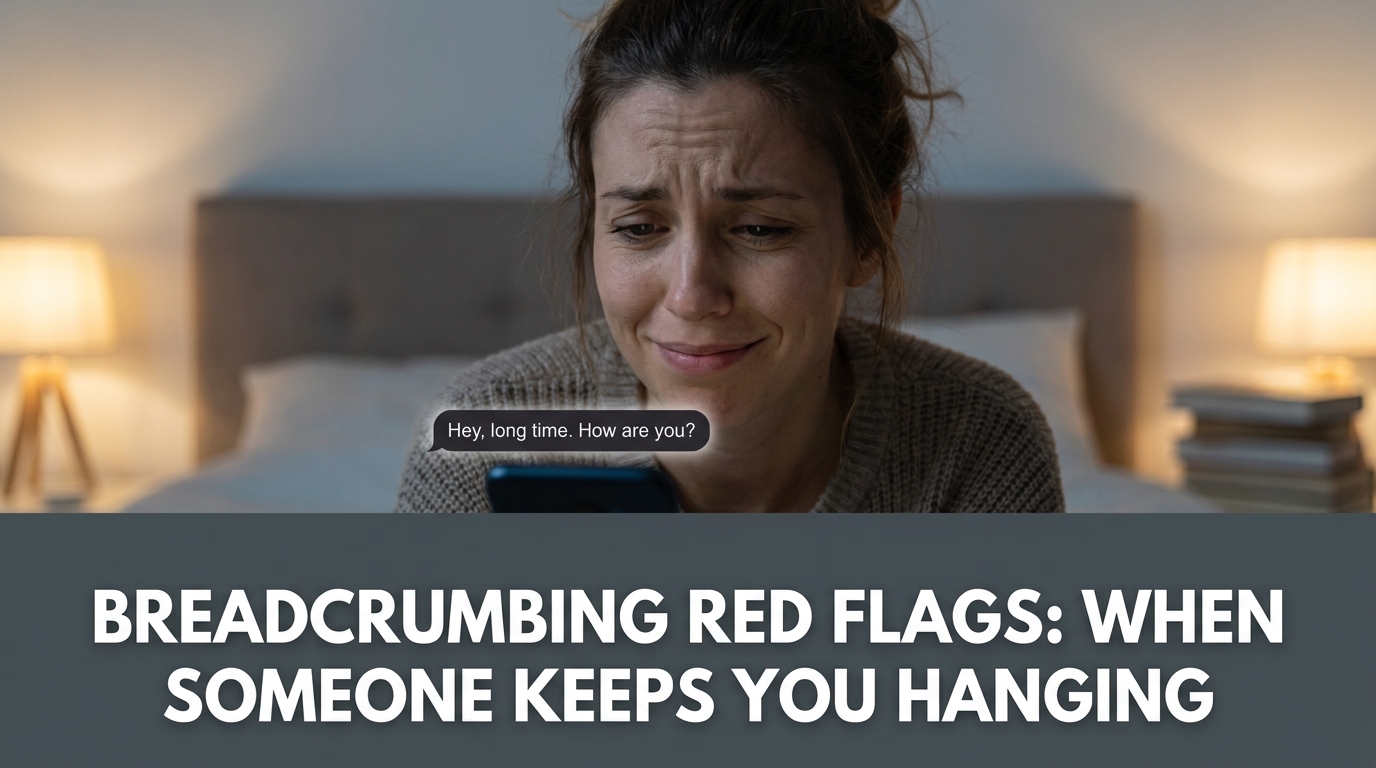
It has been four days of silence. You’ve moved on mentally — or tried to. And then a single message arrives. Nothing significant. A meme. A “hey, been thinking about you.” A response to a story you posted three days ago. And just like that, the hope resets. The silence is forgiven. The cycle begins again.
You are being breadcrumbed. And you deserve to know it.
Breadcrumbing is one of the defining patterns of modern dating — and one of the most psychologically damaging, precisely because it is so difficult to name. According to research from the University of Padova, breadcrumbing activates the same neurological reward-and-uncertainty loop as intermittent reinforcement — the same mechanism that makes gambling addictive. The occasional, unpredictable crumb of attention is neurologically more compelling than consistent warmth — which is why the pattern is so effective at keeping people invested in something that is offering them almost nothing. Understanding breadcrumbing red flags is not just about recognizing a behavior. It is about understanding the psychology that makes it work — so you can finally step off the cycle entirely.

What Breadcrumbing Actually Is
Breadcrumbing is the practice of giving someone just enough attention, warmth, or signals of interest to keep them engaged and hopeful — without any genuine intention of building something real. It is not the same as slow dating, thoughtful pacing, or genuine uncertainty about a connection. It is the deliberate or semi-conscious use of minimal investment to maintain maximum availability from another person.
The term comes from the fairy tale image of leaving a trail of breadcrumbs — enough to keep someone following, never enough to actually feed them.
Breadcrumbing exists on a spectrum. At one end is the fully conscious manipulation of someone who knows exactly what they are doing — maintaining multiple options, investing the minimum required to keep each one available, and cycling through attention whenever a particular person shows signs of moving on. At the other end is the semi-conscious behavior of someone who genuinely enjoys the connection but cannot or will not offer anything more — who gives what they can in the moments they feel like giving it, without consideration for what that inconsistency costs the other person.
Both ends of the spectrum produce the same experience in the person on the receiving end: hope sustained by insufficient evidence, investment maintained by intermittent reward, and a gradual erosion of the self-trust that would allow them to recognize and walk away from a dynamic that is not serving them.
Why Breadcrumbing Works: The Psychology of Intermittent Reinforcement
Understanding why breadcrumbing is so psychologically powerful is essential — because without that understanding, people tend to blame themselves for being “too invested” or “too sensitive” rather than recognizing that their response is a predictable neurological reaction to a specific kind of manipulation.
Intermittent reinforcement — the delivery of reward on an unpredictable schedule — produces stronger and more persistent behavioral responses than consistent reward. This is the principle behind slot machines: it is not the winning that creates addiction, but the unpredictability of when the winning will come. The brain’s dopamine system becomes more activated, not less, by uncertainty — generating a compulsive orientation toward the source of the unpredictable reward.
In breadcrumbing, the occasional message, the unexpected warmth, the random reappearance after silence, functions as exactly this intermittent reward. Each crumb resets the dopamine cycle. Each silence creates the heightened anticipation that makes the next crumb more compelling than consistent attention would be. The person being breadcrumbed is not weak or foolish for responding this way. Their nervous system is responding exactly as nervous systems respond to intermittent reinforcement — which is to say, compulsively and powerfully, regardless of the rational mind’s awareness of the pattern.

The Breadcrumbing Red Flags
1. Contact Is Inconsistent — And Always on Their Terms
They reach out when they feel like it. Not when you need to hear from them. Not in response to any pattern of mutual investment. Simply when the mood strikes, when boredom creates availability, when they want the emotional reward of your response without the investment of sustained presence. The contact follows their internal rhythm entirely — and that rhythm has nothing to do with building anything with you.
This is the foundational pattern of breadcrumbing: contact as a function of their availability and desire, not as an expression of genuine mutual investment. You are available to them. They are available to themselves — and occasionally, when it suits them, to you.
2. The Messages Are Warm But Content-Free
The messages arrive and they feel good — because they are designed to. A “miss you.” A “you’ve been on my mind.” A response to something you posted with an emoji that implies more than it states. But when you examine the messages honestly, there is no content. No plan. No genuine inquiry about your life. No investment in the actual substance of who you are and what is happening for you. The warmth is real in its effect. It is not real in its investment. It is warmth deployed strategically — whether consciously or not — to produce a response that keeps you available without requiring anything in return.
3. Plans Are Suggested But Never Confirmed
They mention getting together. They float an idea — dinner, a drink, something vague and appealing. And then it doesn’t materialize. No follow-up, no date set, no confirmation. The suggestion exists in a permanent state of theoretical future — present enough to sustain your hope, absent enough to never require their actual commitment. The next time you hear from them, the suggestion may be floated again. And again, nothing will come of it.
This pattern — of plans as breadcrumbs rather than actual commitments — is one of the clearest behavioral signatures of breadcrumbing. It creates the impression of interest and forward motion while requiring nothing and delivering nothing.

4. They Reappear Exactly When You Start to Move On
The timing is never random. Just as you’ve genuinely begun to redirect your attention — just as the silence has gone on long enough that you’ve started to accept what it means — they reappear. A message. A like. A sudden resurgence of warmth that arrives precisely at the moment your withdrawal would have been complete. This timing is not always conscious. But whether it is deliberate or instinctive, its function is the same: to reset your investment just as it was about to expire.
This pattern — of reappearance calibrated to your withdrawal — is one of the most revealing signs that what you are dealing with is not genuine connection but the management of your availability. You are being kept available. And the reappearances are the mechanism of that management.
5. The Connection Never Progresses
Weeks pass. Months pass. The dynamic remains exactly what it was in the beginning — warm but undefined, intimate but not deepening, promising but never delivering on its promise. Real connections, even slow ones, move. They develop. They deepen. The specific quality of knowing another person grows over time when both people are genuinely investing. Breadcrumbing produces a connection that is permanently in place — never dying, never growing, never becoming what the warmth of it keeps suggesting it might.
If you look back at where the connection was three months ago and compare it honestly to where it is today — and the answer is that it is essentially the same — that stasis is information. Real relationships, however slowly they develop, move forward. Breadcrumbing keeps them in permanent suspension.
6. You Feel More Anxious Than Secure
The connection, such as it is, produces more anxiety than peace. You analyze messages. You track response times. You calibrate your own communication to avoid seeming too available or too detached. You spend significant mental energy on a connection that has given you insufficient reason to spend any mental energy on it at all. This chronic anxiety — the specific anxiety of someone living in the uncertainty that intermittent reinforcement creates — is one of the most accurate experiential signatures of breadcrumbing. It is not your anxiety disorder. It is a predictable neurological response to a genuinely anxiety-producing dynamic.
7. They Are Unavailable for Anything Real
Suggest an actual plan. Ask a direct question about what this is. Reach toward genuine emotional depth. And watch what happens. The availability that seems warm and present in the undemanding space of occasional contact disappears immediately when anything real is required of it. They are busy. They are not sure. They need more time. They like things as they are. The warmth that seemed to signal availability is revealed, under any genuine test, to be available only for the specific, low-demand interaction that breadcrumbing requires — nothing more.

8. You’re Always Waiting — And They’re Always Fine
The asymmetry is complete. You are waiting for their message. Adjusting your schedule around the possibility of hearing from them. Keeping yourself available for a connection that makes no equivalent space for you. And they are fine. Living their life fully, investing their attention elsewhere, reaching out when convenient and disappearing when it isn’t. The power differential — one person waiting, one person unbothered — is the structural reality of breadcrumbing. And recognizing it honestly is one of the most clarifying things you can do.
9. You Make Excuses for the Pattern
They’re busy. They’re not great at texting. They’ve been going through something. They show up eventually. You find, without realizing you’re doing it, that you have developed an elaborate explanatory framework for their inconsistency — a set of interpretations that always land on reasons that protect the possibility of the connection rather than examining what the connection is actually offering. This pattern of excuse-making is not a character flaw. It is what intermittent reinforcement produces — a mind that works to explain away the gaps rather than registering them honestly, because registering them honestly would require letting go of the hope the dopamine cycle depends on.
10. They Have Never Made Their Intentions Clear — And Resist Clarity When Asked
You have asked, in some form, what this is. Directly or indirectly, with words or with the implicit question of continued investment. And the answer has been vague. Non-committal. Deflective. Warmly unclear. They value what you have. They don’t want to label things. They’re figuring it out. The lack of clarity is not an accident. Clarity would require a definition that either creates genuine commitment — which they are not prepared to make — or ends the dynamic — which would remove your availability. Vagueness is the tool that maintains the breadcrumbing indefinitely.
Why People Breadcrumb — And Why It Matters
Understanding why people breadcrumb doesn’t excuse it — but it makes it less personal and easier to see clearly.
Some breadcrumbers are genuinely avoidant — wanting connection while being afraid of it, giving what they can without being able to give more, unaware of or unwilling to examine the impact of their inconsistency on the other person.
Some are managing options — maintaining multiple connections at varying levels of investment, allocating more attention to whoever seems most immediately available or appealing, and keeping others on low-level warmth to preserve optionality.
Some genuinely enjoy the connection but have no intention of building something real — and have made a calculation, conscious or not, that the minimum investment required to maintain your availability is worth the reward of having you available.
And some are simply incapable of the emotional honesty that would require them to say clearly what they want and what they can offer — so they offer warmth instead of truth, and keep the connection alive in the only form they know how to sustain it.
In all cases, the result for you is the same: your investment, your hope, and your emotional energy are being used to sustain something that is not investing equivalently in return. That is not love. It is not even the beginning of love. It is the appearance of interest maintained at the minimum cost required to keep you present.
How to Stop Being Breadcrumbed
Name it clearly. The first and most important step is calling it what it is — not “things are complicated” or “the timing is off” or “they’re just not great at communication.” They are breadcrumbing you. That language is specific, it is accurate, and using it removes the ambiguity that the pattern depends on to survive.
Stop responding to crumbs. Every response to a breadcrumb rewards the behavior and resets the cycle. This does not mean a dramatic declaration or a speech about what you deserve. It means simply — gradually, consistently — reducing your responsiveness to the specific pattern of inconsistent, low-investment contact that has been keeping you available. Not as a game. As a genuine withdrawal of the investment that the dynamic does not merit.
Ask one direct question. Not as an ultimatum but as a genuine request for clarity: “I’ve noticed that we connect sometimes but it never seems to go anywhere — I’d like to understand where you actually are and what, if anything, you’re looking for.” Their response — or their avoidance of the question — is the most important data you can receive.
Recognize the difference between potential and reality. The connection feels like it could be something. But what it actually is, right now, measured by consistent behavior over time, is what you have to decide based on. Not the glimpses of warmth. Not the good moments. The full, honest pattern.
Invest your energy elsewhere — actively, deliberately. The most effective way to break the neurological hold of intermittent reinforcement is to create alternative sources of genuine investment, connection, and reward. Not as distraction — but as the deliberate reorientation of your attention toward people and relationships that offer what this one has been withholding.

The Bottom Line
Breadcrumbing red flags are not dramatic. They arrive in the warm-but-content-free message, the plan that never materializes, the reappearance calibrated to your withdrawal, the connection that never progresses beyond its original warmth. They are designed — consciously or not — to be mistaken for something more than they are.
You are not foolish for being affected by them. You are neurologically human. Intermittent reinforcement is one of the most powerful behavioral mechanisms available, and the hope it produces is genuine even when what produces it is not.
What changes when you understand breadcrumbing is not the hope — that will take time to release. What changes is your ability to name what is happening, to trust what the behavior is telling you rather than what the crumbs are suggesting, and to make a decision about your own investment from that honest place rather than from the neurochemical pull of the next message.
You were never asking for too much. You were asking a person who had decided, consciously or not, that offering you too little was easier than offering you the truth. And you deserve someone for whom the truth — however uncomfortable — is what they choose to give you. Not crumbs. The whole thing.
📌 Save, Share & Follow
💾 SAVE this article — return to it the next time a single message resets everything and you need a reminder of what the full pattern actually looks like. 📤 SHARE this with someone who keeps getting pulled back in just as they were finally starting to move on. 👉 FOLLOW TruthsInside.com for more honest, psychology-backed relationship content that helps you see clearly when clarity is the hardest thing to find.
❓ Frequently Asked Questions
Q1: Is breadcrumbing always intentional? Not always — and this distinction matters for how you interpret it, though not for how you respond to it. Some people breadcrumb with full awareness of what they are doing. Others are genuinely unaware — giving what they can in the moments they feel it, without conscious awareness of the pattern their inconsistency creates. Regardless of intent, the impact is the same: your investment is being sustained by insufficient reciprocation. Intent matters for understanding the person. It does not change what the dynamic requires from you in response.
Q2: How is breadcrumbing different from someone who is just a bad texter? A person who is genuinely a bad communicator is consistently bad at communication — with everyone, not just with you. They may respond slowly, infrequently, or with minimal effort — but when you are together, they are fully present, they follow through on plans, and the relationship moves forward despite the communication style. Breadcrumbing is specifically inconsistent — warm when it serves them, absent when it doesn’t — and combined with a connection that never actually progresses. The test is the full picture: communication style plus follow-through plus progression. Bad texters show up. Breadcrumbers don’t.
Q3: Can someone who breadcrumbs genuinely change? Yes — but it requires genuine recognition of the pattern and genuine motivation to change it, neither of which can be produced by your patience or your continued availability. If someone acknowledges that they have been inconsistent, takes genuine responsibility for the impact, and demonstrates sustained behavioral change — that is meaningful. If the acknowledgment arrives and nothing actually changes, the acknowledgment was itself a crumb. Watch the behavior over time, not the words in the moment.
Q4: What if I’ve been breadcrumbing someone without realizing it? This recognition is valuable and deserves honest examination. Ask yourself: am I giving this person just enough to keep them available without genuine intention of building something real? Am I inconsistent in my contact in ways that produce anxiety rather than security? Am I avoiding the honest conversation about what I can and cannot offer because that conversation would be uncomfortable? If any of these resonate, the most respectful thing you can do is have that honest conversation — even if it is difficult, even if it ends the connection. The person on the receiving end deserves your honesty more than your comfortable ambiguity.
Q5: How long does it take to get over being breadcrumbed? The neurological hold of intermittent reinforcement can persist longer than the rational mind expects — because it is not sustained by the logic of the connection but by the dopamine cycle the pattern has created. Breaking the cycle requires consistent non-engagement with the breadcrumbing behavior, active reinvestment in other connections and sources of meaning, and often time and honest self-examination about what made the dynamic compelling. Most people begin to feel meaningfully free within weeks of genuinely breaking contact — but the pull may resurface for months, particularly if the breadcrumber reappears.
🎵 Music
Maren Lull is a singer-songwriter who writes from the places most people don’t talk about out loud.
Not the dramatic grief. Not the obvious heartbreak. The quiet kind — the ordinary Tuesday emptiness, the habit of reaching for someone who isn’t there anymore, the particular exhaustion of being strong for so long that the strength itself wears thin.
Her music lives at the intersection of emotional honesty and soft beauty — breathy vocals over gentle piano, slow tempos, lyrics that feel less like songs and more like something you wrote in a private notebook at two in the morning and never showed anyone.
Maren Lull writes for the people who feel everything deeply and say very little about it. For the ones who listen to sad music not because they want to feel worse — but because being understood, even by a song, makes the feeling easier to carry.
📱 Follow Maren Lull:
→ Spotify
→ Apple Music
→ Youtube
→ Audiomack