Something feels off — but you can’t quite put your finger on it. Your partner seems distant, their habits have quietly shifted, and that quiet voice in your gut keeps whispering that something isn’t right. You’re not imagining it. Cheating red flags are rarely loud and obvious — they are subtle, gradual, and easy to rationalize away until the truth becomes impossible to ignore. According to the American Association for Marriage and Family Therapy, approximately 15% of wives and 25% of husbands have had extramarital affairs — and in most cases, the warning signs were present long before discovery. Your instincts deserve to be taken seriously.
Infidelity is one of the most devastating experiences a person can go through in a relationship. It doesn’t just break trust — it breaks your sense of reality. Many people who have been cheated on describe the aftermath not just as heartbreak, but as a kind of identity crisis — a moment where everything they believed about their relationship, their partner, and even themselves suddenly came into question. The pain is real, and it is valid.
This article is not about paranoia. It is not about accusing a partner without cause or turning love into a surveillance operation. It is about giving you the knowledge and language to recognize when something in your relationship has genuinely, meaningfully shifted — and empowering you to trust yourself enough to pay attention. Because you deserve honesty. You deserve loyalty. And you deserve to know the truth.
Cheating Red Flags Start With a Change in Behavior
The most reliable indicator that something is wrong in a relationship is a significant, unexplained change in your partner’s behavior. Not a bad day. Not a stressful week. A sustained, noticeable shift in how they act, communicate, and show up in the relationship. Cheating red flags almost always begin here — in the subtle but unmistakable gap between who your partner was and who they are suddenly becoming.
Psychologist Dr. Shirley Glass, one of the world’s leading experts on infidelity and author of Not Just Friends, spent decades researching the patterns of unfaithful partners. Her research found that emotional affairs — which frequently precede physical ones — often begin with small behavioral shifts that partners dismiss as stress, busyness, or mood changes. By the time the physical affair begins, an emotional wall has already been quietly built inside the relationship.
Trust your baseline. You know your partner. You know their normal. When normal changes — and the explanation doesn’t add up — that instinct is worth examining.
Red Flag 1: Their Phone Has Become a Secret
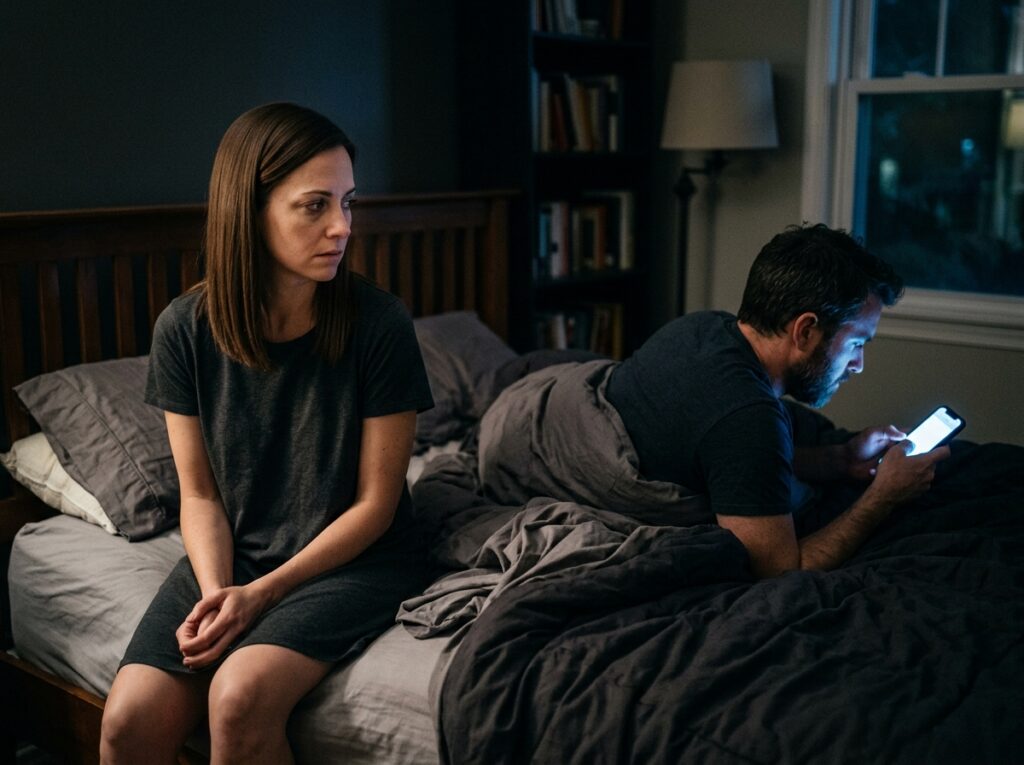
One of the most common and telling cheating red flags is a sudden, dramatic change in how your partner handles their phone. A person who once left their phone on the table face-up, shared passwords freely, and never thought twice about handing you their device to look something up — now carries it everywhere, flips it face-down the moment you walk in, sleeps with it under their pillow, and changes passwords without explanation.
According to a 2021 survey by private investigation firm Trustify, 88% of unfaithful partners used their smartphone to conduct the affair. The phone becomes a private world — a separate life maintained in texts, apps, and notifications that disappear before you can see them.
This doesn’t mean every person who values phone privacy is cheating. Privacy in a relationship is healthy and normal. The red flag is the change — when a partner who was previously open and relaxed about their phone suddenly becomes guarded and secretive about it without any reasonable explanation.
Red Flag 2: Emotional Distance Has Replaced Closeness
Intimacy in a healthy relationship is not just physical — it is emotional. It is the ease of conversation, the comfort of shared silence, the habit of turning toward each other at the end of the day. When a partner is being unfaithful, one of the earliest signs is often a quiet but unmistakable emotional withdrawal from the relationship.
They stop asking about your day. Conversations become transactional — schedules, logistics, surface-level exchanges — but the depth is gone. You find yourself talking at each other rather than with each other. The warmth that once defined your relationship has been replaced by a polite, manageable distance that you can feel but struggle to name.
Psychologists refer to this as emotional compartmentalization — the process by which an unfaithful partner mentally separates their affair life from their home life. To maintain the affair without guilt destroying them, they create emotional distance from their primary partner. It isn’t always conscious. But it is almost always felt by the person on the receiving end.
Red Flag 3: Unexplained Absences and Inconsistent Stories
Cheating requires time and opportunity — and time has to come from somewhere. If your partner has suddenly developed a new pattern of unexplained absences, working late with increasing frequency, taking calls in another room, or coming home at unusual hours — and the explanations feel inconsistent or vague — this is a significant cheating red flag worth paying attention to.
It’s not just the absence itself. It’s the quality of the explanation. Honest people who are simply busy tend to over-explain naturally — they share details, they check in, they feel slightly guilty for being unavailable. Partners who are hiding something tend to be vague, defensive when questioned, and inconsistent in the details they provide.
A 2018 study published in the Journal of Sex Research found that opportunity and time are among the top three factors that enable infidelity. Unexplained gaps in time — especially when paired with defensiveness — are among the most reliable behavioral indicators of an affair.
Red Flag 4: Sudden Changes in Appearance and Self-Presentation
There is a meaningful difference between a partner who decides to take better care of themselves as an act of personal growth — and one who suddenly becomes intensely focused on their appearance in a way that seems disconnected from any shared context in the relationship.
New cologne or perfume that wasn’t discussed. A sudden gym obsession that emerged without explanation. New clothes that seem designed to impress rather than reflect their usual style. An unusual amount of time spent grooming before certain outings. These shifts, on their own, mean very little. But when combined with other behavioral changes — emotional distance, phone secrecy, unexplained absences — they form part of a pattern that deserves attention.
Research on infidelity consistently shows that people engaged in affairs invest significantly in their physical presentation for their affair partner. It’s a form of courtship — the same energy that was once directed toward you, quietly redirected elsewhere.
“The most painful part of being cheated on is not the betrayal itself — it’s realizing that the signs were there all along, and love made you look the other way.”
Red Flag 5: They Become Overly Defensive Without Reason
Ask a person with nothing to hide a simple question, and they’ll answer it simply. Ask a person who is hiding something the same question — and watch what happens. Sudden, disproportionate defensiveness to innocent questions is one of the most psychologically revealing cheating red flags in any relationship.
You ask where they were. They explode. You mention you called and they didn’t answer. They accuse you of not trusting them. You express that you’ve been feeling distant from them lately. They flip it into an argument about your insecurities. This is a psychological defense mechanism called DARVO — Deny, Attack, Reverse Victim and Offender — and it is commonly observed in partners who are engaging in deceptive behavior.
Dr. Jennifer Freyd, psychologist and researcher at the University of Oregon, identified DARVO as a frequent manipulation tactic used by people who are engaging in betrayal. When your reasonable, calm questions are consistently met with disproportionate anger or accusations, the defensiveness itself becomes a red flag.
Red Flag 6: Intimacy Has Significantly Changed
Changes in physical intimacy — in either direction — can be an indicator that something has shifted outside the relationship. Some unfaithful partners become distant and avoidant of physical connection at home, driven by guilt or emotional disconnection. Others, counterintuitively, become temporarily more affectionate — driven by guilt, overcompensation, or a desire to maintain the appearance of a normal relationship.
What matters is the change from your established normal, combined with an inability or unwillingness to address it openly when you bring it up. A partner who genuinely has no explanation for why things have changed — and who deflects or dismisses your concern when you raise it — is displaying behavior worth taking seriously.
Sexual health researchers at the Kinsey Institute have found that changes in sexual behavior are among the top behavioral signals that relationship infidelity may be occurring, particularly when the change is sudden, unexplained, and accompanied by emotional withdrawal.

Red Flag 7: New Friends You’ve Never Met — and Never Will
Healthy social lives are important in any relationship — both partners should have their own friends and their own space. But when a partner suddenly develops a close, seemingly significant relationship with someone you’ve never met, never been introduced to, and are subtly discouraged from asking about — that is a cheating red flag worth examining.
Pay attention to how they talk about this new person — or more tellingly, how they don’t talk about them. Unfaithful partners frequently mention their affair partner casually at first — almost testing the waters — and then go quiet about them when they sense they’ve said too much. If you notice a name appearing and then disappearing from conversation, or if your partner seems evasive when you ask about specific people in their life, trust that observation.
The American Association for Marriage and Family Therapy notes that the majority of affairs begin with emotional connections that form at work or through mutual social circles. A person your partner spends significant time with — but keeps carefully separated from your shared life — deserves more than a passing thought.
Red Flag 8: Gut Feeling That Something Is Wrong
No list of cheating red flags would be complete without acknowledging the most powerful signal of all — your own intuition. The gut feeling that something is deeply wrong, even when you can’t articulate exactly what it is, is not paranoia. It is information.
Neuroscientist Antonio Damasio’s research on somatic markers demonstrates that the human brain processes enormous amounts of social and emotional data subconsciously — data that surfaces as a feeling long before it becomes a conscious thought. When your body tells you something is wrong in your relationship, it has likely already processed dozens of micro-signals that your conscious mind hasn’t yet organized into a coherent picture.
This doesn’t mean every anxious feeling is a sign of infidelity. Context matters. History matters. But if you are a person who is not generally anxious or suspicious in relationships — and something in you has quietly, persistently shifted into unease — that feeling deserves respect, not dismissal.
“Intuition is not paranoia dressed up in feelings. It is your mind processing what your heart hasn’t yet accepted.”
Red Flag 9: They Project Their Guilt Onto You
One of the less discussed but psychologically significant cheating red flags is when an unfaithful partner begins to accuse you of the very behaviors they are engaged in. Suddenly, you are the one being accused of flirting. You are the one being questioned about where you’ve been. You are the one being told you’re probably interested in someone else.
This phenomenon — psychological projection — is a defense mechanism by which people unconsciously attribute their own unacceptable thoughts, feelings, and behaviors to others. In the context of infidelity, it often serves a dual purpose: it relieves some of the internal guilt pressure, and it keeps you off-balance and defensive — less likely to be examining their behavior because you’re too busy defending your own.
If your partner has become inexplicably suspicious of you in a relationship where you’ve given no cause for it — and this suspicion emerged suddenly alongside other behavioral changes — it may reveal far more about what they are doing than what they think you are.
Red Flag 10: The Relationship Feels Like a Performance
Perhaps the most unsettling of all the cheating red flags is when the relationship starts to feel performative rather than genuine. You notice your partner going through the motions — saying the right things, showing up physically, maintaining the routines — but something essential is missing. The presence. The investment. The sense that they are actually here, with you, choosing you.
Relationships thrive on genuine emotional engagement. When a partner’s heart has divided its loyalty, the relationship begins to feel like a role they are playing rather than a life they are living. You might not be able to point to one specific thing. But the relationship feels hollow in a way it never did before — and that hollowness has a source.
Trust what you feel. And if the weight of these signs is sitting heavily in your chest right now, know this: whatever the truth turns out to be, you are strong enough to handle it. You are worthy of honesty, loyalty, and a love that doesn’t have to be investigated.

What to Do If You Recognize These Cheating Red Flags
Recognizing the signs is only the first step. What you do with that knowledge matters enormously — for your emotional wellbeing, the integrity of your relationship, and your long-term happiness. Here is what relationship experts consistently recommend:
Don’t confront in anger. The urge to explode the moment suspicion becomes conviction is completely understandable — but confrontations driven by raw emotion rarely produce honest conversations. Give yourself time to process, gather your thoughts, and approach the conversation from a place of calm clarity rather than reactive pain.
Seek professional support. Whether you speak to a therapist individually or attend couples counseling, professional guidance can help you navigate one of the most emotionally complex situations a person can face. A therapist will help you process what you’re feeling, clarify what you need, and make decisions from a grounded rather than reactive place.
Trust your worth. Whatever the outcome of this situation — whatever the truth reveals — your worth as a person is not determined by your partner’s choices. Infidelity is a reflection of the unfaithful person’s character, not a verdict on your value, your love, or your desirability.
Decide what you need — not just what you’ll accept. There is a meaningful difference between staying in a relationship because you genuinely want to rebuild it — and staying because you’re afraid to leave. Know the difference. Choose yourself with the same loyalty you’ve given your relationship.
Final Thoughts
Cheating red flags don’t always arrive as dramatic, undeniable moments of revelation. More often, they accumulate quietly — small shifts in behavior, unexplained absences, emotional withdrawals — until the picture becomes impossible to ignore. Trusting yourself enough to pay attention to these signs is not weakness. It is self-respect.
You deserve a relationship where you never have to wonder. Where loyalty is not a question but a certainty. Where love doesn’t require investigation. If the signs in this article have resonated with something you’ve been feeling — take that seriously. You are not paranoid. You are paying attention. And paying attention to yourself, to your relationship, and to the truth — is always the right choice.
💾 SAVE this article — you may need it or someone you know might.
📤 SHARE it with a friend who deserves to know the signs.
👉 FOLLOW Truthsinside.com for more real, honest relationship truths that empower you.
📃 Related article: 15 Subtle Red Flags in a New Relationship Most People Miss
FAQ: Cheating Red Flags
Q1: Is it normal to feel guilty for suspecting my partner of cheating?
Completely normal. Most people in loving relationships feel enormous guilt for even entertaining the thought that their partner might be unfaithful. But suspicion based on observable behavioral changes is not a betrayal of your partner — it is a natural response to real signals your mind is processing. Trust your instincts without shame.
Q2: Can cheating red flags appear even in long-term, stable relationships?
Yes. Research shows that infidelity is not limited to unhappy or unstable relationships. Affairs can and do happen in relationships that appear — even from the inside — to be solid and committed. Length of relationship does not guarantee loyalty. Awareness does not discriminate by relationship duration.
Q3: What if my partner shows some of these signs but has a legitimate explanation?
Context is everything. Individual signs, on their own, are rarely definitive proof of infidelity. Stress, depression, work pressure, and personal struggles can all produce behavioral changes that overlap with cheating red flags. What matters is the pattern — multiple signs appearing together, combined with your gut instinct, and your partner’s willingness or unwillingness to openly address your concerns.
Q4: Should I check my partner’s phone if I suspect they are cheating?
This is a deeply personal decision with significant ethical and relational implications. Most relationship therapists advise against covert investigation — not because your feelings don’t matter, but because discovering information this way often complicates the path forward. An honest, direct conversation — as difficult as it is — tends to be more productive and less damaging to your own sense of integrity.
Q5: Is a relationship recoverable after infidelity?
Some relationships do survive and even grow stronger after infidelity — but only with radical honesty, genuine accountability from the unfaithful partner, professional support, and a real willingness from both people to do the difficult work of rebuilding. Recovery is possible, but it is never guaranteed, and it is never easy. Your decision to stay or leave is valid either way — and it belongs entirely to you.
🎵 Music
Maren Lull is a singer-songwriter who writes from the places most people don’t talk about out loud.
Not the dramatic grief. Not the obvious heartbreak. The quiet kind — the ordinary Tuesday emptiness, the habit of reaching for someone who isn’t there anymore, the particular exhaustion of being strong for so long that the strength itself wears thin.
Her music lives at the intersection of emotional honesty and soft beauty — breathy vocals over gentle piano, slow tempos, lyrics that feel less like songs and more like something you wrote in a private notebook at two in the morning and never showed anyone.
Maren Lull writes for the people who feel everything deeply and say very little about it. For the ones who listen to sad music not because they want to feel worse — but because being understood, even by a song, makes the feeling easier to carry.
📱 Follow Maren Lull:
→ Spotify
→ Apple Music
→ Youtube
→ Audiomack