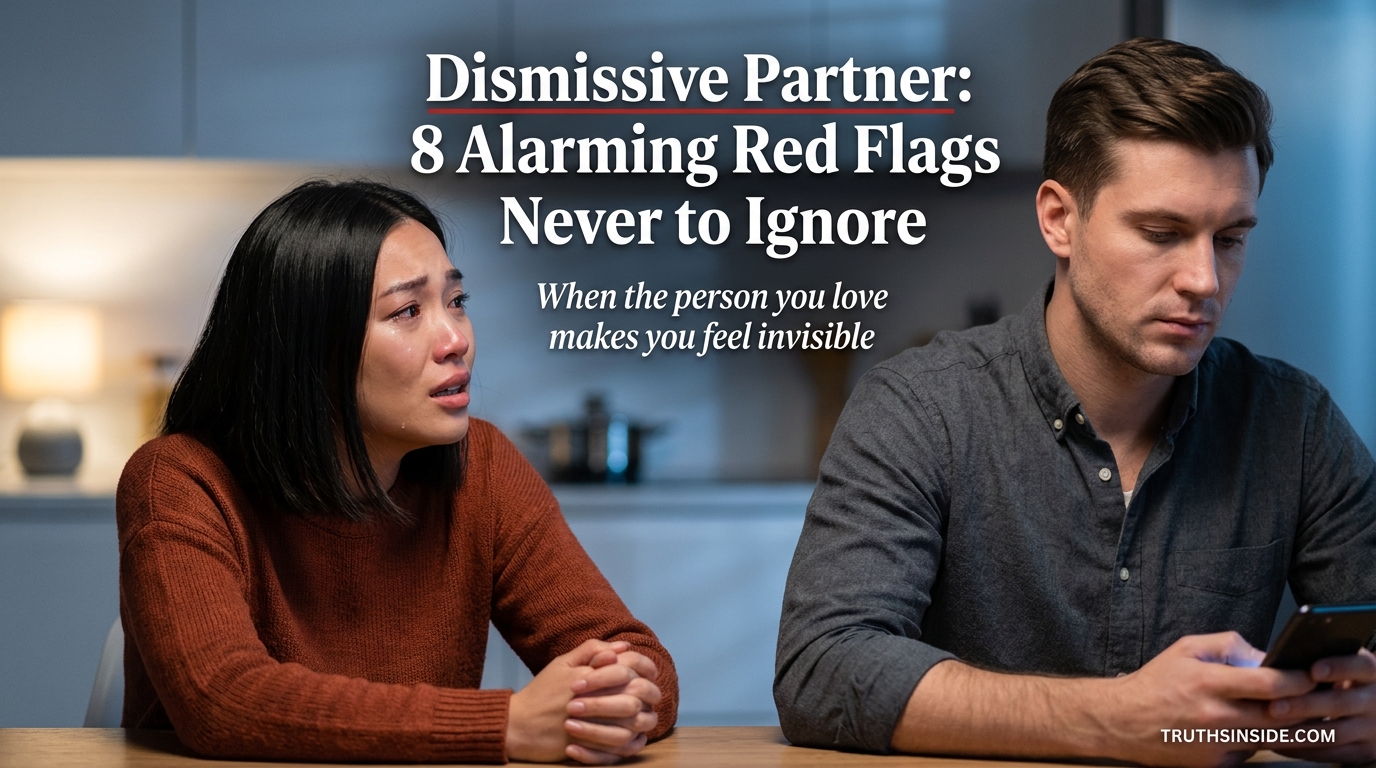
The Dismissive Partner: Red Flags They Minimize Your Feelings
A dismissive partner is one of the most quietly devastating relationship dynamics a person can find themselves inside — not because it is loud or dramatic, but precisely because it isn’t. Dismissal doesn’t announce itself. It doesn’t leave visible marks. It operates in a register of everyday interaction that is easy to explain away, easy to absorb, and devastatingly easy to internalize as your own fault. If you have ever shared something that mattered to you — a fear, a hurt, a need — and walked away from the conversation feeling smaller than before you spoke, you have experienced emotional dismissal.
Research from the Journal of Family Psychology found that emotional invalidation from a romantic partner is one of the strongest predictors of psychological distress in relationships — linked directly to increased anxiety, depression, and erosion of self-trust in the partner on the receiving end. This is not a minor interpersonal style difference. It is a pattern with measurable psychological consequences.
Emotional dismissal operates through a hundred small moments rather than a single obvious event. It lives in the eye-roll after you express worry. In the “you’re overreacting” delivered with weary impatience. In the change of subject that happens exactly when you reach something vulnerable. In the silence that follows your most honest sharing — not the silence of someone processing, but the silence of someone who has already moved on. These moments, individually, can be rationalized. Accumulated over time, they form a pattern that teaches you something deeply damaging: that your inner world is not worth engaging with.
This article names eight specific red flags of a dismissive partner — not to manufacture conflict or assign blame, but because clearly named patterns can be clearly addressed. And patterns that remain unnamed continue, quietly, to cost you more than you realize.
Red Flag 1: They Consistently Minimize What You Feel
The most fundamental red flag of a dismissive partner is the consistent minimization of your emotional experience. This is the pattern of responses that shrink your feelings before they have a chance to be fully expressed. “You’re being too sensitive.” “It’s not that big a deal.” “Why are you making such a huge thing out of this?” “Other people have real problems.” Each of these responses communicates the same message through different words: what you feel is disproportionate, inconvenient, or invalid.
Minimization is particularly damaging because it disguises itself as perspective or reason. The dismissive partner often genuinely believes they are being helpful — offering a more measured view, grounding an emotional reaction, preventing unnecessary suffering. But the impact of consistent minimization is not perspective. It is the slow erosion of your confidence in your own emotional responses.
Over time, a partner whose feelings are consistently minimized begins to preemptively edit themselves. They filter their emotional experience before sharing it, asking themselves whether this feeling is “big enough” or “reasonable enough” to mention — using their dismissive partner’s anticipated response as the measuring stick. That self-censorship is the internal fingerprint of having been dismissed too many times. It is not sensitivity. It is adaptation to an emotionally unsafe environment.

Red Flag 2: Your Emotions Are Treated as a Problem to Solve — or Endure
A dismissive partner typically responds to emotional expression in one of two ways — either by immediately attempting to fix it (problem-solving mode that bypasses emotional acknowledgment entirely) or by visibly tolerating it with impatience until it passes. In both cases, your emotional experience is framed as something to be resolved or survived — not something to be genuinely received.
The problem-solving response sounds caring on the surface. They jump immediately to solutions, suggestions, and logical action steps. But emotional expression is rarely a request for solutions — it is usually a request for presence and understanding first. When someone skips directly to fixing, they are communicating that the feeling itself is an obstacle rather than something worth sitting with. The message, however unintentional, is: your emotions are a problem I need to eliminate so we can move on.
The tolerating response is more overtly dismissive. It looks like visible impatience — checking the phone, looking elsewhere, giving short responses, sighing — while waiting for your emotional expression to run its course. This response communicates something equally damaging: your feelings are an inconvenience I am enduring. Both responses share the same root — a fundamental discomfort with emotional expression that manifests as dismissal of the person expressing it.
📃 Related article: Cycle of Apology and Repeat: 8 Red Flags Sorry Won’t Fix
Red Flag 3: They Turn Your Vulnerability Into Evidence Against You
This red flag is among the most harmful and the most difficult to recognize clearly — because it tends to happen in the context of conflict, when emotions are already high and clarity is lowest. A dismissive partner will take something you shared in a moment of genuine openness — a fear, an insecurity, a past wound — and use it, in a later argument, as a point of criticism or proof of your irrationality.
You shared that you struggle with abandonment. Later, when you express a need for reassurance, they say “There you go again with your abandonment issues.” You shared that you’ve felt overlooked in past relationships. Later, when you raise a concern, they say “You always do this — you’re just looking for problems because of your past.” Your vulnerability, offered in trust, becomes a liability used to invalidate your present emotional experience.
This pattern is deeply corrosive to emotional intimacy — because emotional intimacy requires the safety of knowing that what you share will be held with care, not stored as ammunition. When vulnerability is weaponized — even once — the message is received clearly at the nervous system level: it is not safe to be real here. And that message, once absorbed, dramatically reduces authentic sharing in the relationship.
“A partner who uses your vulnerability against you hasn’t just dismissed your feelings. They’ve made it unsafe to have them out loud. That silence they create is not peace — it’s damage.”
Red Flag 4: They Constantly Reframe Your Experience as Your Fault
Dismissive partners frequently employ a conversational pattern in which any emotional concern you raise is redirected back to something you did, said, or felt incorrectly. You express hurt — and somehow, by the end of the conversation, you are apologizing. You raise a concern — and you end up defending your character. You share a need — and you leave the conversation questioning whether having needs is acceptable.
This pattern — sometimes called DARVO (Deny, Attack, Reverse Victim and Offender) in clinical psychology — is a consistent feature of dismissive and emotionally invalidating relationships. It operates by making the expression of emotion itself the problem rather than whatever prompted it. “If you didn’t react so dramatically, we wouldn’t even be having this conversation.” “I wouldn’t have said that if you hadn’t pushed me.” The focus shifts from their behavior to your reaction — and your reaction is always the primary issue.
Over time, this pattern produces a particularly painful form of self-doubt. You begin arriving at difficult conversations already pre-apologetic — already half-convinced that your feelings are the problem before you’ve even spoken. That pre-emptive self-blame is not a personality trait. It is the direct psychological product of a relationship where emotional expression consistently produces blame rather than care.
Red Flag 5: They Are Selectively Emotionally Available
One of the clearest indicators of a dismissive partner is the pattern of selective emotional availability — they can be warm, attentive, and emotionally present in certain contexts, but become dismissive and unavailable specifically when your emotional needs conflict with their comfort or convenience.
This selectivity is important to identify because it disproves the common rationalization that “they’re just not an emotionally expressive person.” A partner who is genuinely emotionally limited tends to struggle across contexts — with friends, with family, in professional relationships. A dismissive partner, by contrast, is often capable of emotional attunement — they simply choose not to extend it toward your emotional needs when doing so would require something of them.
You may notice they engage warmly with your emotions when those emotions are positive, uncomplicated, or require nothing beyond their presence. But when your emotions are difficult — when they involve hurt that implicates them, needs that inconvenience them, or fears that require sustained engagement — the availability disappears. That selectivity is not a limitation. It is a choice. And recognizing it as such is one of the most clarifying — and painful — realizations in a relationship with a dismissive partner.

Red Flag 6: Apologies Are Rare, Conditional, or Weaponized
Genuine accountability is structurally incompatible with consistent emotional dismissal — because accountability requires acknowledging that your partner’s feelings were valid and that your behavior contributed to their pain. A dismissive partner cannot do this without dismantling the core mechanism of their dismissal. So apologies, when they come, are almost never genuine.
Instead, they take recognizable forms. The non-apology apology: “I’m sorry you feel that way” — which expresses regret about your emotional state rather than about the behavior that caused it. The conditional apology: “I’m sorry, but you have to admit that you—” — which immediately redirects accountability back toward you. The performative apology: a dramatic, emotional expression of remorse that lasts long enough to end the conversation but produces no behavioral change.
The consistent absence of genuine, unconditional accountability is one of the most reliable indicators of a dismissive partner — because it reveals that their primary concern is the resolution of their own discomfort, not the repair of your hurt. Real apologies cost something. They require setting aside defensiveness and sitting in the discomfort of having caused harm. A partner who consistently produces apologies that cost them nothing — because they contain no real acknowledgment — is a partner who has not yet chosen to genuinely prioritize your emotional experience.
📃 Related article: Gaslighting in Relationships: How to Recognize, Name, and Leave It
Red Flag 7: They Pathologize Your Normal Emotional Responses
A particularly insidious form of emotional dismissal involves characterizing your normal, appropriate emotional responses as evidence of psychological instability, oversensitivity, or dysfunction. “You’re so dramatic.” “You need therapy for how you react to things.” “Normal people don’t respond like this.” “I’ve never had this problem with anyone else — that tells you something.”
This pattern — sometimes called pathologizing — takes your legitimate emotional expression and reframes it as a symptom of something wrong with you. It is doubly damaging because it not only dismisses the immediate feeling but also attacks the credibility of your entire emotional perspective. If your reactions are inherently disordered, then nothing you feel can be taken at face value — including the growing recognition that something is deeply wrong in the relationship.
Pathologizing is also deeply effective at preventing you from seeking external perspective or support. If you’ve been told repeatedly that your emotional responses are abnormal, you may feel ashamed to share them with friends or a therapist — afraid that others will confirm what your partner has told you. That isolation, however it arrives, serves the dismissive partner’s dynamic by ensuring your only reference point for what is “normal” remains them.
Red Flag 8: You Have Started Shrinking Your Emotional World to Survive
This final red flag is not something your partner does — it is something that happens to you as the cumulative result of all the others. And it may be the most important signal of all. If you have started automatically editing your feelings before you express them, choosing silence over vulnerability because speaking up has too often left you worse off, or feeling a sense of relief when you keep your emotional world small and unshared — your relationship has taught you something it should never have taught you.
You have learned that your feelings are a burden. That your needs are excessive. That your emotional experience is less valid, less important, and less worthy of engagement than the comfort of the person who was supposed to be your safe place. That learning did not come from inside you. It was produced, slowly and consistently, by an environment that repeatedly failed to receive you.
Recognizing this — honestly, without minimizing it — is not self-pity. It is clarity. And clarity, however painful its arrival, is always the beginning of something better. You were not born editing yourself. You adapted to an environment that made full expression feel unsafe. That adaptation was intelligent. Continuing it indefinitely, in service of a relationship that does not change, is the only part of the equation that is within your control to shift.
“You were not born afraid to feel things out loud. Someone, somewhere, made it cost too much. Recognizing that cost is the first step to refusing to keep paying it.”
The Psychological Impact of Long-Term Emotional Dismissal
The consequences of sustained emotional dismissal extend well beyond the relationship itself. Research consistently links chronic emotional invalidation to elevated rates of anxiety and depression, reduced self-esteem, difficulty trusting one’s own perceptions, hypervigilance in relationships, and a diminished capacity for emotional expression that can persist long after the dismissive relationship ends.
Partners who have spent years with a dismissive individual often describe entering new relationships — or therapy — with a profound uncertainty about whether their feelings are real, proportionate, or worth sharing. They preemptively apologize for having emotions. They frame their own needs as impositions. They feel genuine surprise when someone responds to their feelings with care rather than dismissal — because care had stopped feeling like something they were allowed to expect.
This is the longer arc of what emotional dismissal does. It doesn’t just make individual moments painful. It reshapes your relationship with your own inner world — teaching you to be a stranger to yourself in the service of someone else’s comfort. Healing from that requires both time and deliberate work — often with a therapist who can provide the consistent, genuine validation that the relationship withheld.
What to Do When You Recognize These Red Flags
Recognition is step one — and it is a significant one, because the nature of dismissal makes self-trust difficult. If you recognize multiple red flags in this article, begin by grounding yourself in the objective pattern rather than individual incidents. One dismissive comment does not define a relationship. A consistent, pervasive pattern of emotional minimization, blame-shifting, pathologizing, and selective availability does.
Once the pattern is clear, a direct, calm conversation about your specific experience — “When I share something emotional and you respond with ‘you’re overreacting,’ I feel completely alone, and I need that to change” — is the appropriate first step. Describe the behavior. Name its impact. Request a specific change. How your partner responds to that conversation is itself significant data.
If the response is genuine acknowledgment and demonstrated effort to engage differently, that is a meaningful starting point. If it is defensiveness, minimization of your concern, or a replication of the exact pattern you just described — that response tells you something important about whether change is genuinely available here. Either way, you deserve to make your next decision with clear eyes and full information — including the information that your feelings have always been worth taking seriously.
When to Seek Support
If this article has reflected your relationship experience with painful accuracy, professional support — individual therapy first, couples therapy when both partners are genuinely committed — is a meaningful next step. A skilled therapist provides something a dismissive relationship consistently withholds: a space where your emotional experience is received as valid, worth exploring, and important simply because it is yours.
Individual therapy is particularly valuable for rebuilding self-trust — learning to recognize your own feelings as reliable again, re-establishing the internal authority over your emotional experience that dismissal quietly stripped away. You do not need your partner’s participation to begin this work. You only need your own willingness to take your inner world as seriously as it has always deserved to be taken.
💾 Save this article. Share it with someone who needs to see this clearly. Follow Truthsinside.com for relationship psychology and red flag truth that protects your peace.
FAQ
Q1: What is the difference between a dismissive partner and someone who is just emotionally reserved?
An emotionally reserved person struggles to express their own feelings openly but can still acknowledge and respond to yours with care and genuine attention. A dismissive partner specifically minimizes, redirects, or invalidates your emotional expression — the issue is not their own emotional expression but their response to yours. Reserved people can be deeply empathetic listeners. Dismissive partners consistently make you feel that your emotions are unwelcome, disproportionate, or burdensome.
Q2: Can a dismissive partner change?
Yes — but only with genuine self-awareness and active commitment to growth, usually supported by individual therapy. Change requires the dismissive partner to recognize their pattern, understand its impact, and develop new emotional response habits over time. This is real work that cannot be shortcut by good intentions alone. Partners who acknowledge the pattern with humility and pursue consistent behavioral change over months — not days — demonstrate that genuine change is occurring. Promises without behavioral evidence are not change.
Q3: Is emotional dismissal considered emotional abuse?
Emotional dismissal exists on a spectrum. Consistent, pervasive dismissal that erodes a partner’s self-trust, isolates them emotionally, and produces measurable psychological harm meets many clinical definitions of emotional abuse — particularly when combined with pathologizing, blame-shifting, and weaponized vulnerability. Not every dismissive interaction constitutes abuse. A pattern of dismissal that systematically damages a partner’s psychological wellbeing and sense of reality does. The frequency, intensity, and impact over time are the defining factors.
Q4: Why do I feel guilty for being upset about being dismissed?
This guilt is one of the most reliable psychological fingerprints of a dismissive relationship. When emotional dismissal is consistent, the dismissed partner internalizes the message that their feelings are disproportionate or burdensome — and guilt becomes the automatic response to having them. This guilt does not mean your feelings are wrong. It means the relationship has successfully taught you to police your own emotional experience on behalf of someone else’s comfort. Recognizing that the guilt is a learned response — not an accurate moral signal — is an important step in reclaiming your emotional authority.
Q5: How do I bring up emotional dismissal without starting a fight?
Choose a calm, neutral moment — not during or immediately after a dismissive incident. Use specific, behavioral language rather than character-based accusations: “When I share something difficult and the response is ‘you’re overreacting,’ I feel completely alone. I need to feel heard first before anything else.” Avoid the word “always” and focus on specific recent examples. Be clear about what you need — not just what hurt. If the conversation consistently derails into defensiveness or counter-attack despite calm delivery, that pattern itself is important information about the relationship’s capacity for genuine repair.
🎵 Music
Maren Lull is a singer-songwriter who writes from the places most people don’t talk about out loud.
Not the dramatic grief. Not the obvious heartbreak. The quiet kind — the ordinary Tuesday emptiness, the habit of reaching for someone who isn’t there anymore, the particular exhaustion of being strong for so long that the strength itself wears thin.
Her music lives at the intersection of emotional honesty and soft beauty — breathy vocals over gentle piano, slow tempos, lyrics that feel less like songs and more like something you wrote in a private notebook at two in the morning and never showed anyone.
Maren Lull writes for the people who feel everything deeply and say very little about it. For the ones who listen to sad music not because they want to feel worse — but because being understood, even by a song, makes the feeling easier to carry.
📱 Follow Maren Lull:
→ Spotify
→ Apple Music
→ Youtube
→ Audiomack