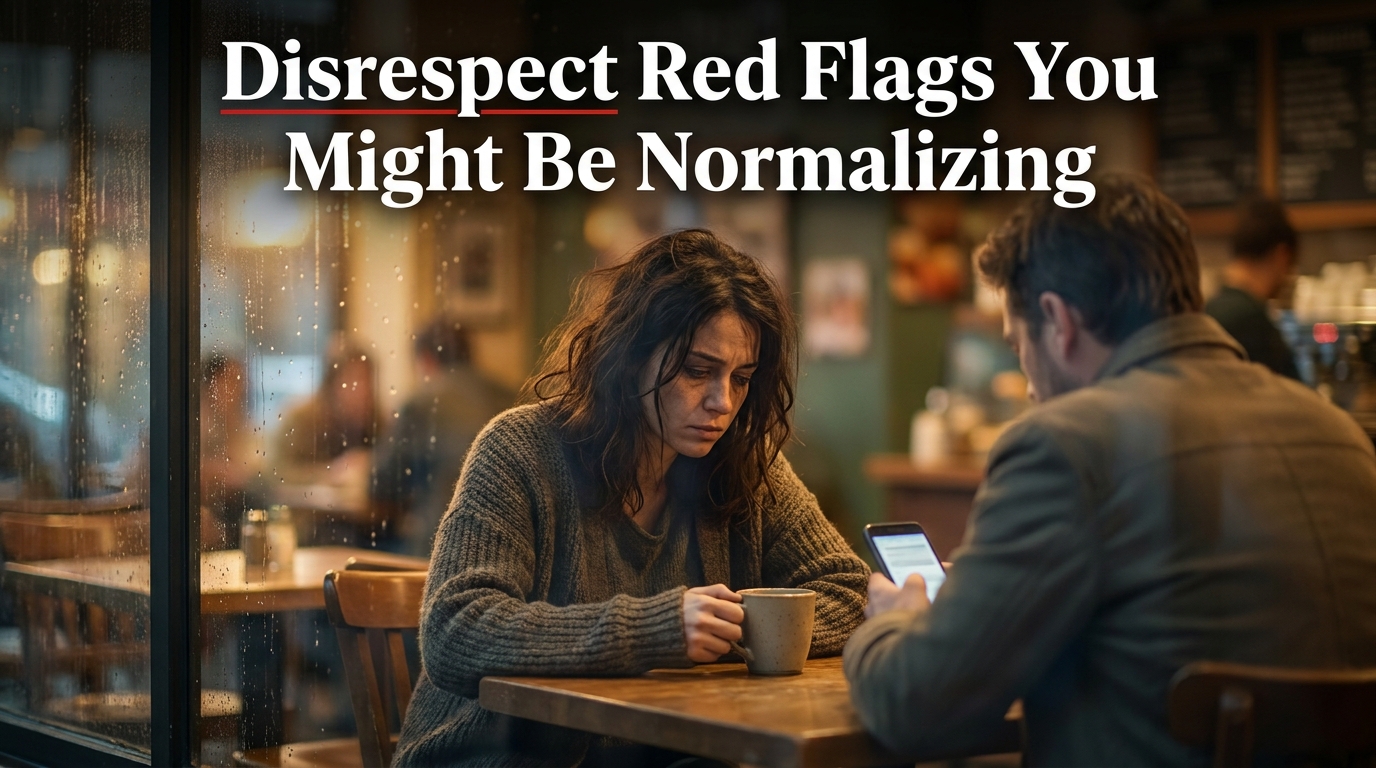
You make excuses for the way they speak to you. You tell yourself everyone argues like this. You convince yourself that if you were less sensitive, less needy, less difficult — it would not feel this bad. But here is what the research says: a 2021 study published in the Journal of Social and Personal Relationships found that individuals who grew up in environments with inconsistent emotional validation are significantly more likely to normalize disrespectful behavior in adult romantic relationships, often misidentifying it as passion, honesty, or simply “how relationships work.” Disrespect red flags do not always look like shouting or obvious cruelty. More often, they look like something you have quietly learned to live with.
That is the most dangerous kind of disrespect — the kind that arrives softly enough that you adjust to it, absorb it, and eventually stop recognizing it as something wrong. It becomes your normal. And once something becomes your normal, it becomes almost invisible.
This article is an honest, clear-eyed look at the disrespect red flags that are most commonly normalized in relationships — the behaviors that people rationalize, minimize, and explain away until the damage to their self-worth becomes undeniable. Not because you are naive or weak. But because human beings are wired for attachment, and attachment sometimes makes us extraordinarily skilled at not seeing what we do not want to see.
If something in what follows makes your chest tighten — lean into that. Your body often knows before your mind catches up.
Why We Normalize Disrespect Red Flags in the First Place
Before naming the specific behaviors, it is worth understanding why normalizing disrespect happens at all — because without that understanding, the list of red flags can feel like an accusation rather than a mirror.
Normalization of disrespect is rarely a conscious choice. It is a psychological process shaped by multiple forces, often beginning long before the current relationship.
Early Attachment Experiences
Attachment theory, developed by psychologist John Bowlby and later expanded by Mary Ainsworth, establishes that our earliest experiences with caregivers form an internal template for what love feels like — what it looks, sounds, and behaves like. If those early relationships included inconsistency, criticism, emotional unavailability, or conditional love, the nervous system does not learn to expect respect as a baseline. It learns to expect unpredictability. And in adulthood, unpredictability disguised as passion, or criticism disguised as caring, can feel remarkably familiar — and familiarity, neurologically, can feel like home.
The Gradual Escalation Pattern
Disrespect in relationships almost never begins at full intensity. It escalates gradually — starting with behaviors mild enough to dismiss, then intensifying incrementally in ways that are difficult to track from the inside. This is sometimes called the “boiling frog” phenomenon in psychology. Each individual step feels small. But the cumulative distance traveled is enormous.
Cognitive Dissonance and Love
When we love someone, we are deeply motivated to maintain a positive image of them and of the relationship. When their behavior conflicts with that image, the mind experiences cognitive dissonance — an uncomfortable tension between two contradictory realities. To resolve that tension, we frequently reinterpret the disrespectful behavior rather than acknowledge the conflict. “They did not mean it that way.” “They were stressed.” “I probably provoked it.” This is not stupidity. It is a very human psychological defense mechanism protecting a very human emotional investment.
Social and Cultural Messaging
Cultural narratives around love — particularly those absorbed through media, family modeling, and peer environments — frequently romanticize dynamics that are actually dysfunctional. Jealousy is reframed as passion. Control is reframed as protectiveness. Emotional volatility is reframed as intensity. These narratives make it harder to identify disrespect red flags because the culture itself has handed you a flattering label for them.
Understanding these forces does not excuse disrespectful behavior. It simply explains why intelligent, self-aware people so often find themselves deep inside it before they recognize what has happened.

Disrespect Red Flag 1: Dismissing Your Feelings as Overreaction
“You are so sensitive.”
“Why do you always make everything a big deal?”
“I was just joking — you cannot take a joke.”
“Here we go again.”
If any of these phrases feel familiar, you have encountered one of the most commonly normalized disrespect red flags in existence: the systematic dismissal of your emotional responses as disproportionate, irrational, or inconvenient.
This pattern is sometimes called “emotional invalidation” — and in its more deliberate, sustained form, it overlaps significantly with what psychologists identify as gaslighting. When a partner consistently reframes your legitimate emotional responses as the problem, several things happen simultaneously.
You begin to distrust your own perceptions. You spend increasing amounts of mental energy second-guessing whether your feelings are “reasonable” before deciding whether to express them. You start to self-censor — not because your feelings are inappropriate, but because the cost of expressing them has become too high.
Over time, this erodes one of the most fundamental requirements for emotional health in a relationship: the safety to feel what you feel without having to defend the right to feel it.
Why people normalize this: The person doing the dismissing often frames it as rationality versus emotionality — positioning themselves as the calm, reasonable voice and you as the unstable, dramatic one. If this narrative is consistent enough, you begin to adopt it yourself.
What healthy actually looks like: A respectful partner may not always understand your emotional response immediately. But they do not mock it, minimize it, or use it as evidence of your inadequacy. They say “Help me understand what you are feeling” — not “You are being ridiculous.”
Disrespect Red Flag 2: Public Humiliation Disguised as Humor
There is a particular kind of disrespect that performs itself in front of an audience — a cutting joke at your expense during a dinner with friends, a sarcastic comment about your intelligence or appearance at a family gathering, a mocking impression of something you said, delivered to a room full of people who laugh along while you smile and die a little inside.
Public humiliation as humor is a disrespect red flag that is deeply normalized because it comes wrapped in the social armor of comedy. If you react, you are the one who cannot take a joke. If you address it privately afterward, you are told you are being too sensitive or that you ruined the mood. The humor becomes a double trap — used to humiliate you, and then used again to silence your response to being humiliated.
This pattern has specific psychological consequences. Research on public shaming indicates that humiliation — particularly in front of people whose opinion matters to you — activates the same threat-response systems as physical danger. The body treats social humiliation as survival-level threat. And when this happens repeatedly within a relationship you depend on emotionally, it creates a persistent state of hypervigilance and shame.
Beyond the immediate sting, public humiliation functions as a social power move. It establishes a hierarchy — one partner positioned as the witty, superior one, the other as the punchline. Over time, this erodes the equal dignity that healthy partnerships require.
Why people normalize this: Laughter is disarming. The public social contract makes it difficult to respond authentically in the moment. And often, the person being humiliated has been conditioned to prioritize the relationship’s public image over their own private dignity.
What healthy actually looks like: Partners who genuinely respect each other protect each other’s dignity in public — even during playful teasing. There is a clear difference between affectionate humor shared between equals and humor used as a subtle weapon. You should never leave a social situation feeling smaller than when you arrived because of your partner.

Disrespect Red Flag 3: Conditional Respect — Kindness With a Price Tag
In a healthy relationship, basic respect is not a reward for good behavior. It is a baseline. It does not disappear when you disagree, when you make a mistake, or when you fail to meet an expectation.
Conditional respect — kindness that is withheld as punishment and restored as reward — is one of the most psychologically destabilizing disrespect red flags because it creates an intermittent reinforcement pattern that is almost impossible to disengage from once established.
Here is how it typically manifests: Your partner is warm, engaged, and loving when things are going their way. When you disappoint them, challenge them, or simply fail to anticipate their needs, the warmth vanishes. They become cold, dismissive, or subtly punishing — through silence, through short clipped responses, through the withdrawal of affection. And then, when the tension resolves — usually on their terms — the warmth returns.
This cycle is addictive in a neurological sense. The unpredictable alternation between warmth and withdrawal activates the brain’s dopamine reward system in a way that consistent warmth does not. You become, without fully realizing it, oriented around managing their emotional temperature — doing whatever is necessary to restore the warmth, because the withdrawal feels unbearable.
Psychologists recognize this as a feature of emotionally manipulative relationship dynamics. It is a form of control that does not require raised voices or obvious threats. It operates through the manipulation of something you desperately need: connection and emotional safety.
Why people normalize this: Because the good periods feel so good. And because the person in this dynamic often believes — genuinely — that if they could just be better, the withdrawal would stop. The problem gets attributed to their own inadequacy rather than their partner’s conditional treatment.
What healthy actually looks like: Respectful partners maintain basic kindness and dignity in their interactions even during conflict. Disagreement does not become a trigger for punishment. Disappointment is expressed directly rather than performed through emotional withdrawal.
“Respect in a relationship is not something you earn through perfect behavior. It is something you are owed simply because you are a human being in a relationship with another human being. The moment it becomes conditional, it is no longer respect. It is a leash.”
Disrespect Red Flag 4: Interrupting, Talking Over, and Dismissing Your Perspective
It happens in conversations so routinely that it barely registers anymore. You begin to speak and they cut you off mid-sentence. You offer a perspective and they redirect to their own without acknowledging yours. You share an opinion and they dismiss it with a quick “That is not how it works” or “You do not understand” — before you have even finished making your point.
Chronic interrupting and perspective dismissal is a disrespect red flag that is almost universally underestimated in its impact. It operates below the threshold of what most people would consciously classify as “disrespect” — but its cumulative effect is the slow, steady communication that your voice does not matter, your thoughts are not worthy of full consideration, and your presence in the conversation is primarily as an audience for theirs.
Research on conversational dynamics consistently finds that feeling genuinely heard is one of the top predictors of relationship satisfaction. Not agreed with — heard. When a partner consistently fails to hear you — through interruption, dismissal, or the performance of listening while actually just waiting to speak — it creates a profound sense of relational loneliness.
You can be in a relationship and feel profoundly unseen. And this is one of the primary mechanisms by which that happens.
Why people normalize this: Many people were raised in environments where interrupting was simply how conversation worked — where the loudest or most dominant voice held the floor. They may not experience their partner’s behavior as disrespect because they have never experienced the alternative. They have never been in a dynamic where their words were truly received.
What healthy actually looks like: A respectful partner lets you finish. They reflect back what they heard before responding. They ask follow-up questions. They demonstrate, through their behavior, that what you say matters to them — not because they always agree, but because they value your perspective as worth engaging with fully.

Disrespect Red Flag 5: Using Your Vulnerabilities Against You
At some point in your relationship, you trusted your partner with something that cost you something to share. A fear. A past wound. An insecurity. A moment of real, unguarded vulnerability. You shared it because you felt safe enough to — because intimacy requires that kind of risk, and you were willing to take it.
And then, during a fight — or sometimes casually, almost offhandedly — they used it. They turned the thing you shared in your most unguarded moment into ammunition. They referenced your insecurity to win an argument. They weaponized your past trauma to explain away your current feelings. They repeated something you told them in confidence in a way that made you feel exposed, stupid, or weak for having shared it at all.
This is one of the most profound violations of relational trust possible — and it is a disrespect red flag that cuts deeper than most because of what it destroys: the safety to be known.
Healthy intimacy requires vulnerability. Vulnerability requires safety. Safety requires the certainty that what you share in your most open moments will be honored, not stored as future leverage. When that certainty is destroyed, something fundamental in the relationship breaks. And it does not rebuild easily — because the lesson has been learned at a cellular level: being known is dangerous.
Why people normalize this: It often happens in moments of conflict, when both people are emotionally dysregulated. The person on the receiving end frequently absorbs the shame of having been exposed rather than identifying their partner’s behavior as the violation it is. They may even apologize — for being too sensitive, for sharing too much, for “making” their partner say it.
What healthy actually looks like: What is shared in vulnerability is held sacred. Always. A respectful partner — even in their worst moments of conflict — does not reach for your deepest wounds to score points. They fight with you, not against who you are.
Disrespect Red Flag 6: Chronic Lateness and Disregard for Your Time
This one is frequently minimized because it seems logistical rather than emotional. But chronic disregard for your time — showing up late consistently, canceling plans without adequate notice, agreeing to commitments and then simply not following through — is a behavioral expression of how much your needs and your time are valued.
Time is one of the most intimate resources human beings have. When someone repeatedly fails to honor your time, what they are communicating — regardless of their stated intentions — is that their convenience takes precedence over your experience. That keeping you waiting, disappointing you, or forcing you to adjust your life around their unreliability is an acceptable cost.
Single instances of lateness or plan changes are entirely human and deserve grace. The red flag is the pattern — the chronic, repeated, unaddressed pattern — particularly when raising the issue is met with defensiveness, minimization, or the turning of the conversation back to your “controlling” expectations.
Why people normalize this: Disregard for time is often reframed within the relationship as a personality trait rather than a behavioral choice — “That is just how they are.” Partners of chronically late or unreliable people often eventually stop making plans, stop expecting follow-through, and unconsciously reorganize their own expectations downward to avoid disappointment.
What healthy actually looks like: A respectful partner communicates proactively when plans change. They take seriously the impact their unreliability has on you. They work — genuinely and consistently — to honor the time and plans you share.

Disrespect Red Flag 7: Talking Down to You — Condescension and Patronizing Behavior
There is a particular tone of voice that some partners use — slower, slightly louder, with the careful enunciation of someone explaining something to a person they consider slow. Or the sigh before answering your question, as if your not knowing is a mild but genuine burden. Or the habit of explaining things you already know, unsolicited, in the manner of a teacher correcting a student rather than a partner sharing a thought.
Condescension and patronizing behavior is a disrespect red flag disguised as helpfulness or intelligence. It communicates, through every subtle signal of tone and posture and word choice, that your partner considers themselves intellectually or practically superior to you — and has appointed themselves the authority on most matters you encounter together.
This manifests in various ways:
- Explaining things to you that you did not ask to be explained and already know
- Using a tone with you that they would not use with other adults
- Correcting you in front of others, particularly on minor points
- Treating your opinions on practical matters as naive or uninformed
- Assuming you cannot handle complex decisions and making them for you without consultation
The insidious quality of condescension is that it is frequently invisible to the person doing it — because in their own internal narrative, they are simply being helpful, knowledgeable, or efficient. The impact on the receiving end, however, is cumulative and quietly devastating: a slow erosion of intellectual confidence and the growing, uncomfortable sense of occupying a lesser position within the partnership.
Why people normalize this: Condescension can initially be mistaken for competence or protectiveness. Partners who are consistently talked down to may eventually internalize the implicit message — begin to doubt their own judgment, defer more readily, and gradually cede their voice in the relationship.
What healthy actually looks like: Respectful partners engage with you as an intellectual equal. They share knowledge without performing superiority. They ask your opinion genuinely. They recognize that your different knowledge base is a complement, not a deficit.
“The relationship you normalize becomes the relationship you inhabit. And the relationship you inhabit shapes who you believe you are. That is why disrespect red flags are never just about one moment — they are about who you slowly become inside them.”
Disrespect Red Flag 8: Stonewalling as Punishment
There is an important distinction between stonewalling that happens because someone is emotionally flooded and needs time to regulate — and stonewalling that is deployed deliberately as a punishment tool.
Punitive stonewalling looks like this: your partner goes silent not because they are overwhelmed, but because you did something they disapprove of. They withdraw communication, warmth, and engagement as a calculated consequence for your behavior. They may ignore you for hours or days. They refuse to engage with normal conversation. They create an atmosphere of cold, pointed silence designed to communicate your wrongness and their displeasure.
This is sometimes called the “silent treatment” — and research in relationship psychology consistently classifies it as a form of emotional manipulation and, in its sustained form, emotional abuse. Studies show that being subjected to prolonged deliberate silence by someone you love activates the same neural regions as physical pain — and that the sense of social exclusion it creates can be more psychologically damaging than overt conflict.
The silent treatment as punishment is a power play. It controls through deprivation. And it is particularly effective on people who experienced abandonment fears in childhood — for whom silence from a loved one triggers primal terror rather than simple frustration.
Why people normalize this: People frequently confuse punitive silence with someone “needing space to calm down” — a healthy and valid need. The difference is in the communication and the intent. Healthy space is requested openly and returned from genuinely. Punitive silence is imposed without explanation and designed to be felt as punishment.
What healthy actually looks like: When a respectful partner needs space, they say so directly and return when they said they would. They do not use their withdrawal as leverage. Silence between healthy partners can be comfortable and easy — not weaponized and suffocating.
What to Do When You Recognize These Disrespect Red Flags
Recognizing these patterns in your relationship does not automatically tell you what to do next. That is a deeply personal decision, shaped by your specific circumstances, history, safety, and values. But here are the honest starting points:
Name it to yourself first. Before anything else, stop minimizing. Allow yourself to call what is happening what it actually is. Not to condemn your partner, but to stop abandoning yourself in the process of protecting them.
Observe the pattern, not just the incident. One instance of any of these behaviors does not define a relationship. The pattern does. How often does this happen? How does your partner respond when you raise it? Do they take genuine responsibility, or do the same patterns repeat unchanged?
Raise it directly — once, clearly, and without accusation. Express specifically what behavior affected you, how it made you feel, and what you need to change. Pay attention — genuinely and carefully — to how they receive it.
Take their response seriously as information. If they hear you, acknowledge the impact, and make genuine effort to change — that is meaningful. If they dismiss your concern, turn it back on you, or repeat the behavior without acknowledgment — that is also meaningful. Perhaps more so.
Consider professional support. Individual therapy can be invaluable for rebuilding the clarity and self-trust that chronic disrespect erodes. Couples therapy can help both partners engage with these dynamics in a structured, supported environment — if both partners are genuinely willing.
Trust yourself. Chronic disrespect is specifically good at dismantling your trust in your own perceptions. Rebuilding that trust — your confidence in what you see, what you feel, and what you deserve — is the most important work you can do, regardless of what happens with the relationship.

Final Thoughts
Disrespect red flags do not always announce themselves. They wear the clothes of normal. They borrow the language of love — “I am just being honest,” “I say this because I care,” “You know I would not say it if it were not true.” They arrive gradually enough that by the time you notice the distance between who you were and who you have become inside this relationship, it feels like you have always been this small.
You have not. You were not. And you do not have to stay there.
Recognizing disrespect red flags is not about building a case against someone you love. It is about returning to yourself — to the version of you that knew, before anyone taught you differently, that you deserved to be spoken to with kindness, heard with genuine attention, treated with basic dignity, and loved without conditions attached.
That version of you was right. And it is not too late to listen to them again.
Save this article — you may need to come back to it on a day when you are second-guessing yourself.
Share it with someone who keeps making excuses for how they are being treated.
Follow Truthsinside.com for more honest, psychology-informed content on relationships, red flags, and finding your way back to yourself.
Related article: Gaslighting in Relationships: How to Recognize, Name, and Leave It
Frequently Asked Questions
Q1: Is it possible to disrespect someone without realizing it?
Yes — and it is more common than most people realize. Many disrespectful behaviors are learned patterns from family of origin or past relationships that the person has never examined critically. This does not make the impact less real, but it does mean that some partners, when genuinely confronted with the effect of their behavior, are capable of real change. The key variable is how they respond when it is named.
Q2: How do I know if I am being too sensitive or if something is actually a red flag?
A useful question to ask yourself is: “Would I accept this behavior from a friend or colleague, or would I consider it disrespectful in that context?” We often apply a far more forgiving standard to romantic partners than we would to anyone else. If a behavior would be clearly unacceptable from anyone else in your life, it does not become acceptable simply because it comes from someone you love.
Q3: Can a relationship change after these patterns have been established?
Yes, but it requires genuine acknowledgment from the person engaging in the disrespectful behavior — not minimization, not defensive justification, but real recognition of the impact and sustained, consistent effort to change. Change is possible. But it cannot be willed into existence by the person on the receiving end of the disrespect. It has to be chosen by the person doing it.
Q4: What if my partner says these behaviors are normal in relationships?
That is itself important information. Someone who defends disrespectful behavior as normal either has a genuinely distorted frame of reference for what healthy relationships look like, or is motivated to maintain your acceptance of their behavior. Neither situation bodes particularly well for change without significant intervention.
Q5: Is it disloyal to talk to a therapist or counselor about these patterns?
Not at all. Seeking support to understand your own experience, rebuild your self-trust, and make clear-eyed decisions about your relationship is one of the most responsible and loving things you can do — for yourself and, ultimately, for the relationship. Loyalty does not require silence about your own pain.
🎵 Music
Maren Lull is a singer-songwriter who writes from the places most people don’t talk about out loud.
Not the dramatic grief. Not the obvious heartbreak. The quiet kind — the ordinary Tuesday emptiness, the habit of reaching for someone who isn’t there anymore, the particular exhaustion of being strong for so long that the strength itself wears thin.
Her music lives at the intersection of emotional honesty and soft beauty — breathy vocals over gentle piano, slow tempos, lyrics that feel less like songs and more like something you wrote in a private notebook at two in the morning and never showed anyone.
Maren Lull writes for the people who feel everything deeply and say very little about it. For the ones who listen to sad music not because they want to feel worse — but because being understood, even by a song, makes the feeling easier to carry.
📱 Follow Maren Lull:
→ Spotify
→ Apple Music
→ Youtube
→ Audiomack