
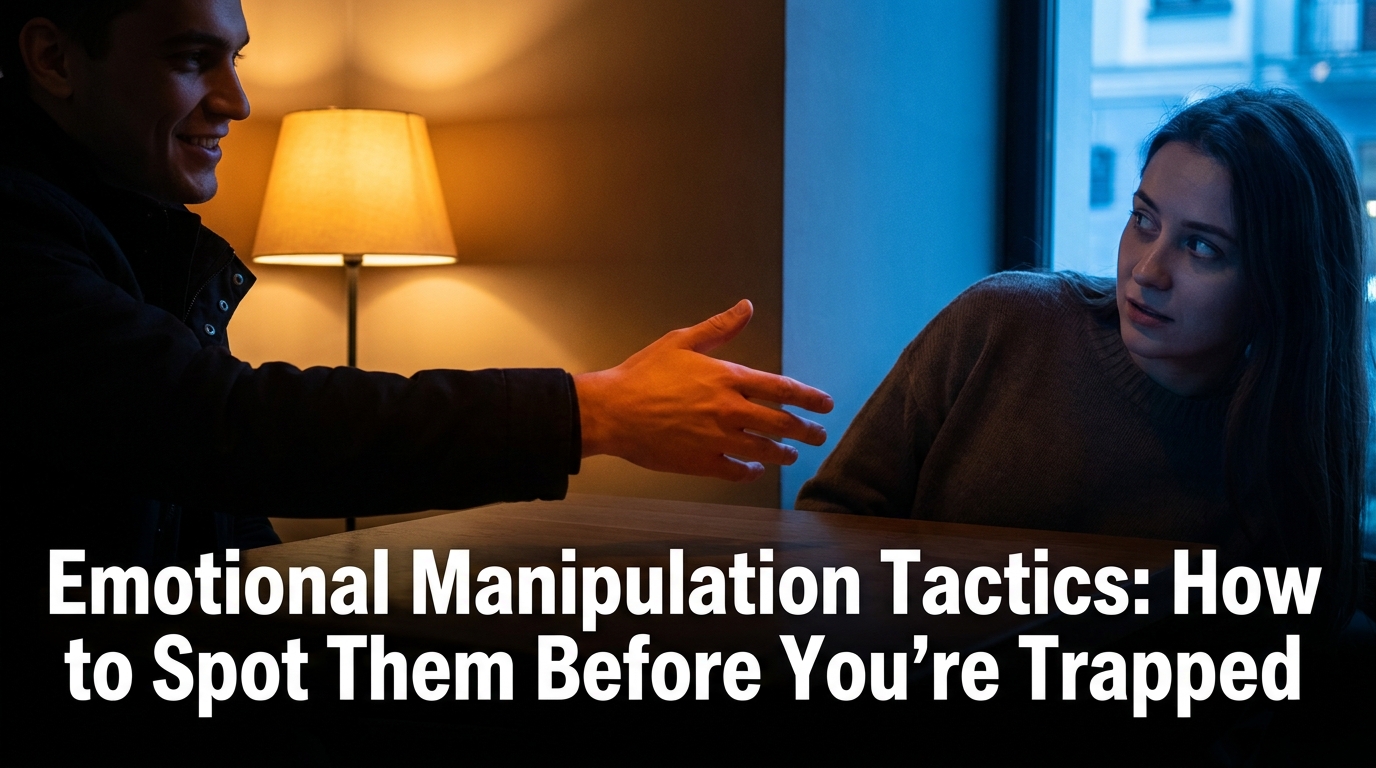
It rarely announces itself.
There is no moment where someone sits across from you and says: I am going to manipulate you. Instead it arrives wrapped in charm, in apparent care, in the language of love and concern.
By the time most people recognize emotional manipulation for what it is, they are already deep inside it — doubting themselves, managing someone else’s emotions, and struggling to remember who they were before the relationship began.
A 2019 study published in the Journal of Interpersonal Violence found that psychological manipulation is present in over 80% of reported abusive relationships — and is frequently more damaging to long-term mental health than physical abuse.
This article names the tactics clearly. Because you cannot protect yourself from something you cannot see.

What Is Emotional Manipulation?
Emotional manipulation is the use of indirect, deceptive, or coercive psychological tactics to control another person’s feelings, thoughts, or behavior — in service of the manipulator’s own needs, at the expense of the other person’s wellbeing.
It is distinct from healthy influence — the natural and legitimate way all humans affect each other through honest communication, shared values, and mutual care. The defining difference is intent and impact. Healthy influence respects the other person’s autonomy. Emotional manipulation undermines it.
Emotional manipulation exists on a spectrum. At one end, occasional manipulative behavior born of poor emotional regulation and learned patterns — behavior that, with awareness and willingness, can change. At the other end, deliberate, sustained psychological control that constitutes abuse.
Both ends of that spectrum cause harm. Both deserve to be named.
Emotional manipulators are not always conscious of what they are doing. Some manipulate instinctively — having learned these patterns in childhood as survival strategies. Others are fully aware and calculated. In either case, the impact on the person experiencing it is the same.
“Manipulation is the art of making you feel responsible for their behavior while making you feel guilty for noticing.” — Psychology Today
Why Emotional Manipulation Is So Hard to Detect
Several factors make emotional manipulation uniquely difficult to recognize — particularly in intimate relationships.
It is gradual. No one begins a relationship by openly manipulating. The tactics emerge slowly — one small incident, then another — each individually explainable, together forming a pattern that only becomes visible over time.
It is mixed with genuine warmth. Emotional manipulators are frequently charming, generous, and genuinely loving in intervals. The warmth is not always false. This inconsistency makes clear perception almost impossible — because every concerning behavior has a counter-example of genuine care.
It targets your best qualities. Empathy, loyalty, the desire to be fair, the reluctance to assume the worst — these are the qualities emotional manipulation most effectively exploits. Your goodness becomes the mechanism of your own entrapment.
It makes you the problem. The most sophisticated manipulation doesn’t just control your behavior. It convinces you that the problem is your perception, your sensitivity, your unreasonableness. By the time you are questioning your own sanity, the manipulation is working exactly as intended.

15 Emotional Manipulation Tactics to Recognize
1. Gaslighting
The most well-known manipulation tactic — and one of the most devastating. Gaslighting involves systematically denying, distorting, or reframing another person’s reality until they lose trust in their own perception and memory.
It sounds like: “That never happened.” “You’re imagining things.” “You always do this — you make everything into a drama.” “I’m worried about you, you seem to be losing your grip on reality.”
Each instance feels like a disagreement. The cumulative effect is the destruction of self-trust. When you can no longer rely on your own mind, you become dependent on theirs — which is precisely the point.
2. Love Bombing Followed by Withdrawal
An initial flood of affection, attention, and intensity — enough to create real attachment and dependency. Then, once that attachment is established, the warmth becomes conditional. Available when you comply. Withdrawn when you don’t.
The withdrawal is the mechanism of control. Having experienced the high of the love bombing, the absence of warmth is felt as a profound loss — and the manipulated person works to restore it, often by compromising their own needs and boundaries in the process.
3. The Silent Treatment
Silence deployed as punishment — not the healthy withdrawal of someone who needs time to self-regulate, but calculated, prolonged emotional withdrawal designed to produce anxiety, guilt, and submission.
The silent treatment is particularly effective because it is deniable — “I just needed space” — while being unmistakably felt as punishment by the person on the receiving end. It teaches a clear lesson: cross me, and you lose access to my warmth. The result is walking on eggshells.

4. Moving the Goalposts
No matter what you do, it is never quite enough. The standard shifts just as you reach it. The expectation changes just as you meet it. You work harder. They find a new deficiency.
This tactic keeps you in a permanent state of striving — always trying to earn something that is never actually available. It produces both exhaustion and a deepening sense of inadequacy. Over time, you internalize the message: I am fundamentally not enough.
The goalposts don’t move by accident. They move to keep you trying.
5. Emotional Blackmail
A direct or implied threat: if you do — or don’t do — this specific thing, there will be emotional consequences. For you, for them, for the relationship.
Emotional blackmail operates through four primary levers that therapist Susan Forward identified as FOG — Fear, Obligation, and Guilt. The manipulator may threaten to harm themselves, to end the relationship, to withdraw love, or simply to be deeply hurt — all contingent on your behavior.
“If you really loved me you would.” “After everything I’ve done for you.” “I don’t know what I’ll do if you leave.” These are not expressions of vulnerability. They are leverage.
6. Minimizing and Dismissing Your Feelings
Your feelings are consistently treated as excessive, irrational, or evidence of some personal deficiency. “You’re overreacting.” “You’re too emotional.” “Why do you always make everything so dramatic?”
This tactic trains you to suppress your emotional responses — to pre-edit your inner experience before expressing it, always measuring whether what you feel is “reasonable enough” to be permitted. Over time, you stop trusting your own feelings entirely.
Which means you stop trusting the most important warning system you have.

7. Projection
They accuse you of exactly what they are doing. The unfaithful partner who questions your loyalty. The dishonest person who calls you a liar. The manipulator who tells you that you are the one who manipulates.
Projection is both a defense mechanism and a manipulation tactic. It keeps the focus on your behavior rather than theirs. It keeps you defending yourself rather than examining them. And it creates enough confusion and self-doubt that the actual dynamic becomes genuinely difficult to see clearly.
8. Triangulation
Introducing a third party — real or implied — to create jealousy, insecurity, or competition. An ex who is mentioned a little too frequently. A colleague who is compared to you favorably. A vague reference to someone who “really understands” them in a way you apparently don’t.
Triangulation destabilizes your sense of security in the relationship and redirects your energy toward competing for their approval — rather than evaluating whether their behavior deserves your investment in the first place.
9. Playing the Victim
Every conflict becomes their suffering. Every concern you raise becomes evidence of how much they are hurt by you. Your needs become the source of their pain.
The role reversal is complete: you entered the conversation with a legitimate concern and left it managing their emotional reaction to being confronted. Your original issue was never addressed. And somehow, you are the one apologizing.
Playing the victim disarms accountability entirely — because how can you hold someone responsible when they are already the one who is suffering?

10. Intermittent Reinforcement
This is the mechanism that makes manipulation addictive.
Intermittent reinforcement — the unpredictable alternation of warmth and withdrawal, praise and criticism, closeness and coldness — creates one of the most powerful and most unhealthy emotional bonds known to behavioral psychology. It is the same principle that makes gambling addictive: the unpredictability of the reward makes the pursuit of it compulsive.
In a manipulative relationship, the moments of warmth — the apologies, the loving gestures, the glimpses of the person you fell for — become the reward that keeps you trying. The withdrawal is the punishment that keeps you anxious. Together, they create a bond that is extraordinarily difficult to break — even when you can clearly see that it is harming you.
11. Future Faking
Grand promises about the future — the life you’ll build together, the changes they’ll make, the relationship this could become — that never materialize.
Future faking keeps you invested in a potential that is always just out of reach. It gives you something to hold onto when the present is painful. And it makes leaving harder — because leaving means abandoning not just the relationship that exists, but the relationship that was promised.
The promises are rarely outright lies. They are genuine in the moment — and forgotten equally genuinely when the moment passes.
12. Using Your Vulnerabilities Against You
Things you shared in moments of trust — fears, insecurities, past traumas, private struggles — surface later as weapons. During conflict, your anxiety is used to discredit your concerns. Your past is used to preemptively invalidate your present. Your deepest vulnerabilities become the ammunition most reliably deployed against you.
This betrayal — of the intimacy in which those things were shared — is one of the most painful features of emotional manipulation. It turns the very act of being known into a liability.
13. Blame Shifting
Nothing is ever their responsibility. Every conflict, every mistake, every harmful behavior is ultimately your fault — or someone else’s, or the circumstances. The architecture of deflection is sophisticated and consistent.
Blame shifting keeps accountability permanently out of reach. It also keeps you in a posture of defense — always justifying, always explaining, always trying to demonstrate that what happened was not actually your fault. The energy spent on that defense is energy unavailable for clearly seeing what is actually happening.
14. Guilt Tripping
A sustained campaign of implied or explicit guilt designed to override your judgment and produce compliance.
“After everything I’ve done for you.” “I sacrifice so much and this is how you treat me.” “I just thought you cared about me.”
Guilt is a natural and healthy emotion — a signal that we have acted against our values. But manufactured guilt — guilt engineered not by genuine wrongdoing but by another person’s strategic expression of hurt — is a tool of control. Learning to distinguish between the two is one of the most important skills in protecting yourself from emotional manipulation.
15. Isolation
Gradual, often subtle separation from the people and resources that provide perspective, support, and the possibility of exit.
It begins as preference — they love your time together. Progresses to mild criticism of your support network — your friends don’t really have your best interests at heart. Becomes logistical — plans with others become complicated, guilty, more trouble than they’re worth.
By the time isolation is complete, you are dependent on the manipulator for your entire emotional reality — which is exactly where they need you to be.
What to Do When You Recognize These Patterns
Name it. The act of giving the pattern a name — even privately, in a journal — is the first step toward clarity. You cannot address what you cannot see.
Trust your body. Emotional manipulation produces physical symptoms — a knot in the stomach before certain conversations, tension in the chest after interactions, a persistent low-level anxiety that has no clear source. Your body often knows before your mind catches up.
Reconnect with your support network. Whoever has been pushed to the edges of your life — reach back. Their perspective, offered without agenda, is some of the most valuable information available to you right now.
Seek professional support. A therapist familiar with coercive control and emotional abuse can help you see the patterns clearly, rebuild self-trust, and develop a safety plan if needed.
Move carefully. Leaving a manipulative relationship requires strategy. The most dangerous moment in many controlling relationships is the exit. Organizations like the National Domestic Violence Hotline — 1-800-799-7233 — offer confidential support regardless of whether physical abuse has occurred.
The most radical act after emotional manipulation is this — to trust yourself again. Your feelings were real. Your perception was accurate. Your instincts were trying to protect you. Listen to them now.
💾 Save this — you may need it, or someone you love may need it more. 📤 Share it quietly with someone whose relationship has been worrying you. 👣 Follow Truthsinside.com for honest, psychology-backed content on red flags, toxic patterns, and healing.
Frequently Asked Questions
Q1: Is emotional manipulation always intentional? Not always. Some manipulative behavior is learned in childhood as a survival strategy — ways of getting needs met in an environment that didn’t respond to direct expression. These patterns can operate largely unconsciously in adulthood. Others are fully aware and deliberate. Whether intentional or not, the impact on the person experiencing it is the same — and the behavior causes the same harm. Intent matters for understanding origin. It does not mitigate impact.
Q2: Can an emotionally manipulative person change? Change is possible — but requires genuine self-awareness, consistent therapeutic work, and the sustained motivation to do things differently. The critical factor is whether the person can honestly acknowledge the pattern — not just during a conflict when they need to restore the relationship — but genuinely, with accountability. Manipulators who seek help only to manage consequences rather than from authentic desire for change rarely sustain meaningful behavioral shifts. Observable, consistent change over time — not promises — is the only reliable evidence.
Q3: How do I know if I am being manipulated or if I am just being too sensitive? This is one of the most painful questions to sit with — and one that emotional manipulation deliberately makes harder to answer. A useful framework: healthy relationships make you feel more like yourself over time — more confident, more secure, more clearly known. Manipulative relationships make you feel less like yourself — more uncertain, more anxious, more dependent on the other person’s perception of you.
If you consistently leave interactions doubting your own reality, if your self-trust has eroded significantly since the relationship began, if people who knew you before the relationship notice you have changed — these are not signs of excessive sensitivity. They are signs worth taking seriously.
Q4: What is the difference between manipulation and normal relationship conflict? Normal relationship conflict involves two people with different needs or perspectives trying to reach mutual understanding. Both people feel heard some of the time. Accountability is shared. Repair happens. Emotional manipulation involves a consistent pattern in which one person’s reality, needs, and feelings are systematically subordinated to the other’s — through tactics rather than through honest communication. The defining features are pattern, consistency, and the cumulative impact on one person’s self-trust and sense of self.
Q5: How do I heal after an emotionally manipulative relationship? The first priority is rebuilding self-trust — learning to believe your own perceptions again after they have been systematically undermined. Trauma-informed therapy is the most effective vehicle for this, particularly approaches like EMDR, IFS, and somatic therapy that work with the nervous system as well as the rational mind. Reconnecting with your support network, rebuilding a sense of identity outside the relationship, and allowing yourself to grieve what the relationship actually was rather than what it promised to be are all essential parts of the healing process. Recovery is real. It takes time. And it is entirely worth it.
🎵 Music
Maren Lull is a singer-songwriter who writes from the places most people don’t talk about out loud.
Not the dramatic grief. Not the obvious heartbreak. The quiet kind — the ordinary Tuesday emptiness, the habit of reaching for someone who isn’t there anymore, the particular exhaustion of being strong for so long that the strength itself wears thin.
Her music lives at the intersection of emotional honesty and soft beauty — breathy vocals over gentle piano, slow tempos, lyrics that feel less like songs and more like something you wrote in a private notebook at two in the morning and never showed anyone.
Maren Lull writes for the people who feel everything deeply and say very little about it. For the ones who listen to sad music not because they want to feel worse — but because being understood, even by a song, makes the feeling easier to carry.
📱 Follow Maren Lull:
→ Spotify
→ Apple Music
→ Youtube
→ Audiomack