
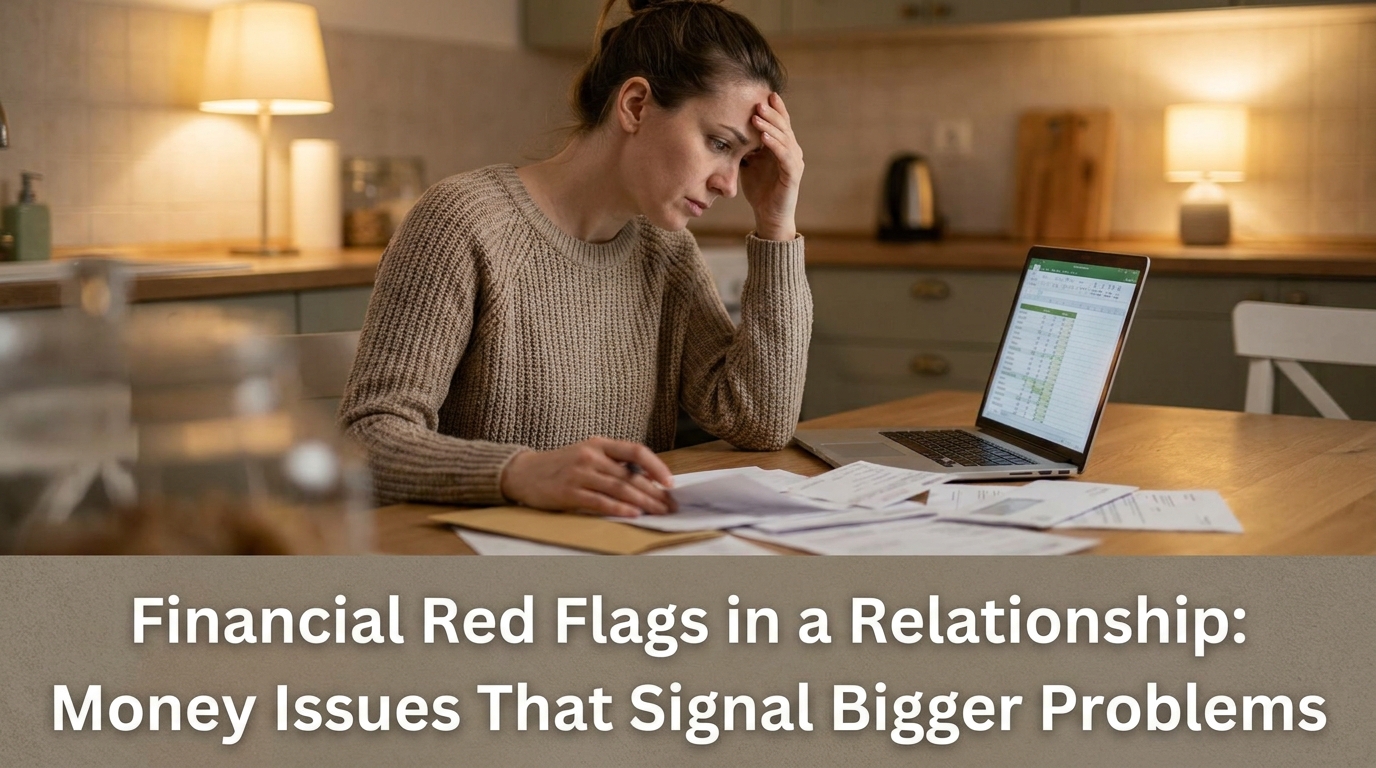
You didn’t fall in love with their bank account. You fell in love with them — their laugh, their mind, the way they make you feel seen. But somewhere between the early dates and the deeper commitment, money started to show up. In the unpaid bills they mentioned casually. In the way they reacted when you brought up finances. In the quiet tension that appears whenever the subject gets close. And now you’re wondering whether what you’re seeing is a personality quirk — or something that should genuinely concern you.
Money is one of the most consistent predictors of relationship outcomes. A landmark study from Kansas State University found that arguments about money are the top predictor of divorce — more than arguments about any other topic — because financial conflict almost never stays contained to finances. It reveals values, exposes character, and surfaces patterns of honesty, control, and responsibility that affect every corner of a shared life. Understanding the financial red flags in a relationship is not about being materialistic. It is about recognizing that how someone handles money tells you, with remarkable clarity, who they are — and what a future with them will require of you.

Why Money Is Never Just About Money
Before the specific red flags, this context is worth understanding: financial behavior in a relationship is almost never purely about finances.
How someone manages money reflects their relationship with responsibility, delayed gratification, honesty, and personal accountability. How someone communicates about money reveals their capacity for transparency, vulnerability, and genuine partnership. How someone uses money in a relationship — whether it becomes a tool for generosity, equality, or control — reflects the power dynamics they are consciously or unconsciously building.
This is why financial red flags in relationships are worth taking seriously even when finances themselves feel like a minor concern. The behavior is rarely just about the money. It is about what the money is revealing.
The Financial Red Flags in a Relationship
1. Complete Secrecy About Their Financial Situation
Everyone deserves privacy, and nobody is obligated to share every financial detail in casual dating. But as a relationship deepens toward genuine commitment, a partner who remains completely opaque about their financial situation — deflecting questions, refusing to discuss basics, reacting with defensiveness or anger when money is mentioned — is withholding information that matters to a shared future.
Financial secrecy in a committed relationship is not privacy. It is concealment. And what is being concealed — debt, financial instability, a history of irresponsibility, or simply a profound discomfort with financial honesty — is worth understanding before the two of you share a life.
2. Significant Hidden Debt
Discovering after a serious commitment that a partner has substantial debt they never disclosed — student loans, credit card balances, personal loans, back taxes — is a financial red flag that is really about honesty. The debt itself may be manageable. The decision to conceal it is not.
In a relationship moving toward a shared financial life, undisclosed debt becomes shared debt in practical terms — affecting joint credit, purchasing power, and the financial decisions available to both people. More importantly, a partner who hid significant debt from you has demonstrated a willingness to let you make major life decisions without the information you needed to make them wisely.
3. They Spend Impulsively and Defensively
They make large purchases without discussion. They react to any financial conversation with irritation or dismissal. When you raise a concern about spending, it becomes a conflict about your values rather than a conversation about shared priorities. Impulsive spending combined with defensiveness about it creates a pattern that makes genuine financial partnership almost impossible — because partnership requires both honesty about behavior and openness to adjusting it.

4. They Expect You to Cover Everything — Consistently
Generosity in a relationship is beautiful. Occasionally covering more when your partner is going through a lean period is a normal expression of care. But a sustained pattern — where one person consistently pays for dates, trips, shared expenses, and daily costs while the other contributes nothing and expects everything — is a financial red flag that signals something beyond financial difficulty.
It signals an absence of reciprocity. And as discussed throughout this series, relationships without reciprocity — including financial reciprocity — are relationships where one person’s needs consistently take precedence over the other’s. This pattern, sustained without honest conversation and genuine effort to rebalance, rarely stays confined to finances.
5. They Have No Financial Goals or Future Orientation
They live entirely for now. Every paycheck spent immediately. No savings, no retirement consideration, no thought given to a future that requires any financial planning. In a casual relationship, this might be a lifestyle difference. In a relationship moving toward a shared life — a home, potential children, retirement — a partner with no financial future orientation creates an enormous practical incompatibility that compounds over time.
This is not about judging someone for financial struggle. It is about recognizing the difference between someone who is working toward stability and someone who is structurally disinterested in building it. One requires patience and support. The other requires honest assessment of whether your financial futures can actually be shared.
6. Financial Dishonesty — Small or Large
They understate how much something cost. They describe a financial situation differently to you than it actually is. They hide purchases. They tell small financial lies that feel harmless until you realize they are part of a pattern. Financial dishonesty — at any scale — is a relationship red flag that is fundamentally about honesty rather than finances. A person who is dishonest about money is a person who has decided that managing your perception matters more than telling you the truth. That decision does not stay contained to money.
7. They Refuse to Discuss Finances at All
Any attempt to have a financial conversation — about splitting expenses, planning a shared purchase, discussing financial goals — is shut down, dismissed, or avoided entirely. This avoidance may stem from shame, from past financial trauma, or from a fundamental incompatibility with financial transparency. But regardless of its origin, a partner who cannot or will not engage in financial conversation makes genuine partnership structurally impossible. Shared lives require financial communication. A partner who refuses it is refusing a fundamental dimension of what partnership means.

8. Using Money as Control
They manage all finances and limit your access to shared money. They require you to justify purchases. They use financial generosity as a reward for compliance and financial restriction as a punishment for non-compliance. They have created, gradually or deliberately, a situation in which your financial independence is constrained by their oversight.
Financial control is one of the most recognized forms of coercive control in relationships — and one of the most practically effective, because financial dependency directly restricts the freedom to leave. If you recognize this pattern in your relationship, it deserves to be named clearly and addressed with support — not minimized as a financial difference or a practical arrangement.
9. Dramatically Different Financial Values
You save carefully; they spend freely. You believe in financial transparency in a partnership; they believe their money is entirely their own business. You are building toward a specific future; they are unconcerned with any future beyond the immediate. Dramatically different financial values are not always red flags in isolation — but in a relationship moving toward genuine commitment, they represent a fundamental compatibility question that doesn’t resolve on its own. Values about money are values about life priorities. And two people with profoundly incompatible life priorities face a structural challenge that goodwill alone cannot bridge.
10. They Have Burned Financial Bridges
They owe money to family members who no longer speak to them because of it. Former friends have cut ties over financial disputes. Previous partners left partly because of financial irresponsibility. A pattern of damaged relationships specifically tied to financial behavior is significant — not because people cannot change, but because a pattern across multiple relationships and multiple people is the most reliable indicator of how someone consistently behaves when financial accountability is required of them.

11. Financial Generosity That Feels Like Manipulation
This one surprises people — because generosity reads as positive. But financial generosity that comes with strings — gifts that arrive before difficult conversations, expensive gestures that follow conflict, financial treatment that creates obligation or guilt — is a form of emotional manipulation. True generosity is offered freely. Generosity deployed strategically to manage your emotions, create indebtedness, or make leaving feel financially complicated is something else entirely.
12. They Involve You in Financial Risk Without Full Disclosure
They ask you to co-sign a loan without fully disclosing their credit history. They propose a joint financial venture without transparent information about the risks. They suggest combining finances before you have a complete picture of what you’d be combining with. Financial risk that is shared without full disclosure is not a partnership decision — it is a decision made for you, without the information you would need to make it wisely. This pattern, wherever it appears, reflects a fundamental disregard for your financial autonomy and informed consent.
What to Do When You Recognize These Signs
Start with a direct, calm conversation. Choose a quiet moment — not mid-conflict — and approach the topic from genuine curiosity rather than accusation. “I’d like us to be more open about finances as we get more serious” opens a conversation. The quality of their response — their honesty, their openness, their willingness to engage — is itself important information.
Distinguish between struggle and pattern. Financial difficulty is not a red flag. Financial irresponsibility, dishonesty, or control is. Give your partner the benefit of genuine context — and then pay attention to whether the behavior reflects circumstances or character.
Protect your own financial independence. Regardless of where the relationship goes, maintaining your own financial accounts, your own credit history, and your own financial literacy is not a lack of trust. It is a foundation of self-respect that serves you in any outcome.
Seek advice if control is involved. If financial control is present — restricted access to money, required justifications for spending, financial punishment or reward tied to compliance — this is not a financial issue. It is a relationship safety issue, and it deserves support from a counselor, a domestic violence resource, or a trusted professional.
Be honest about compatibility. Some financial differences are workable with communication and goodwill. Others reflect values incompatibilities that communication alone cannot resolve. Being honest about which you are facing — early, before a shared financial life makes the assessment more complicated — is one of the most important things you can do for your own future.

The Bottom Line
Financial red flags in a relationship are never just about money. They are about honesty, control, compatibility, and the fundamental question of whether two people can build a genuine partnership — one where both people are seen, respected, and financially safe.
You do not need to be wealthy, financially perfect, or free of financial struggle to be a good partner. You need to be honest, willing to engage, and genuinely invested in the financial wellbeing of the relationship — not just your own. When those qualities are absent, what you have is not a financial problem. It is a relationship problem that happens to be expressed through money.
How someone handles money tells you who they are when the stakes are real. Pay attention — not to their bank balance, but to their honesty, their accountability, and their willingness to build something with you rather than just alongside you.
📌 Save, Share & Follow
💾 SAVE this article — return to it when something about money in your relationship doesn’t quite add up. 📤 SHARE this with someone who needs to hear that financial red flags are never just about finances. 👉 FOLLOW TruthsInside.com for more honest, psychology-backed relationship content that protects what matters most.
❓ Frequently Asked Questions
Q1: Is it a red flag if my partner has debt? Debt alone is not a red flag — it is a financial reality for a significant portion of adults. What matters is how your partner handles and communicates about that debt. A partner who is honest about their debt, actively managing it, and open to discussing how it affects shared financial planning is demonstrating exactly the qualities a financial partnership requires. A partner who conceals debt, ignores it, or becomes defensive when it’s raised is demonstrating something very different.
Q2: When should finances be discussed in a relationship? There is no universal timeline, but as a general principle: before any significant shared financial commitment — moving in together, joint purchases, meeting each other’s families regularly — both people should have a reasonably clear picture of each other’s financial situation, values, and goals. The conversation doesn’t need to be exhaustive in early dating, but it should become progressively more honest as commitment deepens.
Q3: What if we just have different spending styles — is that a red flag? Different spending styles are common and workable — provided both people are willing to discuss them honestly and find a shared approach that respects both partners. The red flag is not the difference itself but the refusal to acknowledge, discuss, or adjust to the reality of a shared financial life. Flexibility and honest communication can bridge most spending style differences. Rigidity and defensiveness cannot.
Q4: How do I bring up financial concerns without seeming materialistic? Frame the conversation around shared goals and partnership rather than judgment of their financial behavior. “I want us to be on the same page financially as we get more serious — can we talk about that?” positions the conversation as a relationship investment rather than a critique. Approaching it with genuine curiosity and without accusation gives the conversation the best possible chance of being received well.
Q5: Is financial control always intentional? Not always. Some financial control dynamics develop from anxiety, past experiences with financial instability, or deeply conditioned beliefs about money and gender roles rather than deliberate manipulation. But regardless of intent, the impact — restricted financial autonomy, dependency, and limited freedom — is the same. Intent matters for understanding the dynamic. It does not change what the dynamic requires from you in response.
🎵 Music
Maren Lull is a singer-songwriter who writes from the places most people don’t talk about out loud.
Not the dramatic grief. Not the obvious heartbreak. The quiet kind — the ordinary Tuesday emptiness, the habit of reaching for someone who isn’t there anymore, the particular exhaustion of being strong for so long that the strength itself wears thin.
Her music lives at the intersection of emotional honesty and soft beauty — breathy vocals over gentle piano, slow tempos, lyrics that feel less like songs and more like something you wrote in a private notebook at two in the morning and never showed anyone.
Maren Lull writes for the people who feel everything deeply and say very little about it. For the ones who listen to sad music not because they want to feel worse — but because being understood, even by a song, makes the feeling easier to carry.
📱 Follow Maren Lull:
→ Spotify
→ Apple Music
→ Youtube
→ Audiomack