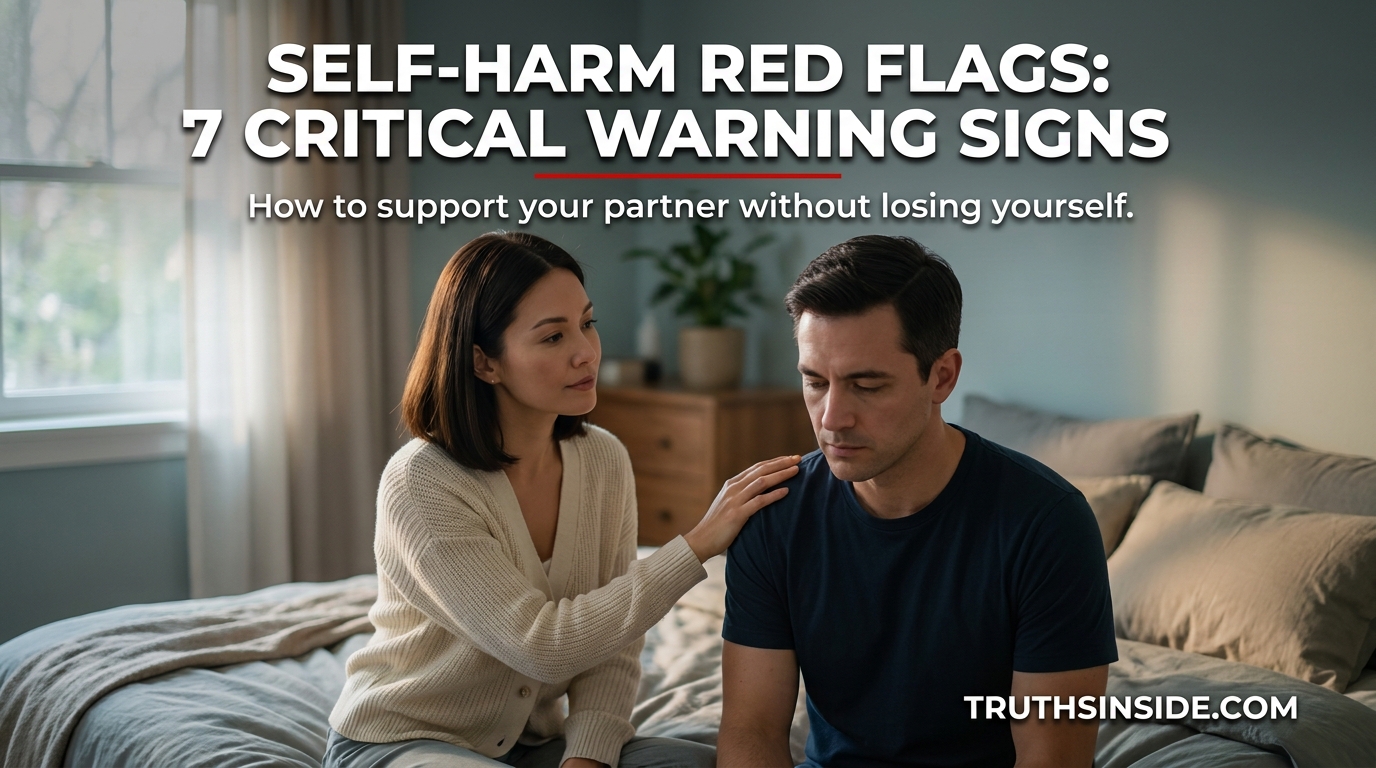
Self-Harm Red Flags in a Partner: How to Support Without Enabling
Noticing self-harm red flags in someone you love can leave you frozen between fear and uncertainty. You may see changes that do not add up, hear things that worry you, or sense that your partner is carrying pain they are not ready to say out loud. You want to help, but you also fear saying the wrong thing, making it worse, or losing yourself in the process.
You are not imagining how common this is. A large research review by Swannell and colleagues estimated that about 5.5 percent of adults, 13 percent of young adults, and 17 percent of adolescents report self-injury at some point in their lives. That means many couples face this quietly, often with shame and secrecy. Awareness is the first step toward safety, and it is one of the most loving things you can offer.
This guide explains the self-harm red flags to watch for, what they may and may not mean, and how to support your partner without enabling harmful patterns. You will learn how to start a caring conversation, how to set boundaries, and how to protect your own wellbeing. If anyone is in immediate danger, call 911 or your local emergency number. In the United States, you can also call or text 988 at any time.

What Self-Harm Is, and What It Is Not
Self-harm means deliberately hurting yourself, usually as a way to cope with overwhelming emotions such as shame, numbness, anger, or despair. Professionals often call the most common form non-suicidal self-injury. It is not the same as a suicide attempt, but it is still serious, and research links it with a higher risk of suicidal thoughts later on. That is why spotting self-harm red flags early matters so much.
Self-harm is also widely misunderstood. It is rarely about attention or manipulation. Most people who hurt themselves hide it carefully because of shame, and many feel trapped between wanting relief and wanting to stop. Understanding this helps you respond with compassion instead of anger or disgust, which can push your partner deeper into secrecy.
This article avoids graphic detail on purpose. You do not need to know how someone might hurt themselves to help them. You need to know how to notice distress, how to talk about it kindly, and how to connect them with professionals. Your role is to be a safe, steady presence, not a rescuer or a detective.
📃 Related article: Limits With In-Laws: 7 Proven Steps for Peace
Why Self-Harm Red Flags Are Easy to Miss
Many people go to great lengths to hide what they are going through. Your partner may be funny, productive, and affectionate in public while struggling privately. Fear of being judged, hospitalized, or abandoned can keep the truth buried for months or years. As a result, self-harm red flags often look like small, scattered oddities rather than a clear picture, and you may talk yourself out of what you notice. Look at changes over time, not isolated moments.
7 Self-Harm Red Flags in a Partner You Should Not Ignore
No single sign proves that someone is hurting themselves, and each can have other explanations. Treat these self-harm red flags as reasons to check in with love, not as evidence to confront.
1. Frequent Unexplained Injuries or Scars
Repeated injuries with vague or changing explanations are among the clearest self-harm red flags. You may notice marks that your partner covers quickly, awkward excuses, or discomfort when you notice them. Avoid interrogating or inspecting. A calm “I noticed something, and I care about you” opens a door without forcing them through it.
Clothing can offer clues too, such as long sleeves in very warm weather, or avoiding situations where the body is visible. Again, there can be innocent reasons. The pattern and the secrecy are what matter.
2. Intense Emotional Swings and Overwhelm
Many people who self-harm struggle with strong emotions they do not know how to handle. You might see sudden crying, sharp anger, long stretches of numbness, or guilt that seems bigger than the situation. Watch for emotional intensity that keeps repeating without a way to settle.
Everyone has hard days. The concern is when overwhelm becomes the pattern and your partner cannot recover without great distress. Therapists often explore this among the self-harm red flags, because difficulty managing emotions is commonly linked with self-injury.
3. Withdrawal and Isolation
Pulling away from friends, hobbies, intimacy, and plans is a common warning sign. Your partner may cancel often, stay in their room, or seem present but unreachable, saying they are fine while their behavior says otherwise.
Isolation can be an attempt to hide what is happening or to avoid burdening others. Gentle, steady contact helps more than pressure. Invite them to simple, low-demand activities, like a short walk, and let them know you are glad they are in your life.
4. Talk of Hopelessness, Self-Hatred, or Being a Burden
Listen closely to how your partner speaks about themselves. Repeated comments like “I hate myself,” “I deserve this,” “I am just a burden,” or “Nothing will ever change” are serious. They may be said casually or as a joke, which can hide real pain. Never dismiss them as drama.
If your partner ever talks about wanting to die or not wanting to be here, treat it as an emergency and follow the steps in the safety section below. Asking directly about suicide does not plant the idea. Crisis experts agree that a caring, direct question can bring relief and open the way to help.

5. Secrecy, Shame, and Long Periods Alone
Everyone needs privacy, but a sudden increase in secrecy deserves attention. You may notice that your partner avoids being seen without clothing, spends unusually long stretches alone behind closed doors, or becomes anxious when you enter a room unexpectedly.
Resist the urge to search their things. Secret investigating usually damages trust and may increase shame. Instead, name what you see with kindness: “I have noticed you seem to be carrying something heavy. I am here, and there is no judgment.”
6. Sudden Changes in Sleep, Eating, or Substance Use
Self-harm rarely appears alone. It often travels with disrupted sleep, major changes in appetite, or increased drinking or drug use as ways to numb feelings. Your partner may seem exhausted, restless, or detached, and everyday tasks may become difficult.
These changes may also point to depression, anxiety, trauma, or other health concerns that deserve professional support. You do not have to figure out the cause. You only need to notice that something has shifted and encourage a conversation with a doctor or therapist.
7. Threats of Self-Harm Used to Control Your Choices
This is the most complicated of the self-harm red flags. Some people say things like “If you leave, I will hurt myself” out of genuine panic and pain. Others, intentionally or not, use that fear to control a partner’s decisions. Either way, the statement must be taken seriously, and it must not become the thing that runs your life.
If your partner makes such a threat, stay calm, take it seriously, and connect them with crisis support such as 988, or emergency services if there is immediate danger. You can care deeply and still refuse to be controlled. If threats appear whenever you set a boundary, speak with a counselor about the pattern. Your safety and wellbeing matter too.
You can take someone’s pain seriously without letting it become your prison.
Emergency Warning Signs: When to Act Immediately
Some self-harm red flags mean the situation may be urgent. These include talking about wanting to die or ending their life, saying goodbye in unusual ways, giving away important belongings, expressing a plan, or suddenly seeming strangely peaceful after a long period of despair. Any of these calls for immediate action.
If you believe your partner is in immediate danger, do not leave them alone. Call 911 or your local emergency number, or call or text 988 in the United States. If you can do so safely, help reduce access to anything they could use to harm themselves, such as medications or firearms. Stay calm, speak gently, and let professionals take over. Acting is not a betrayal. It is protection.
📃 Related article: They Will Never Change: 9 Painful Red Flags
How to Talk to Your Partner About Self-Harm Red Flags
Starting this conversation is frightening, but it matters. Choose a private, calm moment when neither of you is rushed or angry. Sitting beside your partner rather than across from them can feel gentler. Begin with care, not accusation.
Start with what you have noticed and how you feel. “I have noticed you seem really down lately, and I am worried because I love you.”
Ask directly and kindly. “Are you hurting yourself?” or “Have you had thoughts of ending your life?” Direct questions show that you can handle the answer.
Listen without fixing or judging. Let them talk. Resist the urge to lecture, show shock, or promise quick solutions.
Thank them for trusting you. “Thank you for telling me. I am glad I know.”
Do not promise secrecy. “I will keep you safe, and that may mean involving people who can help. I will tell you first whenever I can.”
Offer to help find support. “Would you like me to help you find a therapist, or go with you?”
If your partner denies everything but the signs remain, do not force it. Say, “I believe you, and if anything changes, I am here.” Then keep showing up. Many people need several conversations before they feel safe enough to open up.
What Real Support Looks Like
Real support, once you have spotted self-harm red flags, is steady, patient, and aimed at connecting your partner with professional help. Therapies such as dialectical behavior therapy, known as DBT, have good evidence for helping people manage intense emotions and reduce self-harm. A doctor or licensed therapist can assess needs, treat underlying conditions, and build a safety plan. Offer to help find providers, make calls, or attend the first appointment.
Between sessions, be consistent. Check in regularly, listen without lecturing, and notice progress, even small progress. A safety plan is a written list of warning signs, healthy supports, trusted people, and crisis numbers. Leave specific coping techniques to your partner’s treatment team, since the right tools vary by person. Recovery is rarely a straight line, and a setback does not mean failure.
Supporting vs. Enabling: Where the Line Is
Supporting means caring for your partner while encouraging safety, treatment, and responsibility. Enabling means protecting the problem, often with good intentions. It can look like covering up, avoiding every hard topic to keep the peace, or accepting threats as the rule in the relationship. Here is how they differ:
| Supporting | Enabling |
|---|---|
| Encouraging professional treatment | Insisting you can fix everything alone |
| Naming concerns kindly and clearly | Staying silent to avoid conflict |
| Calling for help when safety is at risk | Promising to keep dangerous secrets |
| Keeping your own boundaries | Giving up your friends, sleep, and needs |
| Letting your partner own their recovery | Making excuses or hiding the problem |
| Responding to threats with care and crisis support | Letting threats decide your choices |
Enabling is rarely about weakness. It usually comes from love, fear, and the wish to prevent pain. But over time, it can leave both people stuck. Your partner may not get the help they need, and you may become exhausted, resentful, or afraid. The goal is not to withdraw love. It is to love in a way that keeps everyone safer.
Setting Healthy Boundaries When You See Self-Harm Red Flags
Boundaries do not abandon your partner. They make support sustainable. You might say, “I care about you, and I cannot be your only support. I want us to find a professional who can help.” Or, “If I think you are in danger, I will call for help, even if you are angry with me.” Clear statements like these protect both of you.
Decide in advance what you can and cannot offer. Perhaps you can listen for an hour in the evening but not at 3 a.m. every night. Perhaps you can attend appointments but cannot monitor your partner constantly. Say so kindly, and point to other supports. You are one part of the safety net, not the entire net.
If your partner reacts with anger or guilt when you set limits, stay calm and repeat the boundary. Seek guidance from a therapist, especially if pressure appears whenever you assert your needs. Healthy love leaves room for both people.
Taking Care of Yourself While You Support Someone
Supporting a partner after you notice self-harm red flags can be draining. You may feel anxious, helpless, guilty, angry, or numb. These reactions are normal. Many people in your position stop sleeping well, drop their own friendships, or feel that every moment of peace is temporary.
Protect your wellbeing. Keep your routines, see friends, and make time to rest. Consider your own therapist, or a family support group such as those offered by the National Alliance on Mental Illness (NAMI). Remember that you did not cause your partner’s pain, you cannot control it, and you cannot cure it. You can offer support and invite them toward help. If you ever feel overwhelmed, reach out for help yourself.
Mistakes to Avoid When You Notice Self-Harm Red Flags
Shaming or punishing. Anger and disgust increase secrecy and make it harder for your partner to seek help.
Demanding they stop immediately. Change takes support and time. Ultimatums often backfire.
Hovering or secretly investigating. Constant monitoring erodes trust and drains you.
Promising secrecy. If safety is at risk, you may need to involve others. Be honest about that from the start.
Minimizing. Saying “It is just a phase” or “Just think positive” can make your partner feel unseen.
Becoming the only support. No one person can carry this alone. Encourage professional and community help.

Where to Get Help
If you or someone you love needs support after noticing self-harm red flags, these services are free and confidential in the United States:
- 988 Suicide & Crisis Lifeline: call or text 988, or chat at 988lifeline.org, 24 hours a day.
- Crisis Text Line: text HOME to 741741.
- Emergency: call 911 if someone is in immediate danger.
- SAMHSA National Helpline: 1-800-662-4357 for treatment referrals.
- NAMI HelpLine: 1-800-950-6264 for information and support.
- Outside the United States: findahelpline.com lists services by country, or contact your local emergency number.
Frequently Asked Questions About Self-Harm Red Flags
What are the most common self-harm red flags?
Common self-harm red flags include unexplained injuries, emotional overwhelm, withdrawal, hopeless or self-critical talk, secrecy, changes in sleep or substance use, and threats used to control choices. No single sign proves anything, so look for patterns over time.
Is self-harm the same as a suicide attempt?
Not usually. Self-harm is often a way of coping with painful emotions rather than an attempt to end life. Still, it is serious and linked with higher suicide risk over time, so every instance deserves care and professional attention.
What if my partner asks me to keep it secret?
Be honest: you cannot promise secrecy if their safety is at risk. You can promise to be caring, to tell them first when possible, and to involve only people who can help. Safety must come before secrecy.
Can I make my partner stop?
No. You cannot control another person’s choices, and trying often increases shame and conflict. You can listen, encourage treatment, and set healthy boundaries. Lasting change usually needs professional support and your partner’s own motivation.
What if my partner threatens to hurt themselves if I leave?
Take it seriously and respond with care: encourage them to contact 988 or emergency services if there is immediate danger. You are not responsible for another person’s choices, and you can still make decisions that keep you safe. A counselor can help you plan next steps.
Final Thoughts
Noticing self-harm red flags in someone you love takes courage. You do not have to be an expert, and you do not have to carry this alone. Listen with compassion, ask with care, connect your partner to professional help, and keep your own boundaries and wellbeing strong. Support and safety can exist together, and healing is possible with the right help.
💾 Save this guide so you can find the resources when you need them.
📤 Share it with someone who may be worried about a partner.
➕ Follow Truthsinside.com for more honest relationship and psychology insights every week.
🎵 Music
Maren Lull is a singer-songwriter who writes from the places most people don’t talk about out loud.
Not the dramatic grief. Not the obvious heartbreak. The quiet kind — the ordinary Tuesday emptiness, the habit of reaching for someone who isn’t there anymore, the particular exhaustion of being strong for so long that the strength itself wears thin.
Her music lives at the intersection of emotional honesty and soft beauty — breathy vocals over gentle piano, slow tempos, lyrics that feel less like songs and more like something you wrote in a private notebook at two in the morning and never showed anyone.
Maren Lull writes for the people who feel everything deeply and say very little about it. For the ones who listen to sad music not because they want to feel worse — but because being understood, even by a song, makes the feeling easier to carry.
📱 Follow Maren Lull:
→ Spotify
→ Apple Music
→ Youtube
→ Audiomack