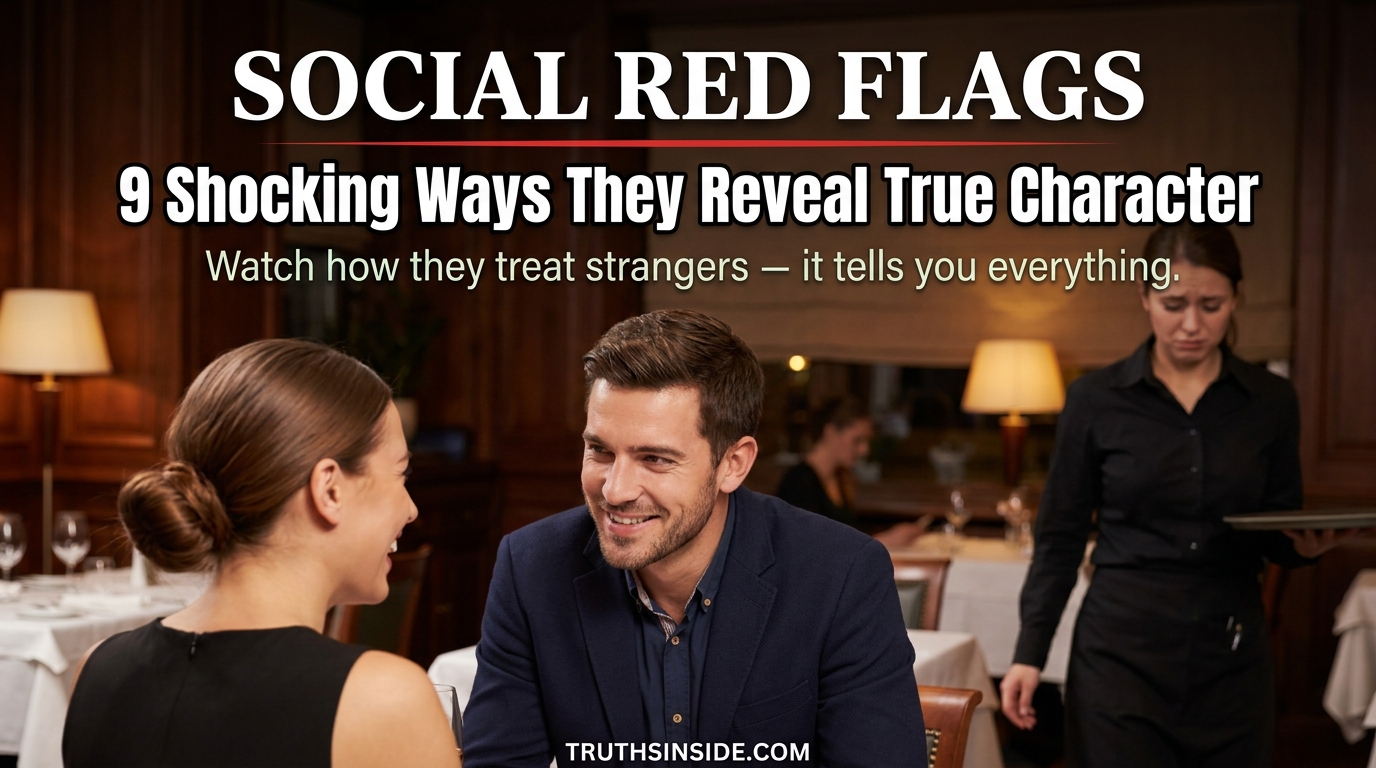
There is a moment most people can look back on and recognize — a small, quiet moment that happened early in a relationship, before everything unraveled, where someone showed them exactly who they were. Not to them. To someone else. A server at a restaurant. A coworker on the phone. A family member at dinner. And in that moment, something flickered — a small internal alarm that whispered pay attention. But because that person was so warm, so charming, so wonderful to you, you told that alarm to quiet down.
You rationalized it away. You gave the benefit of the doubt. If this sounds painfully familiar, research suggests you are far from alone. A 2019 study published in the Journal of Research in Personality found that how individuals treat people of lower social status is one of the strongest behavioral indicators of core character traits — including narcissism, empathy deficits, and long-term relationship toxicity.
Social red flags are not the dramatic, obvious warning signs that everyone talks about. They are the subtle behavioral patterns that reveal who someone truly is when they believe their reputation is not on the line — when they are interacting with people they think don’t matter, or when they think no one important is watching. These are the moments that strip away the performance and expose the person beneath the charm. And they are almost always visible early in a relationship, long before the damage is done — if you know what to look for.
The human brain is extraordinarily good at detecting inconsistency. When someone’s behavior toward you doesn’t match their behavior toward the world around them, something deep in your nervous system registers that gap. Psychologists call this cognitive dissonance — the discomfort of holding two contradictory pieces of information simultaneously. That discomfort is not a sign of insecurity or paranoia. It is your brain doing its job. This article is about learning to trust that signal — and understanding exactly what these social red flags mean, why they matter so profoundly, and what they are telling you about the person you’re considering building your life with.
Why How Someone Treats Others Is the Most Honest Data You Have
Before diving into the specific social red flags to watch for, it is worth understanding why this particular category of behavior is so revealing — because most people underestimate it entirely.
When someone is interested in you — romantically, professionally, socially — they are motivated to present the best version of themselves to you. They are conscious, intentional, and often strategic about how they come across. This is normal human behavior. We all put our best foot forward in situations that matter to us. But here is the critical insight: that same level of intentionality does not extend to people they perceive as unimportant, powerless, or irrelevant to their goals.
The way someone treats a waiter, a parking attendant, a janitor, a customer service representative — people who have no social leverage over them — is behavior that is largely unfiltered. It is automatic. It reflects deeply conditioned attitudes about other people’s worth, dignity, and humanity. And those attitudes, once revealed, are extraordinarily difficult to hide indefinitely — especially as a relationship deepens and the performance of early courtship fades.
Psychologist and researcher Dr. Robert Hogan has argued extensively that the truest measure of character is not how someone behaves when they are being observed and evaluated, but how they behave when they believe the stakes are low. Social red flags are essentially windows into that unguarded version of a person — and what you see through those windows is far more predictive of your future together than anything they tell you about themselves directly.
Social Red Flag #1 — Rudeness or Contempt Toward Service Workers
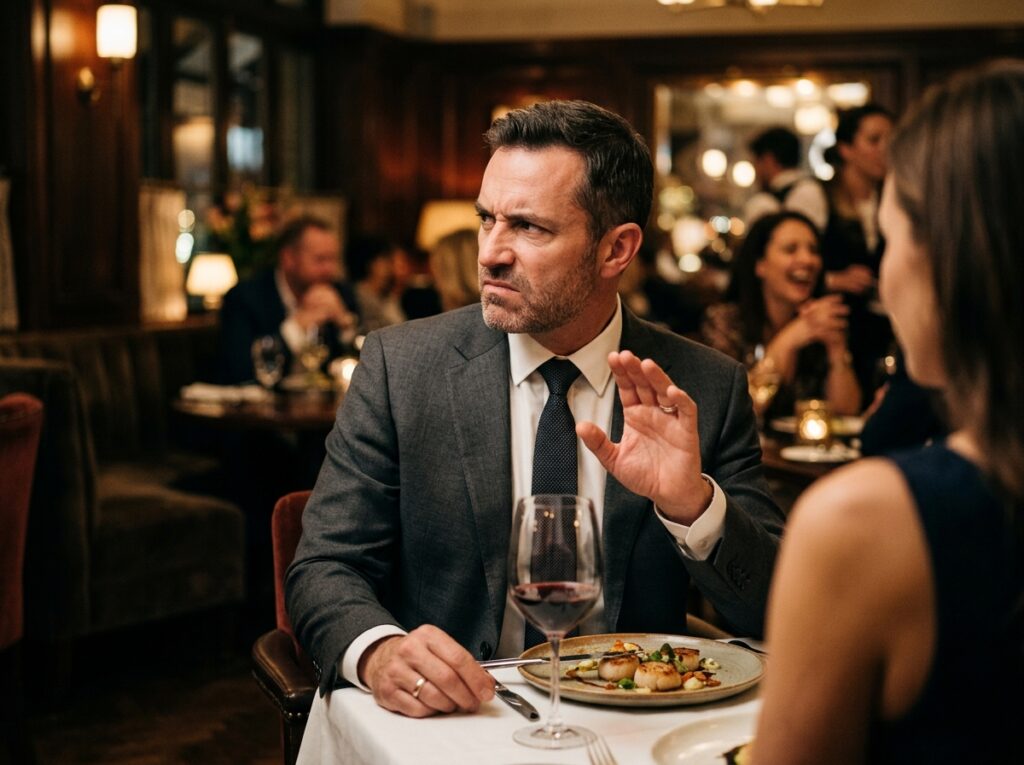
This is the most classically cited social red flag — and it remains at the top of the list for good reason. How someone treats people in service roles, particularly when those interactions involve minor inconveniences, mistakes, or waiting, is one of the clearest character tests available in everyday social life.
A person who speaks condescendingly to a server, snaps at a barista over a wrong order, or treats a hotel employee with visible contempt is revealing several things simultaneously: a sense of entitlement, a lack of empathy, an inability to regulate frustration, and a belief — whether conscious or not — that certain people are beneath them and therefore do not deserve basic human dignity.
These are not isolated incidents of a bad day. Research from the University of Florida found that people who are consistently rude to service workers score significantly higher on measures of narcissism and significantly lower on measures of agreeableness and emotional empathy. The pattern is stable across contexts and time. If they treat the waiter this way today, that same contempt will eventually find its way toward you — the moment you are no longer in the category of people they feel they need to impress.
Pay attention not just to what they say, but to the tone. The sigh of visible irritation. The clipped, dismissive response. The eye roll. The failure to say thank you. These micro-behaviors are social red flags that speak volumes about the person sitting across from you.
Related article: 15 Signs She Is Testing You: Why Women Test Men and What to Do
Social Red Flag #2 — The Way They Talk About People Who Aren’t in the Room
Listen carefully to how someone speaks about others when those people are not present. This is one of the most revealing and consistently overlooked social red flags in the early stages of getting to know someone.
Do they mock their friends behind their backs while smiling to their faces? Do they speak about their ex-partners with cruelty, contempt, or a complete absence of accountability? Do they gossip maliciously, share private information about others carelessly, or casually tear people down in conversation? Do they speak about family members with dismissiveness or derision?
The psychological principle at work here is simple but profound: the way someone talks about absent people tells you exactly how they will talk about you the moment you become an absent person. If they are capable of contempt, mockery, and betrayal of confidence toward the people they claim to care about — you are not exempt from that same treatment. You are simply not on the receiving end of it yet.
This red flag also reveals something important about how someone processes negative emotions. A person with healthy emotional maturity is capable of being hurt, frustrated, or disappointed by others without needing to destroy their reputation or character in private conversations. The compulsive need to villainize, mock, or diminish others — particularly exes or former friends — is a significant indicator of unprocessed emotional wounds and a lack of personal accountability.
Social Red Flag #3 — Zero Long-Term Friendships
This one requires careful, nuanced attention — because there are legitimate life circumstances that can result in someone not having a large social circle. Introverts exist. People move across the country. Life gets busy. But there is a meaningful difference between someone who has a small number of deep, stable, long-term friendships and someone who has no lasting relationships of any depth whatsoever.
If someone is in their 30s or beyond and cannot point to a single friendship that has lasted more than a year or two — if there is a consistent pattern of relationships that start intensely and end dramatically — that is a social red flag worth examining carefully.
Long-term friendships require compromise, conflict resolution, tolerance of imperfection, and the ability to repair after disagreement. They require emotional reciprocity — the capacity to give and receive. If someone has never been able to maintain that kind of sustained connection with anyone, it raises an important question: is the pattern in the people they’ve known, or is the pattern in them?
Ask gentle but honest questions. Who are your closest friends? How long have you known them? What happened with that friend you mentioned? Listen not just to the answers, but to the narrative. If every story about a ended relationship casts them as the blameless victim and everyone else as the villain — that tells you something crucial about their capacity for self-reflection and accountability.
Related article: Signs He Likes You But Is Scared: 18 Behaviors Men Show When Afraid to Commit
“Pay attention to how they treat people who can do nothing for them. That is not a small thing. That is everything.”
Social Red Flag #4 — How They Handle Being Told No
The response to the word “no” is one of the most diagnostic social moments available in a relationship. Watch carefully the first time a boundary is set — not by you, but by anyone in their social world.
Does a friend decline their invitation and they respond with maturity and grace? Or do they sulk, guilt-trip, or punish the friend with coldness? Does a family member decline a request and they escalate into anger or passive aggression? Do they accept “no” as a valid answer, or do they treat it as a personal attack that demands a response?
A person who cannot tolerate being told no by others is a person who will struggle enormously with your boundaries. The inability to accept refusal is deeply connected to a sense of entitlement — the unconscious belief that their wants and needs supersede other people’s right to decline. And in a relationship, this manifests as pressure, manipulation, emotional punishment, and the slow erosion of your freedom to say no without consequence.
This social red flag is particularly important to observe in low-stakes situations — when the “no” is small and inconsequential. Because if someone reacts disproportionately to minor refusals from people in their life, their reaction to meaningful boundary-setting from you will be exponentially more intense.
Social Red Flag #5 — Competitiveness and One-Upmanship in Social Settings
Healthy ambition and self-confidence are attractive qualities. But there is a meaningful difference between a person who is confident in their own accomplishments and a person who is compelled to position themselves above everyone else in every social interaction.
Watch for the pattern of one-upmanship — the person who cannot let someone else’s success, story, or experience stand without immediately redirecting attention back to themselves. Someone shares good news and they immediately share bigger news. Someone tells a difficult story and they immediately tell a more difficult one. Someone receives a compliment and they find a way to claim the same or superior quality.
This behavior is a social red flag because it reveals an underlying insecurity that is managed through dominance rather than connection. People who operate this way in social settings are not genuinely celebrating others. They are using every social interaction as an opportunity to reassert their position — and in a relationship, this same dynamic will eventually be turned on you.
Your achievements will be minimized. Your struggles will be outcompeted. Your growth will be perceived as a threat rather than celebrated as a joy. The person who cannot authentically celebrate anyone else in a social setting will struggle profoundly to be your genuine partner and champion in a relationship.

Social Red Flag #6 — Lack of Accountability When Things Go Wrong
Every person, in the course of normal social life, makes mistakes. They say the wrong thing. They let someone down. They handle a situation poorly. What happens after that moment is one of the most defining character tests available — and one of the most revealing social red flags to observe.
A person with emotional maturity and genuine character acknowledges their mistakes, takes responsibility without excessive defensiveness, offers a genuine apology, and works to repair the damage. This process may not be perfect, but the intention and effort are visible.
A person who consistently deflects, minimizes, blames others, or reframes every mistake as someone else’s fault is showing you something deeply important: they do not have the internal capacity for accountability that healthy relationships require. And without accountability, there is no genuine repair. Without repair, resentment accumulates. Without the ability to address resentment, relationships deteriorate — slowly, painfully, and predictably.
Watch how they respond when a friend confronts them gently. Watch how they handle a situation where they clearly made an error. Do they go quiet and defensive? Do they immediately flip the narrative to make themselves the victim? Do they apologize quickly just to end the conversation, then repeat the same behavior? These patterns in their social relationships are not isolated to those relationships. They will be the exact same patterns you experience inside your relationship with them.
Social Red Flag #7 — How They Act When Someone Else Is Struggling
Empathy is not just a feeling — it is a behavior. And one of the clearest ways to assess someone’s genuine empathic capacity is to observe how they respond when someone in their social world is going through something difficult.
Do they show up? Do they offer support, even when it is inconvenient? Do they give the struggling person space to be heard without immediately pivoting to advice, solutions, or their own experiences? Or do they go quiet, disappear, make it awkward, or respond to someone else’s pain with visible discomfort and avoidance?
A person who consistently withdraws or becomes dismissive when others are struggling is not necessarily a bad person — but they are showing you the ceiling of their emotional availability. And in a long-term relationship, you will inevitably go through difficult seasons. You will experience loss, grief, failure, illness, and fear. In those moments, you need a partner who can hold space for your pain without flinching or fleeing.
This social red flag is particularly significant because it is one that people in the early stages of a relationship often miss — because in the early stages, everything is exciting and positive, and there is little opportunity to observe how someone handles the harder frequencies of human experience.
Related article: Gaslighting in Relationships: How to Recognize, Name, and Leave It
Social Red Flag #8 — Selective Kindness Based on Status or Usefulness
One of the most sophisticated and difficult-to-detect social red flags is the pattern of selective kindness — where someone is warm, generous, and considerate toward people who are useful, powerful, or impressive to them, and cold, dismissive, or indifferent toward people who are not.
This is the person who is charming and attentive to their boss but barely acknowledges the office cleaner. Who is effusively warm toward socially connected friends but barely responsive to people they perceive as lower status. Who lavishes attention on new, exciting people but neglects long-term relationships with people who have nothing new to offer.
Selective kindness is a social red flag that points directly to transactional values — the unconscious belief that people have worth only insofar as they can provide something desirable. And here is the painful truth: if you are currently in the position of being someone this person finds impressive or useful, you are on the favorable side of that equation right now. But that position is not permanent. The moment you stop being new, exciting, or advantageous — the moment you need something from them rather than providing something for them — you will experience firsthand what it feels like to be on the other side of that selective warmth.
Social Red Flag #9 — Discomfort With Others’ Happiness or Success
Perhaps the most quietly devastating social red flag on this list is the pattern of genuine discomfort — expressed through subtle competitiveness, minimizing comments, or conspicuous absence of celebration — when people around them experience success, joy, or good fortune.
Psychologists call this freudenfreude in its absence — the inability to share in others’ joy. It is the opposite of schadenfreude. And it is a significant indicator of deep-seated insecurity, unresolved envy, and a scarcity mindset that will profoundly shape the dynamic inside a romantic relationship.
A partner who cannot genuinely celebrate your wins is a partner who will subtly undermine them. Not always overtly. Not always with awareness. But in small, consistent ways — the lukewarm response to your good news, the pivot to their own accomplishments, the almost imperceptible dimming of the room when your light gets brighter. Over time, this creates an environment where you begin to shrink yourself — sharing less, achieving quietly, dimming your own light preemptively to avoid discomfort.
You deserve a partner who is genuinely, enthusiastically, unconditionally in your corner. A person who celebrates others freely in social settings is far more likely to be that partner. A person who cannot is showing you, very clearly, what life beside them will eventually feel like.
“You don’t reveal your character in the moments that matter to you. You reveal it in the moments that matter to everyone else.”

What To Do When You See These Signs
Recognizing social red flags is not about becoming cynical or treating every imperfect moment as a disqualifying offense. Everyone has bad days. Everyone occasionally falls short of their best self in social situations. The question is not whether someone is perfect — the question is whether the patterns are consistent, and whether those patterns align with the kind of person you need beside you for the long term.
When you see these signs, resist the urge to immediately rationalize them away. Instead, get curious. Notice whether the behavior is isolated or repeated. Notice whether it appears in multiple contexts or only one. Notice whether, when gently addressed, the person shows genuine self-awareness and willingness to reflect — or whether they become defensive and dismissive.
Trust your nervous system. If something feels off, that feeling is information. You are not overreacting. You are not being paranoid. You are paying attention — and paying attention is the single most protective thing you can do for yourself in the early stages of any relationship.
The person you choose to build your life with will be who they are — not who you hope they might become. Social red flags are not predictions of a possible future. They are descriptions of a present reality. The only question is whether you are willing to see it clearly enough to act on what you see.
Related article: 15 Subtle Red Flags in a New Relationship Most People Miss
FAQ — Social Red Flags
Q1: Is one instance of bad behavior toward others enough to be considered a red flag?
A single incident can be worth noting, but patterns are what truly define character. One bad day does not a red flag make. However, if the same behavior appears repeatedly across multiple contexts and with multiple people, that consistency is the signal worth taking seriously. Trust the pattern more than the incident.
Q2: What if someone is rude to others but incredibly kind to me — should I still be concerned?
Yes — and this is one of the most important things to understand about social red flags. The way someone treats you in the early stages of a relationship is heavily influenced by how motivated they are to impress you. The way they treat others is far less filtered. Over time, as the relationship deepens and the early performance fades, the behavior you see them directing at others will increasingly become the behavior directed at you.
Q3: Can someone change these patterns if they are pointed out?
Change is possible, but it requires genuine self-awareness, willingness, and sustained effort — typically with professional support. If you point out a social red flag and the person responds with defensiveness, denial, or blame-shifting, that response is itself a red flag. If they respond with genuine curiosity and a desire to understand and grow, that is a more hopeful sign — though behavior, not words, must ultimately be the measure of real change.
Q4: What is the difference between introversion and the social red flags described here?
Introversion is a personality trait related to how someone gains and expends social energy — it has nothing to do with how they treat others. An introverted person can absolutely be warm, respectful, empathic, and accountable in their social interactions. The red flags described in this article are not about how much someone socializes — they are about the quality and character of how they treat people when they do.
Q5: How do I bring up a social red flag I’ve noticed without seeming accusatory?
Approach it with curiosity rather than accusation. Instead of “you were rude to that waiter,” try “I noticed you seemed frustrated at dinner — is everything okay?” This opens a conversation without triggering defensiveness. Pay close attention to how they respond. A person with genuine self-awareness will engage thoughtfully. A person who meets your gentle observation with hostility or dismissal is showing you something important in that very response.
Save This. Share It. Follow for More.
If this article gave you clarity about something you have been quietly noticing — save it. These patterns are easy to rationalize away in the moment, and having a clear reference point can be invaluable when your emotions are pulling you in one direction and your instincts are pulling you in another.
Share it with someone you care about who is in the early stages of a relationship, or someone who keeps finding themselves in dynamics that follow a painful and familiar pattern. Sometimes the most loving thing you can offer someone is a clearer way of seeing.
And follow Truthsinside.com for more deeply researched, honest, and psychologically grounded content on red flags, relationship psychology, and everything in between. Because you deserve to walk into relationships with your eyes wide open — and to choose people who are as good to the world as they are to you.
How someone treats others is not a footnote. It is the whole story.
🎵 Music
Maren Lull is a singer-songwriter who writes from the places most people don’t talk about out loud.
Not the dramatic grief. Not the obvious heartbreak. The quiet kind — the ordinary Tuesday emptiness, the habit of reaching for someone who isn’t there anymore, the particular exhaustion of being strong for so long that the strength itself wears thin.
Her music lives at the intersection of emotional honesty and soft beauty — breathy vocals over gentle piano, slow tempos, lyrics that feel less like songs and more like something you wrote in a private notebook at two in the morning and never showed anyone.
Maren Lull writes for the people who feel everything deeply and say very little about it. For the ones who listen to sad music not because they want to feel worse — but because being understood, even by a song, makes the feeling easier to carry.
📱 Follow Maren Lull:
→ Spotify
→ Apple Music
→ Youtube
→ Audiomack