
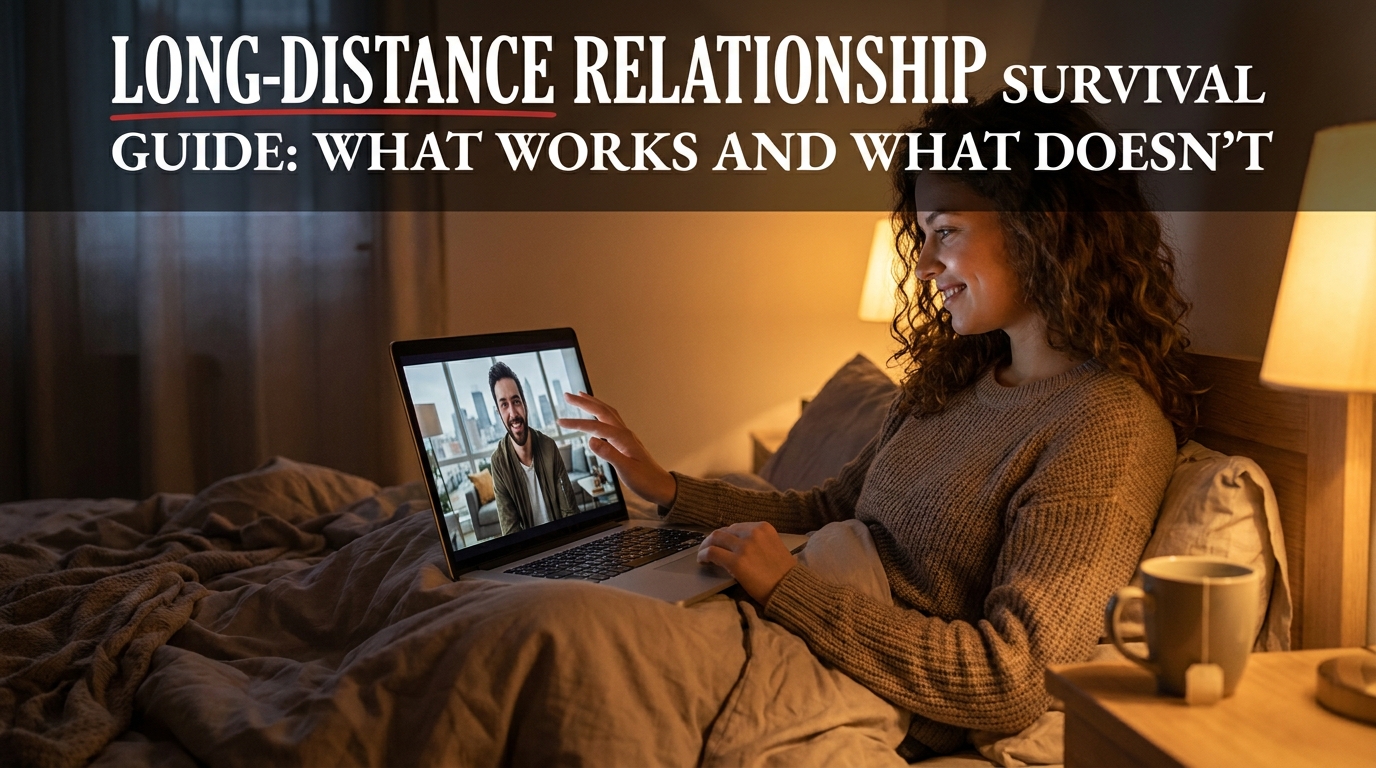
There is a particular kind of loneliness that belongs only to people in long-distance relationships — the loneliness of loving someone fully and being unable to reach them. Not the loneliness of being alone, but the loneliness of being together and apart simultaneously, of falling asleep wishing someone were beside you who is very real and very loved and simply very far away. Research from the Journal of Communication found that couples in long-distance relationships often report higher levels of idealization, deeper communication quality, and greater relationship satisfaction than geographically close couples in the early stages — but they also face a distinct set of challenges that, without the right tools and honest understanding, quietly dismantle even the most genuine love.
A long-distance relationship is not a lesser relationship. But it is a different one — and surviving it, genuinely thriving inside it, requires a different kind of skill set than proximity allows you to take for granted. This article does not traffic in false reassurance. Long-distance relationships are hard. The missing is real. The uncertainty is real. The moments of doubt, jealousy, loneliness, and exhaustion are real. And the specific patterns of communication and behavior that destroy them — often invisibly, from the inside — are equally real and worth naming with full honesty.
What is also real is this: long-distance relationships that are approached with genuine intentionality, honest communication, and a clear shared vision for the future succeed at meaningful rates. According to research published in Psychological Science, relationship quality in long-distance couples is not significantly lower than in geographically close couples — and in several dimensions of intimacy and communication, long-distance couples actually outperform their co-located counterparts.
The question is not whether long-distance relationships can work. The question is whether you are doing the things that make them work — and avoiding the things that silently destroy them.
This is the honest guide to both.
Understanding What Makes a Long-Distance Relationship Fundamentally Different
Before diving into what works and what does not, it is essential to understand the structural differences between a long-distance relationship and a geographically close one — because many of the mistakes couples make in LDRs come from applying proximity-relationship thinking to a fundamentally different situation.
The Absence of Physical Presence
Physical presence in a relationship does far more than most people consciously recognize. It provides moment-to-moment co-regulation — the neurological process by which two people in close proximity literally calm each other’s nervous systems through shared breath, touch, eye contact, and physical proximity. It allows for the accumulation of small, ordinary shared moments — the texture of daily life together — that form the quiet backbone of sustained intimacy.
When physical presence is removed, both of these are lost. The nervous system no longer has access to the co-regulatory presence of the partner. And the small ordinary moments — the shared meals, the casual touches, the doing-nothing-in-particular-together — are replaced by scheduled, intentional communication that, however meaningful, carries a different quality.
This is not a reason to despair. It is a reason to understand that intentionality must replace what proximity makes automatic — and that the absence of ordinary moments places greater weight on the quality of the deliberate ones.
The Compression of Time Together
In most long-distance relationships, time together is compressed — visits that are planned, anticipated, and emotionally loaded in ways that ordinary time together is not. This creates what relationship researchers call the “reunion dynamic” — a pattern where visits are characterized by heightened intimacy and suppressed conflict, because neither partner wants to waste the precious, limited time together on difficulty.
The reunion dynamic has significant consequences. It means that the relationship’s ability to navigate real conflict — a fundamental relationship skill — rarely gets practiced. It means that each visit feels extraordinary, feeding the idealization cycle. And it means that when the relationship eventually does close the distance, couples frequently find themselves poorly equipped to handle the ordinary, unglamorous, conflict-inclusive reality of daily life together.
The Role of Imagination and Idealization
In the absence of continuous real-world experience of each other, the mind naturally fills the gap with imagination — and imagination tends to present the idealized version rather than the complete one. Long-distance partners can develop extraordinarily deep emotional intimacy through sustained communication, while simultaneously having incomplete pictures of each other’s ordinary selves — the irritable morning version, the stressed-and-avoidant version, the version that leaves dishes in the sink and forgets to respond to messages.
This is not a flaw in long-distance love. It is a structural feature of it — one that requires conscious awareness and deliberate countermeasures to manage.

WHAT WORKS: The Foundations That Actually Sustain a Long-Distance Relationship
1. A Clear and Shared Vision for the Future — With a Real Timeline
This is the single most important factor that distinguishes long-distance relationships that survive from those that do not: the presence or absence of a genuine, mutually agreed-upon plan for closing the distance.
Research consistently demonstrates that long-distance couples who have a defined endpoint — a realistic timeline for when and how they will eventually be in the same place — report significantly higher relationship satisfaction and lower anxiety than those in open-ended arrangements. The reason is psychologically straightforward: a defined future allows the present difficulty to be experienced as temporary and purposeful rather than indefinite and potentially permanent.
“Someday we will figure it out” is not a plan. It is a hope dressed as a plan — and hope without structure is one of the most common silent destroyers of long-distance relationships. Because without a concrete timeline, both partners are indefinitely in a state of suspended sacrifice, and suspended sacrifice — over time — breeds resentment.
A real plan does not need to be rigid. It needs to be specific enough to answer: when are we aiming to close this distance, who is moving, what needs to happen for that to become possible, and are we both genuinely committed to making it happen?
What this looks like in practice: Regular, honest conversations about the timeline — not just in the abstract but in the concrete. What specific steps are being taken toward the goal? What obstacles exist and how are they being addressed? Is the plan evolving in a direction that works for both people, or is one person’s future consistently being subordinated to the other’s?
2. Communication Quality Over Communication Quantity
One of the most pervasive myths about long-distance relationship success is that it depends on constant communication — the more contact, the better. This is demonstrably false, and for many couples, the relentless pressure to maintain continuous contact is itself a source of significant stress and eventual conflict.
What research actually supports is communication quality — the depth, honesty, and genuine emotional content of interactions — as the primary communication variable associated with long-distance relationship satisfaction.
A two-hour video call where both partners are genuinely present, emotionally open, and meaningfully connecting is worth more than twelve hours of half-distracted texting. A single voice message that captures something real and vulnerable contributes more to intimacy than a hundred “thinking of you” texts that have become automated habit.
The quality distinction also means being honest when communication is suffering. When one or both partners is exhausted, stressed, or emotionally depleted, the performance of enthusiasm — going through the motions of the scheduled call without genuine presence — is actively damaging because it trains both people to mistake the form of connection for the substance of it.
What this looks like in practice: Design your communication structure around genuine connection rather than anxious coverage. Schedule calls when you can actually be present. Give each other permission to be honest when a particular day is not a good day for depth. Prioritize conversations that involve real emotional disclosure — what you are actually thinking and feeling — over the logistical and surface-level updates that fill time without building intimacy.
3. Maintaining Genuine Individual Lives
The counterintuitive truth about long-distance relationships is that the partners who fare best are not the ones who make the relationship the center of everything — they are the ones who maintain rich, full, genuinely inhabited individual lives while the relationship is developing.
This matters for several reasons. First, it protects both partners from the resentment that builds when a person’s life feels on pause, subordinated to a relationship that is not yet able to provide the daily companionship that ordinary life requires. Second, it gives both partners something real and ongoing to bring to their communication — a life that is being actively lived, not merely survived between visits. Third, it maintains the individual identity that the relationship will eventually need to be in partnership with rather than in replacement of.
The partner who has let their friendships atrophy, their interests lie dormant, and their social world narrow to the relationship is not a more devoted partner. They are a more fragile one — more vulnerable to the anxiety and jealousy that distance produces, more dependent on the relationship for needs it cannot, across distance, adequately meet.
What this looks like in practice: Actively invest in your friendships, your professional development, your creative and physical pursuits, and your local community. Not as a distraction from the relationship — but as the living of a life that makes you a complete, interesting, resilient person to be in relationship with.

4. Rituals of Connection That Create Continuity
One of the most significant losses in a long-distance relationship is the continuity that proximity creates automatically — the shared rhythms and rituals of daily life that form the connective tissue of sustained intimacy. In the absence of physical proximity, this continuity must be deliberately constructed.
Couples who sustain long-distance relationships successfully typically develop what relationship researchers call “rituals of connection” — specific, repeated patterns of interaction that create a sense of shared life across distance. These rituals provide structure, predictability, and a felt sense of togetherness that sporadic, unstructured contact cannot replicate.
These rituals can take many forms, and their content matters less than their consistency and the genuine meaning both partners invest in them:
- A specific time each day for a brief voice message or check-in — not a full call, just a moment of contact that says “I am thinking of you and I am here”
- Watching the same television show simultaneously while texting reactions — a shared experience despite physical separation
- A weekly longer call with a specific structure: how was your week, what are you proud of, what was hard, what are you looking forward to
- Sending physical letters or packages that arrive in the mail — something tangible, held in the hands, that carries the effort and thought of the sender
- Shared playlists, shared book reading, shared podcasts — experiences that create common ground and conversation material across the distance
What this looks like in practice: Sit down together and deliberately design the communication rituals that feel meaningful to both of you — not the ones you feel obligated to maintain, but the ones you genuinely look forward to. And protect them with reasonable consistency, understanding that life will sometimes disrupt the routine and that flexibility is part of sustainability.
5. Honesty About the Hard Parts — Especially the Uncomfortable Ones
Long-distance relationships create specific emotional challenges that proximity relationships do not — and the couples who navigate them successfully are the ones who talk about those challenges honestly rather than suppressing them to protect the other person from worry or to avoid appearing weak or needy.
The specific hard parts that most commonly go undisclosed in LDRs include:
Loneliness that feels like a reflection on the relationship. Many long-distance partners suppress their loneliness because expressing it feels like a complaint about the relationship or an accusation of inadequacy directed at the partner. The result is that each person is carrying loneliness privately — exactly the kind of experience that shared vulnerability could transform into connection.
Jealousy and insecurity. When your partner has an active social life in a city you are not part of, jealousy and insecurity are predictable emotional experiences. Suppressing them does not make them disappear — it makes them distort. Naming them honestly, without accusation, while taking personal responsibility for managing them, is far more productive than pretending they do not exist.
Doubt about the future. There will be periods in every long-distance relationship where the doubt is louder than the certainty — where the distance feels impossibly wide and the timeline feels impossibly long. These moments deserve to be spoken about honestly rather than hidden, because concealing significant doubt from your partner means navigating a fundamental relationship challenge entirely alone.
What this looks like in practice: Create explicit permission within your relationship for the hard parts to be named. A simple shared agreement — “we tell each other when it is hard, without making it the other person’s problem to solve” — can dramatically change the emotional quality of long-distance communication.
“The couples who survive long distance are not the ones who pretend the distance does not hurt. They are the ones who tell each other honestly that it hurts — and choose it anyway, together, because what they are building is worth the cost.”

WHAT DOESN’T WORK: The Patterns That Silently Destroy Long-Distance Relationships
1. Letting Jealousy Go Unaddressed — Or Unmanaged
Jealousy in long-distance relationships is not a character flaw or a sign of insecurity that should be immediately dismissed. It is a predictable emotional response to a genuinely challenging situation — loving someone you cannot see, in a life you cannot fully observe, surrounded by people you do not know.
What is destructive is not the jealousy itself but the ways it tends to be managed — or mismanaged — in LDRs.
Unaddressed jealousy tends to express itself as controlling behavior — demands for constant location updates, interrogation of social plans, surveillance of social media activity, and ultimatums about friendships that feel threatening. This controlling behavior is corrosive on multiple levels: it erodes the partner’s autonomy, it communicates a fundamental lack of trust, and it creates a relationship dynamic that feels more like monitoring than love.
Alternatively, jealousy that is entirely suppressed — never spoken about, managed alone through compulsive social media checking and anxious rumination — becomes a slow, accumulating source of distress that eventually surfaces in displaced and disproportionate ways.
What works instead: Owning the jealousy as your own emotional experience while naming it honestly. “I noticed I felt jealous when you mentioned that work colleague and I want to be honest about it rather than let it fester. This is my feeling to manage — I am not asking you to change anything, but I wanted you to know where I am.” This kind of disclosure builds trust rather than eroding it, and it keeps the emotional landscape of the relationship honest.
2. Using Communication as Surveillance Rather Than Connection
There is a meaningful and important distinction between communicating with your partner because you want to connect — and communicating with your partner because you need to know where they are and what they are doing.
In long-distance relationships, the absence of physical proximity creates an information vacuum that anxiety frequently tries to fill through compulsive checking — constant texting to verify their presence and attention, demands for immediate response, distress when messages go unanswered for lengths of time that would be completely unremarkable in ordinary daily life.
This surveillance-style communication pattern is one of the most consistently relationship-damaging behaviors in LDRs. It communicates distrust, creates an oppressive sense of being monitored, and eventually makes communication feel like obligation and performance rather than genuine connection.
It also, crucially, does not work. It does not reduce anxiety — because the anxiety is internal, not created by the lack of information. Answering it through compulsive contact only temporarily quiets it before it rises again, requiring another reassurance cycle.
What works instead: Addressing the underlying anxiety directly — through honest conversation with your partner about what you need in terms of reassurance, through individual therapy or self-examination of the attachment patterns driving the anxiety, and through the deliberate expansion of your own independent life so that your partner’s attention is not the primary source of your sense of security.
3. Avoiding Conflict to Protect the Limited Time Together
As described earlier, the reunion dynamic — the pattern of suppressing conflict during visits to preserve the quality of limited time together — is one of the most common and most damaging patterns in long-distance relationships.
The cost is not just that conflicts go unresolved. The deeper cost is that the relationship never develops the conflict-navigation capacity that it will urgently need when the distance closes. Couples who have spent a year or two of long-distance visits in an artificially conflict-free zone frequently find themselves completely unprepared for the reality of daily life together — where conflict is ordinary, unavoidable, and requires practiced skill to navigate constructively.
There is also a subtler cost: when conflict is consistently avoided, a false intimacy develops — a closeness built on the shared performance of perfection rather than the genuine navigation of difficulty. This false intimacy feels profound. But it is not the same as the real intimacy that survives being honestly, imperfectly known.
What works instead: Deliberately allowing and navigating conflict — not manufacturing it, but not suppressing it when it genuinely arises. Treating difficult conversations during visits not as failures of the time together but as investments in the relationship’s genuine capacity to sustain real life.
4. Making the Relationship a Performance on Social Media
Long-distance relationships are particularly vulnerable to a specific pattern: performing the relationship publicly in ways that serve the couple’s narrative about their love rather than the actual quality of their connection.
The elaborate Instagram posts about how distance makes the heart grow fonder. The public declarations of love that are more frequent and more effusive than the private ones. The curated highlights of visits that present a picture of sustained romance with none of the difficulty or the longing or the exhaustion.
This pattern is damaging not primarily because of its external audience but because of its internal function. When a relationship is being performed for public consumption, the performance begins to compete with — and sometimes replace — the honest, private work of actually sustaining it. Energy that could go into genuine connection goes into documentation and presentation. And the gap between the public narrative and the private reality widens in ways that create shame and cognitive dissonance.
What works instead: Investing the energy that would go into performing the relationship publicly into the relationship itself. The most important audience for your love is your partner — not your followers.

5. Neglecting Physical Intimacy as a Real Relationship Need
Physical intimacy — touch, closeness, physical affection — is a genuine human need, not a luxury. Research in attachment neuroscience is unambiguous on this point: physical touch activates the release of oxytocin, reduces cortisol, regulates the nervous system, and contributes to the sense of safety and belonging that is fundamental to emotional wellbeing.
Long-distance relationships, by definition, are unable to provide this on a daily basis. And one of the things that does not work is simply not acknowledging this as a real, significant deprivation — pretending that video calls and voice messages fully substitute for what physical closeness provides.
They do not. And pretending they do sets both partners up for an accumulated physical loneliness that eventually expresses itself as emotional distance, diminished desire, or — in some cases — vulnerability to physical connection outside the relationship.
What works instead: Honest acknowledgment of physical longing as a legitimate relationship need. Deliberate attention to physical intimacy during visits — not just sexual intimacy but affectionate touch, physical closeness, the ordinary physical ease of two people who feel safe with each other’s bodies. Creative approaches to maintaining physical connection across distance — the exchange of physical objects that carry scent or warmth, sleep calls that provide a sense of shared presence. And real, honest conversation about how both partners are managing this dimension of their needs across the distance.
6. Having No End Date — Indefinite Distance as a Permanent State
This deserves its own section because it is, in the experience of many long-distance couples, the single most relationship-eroding situation: a long-distance arrangement that has no clear endpoint — that has become, through the accumulation of postponed decisions and unresolved logistics, effectively permanent.
Indefinite long-distance is not a long-distance relationship. It is two separate lives that occasionally intersect. And the longer it continues without genuine, concrete progress toward closure, the more each partner unconsciously — and then consciously — begins to build a life that does not include the other person in any daily, practical sense.
Hobbies, friendships, routines, professional decisions — all of these begin to calcify around the individual life rather than the shared one. And the longer this continues, the harder and more disruptive it becomes to actually close the distance — even when both people still want to.
The gradual drift from “temporary long-distance” to “indefinitely long-distance” is one of the most painfully common ways that genuinely good, genuinely loving long-distance relationships end — not in dramatic confrontation but in the slow, mutual recognition that two separate lives have been built, and that merging them has become increasingly complicated, costly, or simply no longer what one or both people actually want.
What works instead: Regular, honest, specific conversations about the closing-the-distance plan — including its progress, its obstacles, and its ongoing mutual viability. And the courage, when necessary, to name honestly if the plan is not moving forward at a rate that is sustainable for both people.
“Long-distance love is not about enduring the distance. It is about building something across it — deliberately, honestly, and with both eyes open to what the distance is costing and what it is building toward.”

Navigating the Transition: When You Finally Close the Distance
One of the most overlooked and least prepared-for phases of a long-distance relationship is the transition period after the distance closes. Most couples approach this moment as the finish line — the point at which the difficulty ends and the real relationship finally begins.
The reality is significantly more nuanced — and for many couples, the immediate post-distance period is one of the most challenging phases they experience.
After months or years of compressed, intentional, often idealized togetherness, suddenly being in ordinary daily proximity with each other is a significant adjustment. The relationship that existed across distance was built on deliberate communication, scheduled intimacy, and the mutual idealization that absence produces. Daily life together is built on something completely different — on ordinary, unguarded, sometimes unglamorous co-existence.
The irritating habits that never surfaced during visits. The differing domestic standards that were never an issue when you did not share a kitchen. The social rhythms and independence that each person developed and that now must be renegotiated in the context of shared space. The ordinary silences that used to be warm and easy in brief visits that now sometimes feel like distance where there should not be any.
None of these are signs that something is wrong. They are signs that the real, daily relationship is beginning — and that it requires the same intentionality, the same honest communication, and the same genuine curiosity about each other that sustained the relationship across distance.
Navigating this transition well looks like:
Extending patience — to yourself and to your partner — for the adjustment period. Talking explicitly about the transition rather than expecting it to be seamless. Maintaining some of the deliberate communication practices from the long-distance period — not because you still need them logistically, but because they built genuine intimacy and are worth continuing in some form. And seeking couples support if the transition proves significantly more difficult than either partner expected — which is more common than the narrative around “finally being together” tends to acknowledge.
When to Know a Long-Distance Relationship Is No Longer Worth Sustaining
This question deserves an honest answer, even though it is a difficult one.
Not every long-distance relationship should be sustained indefinitely. There are specific circumstances in which the most honest and loving decision is to acknowledge that the arrangement is no longer viable — for either or both partners — and to end it with the care and respect that genuine love deserves.
Signs that a long-distance relationship may have reached this point include:
The plan for closing the distance has been repeatedly postponed, delayed, or has effectively dissolved without honest acknowledgment. One partner is consistently making significantly more sacrifice — emotionally, financially, professionally, or logistically — than the other, and this imbalance has been raised and remains unaddressed. The communication has become performative rather than genuinely intimate — going through the motions of connection without either partner feeling genuinely seen or met. The jealousy, anxiety, or loneliness has reached a level that is significantly impairing one or both partners’ quality of life and daily functioning. One partner has begun building a life — consciously or unconsciously — that does not include the other person in any realistic, integrated way.
None of these are automatic endings. But all of them are conversations that need to happen — honestly, directly, and with genuine respect for both people’s lives and needs.
A long-distance relationship that is no longer viable but continues out of guilt, fear, or the sunk-cost fallacy of how much has already been invested is not love. It is obligation. And obligation is not a foundation worth building a life on.
Practical Tools That Actually Help
Beyond the relational and psychological principles, there are specific practical approaches that consistently make long-distance relationships more sustainable:
Agree on communication expectations explicitly. What platforms will you primarily use? What is a reasonable response time expectation for messages? How often will you have longer calls? Having these agreements explicitly prevents the anxiety and conflict that arises from mismatched unstated expectations.
Visit with a purpose beyond visiting. When you see each other, occasionally do something that reflects real life — grocery shopping together, navigating a mundane logistical challenge, spending a quiet evening doing separate activities in shared space. These ordinary moments are the ones that give you realistic data about daily life compatibility.
Keep a shared document or journal. A shared note or document where both partners can add thoughts, things they want to share, articles they found interesting, or questions they want to discuss on the next call creates a sense of ongoing shared life that the gaps between communication do not interrupt.
Have an explicit conversation about exclusivity and expectations early. Ambiguity about the terms of a long-distance relationship is one of its most anxiety-producing features. The clearer and more explicitly agreed-upon the terms of the relationship are, the lower the baseline anxiety for both partners.
Use voice messages rather than only text. Voice carries tone, warmth, and emotional nuance that text cannot. A thirty-second voice message saying good morning conveys something that a typed “good morning 🙂” simply cannot replicate.
Budget for visits deliberately. Financial constraint is one of the most common practical obstacles to long-distance relationship sustainability. Making visit costs an explicit part of your financial planning — treating them as a non-negotiable budget line rather than an optional expense — ensures that the relationship gets the in-person time it needs rather than being perpetually deferred by financial anxiety.
Final Thoughts
A long-distance relationship is an act of sustained, deliberate love. It is choosing someone consistently, across the absence and the longing and the time zone differences and the missed moments and the accumulated weight of not being able to simply reach over and touch the person you love most.
It is hard in ways that proximity relationships are simply not. And it is also capable of producing a depth of communication, a quality of intentional intimacy, and a level of genuine knowing that the ease of proximity sometimes makes unnecessary — and therefore rare.
What makes it work is not the strength of the feeling — though the feeling matters. What makes it work is the clarity of the shared vision, the honesty of the communication, the maintenance of individual lives rich enough to sustain the wait, and the courage to have the hard conversations that the distance makes it tempting to defer.
It is worth it — when both people are genuinely building toward the same future, genuinely choosing each other with open eyes, and genuinely doing the work that distance requires.
It is worth asking honestly whether it is worth it — when the question has gone unasked for too long.
Save this article — for the hard weeks when the distance feels wider than usual.
Share it with someone who is trying to make their long-distance relationship work and needs more than generic advice to do it.
Follow Truthsinside.com for more honest, research-grounded writing on relationships, love, and the real work of building something that lasts.
Related article: The 5 Love Languages Explained: Which One Are You?
Frequently Asked Questions
Q1: What is the most important factor in making a long-distance relationship work?
Research and clinical experience both point consistently to the same answer: a clear, mutually agreed-upon, and actively pursued plan for closing the distance. Couples who know why they are enduring the distance and when it will end sustain significantly higher relationship quality than those in open-ended arrangements. Every other factor — communication quality, trust, individual life maintenance — matters significantly, but none compensates fully for the absence of a genuine shared direction.
Q2: How often should long-distance couples communicate?
There is no research-supported universal answer to this question. What matters is that the frequency is mutually agreed upon, genuinely sustainable for both people’s lives, and oriented toward quality rather than quantity. Many relationship therapists suggest that daily brief contact supplemented by two to three longer, more intentional weekly conversations works well for many couples — but the right structure is the one that both partners actually look forward to, rather than the one that feels obligatory or exhausting.
Q3: How do we handle different time zones in a long-distance relationship?
Time zone differences require explicit, ongoing negotiation about communication timing — and a genuine commitment from both partners to make reasonable accommodations. The burden of adaptation should not fall consistently on one partner. A rotating schedule — where each partner takes turns being the one who stays up late or gets up early — communicates fairness and mutual investment in the relationship’s sustainability.
Q4: Is jealousy in a long-distance relationship normal?
Yes — and it is near-universal. The question is not whether jealousy is normal but how it is being managed. Jealousy that is named honestly, managed as a personal emotional responsibility, and communicated without accusation or controlling behavior is a normal feature of LDR navigation. Jealousy that expresses itself as surveillance, ultimatums, or controlling behavior is a relationship problem that requires direct attention, and in many cases professional support.
Q5: When is it time to consider ending a long-distance relationship?
When the plan for closing the distance has genuinely dissolved without honest acknowledgment. When the sacrifices are chronically imbalanced and the imbalance is not being addressed. When the communication has become performative rather than genuinely intimate. When one or both partners has begun building a life that does not realistically include the other. And when the honest, private answer to “am I still choosing this person, or am I choosing what we used to be” is the latter. These are not automatic endings — but they are conversations that love requires the courage to have.
🎵 Music
Maren Lull is a singer-songwriter who writes from the places most people don’t talk about out loud.
Not the dramatic grief. Not the obvious heartbreak. The quiet kind — the ordinary Tuesday emptiness, the habit of reaching for someone who isn’t there anymore, the particular exhaustion of being strong for so long that the strength itself wears thin.
Her music lives at the intersection of emotional honesty and soft beauty — breathy vocals over gentle piano, slow tempos, lyrics that feel less like songs and more like something you wrote in a private notebook at two in the morning and never showed anyone.
Maren Lull writes for the people who feel everything deeply and say very little about it. For the ones who listen to sad music not because they want to feel worse — but because being understood, even by a song, makes the feeling easier to carry.
📱 Follow Maren Lull:
→ Spotify
→ Apple Music
→ Youtube
→ Audiomack