
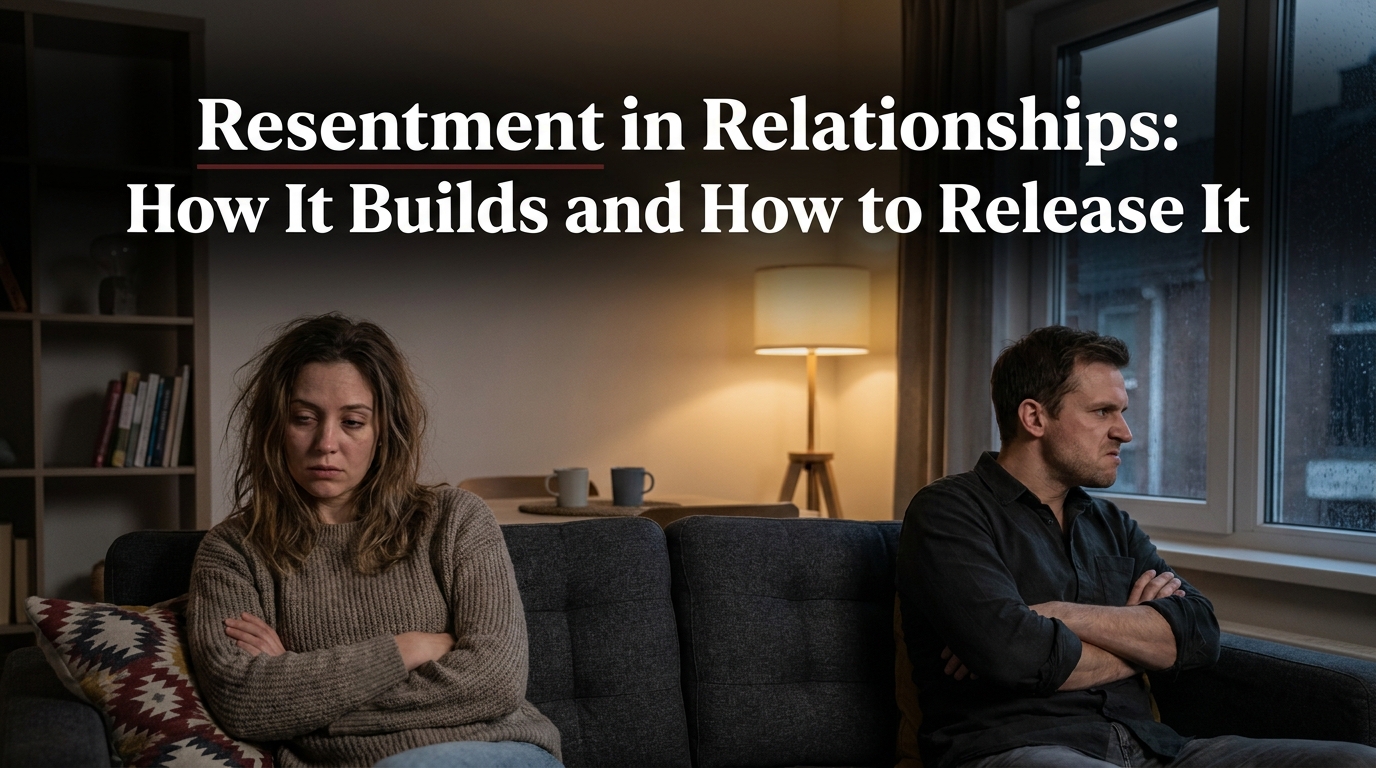
You love someone deeply — and yet, every little thing they do makes your jaw tighten. You remember every broken promise, every dismissive comment, every time you swallowed your feelings to keep the peace. That slow, suffocating weight pressing against your chest? That is resentment in relationships — and research confirms it is one of the leading emotional forces that erodes love over time. According to relationship psychologist Dr. John Gottman, contempt and unresolved resentment are among the top predictors of relationship breakdown, affecting millions of couples globally.
Resentment does not arrive all at once. It is not a dramatic explosion. It is quiet. It is a thousand small moments where you felt unseen, unheard, or unfairly treated — and said nothing. Over weeks, months, sometimes years, those moments stack up into a wall that love alone cannot climb over.
This article is for you if you have ever felt that invisible distance growing between you and someone you care about. If you find yourself replaying past arguments. If you have started keeping score. If the warmth feels like it is slowly draining from something that used to feel safe and beautiful.
You are not broken. And your relationship may not be beyond repair. But resentment in relationships must be understood before it can be healed.
What Exactly Is Resentment in Relationships?
Resentment is not simply anger. Anger is sharp and immediate — it rises, burns, and often passes. Resentment is different. It is anger that was never fully expressed, never truly resolved, and never released. It is anger that turned inward and hardened into something colder and far more dangerous.
In the context of relationships, resentment forms when one or both partners feel chronically:
- Unappreciated or taken for granted
- Dismissed or belittled during conflicts
- Overburdened with responsibilities while the other partner does not contribute equally
- Repeatedly hurt by the same patterns of behavior
- Forced to sacrifice their needs, dreams, or values for the relationship
- Silenced when they try to communicate their feelings
Psychologists describe resentment as a “secondary emotion” — meaning it is almost always rooted in something deeper. Beneath the resentment lives hurt, fear, grief, or an unmet need. The resentment is just the armor those vulnerable feelings put on when they have nowhere else to go.
What makes it particularly destructive is that resentment is often hidden — even from the person feeling it. You may not realize how deep it has grown until you find yourself snapping at your partner over something trivial, feeling a flash of satisfaction when they fail at something, or emotionally checking out of conversations entirely.
It is also important to recognize that resentment is not a character flaw. It is not a sign that you are petty, ungrateful, or a bad partner. It is a signal. A signal that something in your relationship has gone unaddressed for too long.

How Resentment Silently Builds Over Time
Understanding how resentment accumulates is the first step toward stopping it. It rarely begins with one catastrophic event. More often, it is constructed brick by brick, from moments so small they seemed unworthy of confrontation in the moment.
Stage 1: The First Unspoken Hurt
It starts with something that hurt you — a dismissive comment, a forgotten promise, a moment where you needed your partner and they were not present. You decide not to bring it up. Maybe you tell yourself it is not a big deal. Maybe you fear conflict. Maybe you have learned from past experience that bringing things up leads to an argument where you end up feeling worse. So you let it go.
Except you do not actually let it go. You store it.
Stage 2: The Pattern Emerges
The same type of hurt happens again. And again. Each time, you swallow it. Each time, it adds another layer to the growing weight inside you. A pattern has formed — not just in your partner’s behavior, but in your response to it. Silence. Suppression. Survival.
Stage 3: Keeping Score
At some point, you begin mentally cataloging every offense. You remember the birthday they forgot, the time they invalidated your feelings in front of friends, the way they always make you feel responsible for managing the emotional temperature of the relationship. You are no longer in the present moment with your partner. You are dragging the entire archive of past wounds into every interaction.
Stage 4: Emotional Withdrawal
You stop trying to connect. You stop initiating difficult conversations because it feels pointless. You may still be physically present — living in the same house, sleeping in the same bed — but emotionally, you have started to leave. This is one of the most painful stages because from the outside, everything might look fine. But inside, the warmth is gone.
Stage 5: Contempt and Distance
In the final stage, resentment has transformed into something even more corrosive — contempt. This is where eye-rolling, sarcasm, dismissiveness, and emotional cruelty begin to surface. Gottman’s research identifies contempt as the single strongest predictor of relationship dissolution. Once resentment reaches this stage, healing becomes significantly harder — but not impossible.
“Resentment is like drinking poison and waiting for the other person to get sick. But in relationships, it poisons both of you — quietly, slowly, and sometimes without either of you realizing it until the damage is deep.”
The Hidden Roles We Play That Feed Resentment
One of the most uncomfortable truths about resentment in relationships is that both partners typically play a role in allowing it to grow — even if the distribution of responsibility is unequal.
The Over-Giver
Some people build resentment through chronic over-giving. They say yes when they mean no. They absorb their partner’s emotional burdens. They handle every household responsibility, every social arrangement, every emotional crisis. They do this sometimes out of love, sometimes out of fear of conflict, and sometimes because of deeply ingrained beliefs that their worth depends on how much they sacrifice. Over time, they begin to feel invisible and depleted — and when their giving is not matched or even acknowledged, resentment floods in.
The Silencer
Some people build resentment because they genuinely cannot communicate their needs. They grew up in environments where expressing feelings was unsafe, unwelcome, or punished. They learned to minimize their pain and present a composed exterior. In relationships, they struggle to ask for what they need — and then feel angry when their partner, who cannot read minds, fails to provide it. The resentment is real, but it is partly fed by an internal dynamic that the person themselves must recognize and work on.
The Partner Who Does Not See
And then there is the partner on the other side — often not malicious, but genuinely unaware. They may have benefited from the imbalance without recognizing it. They may interpret their partner’s silence as contentment. They may have their own emotional blind spots that prevent them from noticing the slow withdrawal of warmth. This does not absolve them of responsibility — but it does remind us that resentment in relationships is rarely a story of one villain and one victim. It is usually a story of two people with different coping styles, communication wounds, and unmet needs who never found a safe enough space to be fully honest.

The Physical and Mental Health Cost of Carrying Resentment
Resentment is not just an emotional experience — it is a physiological one. Holding onto chronic resentment activates the body’s stress response systems in ways that can cause measurable harm over time.
Studies published in journals like Psychosomatic Medicine have found that unresolved interpersonal conflict and suppressed anger are associated with elevated cortisol levels, which in turn contribute to immune suppression, cardiovascular strain, and disrupted sleep patterns.
People who carry deep resentment in their relationships often report symptoms that mirror anxiety and depression — persistent low mood, difficulty concentrating, chronic fatigue, physical tension in the shoulders and chest, and a pervasive sense of hopelessness. They may also develop what psychologists call “hypervigilance” within the relationship — becoming acutely sensitive to their partner’s tone, facial expressions, and behavior, constantly bracing for the next disappointment.
Beyond the body, resentment distorts perception. When you are deeply resentful, your mind unconsciously filters information to confirm your existing beliefs about your partner. You stop seeing their kindness clearly. You begin interpreting neutral actions as negative ones. This cognitive distortion — known in psychology as “negative sentiment override” — makes even genuine repair attempts from your partner feel hollow or suspicious.
The cost of carrying resentment is enormous. And the longer it is carried, the heavier it becomes.
How to Release Resentment in Relationships: A Real, Honest Guide
Releasing resentment is not about pretending the hurt did not happen. It is not about excusing bad behavior. It is not about forcing yourself to feel warmth you do not currently feel. It is about choosing — deliberately and consistently — to stop letting the past govern your present.
Here is what that actually looks like:
1. Name It Before You Can Tame It
The first step is radical honesty with yourself. Ask: What am I actually resentful about? Not the surface-level things — the dishes, the tone, the forgotten event — but the deeper wound beneath them. Is it that you feel invisible? Unappreciated? Unloved? Unsafe? Getting precise about the real source of your resentment is the foundation of everything else.
2. Break the Silence — Carefully
Resentment thrives in silence. At some point, the hurt has to be spoken. But how you speak it matters enormously. Approaching your partner with blame and accusations will trigger defensiveness and make connection impossible. Instead, use language that centers your experience rather than their failure.
Say: “I feel disconnected from you when I feel like my efforts go unnoticed” rather than “You never appreciate anything I do.”
This is not about being delicate for the sake of sparing your partner’s feelings. It is about speaking in a way that actually creates the possibility of being heard.
3. Practice Radical Empathy — Even When It Is Hard
This step is genuinely difficult. But research consistently shows that understanding why someone behaved in a hurtful way — not excusing it, but understanding it — is one of the most powerful pathways to releasing resentment. Was your partner’s behavior rooted in their own fear, insecurity, or unhealed wounds? Can you hold both truths at once — that what they did was hurtful and that they are also a flawed human being doing their imperfect best?
This is not about letting them off the hook. It is about freeing yourself from the prison of sustained bitterness.
4. Grieve What Was Lost
Sometimes resentment is not just about the other person’s behavior. It is about grief — for the relationship you thought you were going to have, for the version of yourself you lost while trying to maintain the relationship, for the dreams that felt possible before the distance grew. Give yourself permission to grieve those losses. They are real. Grief, when fully experienced, moves through us. Resentment, when suppressed, stays.
5. Seek Professional Support
There is no shame in acknowledging that some wounds are too complex to heal through conversation alone. Couples therapy — particularly approaches like Emotionally Focused Therapy (EFT) or the Gottman Method — has a strong evidence base for helping partners break resentment cycles and rebuild emotional connection. Individual therapy can also be transformative for understanding the personal patterns that contribute to how you accumulate and express resentment.
6. Decide What You Are Doing With This Relationship
Releasing resentment does not always mean staying in the relationship. Sometimes, the honest and courageous thing is to recognize that the damage is irreparable, or that the patterns are unlikely to change, and to choose yourself. Healing is possible both within a relationship and after leaving one. What is not possible — or at least, not sustainable — is staying stuck in resentment indefinitely.

“Healing resentment is not a single conversation. It is a daily practice of choosing presence over punishment, understanding over accusation, and love over the satisfaction of being right.”
When Resentment Is a Signal to Leave
Not every story of resentment ends in reconciliation — and that needs to be said clearly and without judgment.
If your resentment has built up over years of repeated mistreatment, emotional abuse, chronic disrespect, or patterns your partner has shown no genuine willingness to change — then resentment may not be a problem to solve within the relationship. It may be important data about the relationship itself.
Resentment that stems from fundamental incompatibility, repeated betrayals, or a persistent power imbalance is not something to therapy your way through indefinitely. Sometimes the most loving thing you can do for yourself — and paradoxically, even for your partner — is to end a relationship that is slowly corroding both of you.
If you recognize signs like these, take them seriously:
- Your partner consistently dismisses or denies your feelings when you raise concerns
- The same hurtful patterns have repeated for years without meaningful change
- You feel afraid to express your true emotions in the relationship
- You have lost your sense of identity, joy, or self-worth within the relationship
- The resentment has crossed into genuine contempt and you no longer feel respect for your partner
Leaving is not failure. Leaving can be an act of profound self-respect and, sometimes, an act of love.

How to Know Your Relationship Is Healing
If you and your partner are actively working through resentment together, how do you know it is actually working? Healing is not always dramatic or obvious. Here are real signs of progress:
You feel safe bringing up difficult topics again. The wall has started to come down when you notice that conversations about hard feelings no longer immediately escalate into defensiveness or shutdown.
Your partner’s repair attempts land differently. When your partner apologizes or tries to reconnect, you find yourself able to receive it — even if imperfectly — rather than dismissing it as too little, too late.
You catch yourself giving them the benefit of the doubt. Instead of automatically interpreting ambiguous behavior as a confirmation of your worst fears, you find yourself pausing and considering other explanations.
Physical warmth begins to return. Touch, laughter, comfort — the quiet physical ease of two people who feel safe together — begins to re-emerge.
You are living in the present more. You notice fewer instances of dragging past grievances into current conversations. The archive is still there, but it is no longer controlling the narrative.

The Practice of Releasing Resentment Every Day
Even after breakthrough moments of healing, resentment can quietly creep back in if left unchecked. Prevention requires practice — not as a punishment, but as an ongoing act of choosing the relationship you want to live inside.
Daily practices that genuinely help include:
Micro-expressions of appreciation. Saying “thank you” for small things — not just grand gestures — keeps the ratio of positive interactions high enough to buffer against conflict.
Regular emotional check-ins. A simple, honest question — “How are you really doing?” — asked and received with genuine curiosity, can prevent the accumulation of small, unspoken hurts before they solidify.
Maintaining your individual identity. Resentment often feeds on the loss of self within a relationship. Protecting time for your own friendships, passions, and solitude keeps you from developing a martyr mentality that breeds bitterness.
Revisiting and renegotiating agreements. Relationships change as people grow. What worked at the beginning may no longer be fair or sustainable. Regularly checking in about roles, responsibilities, and expectations prevents the imbalances that silently breed resentment.
Choosing to believe in your partner’s goodwill. On days when this is hard — and there will be many such days — it helps to ask: “Is it possible that what I am interpreting as malice is actually ignorance, exhaustion, or fear?” Not always, but often enough to make the question worth asking.
Final Thoughts
Resentment in relationships is not a death sentence. It is a distress signal — one that, if listened to with courage and compassion, can lead to deeper honesty, stronger communication, and a love that is built not on naivety but on real, tested knowing of each other.
The couples who make it through resentment are not the ones who never hurt each other. They are the ones who learned to stop pretending the hurt did not exist, to speak the uncomfortable truth with care, and to choose each other — again and again — not out of habit, but out of genuine, clear-eyed love.
If you are carrying resentment right now, this is your invitation to put it down. Not for your partner’s sake. For yours.
Save this article — you may need to come back to it.
Share it with someone who is quietly struggling in their relationship.
Follow Truthsinside.com for more honest, research-grounded content on love, psychology, and the real work of building healthy relationships.
Related article: 15 Signs She Is Testing You: Why Women Test Men and What to Do
Frequently Asked Questions
Q1: Can a relationship fully recover from deep resentment?
Yes — but only when both partners are willing to acknowledge the resentment, take responsibility for their role in it, and commit to ongoing, honest communication. Recovery is possible, but it requires genuine effort from both sides, not just one.
Q2: How do I know if what I am feeling is resentment or just normal frustration?
Normal frustration tends to be situational and temporary — it rises and passes. Resentment is sustained, accumulative, and often tied to recurring patterns or unresolved past hurts. If you find yourself returning to the same grievances repeatedly, that is likely resentment.
Q3: What if my partner refuses to acknowledge the problem?
This is one of the most painful positions to be in. If your partner consistently dismisses your feelings or refuses to engage with the issue, you face an important choice about whether you can continue to grow within a relationship where your emotional reality is not honored. Individual therapy can help you navigate this decision clearly.
Q4: Is resentment always the “wronged” partner’s problem to fix?
No. Resentment is a relational issue, which means both partners have responsibility in the healing process. The partner who built up resentment needs to communicate and release it constructively. The partner whose behavior contributed to it needs to genuinely listen, take accountability, and change.
Q5: How long does it take to heal resentment in a relationship?
There is no fixed timeline. Some couples begin to feel a shift within weeks of honest, consistent communication. Others — particularly those with years of accumulated hurt — may take months or longer, especially with professional support. The key variable is not time, but the genuine quality of engagement both partners bring to the process.
🎵 Music
Maren Lull is a singer-songwriter who writes from the places most people don’t talk about out loud.
Not the dramatic grief. Not the obvious heartbreak. The quiet kind — the ordinary Tuesday emptiness, the habit of reaching for someone who isn’t there anymore, the particular exhaustion of being strong for so long that the strength itself wears thin.
Her music lives at the intersection of emotional honesty and soft beauty — breathy vocals over gentle piano, slow tempos, lyrics that feel less like songs and more like something you wrote in a private notebook at two in the morning and never showed anyone.
Maren Lull writes for the people who feel everything deeply and say very little about it. For the ones who listen to sad music not because they want to feel worse — but because being understood, even by a song, makes the feeling easier to carry.
📱 Follow Maren Lull:
→ Spotify
→ Apple Music
→ Youtube
→ Audiomack