
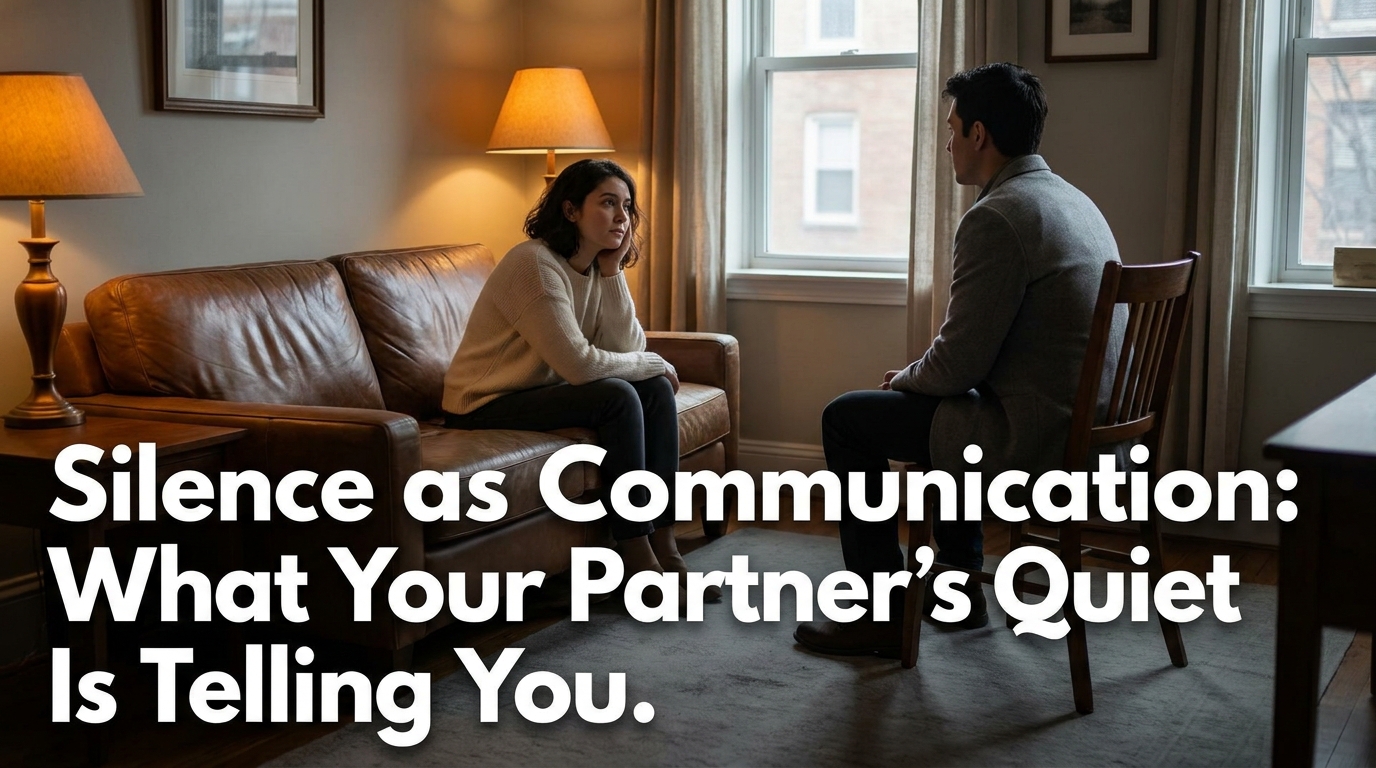
Some of the loudest conversations in a relationship happen without a single word.
The silence after a question that deserved an answer. The quiet that falls when you walk into a room and something shifts. The absence of the good morning text that used to arrive without fail. The dinner that passes without a single moment of real exchange.
Silence in a relationship is not neutral. It is never simply the absence of sound. It is a form of communication — one that carries emotional content, relational information, and sometimes the clearest signal yet that something important needs to be addressed.
Research from the University of Washington found that emotional withdrawal and silence during conflict are among the strongest predictors of long-term relationship dissatisfaction — more damaging, in many cases, than open conflict.
Learning to read your partner’s silence — and to respond to it in ways that open rather than close — is one of the most underrated communication skills in any relationship.

Why Silence Is Never Just Silence
In everyday life, silence is often restful. The comfortable quiet of a long car ride with someone you love. The peaceful stillness of reading side by side. The unhurried ease of two people who do not need to fill every moment with words.
That silence — companionable, warm, chosen — is one of the markers of genuine intimacy. It is the silence of two people who are secure enough in each other’s presence to simply be.
But relational silence — the silence that arrives in the wake of something, or in the absence of something, or in place of something that needed to be said — is an entirely different thing. And distinguishing between the two is one of the most important skills available in a long-term relationship.
Relational silence communicates. It always does. The question is not whether it is saying something. The question is what — and whether you are listening to the right frequency.
“What is left unsaid in a relationship does not disappear. It accumulates — in the body, in the distance, in the growing weight of everything that has found no place to go.” — Relationship Psychology
The Different Kinds of Silence — And What Each One Means
Not all relational silence is the same. Understanding the different types — and what each tends to communicate — is the foundation of responding to it well.
1. Processing Silence — I Need Time to Think
Some people process internally. They need time — sometimes significant time — between an emotional experience and the capacity to articulate it. For introverts and for people with certain attachment styles, the need to be quiet before speaking is not avoidance. It is how genuine communication becomes possible.
This silence often looks like withdrawal — and is frequently misread as such. The partner who goes quiet after a difficult conversation and needs a few hours before they can respond meaningfully is not stonewalling. They are preparing.
What it sounds like if you asked: “I’m not ready to talk about this yet. I need some time to figure out what I actually think and feel.”
How to respond: Give them the time they are asking for — genuinely, without surveillance or repeated check-ins that communicate you do not trust them to return. A simple “Take the time you need. I’m here when you’re ready” creates the safety that makes returning easier.
2. Protective Silence — I Have Learned It Is Not Safe to Speak
This is one of the most important silences to understand — and one of the most painful to receive.
Protective silence develops when a person has learned, through accumulated experience, that expressing certain things in this relationship is not safe. Not safe because it leads to dismissal. Not safe because it leads to ridicule. Not safe because it leads to a disproportionate reaction that makes the expressing worse than the suppressing.
This silence is not chosen freely. It is chosen because all the alternatives have produced outcomes worse than silence.
What it sounds like if you asked: “Every time I say how I feel, it turns into an argument” or “You never really hear me anyway” or simply “It doesn’t matter” — which almost always means it matters enormously.
How to respond: With the recognition that this silence is feedback — about the emotional safety of the relationship. Not with defensiveness, but with genuine curiosity: “I’ve noticed you’ve gone quiet about certain things. I want to understand if there’s something about how I respond that makes it hard to talk to me.” This question, asked sincerely, is one of the most powerful openings available.

3. Punishing Silence — I Am Withdrawing to Make You Feel It
This is the silence most people mean when they talk about the silent treatment. It is deliberate, calculated withdrawal of communication as a form of punishment — deployed to produce anxiety, guilt, and eventually compliance or apology in the other person.
Unlike processing silence, it does not have a natural end point determined by the internal process. It ends when the other person has sufficiently demonstrated distress, remorse, or submission.
Unlike protective silence, it is not defensive. It is offensive — an active use of withdrawal as leverage.
What it sounds like if you asked: Nothing. The refusal to engage is the point.
How to respond: Naming it, calmly and without accusation: “I can see you need space right now and I respect that. When you’re ready to talk about what happened, I’m here. I’m not going to pursue this while you’re not ready, but I do want us to come back to it.” Then actually give space — without pursuing, without escalating, without matching the withdrawal with your own. Remain available without being demanding.
4. Exhausted Silence — I Have Nothing Left
This silence is less about the relationship and more about the person. It is the quiet of someone who is genuinely depleted — by work, by stress, by accumulated demands that have left them with nothing to offer in the evenings, in the conversations, in the moments that require emotional presence.
It can look like withdrawal. It can feel like distance. But it is not about you — or at least, not primarily.
What it sounds like if you asked: “I’m just tired. I’m not upset with you. I don’t have anything left today.”
How to respond: With genuine acceptance rather than further demand. “I hear you. You don’t have to talk. I’m just glad you’re here.” For partners who are naturally more verbally connected, this requires genuine effort — the willingness to be companionably present without requiring engagement. That willingness is itself a profound act of care.

5. Disconnected Silence — We Have Drifted
This is perhaps the most gradual and the most insidious silence in long-term relationships. It is not the result of a single event. It is the accumulation of many small moments in which connection was possible and did not happen — until not connecting has become the new normal.
The conversations that used to happen naturally have stopped. The check-ins, the sharing of small things, the genuine curiosity about each other’s inner lives — these have been replaced by logistics, by parallel screen time, by the comfortable but hollow routine of two people who share space but have stopped sharing themselves.
What it sounds like if you asked: “I don’t know. We just don’t really talk anymore. I’m not sure when that changed.”
How to respond: With the recognition that this silence is not a crisis — it is an invitation. An invitation to begin again, deliberately. A simple “I’ve missed talking to you” is both an honest observation and a door. Walk through it.
6. Grief Silence — Something Has Changed and I Don’t Know How to Say It
This silence accompanies loss — of something external, or of something within the relationship itself. The grief of a relationship that is no longer what it was. The quiet of someone mourning something they have not yet named or given permission to grieve.
This silence often accompanies significant life transitions: a major loss, a health challenge, a shift in identity, or the slow recognition that something in the relationship has fundamentally changed and neither person has yet found the words for it.
What it sounds like if you asked: “I don’t know how to explain it” or “Something feels different and I can’t say what” or simply tears that arrive without a clear reason.
How to respond: With presence rather than problem-solving. “You don’t have to explain it. I’m here.” The willingness to sit with someone in a silence they cannot yet explain is one of the most profound forms of relational care available.

How to Respond to Your Partner’s Silence — Without Making It Worse
Understanding the type of silence is step one. Responding to it well is step two — and it requires resisting several very natural but counterproductive impulses.
Do Not Pursue Relentlessly
When a partner goes quiet, the instinctive response — particularly for anxiously attached people — is to pursue. To ask questions. To check in repeatedly. To fill the silence with increasing urgency until the partner either responds or withdraws further.
Relentless pursuit of silence communicates: your need for space is not acceptable to me. It escalates the very withdrawal it is trying to resolve.
Give space genuinely. Not as a strategy, but as an actual gift. “I’m here when you’re ready” — and then actually being there, actually being okay, actually waiting without surveillance.
Do Not Match Silence With Silence
The other common and equally counterproductive response is to meet withdrawal with withdrawal — to go quiet in return, to create your own distance, to punish the punishment.
This produces two people in parallel withdrawal, both waiting for the other to return first, both accumulating resentment in the meantime. Nothing moves. Nothing resolves. The silence compounds.
Remain available. Remain warm. Do not match the withdrawal with your own.
Name What You Notice — Once, Gently
There is a middle path between pursuing relentlessly and withdrawing entirely: naming what you notice, once, gently, and then giving genuine space.
“I’ve noticed you’ve been quiet. I’m not going to push — I just want you to know I’m here and I care about what’s going on with you.”
This does several things simultaneously. It communicates that you have noticed — which itself is a form of care. It explicitly removes pressure. And it opens a door without demanding it be walked through immediately.
Name it once. Then let it be.
Create the Conditions for Speaking
Sometimes silence persists not because the person does not want to speak but because the right conditions for speaking have not been created.
The right conditions are usually: privacy, calm, adequate time, and the genuine sense that what they say will be received without judgment or immediate counter-argument.
A walk together — side by side, not face to face — often creates speaking conditions that sitting across a table does not. Movement reduces the physiological intensity of difficult conversations. Side-by-side positioning removes the pressure of direct eye contact. The rhythmic activity of walking provides a neutral focus that makes it easier to find words for difficult things.
Ask the Right Question
“What’s wrong?” is a closed question that often produces “nothing” — because the person either does not know yet, or does not feel safe enough yet to say.
Better questions open rather than close:
“Is there anything you need from me right now?” “Is there something on your mind that you haven’t found the words for yet?” “Is there anything about how I’ve been showing up lately that’s made it harder to talk to me?”
These questions are harder to ask. They are significantly more likely to open something real.

When Silence Becomes a Pattern — And What to Do
Occasional silence in a relationship is healthy and normal. Sustained, chronic silence — the kind that has replaced genuine communication over weeks or months — is something different. It is the relationship communicating, at volume, that something needs to change.
When silence has become the dominant mode of relating — when real conversations no longer happen, when genuine curiosity about each other’s inner lives has faded, when both partners have stopped sharing anything that matters — the silence is no longer a symptom. It is the thing itself.
At that point, the question is not how to respond to the silence. It is how to begin again.
The answer, almost always, starts with one person choosing to speak first. To say something real. To ask something genuine. To reach across the quiet and risk the vulnerability of being the one who tried.
That first reach — however awkward, however imperfectly worded — is not a small thing. It is the decision that the relationship is worth the discomfort of breaking the silence. And that decision, made by one person and met with even a small degree of openness by the other, is how things begin to change.
Silence is not the enemy of intimacy. Unaddressed silence is. The quiet that is named, understood, and responded to with genuine care becomes, in time, something both people can rest in together — rather than something one person carries alone.
CALL TO ACTION
💾 Save this — come back to it the next time the quiet feels heavy. 📤 Share it with someone whose relationship has gone quieter than it should. 👣 Follow Truthsinside.com for honest, psychology-backed relationship content every week.
Frequently Asked Questions
Q1: How do I know if my partner’s silence is processing or punishment? The clearest indicators are pattern and history. Processing silence tends to have a natural resolution — the person returns to the conversation when they have found their words, and the return feels genuine rather than conditional. Punishing silence tends to end when the other person has demonstrated sufficient distress or compliance — and the warmth that returns often feels like reward rather than genuine reconnection. You can also ask directly, in a calm moment outside the silence itself: “When you go quiet after a disagreement, what is usually happening for you?” Most people, when asked genuinely and without accusation, can tell you something truthful about their own pattern.
Q2: Is the silent treatment a form of emotional abuse? It can be — when it is used deliberately and consistently as a mechanism of control, designed to produce anxiety, submission, or compliance in the other person. Occasional withdrawal during conflict is human and understandable. Systematic, prolonged, deliberate silence deployed as punishment — particularly when combined with other controlling behaviors — crosses into emotional abuse territory. The distinguishing factors are intent, consistency, and the degree to which it is used to manage and control the other person’s behavior rather than simply to manage the self.
Q3: My partner says they are fine but their silence says otherwise. What do I do? Trust the behavior, not just the words. “I’m fine” accompanied by closed body language, monosyllabic responses, and absence of the warmth that is usually present is communicating something different from the words. You can acknowledge both: “You say you’re fine and I want to believe that — and I also notice you seem like something is on your mind. I’m not going to push you. I just want you to know the door is open.” Then genuinely leave the door open — without repeatedly checking whether they have walked through it yet.
Q4: How do I start a conversation with a partner who has gone completely silent? Start with something real and low-pressure — not a direct question about the silence itself, which can feel like pressure, but a genuine, warm, ordinary reach. “I made your favorite tea.” “I thought of you today when I saw this.” “I miss talking to you.” These small reaches communicate care without demand. They create the conditions for the other person to respond without feeling cornered. The conversation does not have to begin with the difficult thing. It can begin with something that simply reestablishes warmth — and let the rest follow in its own time.
Q5: When should silence in a relationship prompt couples therapy? When it has become the dominant mode of relating over a sustained period — weeks or months rather than days. When direct attempts to open conversation consistently fail. When both partners have stopped reaching for each other and neither knows how to begin again.
When the silence is accompanied by other concerning patterns — emotional withdrawal, parallel lives, increasing resentment or indifference. Couples therapy is not a last resort for silence. It is often most effective precisely at the point when the silence has become entrenched enough that neither person can find the first word alone — and a skilled third party can help create the conditions in which both people can finally speak.
🎵 Music
Maren Lull is a singer-songwriter who writes from the places most people don’t talk about out loud.
Not the dramatic grief. Not the obvious heartbreak. The quiet kind — the ordinary Tuesday emptiness, the habit of reaching for someone who isn’t there anymore, the particular exhaustion of being strong for so long that the strength itself wears thin.
Her music lives at the intersection of emotional honesty and soft beauty — breathy vocals over gentle piano, slow tempos, lyrics that feel less like songs and more like something you wrote in a private notebook at two in the morning and never showed anyone.
Maren Lull writes for the people who feel everything deeply and say very little about it. For the ones who listen to sad music not because they want to feel worse — but because being understood, even by a song, makes the feeling easier to carry.
📱 Follow Maren Lull:
→ Spotify
→ Apple Music
→ Youtube
→ Audiomack