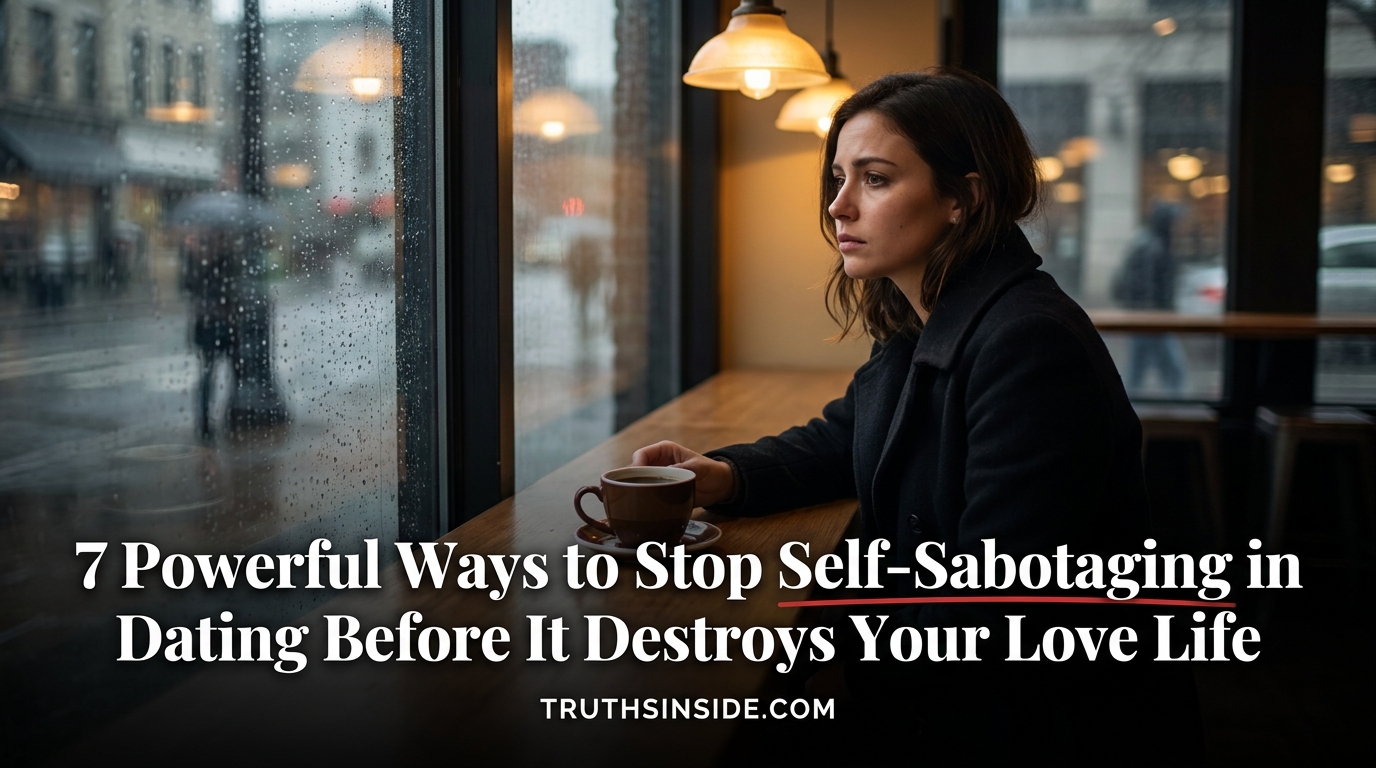
Self-sabotaging in dating is more common than most people want to admit — and it might be silently destroying your chance at real love. You meet someone wonderful. The connection feels genuine. And then, almost out of nowhere, you pull away, pick fights, go cold, or convince yourself it won’t work out.
Research from the Journal of Experimental Psychology found that people with low relationship self-worth unconsciously create the very outcomes they fear most.
If you’ve ever watched a good relationship crumble at your own hands without fully understanding why, you are not broken — you are stuck in a pattern. And patterns can be changed.

What Is Self-Sabotage in Dating, Really?
Self-sabotaging in dating doesn’t always look dramatic. It’s not always ghosting someone or starting an explosive argument for no reason. Sometimes it’s quieter. It’s canceling plans because things feel “too good.” It’s finding small flaws in a perfectly decent person and magnifying them until they feel unbearable. It’s being emotionally unavailable to someone who is giving you everything you ever said you wanted.
At its core, self-sabotage is a defense mechanism. Your brain, shaped by past experiences — especially early attachment wounds and previous heartbreaks — learns to associate intimacy with danger. So when something real and promising shows up, your nervous system hits the alarm: this feels unfamiliar, and unfamiliar feels unsafe.
Psychologist Dr. Guy Winch describes this as “emotional self-handicapping” — when we set up obstacles to love before it can get close enough to hurt us. The cruel irony is that in trying to protect ourselves from pain, we create exactly the pain we were trying to avoid.
Understanding this is the first and most important step. You are not self-destructive by nature. You are self-protective by conditioning. And that conditioning can be rewired.
Why Do We Self-Sabotage in Relationships?
Before we explore how to stop self-sabotaging in dating, we need to understand where it comes from. Because without that foundation, the “solutions” feel hollow.
1. Attachment wounds from childhood
The way your caregivers responded to your emotional needs as a child literally programs your nervous system for how you experience intimacy as an adult. If love was inconsistent, conditional, or completely absent in your early life, your brain wires the message that love is not safe or not sustainable. Anxious attachment, avoidant attachment, and disorganized attachment styles all produce different flavors of self-sabotage — but they share the same root: love once felt like something to fear.
2. Past relationship trauma
Being cheated on, emotionally abandoned, manipulated, or deeply hurt by someone you loved creates scar tissue. Your brain, trying to protect you, sets up early warning systems. But those systems are not always accurate. They fire based on old data — and they can cause you to treat new, healthy partners as if they were the ones who hurt you.
3. Unworthiness and low self-esteem
This is perhaps the most painful driver of self-sabotage. When you don’t fundamentally believe you deserve consistent, healthy love, you will unconsciously work to make your outer world match your inner belief. If someone treats you with genuine kindness and respect, it feels suspicious — because it doesn’t match your self-concept. So you push them away, or create conflict, or find reasons they’re not “really” that great.
4. Fear of vulnerability
Love requires you to be seen. And being seen means risking rejection. For many people — especially those who have used independence as armor — the idea of truly letting someone in feels terrifying. Self-sabotage becomes a way to stay in control. If you end it first, or keep the relationship just emotionally shallow enough, you never have to risk the depth of real heartbreak.
5. Internalized toxic relationship models
If the relationships you grew up witnessing were chaotic, dramatic, or emotionally volatile, your nervous system may have literally wired chaos as the definition of love. Healthy, calm, consistent relationships may feel boring, suspicious, or wrong — not because they are, but because they are unfamiliar.
“You don’t sabotage love because you don’t want it. You sabotage it because some part of you believes you can’t survive losing it.”
7 Powerful Ways to Stop Self-Sabotaging in Dating
Now that we understand the why, let’s talk about the how. These are not quick fixes. They are honest, grounded practices that require consistent effort. But they work.
1. Get Radically Honest About Your Patterns
The first step to changing any pattern is recognizing it. Sit down with a journal and trace the history of your dating life. Look for recurring themes. Do you always get cold right after emotional intimacy? Do you consistently choose unavailable people? Do you find yourself picking fights right when things start to feel serious?
Write it down without judgment. You’re not looking for something to beat yourself up about. You’re looking for a pattern — because patterns have logic, and once you find the logic, you can work with it.
Ask yourself: What usually happens right before I pull away? What am I feeling in my body? What thought comes right before I do the thing that pushes them away?
That thought — that’s the belief you need to work on.

2. Learn Your Attachment Style — and Take It Seriously
Attachment theory, developed by psychologist John Bowlby and later expanded by researchers like Amir Levine, is one of the most practically useful frameworks in all of relationship psychology. Once you understand your attachment style — whether anxious, avoidant, or secure — you can understand WHY you respond to closeness the way you do.
If you’re avoidant, you might deactivate emotionally when things get close. You might nitpick, get busy, or feel suddenly suffocated by someone you were just excited about.
If you’re anxious, you might smother, over-text, or interpret normal delays as rejection — causing you to act in ways that actually push healthy partners away.
Both are forms of self-sabotage. Both come from fear. And both can move toward earned security with awareness and work.
Take a validated attachment style quiz online, or read Amir Levine’s book Attached. Then use that knowledge as a compassionate lens — not a life sentence.
3. Stop Catastrophizing Early on
One of the sneakiest forms of self-sabotage in dating is the way our minds catastrophize during the early stages of a relationship. Someone doesn’t text back for six hours, and suddenly we’ve decided they’re losing interest, they probably don’t like us, and this was doomed from the start.
This narrative spiral is not reality — it’s anxiety dressed up as intuition.
The practice here is catching the spiral early and asking: Is this a fact, or is this a fear? Most of the time, it’s a fear. And acting on fear as if it were fact is how we create the outcomes we’re afraid of.
Try this: When you notice yourself building a story about what someone’s behavior “means,” write out three alternative explanations before you act. You’ll be surprised how quickly the catastrophic interpretation loses its grip.
4. Let Yourself Be Uncomfortable — and Stay Anyway
Vulnerability feels like danger to people who have been hurt before. The racing heartbeat, the urge to run, the sudden discovery of a thousand reasons why this person isn’t right for you — that discomfort is not a sign something is wrong.
Often, it’s a sign something is right.
The practice of tolerating positive intimacy is real. Therapists call it “distress tolerance,” and it essentially means learning to stay present in emotional experiences that feel overwhelming — without acting impulsively.
The next time you feel the urge to pull away from someone who is actually treating you well, try this: don’t act on it for 24 hours. Feel the discomfort. Notice where it lives in your body. Journal about it. Talk to a trusted friend.
Nine times out of ten, the urge to flee is not wisdom — it’s a wound. And wounds deserve healing, not avoidance.
“The relationship you want exists on the other side of the discomfort you keep running from.”
5. Address the Unworthiness Beneath the Surface
You cannot out-strategy a belief that you don’t deserve love. Self-sabotage will always find a way through if the root — the sense of unworthiness — is left untouched. This is where the deeper work lives.
This might look like therapy. It might look like daily affirmations that feel uncomfortable at first but slowly begin to shift something. It might look like practicing self-compassion the way Kristin Neff describes in her research — treating yourself with the same kindness you would offer a good friend.
The goal is not to have perfect self-esteem before you date. The goal is to develop enough self-worth that when someone good shows up, you can tolerate being loved by them.
Start small. Notice when you dismiss compliments. Notice when you explain away your successes. Notice when you assume the worst about yourself in ambiguous situations. Those are the places to gently, consistently push back.

6. Communicate Before You Combust
One of the most common ways self-sabotage plays out in dating is through uncommunicated feelings. Something bothers you. Instead of saying something, you go quiet. Or you start picking fights about unrelated things. Or you withdraw emotionally, leaving your partner confused and eventually disconnected.
The alternative — honest, vulnerable communication — feels impossibly risky if you’ve been hurt for being open in the past. But it is the only bridge between surface-level dating and genuine connection.
Practice saying the vulnerable thing before it festers. “I felt a little off when that happened, and I’m trying to understand why.” “I notice I’m pulling back, and I think it’s because I’m scared of how much I actually like you.” These conversations feel terrifying. They also change everything.
You don’t have to be perfect at it. You just have to be willing to try.
7. Build a Relationship With Yourself First
This is not a cliché. This is the bedrock of everything else on this list.
When your sense of worth, safety, and emotional regulation depends on another person — or on how a relationship is going — you will always self-sabotage. Because the stakes will always feel impossibly high. Losing them would mean losing yourself.
When you build a genuine relationship with yourself — understanding your needs, honoring your values, enjoying your own company, knowing what you truly want and why — you bring a completely different energy to dating.
You stop needing someone to complete you, which paradoxically makes you far more ready for a partnership that completes you both.
This looks like having interests that are entirely yours. It looks like sitting with your own emotions without immediately reaching for distraction. It looks like developing the kind of inner security that doesn’t collapse the first time someone takes a day to reply.
It is the work of a lifetime, done one day at a time. And it is worth every uncomfortable moment.

The Signs You’re Making Progress
Change in deeply ingrained patterns doesn’t happen overnight — and it rarely looks dramatic. But there are real, measurable signs that you’re beginning to break the self-sabotage cycle:
- You notice the urge to pull away and choose to stay present instead.
- You express a vulnerable feeling to a partner rather than bottling it.
- You allow yourself to enjoy a date without mentally preparing for it to fail.
- You catch yourself catastrophizing and consciously choose a more balanced interpretation.
- You feel uncomfortable with someone’s kindness — and you tolerate it anyway.
- You end something because it genuinely isn’t right, not because it got too real.
These moments matter. Celebrate them. They are the evidence that the pattern is loosening.
What Healthy Dating Actually Looks and Feels Like
Part of why self-sabotage is so persistent is that many people genuinely don’t know what a healthy relationship feels like. If dysfunction was the baseline, then calm feels boring. Kindness feels suspicious. Consistency feels suffocating.
Healthy dating feels less like fireworks and more like a long, deep breath. It feels like someone showing up the way they said they would. It feels like a conversation where you can be honest and not punished for it. It feels like a slight nervousness mixed with a sense of safety — excitement without dread.
It might not feel like what movies told you love should feel like. It might feel quieter, softer, and more grounding. Let that be okay. Let that be enough. Let that be what you reach for.
Final Thoughts: You Are Not Destined to Repeat This Pattern
Self-sabotaging in dating is painful. But it is not permanent. It is not a personality trait. It is not proof that you are unlovable or too damaged for real connection.
It is a learned response — and learned responses can be unlearned.
The fact that you’re reading this article, looking for insight, trying to understand yourself better — that is already evidence that you are capable of change. That kind of self-awareness is rare. And it is the very foundation of the love life you want.
The work is not easy. But it is possible. And you deserve a love that doesn’t feel like a battle — especially not a battle against yourself.
💾 Save this article to come back to when you need it most.
📤 Share it with someone who might need to read this today.
👉 Follow Truthsinside.com for more honest, research-backed relationship advice.
📃 Related article: 15 Signs She Is Testing You: Why Women Test Men and What to Do
FAQ: Self-Sabotaging in Dating
Q1: How do I know if I’m self-sabotaging in dating or if the relationship is genuinely wrong?
This is one of the most important questions to ask. A good starting point is examining the pattern: if it happens in nearly every relationship or at the same emotional stage, it’s likely self-sabotage. If it’s specific to one relationship or person, it may be a genuine incompatibility. Therapy can be incredibly helpful in separating the two, as patterns often feel like intuition from the inside.
Q2: Can self-sabotage in dating be fully healed?
Yes — but “healed” doesn’t mean the patterns never surface again. It means you develop enough awareness and emotional regulation to catch them before they cause damage. Many people move from deeply self-sabotaging behaviors to secure, healthy relationships through consistent self-work, therapy, and intentional dating practices.
Q3: Is self-sabotage always unconscious?
Not always, but it often starts that way. Over time, as you develop more awareness, you may begin to feel the impulse consciously — the urge to pull away, to pick a fight, to disappear. At that point, you have a choice you didn’t have before. That space between impulse and action is where the healing happens.
Q4: Does anxiety cause self-sabotage in dating?
Anxiety is one of the most common drivers of dating self-sabotage, particularly for people with anxious attachment styles. It can manifest as clinginess, over-analyzing, preemptive distancing, or creating conflict to “test” a partner. Managing anxiety — through therapy, mindfulness, or professional support — significantly reduces self-sabotaging behaviors.
Q5: What’s the best first step to stop self-sabotaging in dating?
Awareness, always. Before you can change a pattern, you have to see it clearly. Start by journaling your dating history and looking for recurring themes. From there, understanding your attachment style is one of the most high-impact things you can do. And if the patterns feel deeply rooted, working with a therapist who specializes in attachment or relationship psychology can accelerate everything.
🎵 Music
Maren Lull is a singer-songwriter who writes from the places most people don’t talk about out loud.
Not the dramatic grief. Not the obvious heartbreak. The quiet kind — the ordinary Tuesday emptiness, the habit of reaching for someone who isn’t there anymore, the particular exhaustion of being strong for so long that the strength itself wears thin.
Her music lives at the intersection of emotional honesty and soft beauty — breathy vocals over gentle piano, slow tempos, lyrics that feel less like songs and more like something you wrote in a private notebook at two in the morning and never showed anyone.
Maren Lull writes for the people who feel everything deeply and say very little about it. For the ones who listen to sad music not because they want to feel worse — but because being understood, even by a song, makes the feeling easier to carry.
📱 Follow Maren Lull:
→ Spotify
→ Apple Music
→ Youtube
→ Audiomack