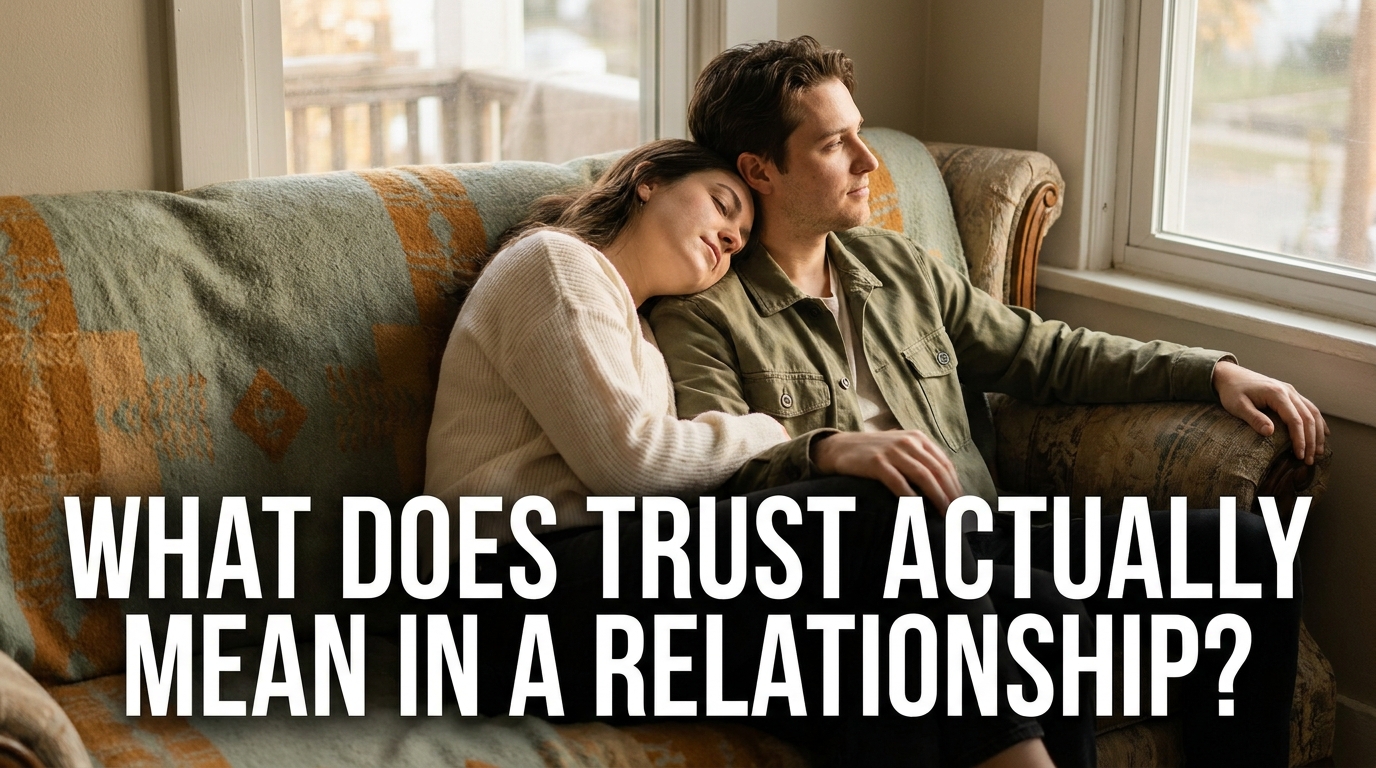
Most people think they know what trust means.
Loyalty. Honesty. Not cheating. Keeping your word.
These things matter — genuinely, significantly. But they are not the whole of trust. They are not even, for most people in most relationships, the part of trust that actually breaks when things go wrong.
The deeper truth about trust in relationships is that it is far more complex, far more multidimensional, and far more actively constructed than most people realize — until they find themselves in a relationship where something is missing and cannot quite name what it is.
Research by psychologist John Gottman found that the foundation of relationship trust is not the absence of betrayal but the consistent presence of specific behaviors — daily, small, unremarkable behaviors that accumulate over time into the bedrock of genuine safety between two people.
Trust is not a state you arrive at. It is something you build — through thousands of small moments — and something you can lose not only through dramatic betrayal but through the gradual accumulation of small violations that individually seem unremarkable.
This article is about what trust actually is. All of it.

Why Trust Is More Than Loyalty
The popular understanding of trust in relationships tends to collapse it into a single dimension: faithfulness. Are you loyal? Do you keep your promises? Have you done the thing that constitutes a betrayal?
This framing reduces trust to its most dramatic and most obvious violations — and in doing so, misses the vast majority of what trust actually is and how it actually functions in the daily life of a relationship.
Trust is not primarily about the absence of infidelity. It is about the presence of safety — psychological, emotional, and relational safety. The kind that allows a person to be fully themselves in the relationship without calculating whether it is safe to do so. The kind that makes vulnerability possible. The kind that tells the nervous system: this person will not use what you give them against you.
This kind of safety is built not through grand gestures and dramatic demonstrations of loyalty but through the accumulation of small, consistent, often unremarkable moments in which a person shows up in exactly the way they said they would.
The partner who follows through on small commitments. Who handles your vulnerabilities with care. Who tells you difficult truths in the way that someone who loves you tells difficult truths — with kindness, with timing, with the intention of being helpful rather than harmful. Who is the same person in private as they are in public. Who does not change their treatment of you based on who is watching.
These are the behaviors that build trust. And their absence — even when no dramatic betrayal has occurred — is what produces the gradual erosion of safety that makes a relationship feel unreliable without either person being able to articulate exactly why.
“Trust is built in very small moments. It is the look across the table. The willingness to stay in a hard conversation. The choice to prioritize the relationship over the impulse to be right.” — Dr. John Gottman
The Seven Dimensions of Trust in a Relationship
Trust is not one thing. It is several — and understanding each dimension separately makes it possible to identify where trust is intact and where it has been damaged in ways that might not have a name yet.
1. Reliability Trust — You Do What You Say You Will Do
This is the most fundamental dimension. Reliability trust is built through the consistent alignment of words and actions over time. You said you would be home at a certain time. You were. You said you would handle something. You handled it. You made a commitment — small or significant — and you kept it.
Reliability trust is damaged not only by obvious broken promises but by the accumulated weight of small misalignments — the consistently late arrival, the repeatedly forgotten task, the pattern of saying yes and meaning maybe. Each small misalignment is individually forgettable. The pattern they form is not.
This form of trust answers the question: can I count on you to be who you say you are?
2. Emotional Safety Trust — I Can Be Vulnerable Here
This is the dimension most people do not have a name for — and the one whose absence is most frequently the unnamed source of relationship dissatisfaction.
Emotional safety trust is the confidence that your inner world — your fears, your insecurities, your failures, your authentic feelings — can be brought into this relationship without being dismissed, ridiculed, weaponized, or met with a response that makes you regret having shared it.
It is built through hundreds of small moments in which vulnerability is met with care. The moment you shared something difficult and your partner listened without judgment. The moment you cried and were held without the discomfort being quickly managed away. The moment you expressed a fear and were not immediately reassured past it but actually heard.
It is damaged through moments in which sharing something vulnerable produced an outcome that taught you: keep that to yourself. The dismissal. The joke at the wrong moment. The information that was later used during a conflict. The eye-roll. The redirection. The subtle signal that your emotional experience is a problem to be solved rather than an experience to be witnessed.
This form of trust answers the question: is it safe to be real with you?

3. Honesty Trust — I Will Hear the Truth From You
Honesty trust is not simply the confidence that your partner does not lie. It is the confidence that they will tell you the truth — including the truths that are difficult to say and difficult to hear.
The partner who omits important information because it is uncomfortable. Who agrees with you in the moment to avoid conflict and then resents the agreement. Who tells you what you want to hear rather than what they genuinely think. Who presents a version of themselves or of events that is managed rather than truthful.
These are not lies in the dramatic sense. But they are violations of honesty trust — and they produce a specific kind of unease in a relationship, the sense that you are never quite sure if you are getting the full picture, that something is always slightly managed.
Honesty trust also includes the confidence that your partner will tell you difficult truths with care — not brutal honesty weaponized as permission to wound, but genuine honesty delivered with the timing, the tone, and the genuine regard of someone who tells you hard things because they respect you enough to trust you with them.
This form of trust answers the question: will I get the truth from you — even when it is hard?
4. Respect Trust — You See My Worth Even When I Cannot
Respect trust is the confidence that your partner holds you in genuine regard — that they see your worth, take your perspective seriously, and treat you as an equal regardless of circumstance.
It is damaged by contempt — the most toxic of Gottman’s Four Horsemen — but it is also damaged by subtler violations. The way they speak about you to others. The dismissal of your opinion in conversation. The failure to include you in decisions that affect you. The pattern of prioritizing their preferences over yours not occasionally, as all couples do, but structurally — as the default architecture of the relationship.
Respect trust answers the question: do you see me as a full person whose inner life, perspective, and worth are genuinely valued?
5. Loyalty Trust — You Are on My Side
Loyalty trust is the confidence that your partner’s fundamental allegiance is to you — to the relationship, to the partnership, to the shared life you are building — and that when competing pressures arise, that allegiance holds.
This does not mean your partner always takes your side in every conflict or that they validate every choice you make. Loyalty trust coexists entirely with honest disagreement. What it does not coexist with is the experience of your partner being systematically aligned against you — speaking disparagingly about you to others, taking others’ sides against you in contexts where you are not present to represent yourself, or making choices that consistently prioritize their interests at the expense of the partnership.
Loyalty trust answers the question: are you fundamentally on my side?

6. Predictability Trust — I Know Who I Am Dealing With
Predictability trust is the confidence that you know who your partner actually is — that their character, their values, their behavior are consistent enough that you can form reliable expectations about how they will act across a range of situations.
This is not about your partner being predictable in a boring or rigid sense. It is about character consistency — the confidence that the person you see on a Tuesday evening is the same person you will see on a difficult Friday, that their kindness is not a performance that disappears under pressure, that their stated values are reflected in their actual choices.
Predictability trust is damaged when someone’s behavior is dramatically inconsistent — when they are one person in public and another in private, when their values appear to shift depending on convenience, when their treatment of you varies widely in ways that cannot be explained by ordinary human variability.
This form of trust answers the question: do I know who you actually are?
7. Growth Trust — You Are Willing to Become Better
This dimension of trust is rarely discussed and profoundly important.
Growth trust is the confidence that your partner is genuinely invested in becoming better — not perfect, but better. That when they cause harm, they will acknowledge it and work to change. That when patterns in the relationship are not serving both people, they will engage with that rather than defend against it. That they see the relationship as something worth investing in and developing over time.
A partner who is completely defensive about their own patterns — who cannot hear feedback, who interprets any concern as an attack, who treats any request for change as an affront — erodes growth trust. Not because they are not good enough but because growth trust requires the willingness to examine oneself honestly and to take another person’s experience seriously.
This form of trust answers the question: are you willing to become better for us?
How Trust Is Built — The Daily Architecture
Understanding what trust is, is the first step. Understanding how it is built is the second — and the more practically important one.
Gottman’s concept of the Trust Metric describes trust as something that accrues through what he calls small moments of attunement — moments in which a partner makes a choice that prioritizes the relationship over their own immediate comfort, convenience, or impulse.
These moments are almost never dramatic. They are:
The choice to put the phone down and be fully present when your partner needs to talk.
The follow-through on a small commitment that would have been easy to forget and easier to let slide.
The moment you choose to say the difficult, honest thing rather than the comfortable, managed version.
The repair attempt — the gesture toward reconnection after conflict — that you make even when everything in you wants to wait for them to make it first.
The moment you respond to your partner’s emotional expression with curiosity rather than defensiveness.
The choice to speak well of your partner to others when they are not present.
None of these are remarkable individually. Accumulated over months and years, they become the bedrock on which genuine relational safety is built. They are, as Gottman says, how trust is built — not in the dramatic moments but in the ordinary ones.

How Trust Is Lost — The Gradual Erosion
Just as trust is built through small moments, it is lost through them — and understanding this is as important as understanding how it is built.
The dramatic betrayals — infidelity, significant lies, public humiliation — are obvious violations. They rupture trust in ways that are immediately visible and immediately painful.
But trust is also lost through accumulation — through the gradual weight of many small moments in which the choice that would have built trust was made, and the alternative was chosen instead.
The repeated lateness. The consistently unkept small promises. The pattern of dismissing your partner’s feelings in ways that never rise to the level of obvious cruelty. The habit of speaking about your partner to others in ways that would surprise them. The consistent prioritization of your own comfort over their stated needs.
None of these are dramatic. Each is individually explainable, forgivable, unremarkable. Together, over time, they produce the particular relationship feeling of being with someone who cannot quite be counted on — a pervasive unease, a background wariness, a relationship that looks fine from the outside while the person inside it feels, without being able to fully articulate why, that something is missing.
This form of trust erosion is one of the most common and most underacknowledged sources of relationship dissatisfaction. Because it has no single cause, it resists the simple narrative of “they betrayed me.” It is harder to name. And things that are hard to name are hard to address.
Rebuilding Trust After It Has Been Damaged
Whether trust has been damaged through dramatic betrayal or through the slower erosion of accumulated small violations, the principles of rebuilding share certain fundamental elements.
Acknowledge specifically what happened. Not “I know I have not been great lately” but “I understand that the specific pattern of X has made you feel Y. That is on me.” Specificity is what makes acknowledgment feel real rather than performative.
Stop the behavior that is causing the damage. This sounds obvious. It is not always honoured. Genuine rebuilding cannot proceed alongside continued erosion. The first step in rebuilding any dimension of trust is the reliable cessation of what has been damaging it.
Make the changed behavior visible and consistent. Trust rebuilt through changed behavior requires that the changed behavior be consistent enough, across a long enough period, that the nervous system can update its assessment. This takes longer than most people want it to. It takes as long as it takes.
Be patient with the lagged response. Trust is not rebuilt the moment the damaging behavior stops. The person whose trust was damaged has developed adaptive responses — wariness, hypervigilance, guardedness — that will persist for some time after the behavior has genuinely changed. This lag is not stubbornness or unforgiveness. It is the nervous system catching up with new evidence. It requires patience and genuine consistency rather than the expectation that change demonstrated should immediately produce change felt.

Trust and Vulnerability — The Relationship That Defines Everything
The deepest truth about trust in relationships is this: trust and vulnerability are not separate things. They are the same thing, viewed from different angles.
Trust is what makes vulnerability possible. Vulnerability is what builds trust.
You cannot have genuine intimacy — the kind that sustains a relationship through decades and difficulty — without both. The relationship that has trust without vulnerability is a relationship in which both people have kept themselves at a safe distance from the thing they actually need. The relationship that attempts vulnerability without trust is one that will produce injury rather than closeness.
Building trust is, at its root, the practice of making vulnerability safe — for yourself, and for the person you are with. It is the daily, small, unglamorous work of showing up in the ways that tell another person: what you give me will be held with care. I am worthy of your openness. And what I give you will be safe here.
That practice — sustained over years, through difficulty and ordinariness and everything in between — is what trust actually is. Not a destination. Not a certificate of loyalty. Not the absence of betrayal.
A living thing. Built daily. In small moments. Between two people who keep choosing it.
Trust is not what you declare. It is what you demonstrate — in the thousand unremarkable moments when no one is watching and the choice is entirely yours.
CALL TO ACTION
💾 Save this — share it with your partner and talk about which of these dimensions feel strongest and which need more attention. 📤 Tag someone who is trying to understand what has changed in their relationship without being able to name it. 👣 Follow Truthsinside.com for honest, psychology-backed relationship content every week.
Frequently Asked Questions
Q1: Can you trust someone and still feel insecure in a relationship? Yes — and this distinction is important. Relational insecurity and the absence of trust are not the same thing. Insecurity in a relationship is often rooted in attachment style — in the anxious person’s nervous system reading ordinary relationship events as potential threats, regardless of their partner’s actual trustworthiness. A securely behaving partner can be genuinely trustworthy while their anxiously attached partner still experiences significant insecurity. Understanding whether your insecurity is rooted in your partner’s actual behavior or in your own attachment patterns — ideally with therapeutic support — is one of the most important questions in any relationship where trust feels uncertain.
Q2: What is the difference between trust and control? Trust involves the willingness to be vulnerable — to accept that you cannot guarantee outcomes and to choose engagement with that uncertainty. Control is the attempt to eliminate that uncertainty — to manage a partner’s behavior, access, and relationships in ways that substitute surveillance for genuine trust. Control looks like trust from the inside because it is driven by the same fear — the fear of being betrayed, of being hurt, of losing something important.
But control cannot build trust. It can only prevent the conditions in which trust might develop. A relationship in which one partner is controlled is not a relationship in which trust exists. It is a relationship in which the need for trust has been bypassed through management.
Q3: Is trust the same as forgiveness? No — and conflating them is one of the most common mistakes in the aftermath of betrayal. Forgiveness is an internal process — the release of the emotional weight of what was done, undertaken for the forgiver’s own wellbeing rather than as a gift to the person who caused harm. Trust is a relational assessment — a judgment, based on evidence, about whether a person’s behavior warrants confidence. You can forgive someone fully and completely without trusting them — because forgiveness addresses the past and trust addresses the future. Trust rebuilt after significant betrayal requires both forgiveness and the accumulation of new evidence — demonstrated behavioral change over a significant period of time.
Q4: How do you build trust with someone who has been deeply hurt before? Through patience, consistency, and the genuine willingness to be trustworthy at the pace their nervous system can update its assessment — which will be slower than you would like, and exactly as slow as their history requires. The person who has been deeply hurt carries an adaptive wariness that was built for protection. It does not dissolve because you have demonstrated trustworthy behavior for two months. It updates — incrementally, non-linearly — as the evidence accumulates over a longer period.
The most important things are consistency (being the same person in all circumstances, not just the ones being evaluated), transparency (offering information freely rather than defensively), and patience with the lagged response that is not stubbornness but the nervous system doing its job.
Q5: Can trust exist without communication? Not in its full dimensions. Some forms of trust — reliability trust, for instance — can be built through consistent action even in a relationship where communication is limited. But emotional safety trust, honesty trust, and growth trust all require direct, honest, vulnerable communication. The willingness to express what is genuinely true — including what is difficult, what is needed, what is not working — is both a demonstration of trust and a builder of it. A relationship in which genuine communication is absent or consistently avoided is one in which trust remains partial — because the full dimensions of genuine safety require the full dimensions of genuine honesty.
🎵 Music
Maren Lull is a singer-songwriter who writes from the places most people don’t talk about out loud.
Not the dramatic grief. Not the obvious heartbreak. The quiet kind — the ordinary Tuesday emptiness, the habit of reaching for someone who isn’t there anymore, the particular exhaustion of being strong for so long that the strength itself wears thin.
Her music lives at the intersection of emotional honesty and soft beauty — breathy vocals over gentle piano, slow tempos, lyrics that feel less like songs and more like something you wrote in a private notebook at two in the morning and never showed anyone.
Maren Lull writes for the people who feel everything deeply and say very little about it. For the ones who listen to sad music not because they want to feel worse — but because being understood, even by a song, makes the feeling easier to carry.
📱 Follow Maren Lull:
→ Spotify
→ Apple Music
→ Youtube
→ Audiomack