It doesn’t happen overnight. One day you are finishing each other’s sentences, talking until 3am about everything and nothing, feeling like this person is the one human being on earth who truly gets you. And then — slowly, quietly, without either of you deciding to — the conversations get shorter. The silences get longer.
You start talking about schedules and groceries and whose turn it is to call the plumber. And somewhere along the way, the real conversations — the ones about feelings and fears and dreams and what actually happened today — simply stop. Research from the University of Michigan found that couples in long-term relationships spend an average of just 35 minutes per week in meaningful conversation. Thirty-five minutes. If that number feels uncomfortably familiar, this article is for you.

The Slow Fade — How It Actually Happens
Nobody wakes up one morning and decides to stop talking to their partner. The silence in long-term relationships is almost never a single event. It is a gradual accumulation — a series of small moments where connection was possible and didn’t happen, until eventually not connecting becomes the new normal.
It usually begins innocuously. Life gets busy. Work demands increase. Children arrive. Routines solidify. The conversations that once happened naturally — late at night, on long drives, over unhurried meals — get squeezed out by the logistics of a shared life. And because neither partner consciously chose this, neither partner knows quite how to name it or reverse it.
What makes this particularly painful is the contrast. The memory of how things were — the ease, the depth, the feeling of being truly known — makes the current silence feel not just lonely but like a loss. Like grief for something that is still technically present but somehow gone.
Understanding why couples stop talking is the first step toward doing something about it. And the reasons are almost always more specific — and more fixable — than they appear.
7 Real Reasons Couples Stop Talking
1. Conversations Stopped Feeling Safe
This is the most common and most underacknowledged reason. When someone shares something vulnerable and it is met with dismissal, criticism, humor at the wrong moment, or simply a distracted response — they learn, quietly and without drama, that this is not a safe place to bring their inner world.
It rarely takes a dramatic incident. A handful of moments where you felt unheard, judged, or insignificant is enough to teach the nervous system: keep it to yourself. Over time, both partners may be doing this simultaneously — both protecting themselves, both wondering why the other has gone quiet, neither aware that the silence is mutual self-protection.
When conversation stops feeling safe, people don’t announce it. They simply stop talking.
2. Resentment Has Built Up Unaddressed
Unspoken resentment is one of the quietest and most corrosive forces in a relationship. It accumulates in the space where honest conversation should be — each unexpressed grievance adding another thin layer of distance until the accumulated weight makes genuine connection feel almost impossible.
When resentment is present, even the most ordinary interaction carries an undercurrent of tension. Small talk feels hollow. Attempts at connection feel performative. And the things that actually need to be said feel so loaded, so layered with everything that has gone unsaid before them, that it becomes easier to say nothing at all.
Resentment doesn’t announce itself. It shows up as irritability, withdrawal, sarcasm, and a creeping sense that you and your partner are no longer quite on the same side.

3. Life Took Over and Connection Got Deprioritized
In the early stages of a relationship, connection is the point. Everything else organizes around it. But as life deepens — careers, children, mortgages, aging parents, health challenges — connection gradually gets pushed further and further down the priority list until it falls off entirely.
This is not a moral failing. It is what happens when two people are genuinely trying to manage the weight of a full life together. But the consequence is real: relationships require active investment to stay emotionally alive. A relationship that runs on autopilot for long enough will eventually feel like a logistical arrangement rather than an intimate partnership.
The tragedy is that both partners often feel this happening and neither knows how to interrupt it without it feeling forced or awkward after so long.
4. Technology Filled the Silence
This one is relatively new in the long history of human relationships — but it has become one of the most significant. Smartphones, streaming services, social media, and endless digital content have given us an infinite supply of ways to be alone together. To occupy the same physical space while being entirely absent from each other.
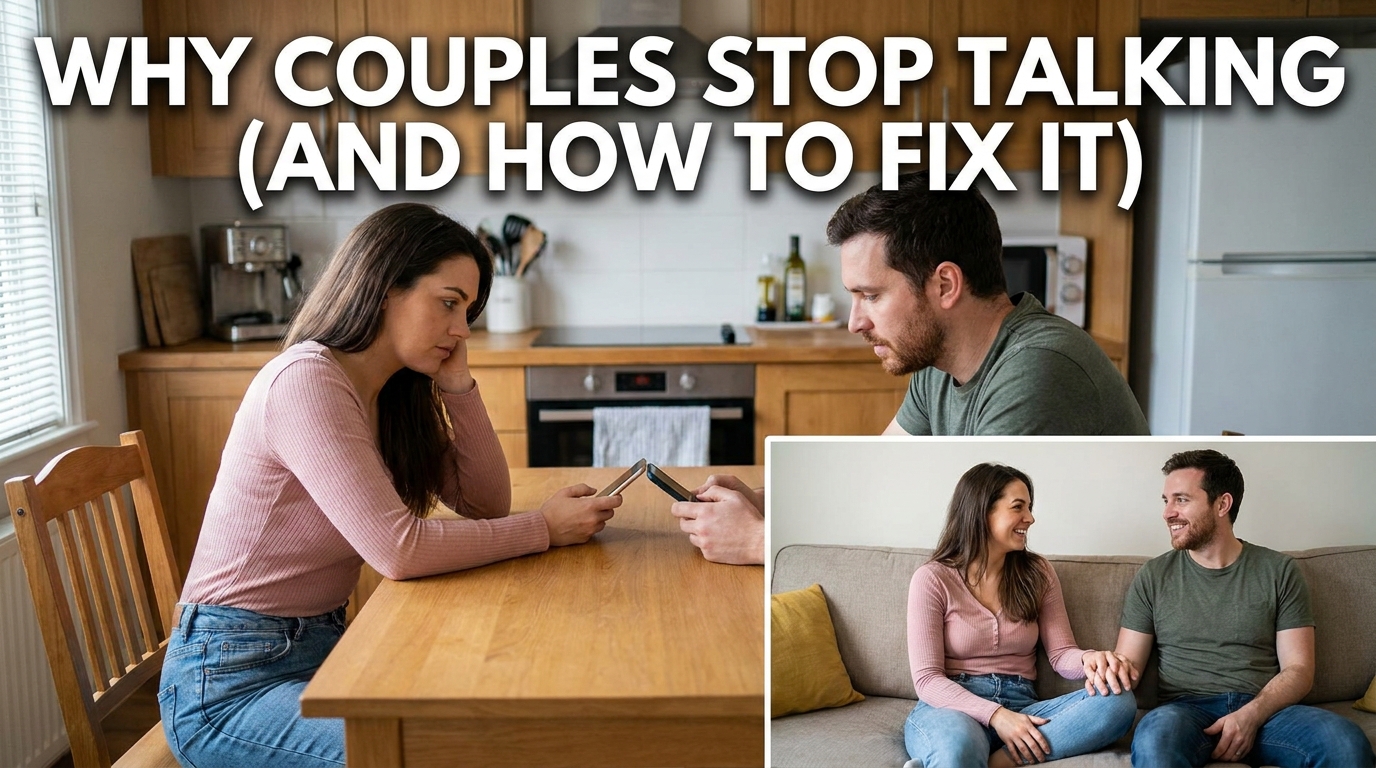
The danger of technology in relationships is not dramatic — it doesn’t look like neglect. It looks like two people relaxing on a couch together. It feels, on the surface, like companionship. But the cumulative effect of hundreds of evenings where real conversation was replaced by parallel screen time is a relationship that slowly empties of genuine intimacy.
The phone is not the villain. But the habit of reaching for it instead of each other, repeated often enough, quietly becomes its own kind of estrangement.
5. They Never Learned How to Talk About Feelings
Many people — particularly those who grew up in households where emotional expression was discouraged, mocked, or simply absent — never developed the vocabulary or the felt sense of safety required for emotional conversation. They are not unwilling to be vulnerable. They genuinely don’t know how.
In the early stages of a relationship, the intensity of new love often overrides these limitations temporarily. But as the relationship matures and deeper emotional communication is required, the gap becomes visible. One partner may want to go deeper. The other doesn’t know how — and may not even fully understand why.
This is not a character flaw. It is a skill deficit — one that can be addressed, with patience, the right tools, and often professional support.

6. Past Conversations Went Badly
If previous attempts to talk — about feelings, about problems, about needs — consistently ended in conflict, defensiveness, or emotional shutdown, the rational response is to stop trying. Why open a door that has led somewhere painful every time?
This pattern is especially common when one partner tends to get flooded during emotional conversations and the other shuts down in response. Both leave the conversation feeling worse than before it started. Both begin to associate “real talk” with pain and conflict. And so, gradually, real talk stops happening.
The avoidance feels protective. And in the short term, it is. But the long-term cost — a relationship that stays permanently on the surface — is far greater than the discomfort of learning to have those conversations better.
7. They Grew in Different Directions — Without Noticing
People change. Values shift. Interests evolve. The person you were at 28 is not exactly the person you are at 38. And when two people grow in different directions without actively investing in knowing each other through that growth, they can find themselves — years later — sharing a life with someone they no longer fully know.
This is not necessarily the end of a relationship. But it does require acknowledgment and active effort. Couples who stay genuinely connected over decades don’t do so by accident. They do so by continuing to be curious about each other — by treating their partner as someone still worth discovering, rather than someone already fully known.
How to Fix It: 9 Ways to Start Talking Again
1. Name What’s Happening — Without Blame
The first step is the most important and often the most avoided: acknowledging that something has changed. Not as an accusation — “you never talk to me anymore” — but as an honest, shared observation.
Try: “I’ve noticed we haven’t really talked — really talked — in a while. I miss you. Can we change that?”
This simple statement does something powerful. It names the distance without assigning fault. It expresses longing rather than grievance. And it invites rather than demands. Most partners, when approached this way, feel relief rather than defensiveness — because they have felt it too.
2. Bring Back the Undivided Hour
Choose one hour per week — the same time each week if possible — that belongs entirely to the two of you. No phones. No television. No agenda beyond being together and talking. It doesn’t have to be a deep emotional excavation every time. Sometimes it’s a walk. Sometimes it’s cooking together. Sometimes it’s sitting with tea and asking each other questions you’ve never thought to ask before.
The consistency matters more than the content. Regular, protected time for connection sends a message to both partners: this relationship is a priority. That message, repeated weekly, begins to shift the emotional climate of the entire relationship.

3. Ask Better Questions
“How was your day?” is a closed door. It invites “fine” and closes. Better questions open space for real conversation.
Try:
- “What was the best moment of your week — and the hardest?”
- “Is there anything you’ve been thinking about lately that you haven’t told me?”
- “What’s something you’re looking forward to right now?”
- “Is there anything you need from me that you haven’t known how to ask for?”
Questions like these signal genuine curiosity — not checklist conversation, but real interest in the interior life of the person sitting across from you. And genuine curiosity, expressed consistently, is one of the most powerful forces for reconnection that exists.
4. Revisit Who You Each Are Now
If you have been together for years, some of your assumptions about each other may be significantly outdated. People change — their fears, their dreams, their opinions, their relationship with themselves. Treating your partner as a fully discovered person rather than someone still worth knowing is one of the quietest ways intimacy fades.
Try the practice of deliberate rediscovery: ask your partner questions as if you are meeting them for the first time. What are they most proud of right now? What are they most afraid of? What do they wish you understood about them that they’ve never quite managed to say?
You may be surprised by the answers. That surprise is intimacy returning.
5. Address the Resentment — Carefully and Directly
If unspoken resentment is part of what has silenced the relationship, it needs to be addressed — not avoided. Not all at once, and not without care. But the accumulated weight of what has gone unsaid will not dissolve on its own.
Begin with the smallest, most recent grievance rather than the oldest or largest. Raise it using “I” statements and positive needs. Give your partner the opportunity to hear it and respond. Then — crucially — actually listen to their response rather than preparing your next point.
One honest conversation, handled with care, can begin to shift what has felt like an immovable weight. Resentment loses its power when it finally has somewhere to go.
6. Create New Shared Experiences
Novelty — doing something new together — has been consistently shown in relationship research to reactivate the neural pathways associated with early romantic connection. New experiences create new conversations. New conversations create new dimensions of knowing each other.
This doesn’t require grand gestures. A new restaurant. A weekend drive somewhere neither of you has been. A class taken together. A book read simultaneously and discussed. The point is not the activity — it is the shared freshness of it, and the conversations it naturally generates.

7. Put the Phones Down — With Intention
This is not about demonizing technology. It is about making a conscious, shared decision to protect certain times and spaces from it. Dinner. The first thirty minutes after getting home. The hour before bed. These small, protected pockets of phone-free time create the conditions in which real conversation can happen — not forced, just possible.
Consider making it a shared agreement rather than a rule: “Can we try keeping phones off the table during dinner this week?” A mutual choice feels collaborative rather than restrictive — and is far more likely to stick.
8. Seek Support If the Silence Feels Too Heavy to Break Alone
Sometimes the distance between two people has grown large enough that bridging it without support feels genuinely impossible. Not because the relationship is over — but because the patterns are entrenched, the resentment is deep, and neither partner knows how to begin without it immediately going wrong.
Couples therapy is not a last resort. It is a skilled intervention — a trained third party who can help both partners feel safe enough to say what has been unsaid, hear what has been unheard, and find a path back to each other that neither could find alone.
Seeking help is not an admission of failure. It is evidence of commitment — to the relationship and to each other.
9. Remember Why You Started Talking in the First Place
This sounds simple. It is not always easy. But it is powerful.
Think about the conversations you used to have. The things you couldn’t wait to tell them. The hours that disappeared. What did you talk about? What did they say that first made you think — this person is different? What version of yourself showed up in those early conversations that has been quieter lately?
That person is still there. So is theirs. And the conversation — however long it has been interrupted — can begin again. Any time. Starting now.
The silence between two people who love each other is never the end of the story. It is an invitation — to be brave enough to speak first.
💾 Save this — share it with your partner tonight. 📤 Send it to someone whose relationship could use a little more conversation. 👣 Follow Truthsinside.com for honest, psychology-backed relationship content every week.
Frequently Asked Questions
Q1: Is it normal for couples to stop talking as much over time? It is common — but common is not the same as healthy or inevitable. Research consistently shows that emotional communication tends to decrease in long-term relationships without intentional effort to maintain it. The couples who sustain genuine conversational intimacy over decades do so actively — through protected time, deliberate curiosity, and the willingness to address distance when it appears. The silence is normal. Accepting it as permanent is the mistake.
Q2: How do I get my partner to open up when they’ve completely shut down? Pushing rarely works — and often deepens the withdrawal. The more effective approach is creating the conditions in which opening up feels safe rather than demanded. This means consistent warmth without pressure, asking gentle questions without requiring answers, and demonstrating through your own behavior that vulnerability in this relationship is met with care rather than judgment. Change happens slowly here. Patience and consistency matter more than any single conversation.
Q3: Can a relationship recover after years of emotional silence? Yes — though the recovery requires honesty about what happened and genuine commitment from both partners. Years of emotional distance leave real residue: habits of withdrawal, accumulated resentment, and sometimes a loss of familiarity with each other that feels disorienting to address. Couples therapy is particularly valuable in these situations, providing both the tools and the safe container needed to begin rebuilding what has eroded. Many couples report that working through a significant period of disconnection ultimately deepens their relationship more than the disconnection damaged it.
Q4: What if only one of us wants to fix the communication problem? One person can begin the process — and sometimes that beginning is enough to shift the dynamic. Naming the distance, asking better questions, creating space for connection, and modeling the vulnerability you want to see can all be done unilaterally. However, genuine reconnection ultimately requires both partners to choose it. If sustained unilateral effort produces no response, individual therapy can help clarify whether the relationship dynamic is something that can be shifted — or whether deeper incompatibilities are at play.
Q5: How long does it take to reconnect after a period of emotional distance? There is no fixed timeline. Some couples feel a significant shift within weeks of beginning intentional reconnection practices. Others — particularly those where the distance has been long or the underlying issues are complex — find it a slower, more gradual process. What matters most is consistency of effort and genuine willingness from both partners. Small, regular investments in connection — weekly protected time, better questions, addressed resentments — compound meaningfully over months into something that feels genuinely different.
🎵 Music
Maren Lull is a singer-songwriter who writes from the places most people don’t talk about out loud.
Not the dramatic grief. Not the obvious heartbreak. The quiet kind — the ordinary Tuesday emptiness, the habit of reaching for someone who isn’t there anymore, the particular exhaustion of being strong for so long that the strength itself wears thin.
Her music lives at the intersection of emotional honesty and soft beauty — breathy vocals over gentle piano, slow tempos, lyrics that feel less like songs and more like something you wrote in a private notebook at two in the morning and never showed anyone.
Maren Lull writes for the people who feel everything deeply and say very little about it. For the ones who listen to sad music not because they want to feel worse — but because being understood, even by a song, makes the feeling easier to carry.
📱 Follow Maren Lull:
→ Spotify
→ Apple Music
→ Youtube
→ Audiomack