
Signs of Quiet Quitting in a Relationship
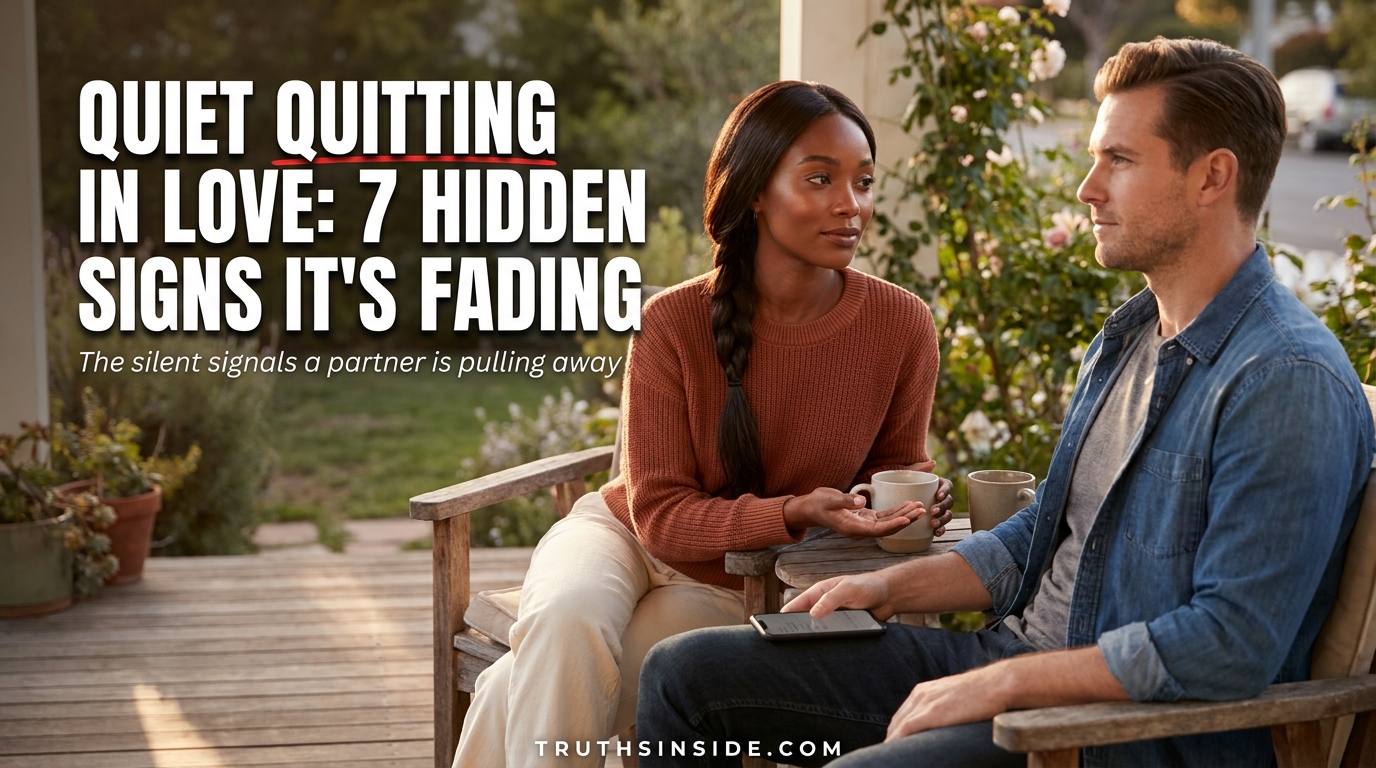
Quiet quitting in love rarely begins with a fight or a confession. It begins with a slow, silent step back: the goodnight kiss that gets shorter, the questions that stop coming, the plans that no longer include “we.” Nothing is officially wrong, and yet the person beside you seems to have moved out of your shared life while still living in your home.
Psychologist Caryl Rusbult and colleagues described four ways people respond to dissatisfaction in a relationship: exit, voice, loyalty and neglect. Neglect means passively letting the relationship fade by spending less time, paying less attention and putting in less effort. Quiet quitting in love is a modern name for that quiet, passive response.
This guide explains what quiet quitting in love looks like, seven hidden signs to watch for, how it differs from a rough patch and what to do whether you are the partner left behind or the one pulling away. It is written to bring clarity, not blame.
What Is Quiet Quitting in Love?
The phrase “quiet quitting” first went viral in the workplace, where it described employees who stop going above and beyond and do only what the job strictly requires. Quiet quitting in love follows the same logic. A partner stays in the relationship but quietly withdraws effort, attention and emotional investment, without announcing that anything has changed.
On the surface, life continues. The bills are paid, the kids are driven to school and holidays are planned. But the warmth, curiosity and playfulness that once made the relationship feel alive have faded. The partner is present physically but absent emotionally, going through the motions of a life together.
It differs from ending a relationship because no decision has been spoken. Often, the person is not even sure they have made one. Quiet quitting in love is usually the result of accumulated disappointment, fatigue or resentment that never found a voice. Understanding it as a signal, not a verdict, gives you a chance to respond before the distance becomes permanent.

Why Quiet Quitting in Love Happens
Most quiet quitters did not start out indifferent. They started out hurt, tired or discouraged. One common path begins with unmet needs. A partner asks for help, attention or change several times, and nothing shifts. Eventually, they stop asking, not because the need disappeared, but because asking feels pointless.
Another path runs through conflict avoidance. Some people fear that raising problems will lead to fights, criticism or abandonment. So they swallow their feelings and withdraw. Over time, this silence becomes a habit, and distance feels safer than honesty. Quiet quitting in love can look like peace, while it actually signals that someone has stopped trying.
Life stress plays a role, too. Work pressure, parenting, illness, money worries and grief can drain emotional energy until little is left for the relationship. Sometimes resentment builds around an uneven division of labor. Sometimes a person has lost hope that things can change. In every case, the underlying message is similar: “I do not believe my effort will make a difference.”
The loudest sign of a fading relationship is often silence.
Quiet Quitting in Love vs. a Temporary Rough Patch
Not every withdrawal means the relationship is ending. Every couple has seasons of distance, such as a new baby, a demanding project or a family crisis. Depression, burnout and anxiety can also make a person pull back in ways that look like quiet quitting in love, even when the person still cares deeply.
The difference usually lies in pattern, duration and response. A rough patch has a clear cause, and the partner remains warm when they have the energy. Quiet quitting in love tends to last for months, shows up across many areas of life and does not respond to attempts to reconnect. The person may seem indifferent to the distance itself.
A useful question is this: when you gently name the distance, does your partner show concern, curiosity or effort, even imperfectly? If so, you are likely in a rough patch. If you meet a shrug, irritation or “I am fine,” the pattern may run deeper. If you are unsure, remember that a partner’s mental health matters, and encourage them to seek professional support if they seem persistently low.
📃 Related article: Taking the Relationship for Granted: 7 Shocking Signs
7 Hidden Signs of Quiet Quitting in Love
No single sign proves that your partner has checked out. Look for clusters of behaviors that appear together, last over time and represent a change from how things used to be.
Sign 1: Effort Shrinks to the Bare Minimum
Chores get done, bills are paid and obligations are met, but the extras vanish. No spontaneous notes, no thoughtful gifts, no planning of dates. The relationship begins to feel like a business arrangement. One of the clearest signs of quiet quitting in love is that practical contributions continue while emotional ones disappear.
Sign 2: Conversations Grow Shorter and Shallower
Talk narrows to logistics: who is picking up the children, what is for dinner. Your partner stops sharing thoughts, worries and funny moments, and stops asking about yours. Answers are brief, such as “fine” or “nothing.” When you try to go deeper, the conversation closes. Many people describe this as living with a polite stranger.
Sign 3: The Fighting Stops, But Not Because Things Are Better
At first, the quiet feels like relief. No more arguments. But silence is not the same as harmony. In quiet quitting in love, a partner stops disagreeing because they have stopped caring about the outcome. “Whatever you want” and “I do not care” replace opinions. Researchers have noted that indifference can be more damaging than open conflict, since conflict at least signals investment.
Sign 4: The Future Disappears From the Conversation
Plans for holidays, trips, renovations and milestones go unanswered. When you mention next year, the response is vague or absent. Words like “we” and “our” fade, while “I” and “my” appear more often. Quiet quitting in love often shows up as a subtle refusal to imagine a shared future, even without saying so.
Sign 5: Affection and Intimacy Fade
Hugs become brief, kisses become routine and physical intimacy becomes rare or mechanical. Emotional closeness fades too: less eye contact, fewer private jokes, less touch for its own sake. This does not always mean a loss of attraction. It often reflects emotional distance, and in quiet quitting in love, the body follows the heart.
Sign 6: Their Energy Goes Elsewhere
Your partner seems more alive with work, a hobby, friends, a screen or a project than with you. They may stay late, plan solo trips or be absorbed in their phone. Everyone needs outside interests, so the sign is not the interest itself, but the contrast: they bring energy everywhere except home.
Sign 7: Your Feelings and Needs Barely Register
When you share a worry, there is little reaction. When you express a need, nothing changes. Your wins draw a flat “good for you,” and your sadness earns a distracted nod. This indifference to your inner world is what many partners find hardest, because it communicates, “I am not invested in how you feel.”

How Quiet Quitting in Love Progresses
Quiet quitting in love often moves through recognizable stages. Seeing them can help you spot where your relationship stands and what response is most useful.
In the first stage, unspoken resentment builds. Small disappointments accumulate, such as a forgotten birthday, an unshared chore load or a conversation that went nowhere. The partner feels unheard but does not say so, or says it once and gives up.
In the second stage, the partner begins to withdraw. They invest less time, share less and protect themselves by caring less visibly. The third stage is detachment, when the emotional bond weakens to the point where the person no longer feels the loss. The final stage may be exit: a sudden separation that seems to come from nowhere, though the partner has been leaving, emotionally, for a long time.
The hopeful truth is that the earlier you notice quiet quitting in love, the more options you have. Early stages respond well to honest conversation. Later stages usually require more effort, and sometimes professional help.
If You Feel Your Partner Is Quiet Quitting in Love
Discovering that your partner is pulling away is painful. You may feel lonely, anxious, angry or confused. You may find yourself working harder to win their attention, only to feel more rejected. This is common, and it is not your fault.
Resist the urge to chase or criticize. Researchers describe a “demand-withdraw” pattern, in which one partner pursues and the other retreats, and each response intensifies the other. The harder you push, the more your partner may pull away. Instead, aim for calm curiosity.
Choose a quiet moment and describe what you have noticed without accusing: “I have felt a distance between us lately, and I miss you. Can we talk about how things have been for you?” Then listen. Your partner may name frustrations they have held for a long time, which can be uncomfortable but also hopeful. If quiet quitting in love is addressed honestly, many couples find a path back to warmth.
If You Are the One Quietly Quitting
It takes courage to ask whether you are the one pulling away. If several signs described here feel familiar, begin with kindness toward yourself. Withdrawing is often a way to protect yourself from further hurt, stress or conflict.
Ask what you are protecting. Perhaps you gave up asking for something important. Perhaps you are exhausted and have nothing left. Perhaps you are not sure you want this relationship anymore. Naming the truth, even privately, is the first step. Rusbult’s research suggests that “voice,” speaking up about problems, is a constructive alternative to neglect.
Then speak. You might say, “I have been pulling away, and I want to understand why. I am not sure what I need, but I do not want to keep hiding.” That honesty gives your partner a chance to respond. Quiet quitting in love is sustained by silence, and the simplest antidote is to break it, even awkwardly.
How to Reverse Quiet Quitting in Love
Reversing the pattern takes effort from both partners, but the steps are simple and practical. Start with one or two, and build from there.
Step 1: Name the Distance Together
Agree that something has changed, without assigning blame. Use phrases such as “We seem to have drifted” and “I want us to feel close again.” Shared acknowledgment is the foundation, because quiet quitting in love thrives on what is left unsaid.
Step 2: Uncover the Unmet Needs
Ask each other what you have stopped asking for. It might be attention, help, affection, appreciation or a different way of handling conflict. Listening without defending is key. Understanding the hurt behind the withdrawal makes repair possible.
Step 3: Repair Old Resentments
Unresolved hurts keep the distance alive. Offer specific apologies, such as “I am sorry I dismissed your concern about money,” and acknowledge the effect. You do not need to resolve everything at once, but one honest repair can soften months of tension.
Step 4: Rebuild Small Rituals
Start with five minutes: a morning coffee together, a daily walk, a phone-free dinner. Gottman’s research on “bids for connection” shows that small moments of turning toward each other matter greatly. Quiet quitting in love is reversed in tiny, repeated acts of attention.
Step 5: Share Something to Look Forward To
A trip, a project, a class or a weekly date gives the relationship a future. Plan something together and talk about it. Anticipation reawakens curiosity and gives both partners a reason to invest again.
Step 6: Consider Couples Therapy
A trained therapist can help you untangle patterns that are hard to see from inside. Approaches such as Emotionally Focused Therapy and the Gottman Method are designed to help couples reconnect. Therapy is not an admission of failure. It is a way of taking the relationship seriously.

A Composite Example of Quiet Quitting in Love
This story is a composite based on patterns couples often describe, not a real individual. Nina and Caleb had been together for eight years. For months, Nina noticed that Caleb no longer asked about her day. He still made dinner and handled the bills, but their evenings were quiet, and his phone seemed to absorb him.
Nina tried hints, then anger, then silence. Nothing changed. One night, instead of arguing, she said, “I miss you. I feel like we are roommates, and I am not blaming you. I just want to know what is going on.” Caleb was quiet for a long time.
He admitted that after a layoff two years earlier, he had felt ashamed and had stopped sharing his worries. He feared burdening her, so he withdrew. They began weekly check-ins and saw a counselor. Recovery was slow, but warmth returned. Looking back, Nina said the clearest sign had been the silence, and the best response had been the honest question. Their experience shows that quiet quitting in love can have understandable roots and a way back.
When Quiet Quitting in Love Means It May Be Time to Let Go
Sometimes, despite honest attempts, a partner remains unwilling to engage. They deny the distance, refuse counseling or confirm that they have no desire to change. In those situations, it is worth asking what you need and whether this relationship can provide it.
You may feel torn between hope and exhaustion. Consider how long the pattern has lasted, whether any effort has been returned and how the relationship affects your well-being. Staying in a relationship where you feel invisible can wear down your confidence over time. Quiet quitting in love that continues despite repeated, kind attempts to reconnect is meaningful information.
Leaving is a serious decision, and it deserves support. Talk with trusted friends, a therapist or a counselor. If at any time your relationship involves fear, intimidation or control, treat it as a safety issue. In the United States, the National Domestic Violence Hotline is available at 1-800-799-7233. You deserve a partner who chooses you actively, not one who merely remains.
📃 Related article: Processing Emotions Together: 7 Powerful Ways to Heal
FAQ: Quiet Quitting in Love
What is quiet quitting in love?
Quiet quitting in love describes a partner who stays in the relationship but quietly withdraws effort, attention and emotional investment, often without saying anything. They fulfill basic obligations but stop contributing warmth, curiosity and connection.
What are the first signs of quiet quitting in a relationship?
Early signs include shorter conversations, fewer questions about your life, less affection, no future planning and a sudden absence of arguments paired with emotional distance. Look for patterns that last for months, not isolated bad days.
Can a relationship recover from quiet quitting?
Yes, especially if it is noticed early and both partners are willing to talk honestly. Naming the distance, repairing resentments and rebuilding small rituals can bring warmth back. Couples therapy often helps.
Is quiet quitting in love the same as depression or burnout?
Not always. Depression and burnout can cause withdrawal that looks similar, even when a partner cares deeply. If your partner seems persistently low, exhausted or hopeless, encourage them to seek professional help, and approach the conversation with compassion.
How do I talk to my partner about quiet quitting?
Choose a calm moment and describe what you have noticed with “I” statements, such as “I have missed feeling close to you.” Avoid accusations, ask open questions and listen. If conversations keep stalling, a couples therapist can provide structure.
Final Thoughts
Quiet quitting in love is rarely about a lack of caring. More often, it is about a lack of hope that caring will be heard. The quiet is a signal, and signals are meant to be noticed.
If you see these signs, begin with one honest sentence. Name the distance, ask one real question and offer one small act of attention. Relationships are not rescued by grand gestures. They are rescued by two people deciding, again and again, to come back to each other.
Found this helpful? Please do three things:
- Save this article so you can return to the seven signs whenever the distance feels unclear.
- Share it with someone who might be feeling unseen in their relationship.
- Follow Truthsinside.com for more signs, signals and relationship insights.
🎵 Music
Maren Lull is a singer-songwriter who writes from the places most people don’t talk about out loud.
Not the dramatic grief. Not the obvious heartbreak. The quiet kind — the ordinary Tuesday emptiness, the habit of reaching for someone who isn’t there anymore, the particular exhaustion of being strong for so long that the strength itself wears thin.
Her music lives at the intersection of emotional honesty and soft beauty — breathy vocals over gentle piano, slow tempos, lyrics that feel less like songs and more like something you wrote in a private notebook at two in the morning and never showed anyone.
Maren Lull writes for the people who feel everything deeply and say very little about it. For the ones who listen to sad music not because they want to feel worse — but because being understood, even by a song, makes the feeling easier to carry.
📱 Follow Maren Lull:
→ Spotify
→ Apple Music
→ Youtube
→ Audiomack