
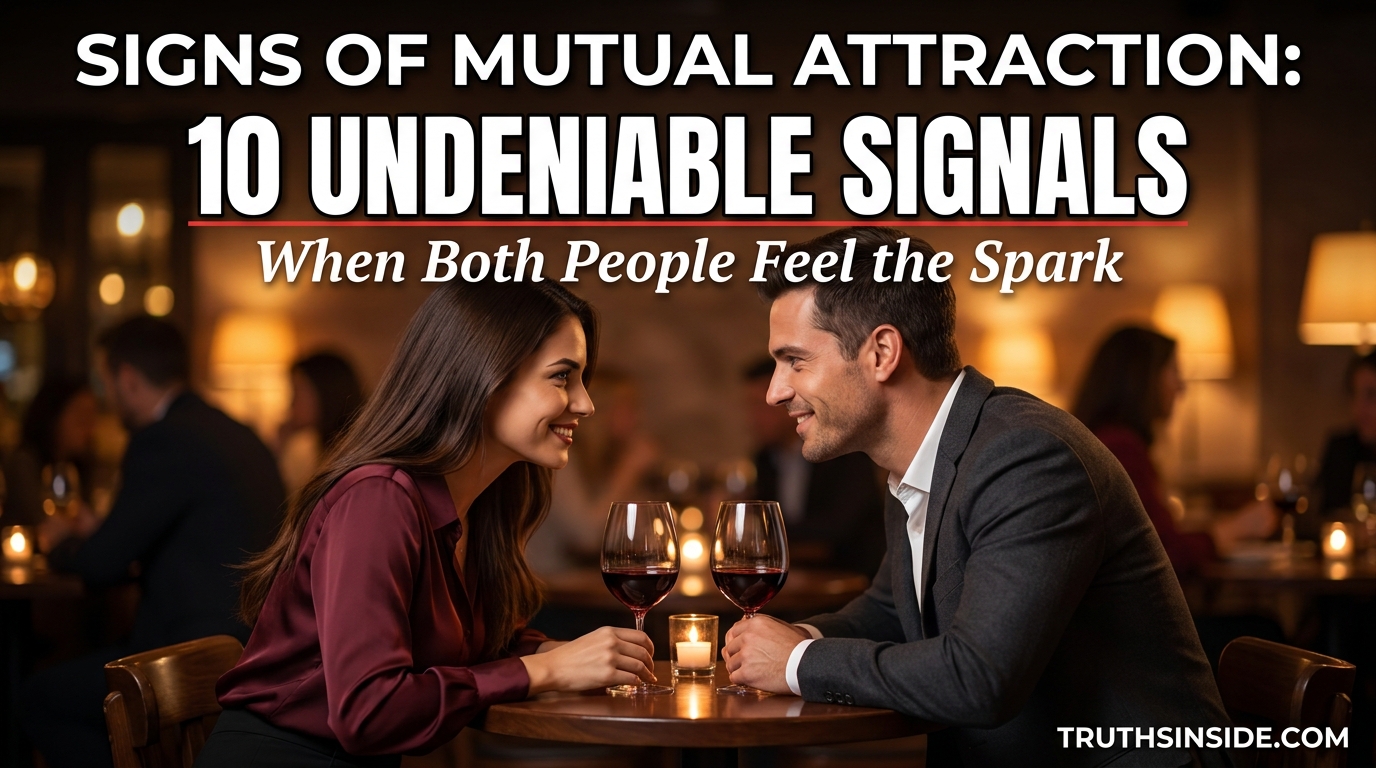
There is a particular kind of electricity that exists between two people when the attraction goes both ways. It is not the one-sided ache of wanting someone who doesn’t want you back. It is something altogether different — a current that runs in both directions simultaneously, lighting up a room, making conversation feel effortless, making time disappear. Most people have felt it at least once. Far fewer know how to recognize it clearly enough to trust what they’re feeling — or to act on it with confidence.
According to research published in the Journal of Nonverbal Behavior, humans are remarkably accurate at detecting mutual attraction when they know what signals to look for — but remarkably poor at trusting those signals without external validation. The study found that people correctly identified mutual attraction approximately 70% of the time based on behavioral and nonverbal cues alone, yet consistently second-guessed themselves due to fear of misreading the situation. We feel the spark. We see the signs of mutual attraction. And then we talk ourselves out of it.
Neuroscientist Dr. Lucy Brown, whose research at Albert Einstein College of Medicine examines the brain activity of people experiencing romantic attraction, explains that mutual attraction is not simply an emotional experience — it is a full neurological event. When two people feel genuine attraction simultaneously, measurable changes occur in brain chemistry on both sides: dopamine surges, serotonin fluctuates, and the brain’s reward circuits light up in ways that are remarkably similar to the effects of certain stimulant substances. The spark, in other words, is not a metaphor. It is biology. And it leaves very real, very readable signals in its wake. Here are the 10 most undeniable ones.
Sign 1: Signs of Mutual Attraction Start With the Eyes
Eye contact is the oldest and most reliable signal of attraction in the human behavioral repertoire — and when it is mutual, it creates one of the most unmistakable feelings two people can share.
Research by psychologist Zick Rubin at Harvard University found that couples deeply in love maintain eye contact approximately 75% of the time during conversation — significantly more than acquaintances or strangers. More tellingly, his research identified that the pattern of eye contact shifts when romantic interest is present: longer holds, more frequent returns to the other person’s gaze, and the phenomenon known as “gaze lingering” — the half-second delay before looking away that signals the brain’s reluctance to break the visual connection.
But mutual attraction eye contact has an additional dimension that one-sided attraction does not. When attraction is mutual, both people experience what researchers call “gaze reciprocity” — the instinctive mirroring of each other’s eye contact patterns. You hold their gaze a beat longer than normal. They hold yours right back. You look across the room and find them already looking. You glance away and feel their eyes return to you before you’ve finished looking down.
There is also the matter of pupil dilation — a physiological response that cannot be consciously controlled or performed. When a person looks at someone they are genuinely attracted to, their pupils dilate measurably. This is the nervous system’s honest response to something it finds compelling, and it happens identically in both people when attraction is mutual.
The eyes, in the context of signs of mutual attraction, don’t lie. They speak the truth of what the mind is sometimes still too cautious to admit.
Sign 2: Mirroring — The Body’s Unconscious Confession
One of the most scientifically validated signs of mutual attraction is behavioral mirroring — the unconscious tendency to replicate another person’s posture, gestures, speech patterns, and even breathing rhythm when you are drawn to them.
Psychologist Albert Mehrabian’s pioneering research on nonverbal communication established that the vast majority of human emotional communication occurs through body language rather than words. When two people are mutually attracted, their bodies begin to synchronize in ways that neither person is consciously orchestrating. She tilts her head slightly — he tilts his. He leans forward — she leans forward. She crosses her legs toward him — he orients his entire body in her direction.
This synchronization happens because mirror neurons in the brain — the same neural circuits responsible for empathy and social bonding — activate in the presence of someone we find compelling. We don’t decide to mirror. We simply do. And the more intense the attraction, the more pronounced and rapid the mirroring becomes.
What makes mirroring one of the clearest signs of mutual attraction specifically — as opposed to simply one-sided interest — is its reciprocal nature. When you notice someone mirroring your movements, it is your nervous system registering that their nervous system is responding to yours. It is two bodies having a conversation that the minds haven’t started yet.
Pay attention the next time you’re with someone you feel drawn to. Are they tilting toward you? Are their gestures beginning to echo yours? Is their energy rising and falling in sync with yours? If the answer is yes — and if you notice yourself doing the same — what you are witnessing is one of the most honest signs of mutual attraction the human body is capable of producing.
Related article: 15 Signs She Is Testing You: Why Women Test Men and What to Do
“The body always confesses what the mind is still debating. When attraction is mutual, two people begin to move like they already know each other — because on some level, they already do.”

Sign 3: They Find Reasons to Close the Physical Distance
Personal space is one of the most telling indicators of comfort, trust, and attraction in human behavioral science. Anthropologist Edward T. Hall’s foundational research on “proxemics” — the study of personal space — established that humans maintain distinct spatial zones for different types of relationships. Strangers and acquaintances are kept at social distance. Friends are permitted closer. And the people we are most drawn to, most comfortable with, and most attracted to are allowed into what Hall called the “intimate zone” — the space within approximately 18 inches.
When attraction is mutual, both people begin instinctively reducing the physical distance between them — and they find increasingly creative reasons to do so. They sit closer than the seating arrangement requires. They find reasons to touch — a hand on the arm during laughter, leaning in to hear better in a noisy room, a brief shoulder brush that lingers a half-second longer than necessary.
These are not accidents. They are the body’s navigation system pointing toward someone it wants to be near. And one of the most telling signs of mutual attraction is when this distance-closing is initiated by both people — when neither person is consistently the one leaning in while the other pulls back.
Watch the choreography of physical space between you and the person you’re drawn to. Do they find excuses to be in your orbit? Do they gravitate toward the seat closest to you? Do they lean in when they could simply speak louder? When the pull toward physical proximity is moving in both directions, that is one of the clearest and most honest signs of mutual attraction the body language research has to offer.
Sign 4: Laughter That Comes Too Easily — And Too Often
There is something specific and unmistakable about the laughter that happens between two mutually attracted people. It is not the polite laughter of social obligation. It is not the performative laughter of someone trying to impress. It is the slightly-too-easy, slightly-too-frequent, genuinely unguarded laughter of two people whose nervous systems are relaxed enough around each other — and stimulated enough by each other — to find everything funnier than it probably is.
Research by Dr. Jeffrey Hall at the University of Kansas, who has spent years studying humor and romantic attraction, found that the frequency and mutuality of laughter between two people is one of the strongest predictors of romantic interest. Specifically, his research found that when two people laugh together frequently and easily during early interactions, the likelihood of mutual romantic attraction is significantly higher than in interactions with lower shared laughter frequency.
This is because laughter in the context of attraction serves multiple neurological functions simultaneously. It releases oxytocin — the bonding hormone. It signals safety and comfort. It communicates that you find the other person’s mind delightful. And it creates shared private moments — inside jokes, callbacks, references that belong only to the two of you — that accelerate the formation of a unique relational world between you.
When you notice that conversations with someone consistently produce more laughter than your average interaction — and when you observe them laughing with the same ease and frequency — you are watching one of the warmest and most human signs of mutual attraction playing out in real time.
Sign 5: They Remember Everything You Said — Even the Small Things
Pay close attention to what someone remembers about you. Because attention is directional — it flows toward what matters. And when someone is genuinely, mutually attracted to you, what matters to them is you — in detail, in specificity, in the small throwaway things you mentioned once without thinking they’d register.
They remember the name of your childhood dog. They bring up a book you mentioned two weeks ago. They ask a follow-up question about a passing comment you made in a previous conversation and had already forgotten you’d said. This level of attentive recall is not an accident of good memory. It is evidence of focused, genuine interest.
Cognitive psychology research on attention and memory consistently shows that we encode and retain information most effectively when we are emotionally engaged with its source. In simple terms: we remember what we care about. When someone cares about you — when their brain has flagged you as significant — the details of your conversations, your preferences, your stories, and your offhand remarks get stored and retrieved with a precision that casual acquaintances simply don’t warrant.
This is one of the signs of mutual attraction that operates on a longer time horizon than the immediate physical signals. It reveals itself over the course of multiple interactions. And it is perhaps the most intimate signal of all — because it tells you not just that someone finds you attractive, but that they find you genuinely interesting. That they are paying attention not just to how you look, but to who you are.

Sign 6: Nervous Energy That Neither Person Can Quite Hide
Here is an interesting paradox in the signs of mutual attraction: the more genuine the attraction, the more likely both people are to display the very nervousness they are desperately trying to conceal. Fidgeting slightly. Speaking faster or slower than usual. A brief flush of color across the cheeks. An uncharacteristic stumble over words from someone who is normally articulate and confident.
This nervousness is not a sign of weakness or discomfort in the negative sense. It is the physiological signature of someone whose nervous system is fully activated by another person. Adrenaline is present. Dopamine is surging. The brain is operating at heightened alertness because it has identified this person as someone who matters.
What makes nervous energy one of the distinguishing signs of mutual attraction — as opposed to simply one person being nervous in the presence of someone they like — is when both people display it. When you notice that they fumble slightly, laugh a little too quickly to fill a silence, or seem uncharacteristically flustered in your presence — while you are simultaneously experiencing your own version of the same thing — you are witnessing mutual nervous energy. Two people whose composure is slightly undone by each other.
Behavioral researchers refer to this as “arousal symmetry” — the matching of physiological activation states between two attracted individuals. It is one of the most honest signals the body produces, precisely because it is so difficult to suppress. You cannot decide not to feel nervous around someone who genuinely thrills you. And when that nervousness is visibly mutual, it is one of the most quietly thrilling signs of mutual attraction you will ever observe.
Sign 7: Conversations That Lose All Track of Time
Time perception is one of the most fascinating and least discussed signs of mutual attraction. Under normal social circumstances, humans are reasonably accurate at estimating the passage of time. We know roughly when an hour has passed, when a conversation has run its natural course, when we are ready to go home.
But in the presence of someone we are mutually attracted to, this internal clock breaks down almost entirely. What felt like thirty minutes was two hours. A conversation that started as a quick coffee became an afternoon. You looked up and the restaurant was empty and the staff was quietly hoping you’d notice.
This temporal distortion is not imagination. It is neurological. Dopamine — released in abundance during genuine mutual attraction — affects the brain’s internal timing mechanisms, causing time to feel subjectively shorter when the experience is intensely rewarding. The brain is so engaged, so stimulated, so thoroughly absorbed in the interaction, that it simply does not allocate the usual monitoring resources to tracking time.
But what specifically makes this one of the signs of mutual attraction — rather than simply a sign that you find someone interesting — is the participation of both people in that absorption. Neither person is checking their phone. Neither person is glancing toward the exit. Neither person is doing the subtle social math of wondering when it’s polite to leave. Both people have, without discussion or agreement, chosen to stay inside this particular bubble of time together. That shared, unspoken decision to keep going is one of the most honest signals two people can send each other.
Sign 8: They Show You Their Real Self — Earlier Than Expected
Most people wear social armor in new interactions. They present their most polished, most agreeable, most carefully curated self to people they don’t yet know well. This is normal and largely unconscious — the social self-protection system doing its job.
But when mutual attraction is present, that armor comes off earlier and more completely than usual. People share opinions they normally soften. They reveal quirks they normally hide. They talk about things that matter to them — genuinely, not performatively — and they do so with a vulnerability that typically takes much longer to earn.
This early authenticity is one of the most beautiful and reliable signs of mutual attraction because it reveals what is happening beneath the surface of the attraction itself. It is not just that you find this person physically appealing. It is that something about their presence makes you feel safe enough to be real. And when that safety is mutual — when they are also showing you more of themselves than they typically would at this stage — what you are experiencing is the beginning of genuine emotional connection building on top of physical chemistry.
Psychologist Arthur Aron’s famous “36 Questions That Lead to Love” research demonstrated that escalating mutual self-disclosure — the progressive sharing of increasingly personal information in a reciprocal pattern — is one of the fastest and most reliable routes to genuine interpersonal closeness and romantic bonding. When this process happens naturally and spontaneously between two people, without the structure of an experiment, it is a sign that the attraction is driving both of them toward real intimacy rather than surface-level interaction.
“When someone makes you feel safe enough to be real before you’ve had enough time to be careful, that is not a coincidence. That is chemistry doing something beautiful.”
Sign 9: The Charged Silence That Needs No Words
Not all signs of mutual attraction are loud. Some of the most powerful ones are quiet — specifically, the quality of silence that exists between two mutually attracted people.
Most new social interactions cannot tolerate silence. An awkward pause is filled immediately with filler conversation, nervous laughter, or a reach for a phone. Silence between people who do not feel connected feels like exposure — a gap that reveals the absence of genuine rapport.
But between two people experiencing mutual attraction, silence takes on an entirely different quality. It becomes comfortable. Charged, yes — but not uncomfortably so. It is the silence of two people who have become so attuned to each other’s presence that conversation is no longer required to maintain the connection. They can simply exist in the same space and feel the warmth of it.
This comfortable, charged silence is one of the most intimate signs of mutual attraction because it requires a level of mutual ease that cannot be performed. You cannot fake being comfortable in silence with someone. Either the silence feels okay — even good — or it doesn’t. And when both people can sit in that charged quiet and find it pleasant rather than panicked, the connection between them has reached a depth that goes beyond initial attraction into something with real roots.
Sign 10: They Make an Effort That Doesn’t Look Like Effort
The final and perhaps most telling of all signs of mutual attraction is the quality of effort both people extend toward each other — and specifically, how naturally that effort seems to flow.
When attraction is mutual, both people show up differently than they do in ordinary interactions. They dress with slightly more care. They arrive on time, or early. They follow up after plans are made. They remember to ask about things you mentioned. They think of you between interactions and find small ways to let you know — a text about something that reminded them of your last conversation, a recommendation for something you said you wanted to try, a check-in that wasn’t required but felt natural.
This is effort. Real, deliberate effort. But the remarkable quality of mutual attraction is that it transforms effort into something that feels effortless — both to the person giving it and to the person receiving it. Because when you genuinely want to show up for someone, showing up doesn’t feel like work. It feels like the most natural thing in the world.
Research on relationship initiation consistently shows that reciprocal investment — when both parties are contributing comparable levels of effort and attention to the developing connection — is the single strongest predictor of whether initial attraction will evolve into a lasting relationship. One-sided effort, no matter how sustained, cannot build the same foundation that mutual effort builds naturally and almost inevitably.
When you notice that both of you are extending this kind of easy, natural, reciprocal effort toward each other — without scorekeeping, without resentment, without one person carrying the weight while the other simply receives — you are looking at one of the clearest and most hopeful signs of mutual attraction that exists.
Related article: Signs He Likes You But Is Scared: 18 Behaviors Men Show When Afraid to Commit

What to Do When You Recognize These Signs
You’ve read the signs. You’ve recognized several — maybe most — of them in a connection you have right now. Your eyes keep finding each other. The laughter comes easily. Time disappears. The silence feels warm rather than awkward. You both seem to show up for each other in ways that feel natural and reciprocal.
So what do you do with that?
First — trust it. One of the most consistent findings in attraction research is that humans consistently underestimate the accuracy of their own intuitive readings of mutual interest. The fear of being wrong, of misreading the situation, of making things awkward, causes people to dismiss or override signals that their minds and bodies have correctly identified. If multiple signs on this list are present, consistently, across multiple interactions — trust what you’re observing.
Second — give it room to breathe. Mutual attraction is a beginning, not a conclusion. It is the opening chapter, not the whole book. The signs of mutual attraction tell you that the spark is real and that it is shared. They do not tell you automatically that this person is right for you, that the timing is correct, or that the connection will develop into something lasting without care and intention. Attraction is the invitation. What you build with it is the relationship.
Third — do something about it. Lean in. Start the conversation. Suggest the plan. Send the text. Life is genuinely too short to spend it wondering whether the spark was real when every signal available to you is telling you that it was.
The signs were always there. Now you know how to read them.
If this article gave you the clarity or the confidence you needed — save it, share it with someone who’s been overthinking a connection, and follow Truthsinside.com for more honest, research-backed insights about love, attraction, and the signals that matter most.
FAQ
Q: What are the most reliable signs of mutual attraction?
A: The most scientifically reliable signs of mutual attraction include sustained and reciprocal eye contact, unconscious behavioral mirroring, mutual reduction of physical distance, easy and frequent shared laughter, and reciprocal effort in the relationship. When several of these signals are present simultaneously and consistently, the likelihood of genuine mutual attraction is very high.
Q: Can you feel mutual attraction without saying anything?
A: Absolutely. In fact, much of mutual attraction communicates itself entirely through nonverbal channels — eye contact, body language, proximity, nervous energy, and the quality of shared silence. Researchers estimate that the majority of attraction signaling occurs through nonverbal behavior rather than verbal communication, which is why body language literacy is so valuable in recognizing and responding to these signals.
Q: Is it possible to mistake one-sided attraction for mutual attraction?
A: Yes, and it happens frequently. The key distinction is reciprocity — whether the signals are flowing in both directions or primarily in one. One-sided attraction often involves one person consistently initiating, leaning in, remembering details, and extending effort while the other person responds pleasantly but passively. Mutual attraction involves both people driving the connection forward with comparable energy and investment.
Q: How quickly can mutual attraction develop?
A: Research suggests that the initial assessment of physical and interpersonal attraction occurs within the first few seconds to minutes of an interaction. However, the deeper, more sustaining form of mutual attraction — the kind that includes emotional resonance, genuine interest in each other’s inner world, and the easy comfort of charged silence — develops over the course of multiple interactions as both people reveal progressively more of themselves to each other.
Q: What should I do if I notice signs of mutual attraction but I’m not sure how to act on them?
A: Start small and observe the response. Increase your eye contact slightly and notice if they hold it. Lean in a little closer during conversation and notice if they mirror you. Send a low-stakes follow-up message after an interaction and notice the energy of their response. Mutual attraction responds to small advances with warmth, engagement, and reciprocity. One-sided attraction tends to respond with pleasant but neutral energy that doesn’t quite match your investment. Let the reciprocity — or its absence — guide your next step.
🎵 Music
Maren Lull is a singer-songwriter who writes from the places most people don’t talk about out loud.
Not the dramatic grief. Not the obvious heartbreak. The quiet kind — the ordinary Tuesday emptiness, the habit of reaching for someone who isn’t there anymore, the particular exhaustion of being strong for so long that the strength itself wears thin.
Her music lives at the intersection of emotional honesty and soft beauty — breathy vocals over gentle piano, slow tempos, lyrics that feel less like songs and more like something you wrote in a private notebook at two in the morning and never showed anyone.
Maren Lull writes for the people who feel everything deeply and say very little about it. For the ones who listen to sad music not because they want to feel worse — but because being understood, even by a song, makes the feeling easier to carry.
📱 Follow Maren Lull:
→ Spotify
→ Apple Music
→ Youtube
→ Audiomack