
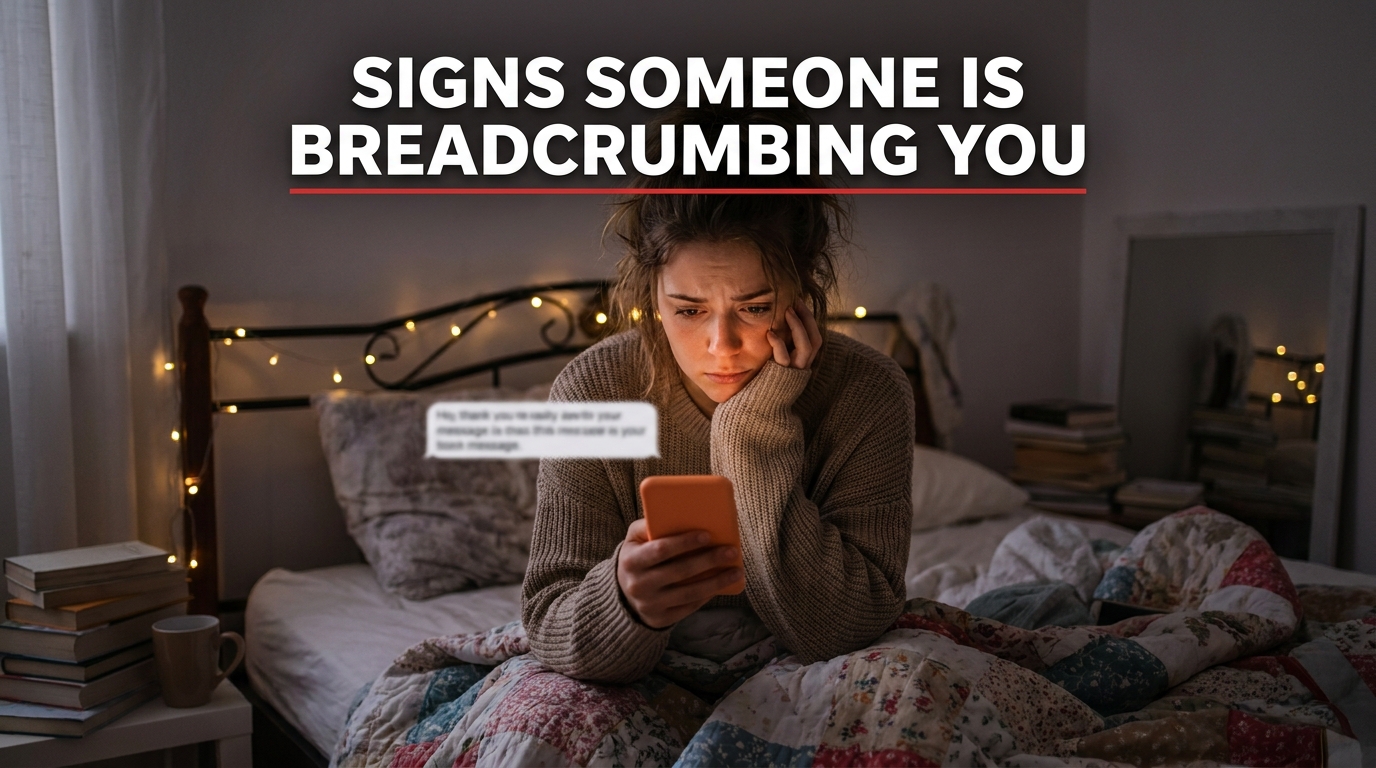
You have not heard from them in four days. Then, out of nowhere — a meme. A late-night “hey, thinking of you.” A reaction to your story. Just enough to make you feel like maybe you were wrong to worry, maybe things are fine, maybe they do care after all. And just like that, you are back to waiting.
If this cycle feels painfully familiar, you may already know the signs someone is breadcrumbing you — even if you have never had a name for it until now. Research in behavioral psychology shows that intermittent reinforcement — the pattern of unpredictable, inconsistent rewards — is one of the most powerful and damaging psychological hooks that exists. It is the same mechanism behind slot machines. And some people, whether consciously or not, use it in relationships.
Breadcrumbing is not always malicious. But it is always harmful. And recognizing it — clearly, honestly, without excuses — is the first step toward choosing better for yourself.
This article will walk you through every major sign, the psychology that makes it so hard to leave, and what to do when you finally see it for what it is.
What Is Breadcrumbing — And Where Does the Term Come From
The term breadcrumbing comes from the fairy tale of Hansel and Gretel — two children who followed a trail of breadcrumbs through the forest, only to find the trail led nowhere safe. In modern relationship psychology, breadcrumbing refers to the act of giving someone just enough attention, affection, or communication to keep them emotionally invested — without any real intention of committing, deepening the relationship, or following through.
It is the person who texts you just enough to stay on your radar but never makes concrete plans. The one who calls you “babe” in private but is vague about what you are in public. The one who shows up with warmth and affection when you start to pull away — only to disappear again once you are re-engaged.
The breadcrumber keeps the other person in a state of suspended hope. Always almost there. Never fully present. And because the attention is real — even if it is inconsistent — the person receiving the breadcrumbs keeps interpreting the good moments as proof that the relationship has potential, rather than seeing the full pattern for what it is.
Breadcrumbing exists on a spectrum. On one end, it can be someone who is emotionally immature and genuinely unaware of the impact of their inconsistency. On the other end, it can be a calculated strategy used by someone who wants the emotional benefits of a relationship — the validation, the attention, the safety net — without the responsibility of actually being in one.
Either way, the impact on the person receiving the breadcrumbs is the same: confusion, self-doubt, and a slow erosion of self-worth.

Sign 1 — Their Communication Is Inconsistent and Unpredictable
The most foundational sign someone is breadcrumbing you is a communication pattern that is deeply inconsistent with no clear explanation. They text you every day for a week, then disappear for five days. They call you late at night like you are the most important person in their world, then go cold for days after. You never know which version of them you are going to get — or when.
This inconsistency is not random. Whether the breadcrumber is conscious of it or not, unpredictable communication keeps you in a neurological state of anticipation. Your brain — specifically the dopamine reward system — becomes activated by the uncertainty. Every time a message comes through after a silence, there is a small rush of relief and excitement. That rush is biochemically similar to what a gambler feels when they finally win after a losing streak.
The result is that you become more attached to the intermittent contact than you would be to consistent, reliable communication. Consistent love actually produces less neurological excitement than inconsistent love. That is not a flaw in your character — it is a feature of how the human brain is wired. And breadcrumbing exploits it.
Pay attention to the pattern over weeks and months, not individual days. Anyone can have a busy week. But a sustained pattern of showing up and disappearing — without accountability, explanation, or effort to do better — is one of the clearest signs someone is breadcrumbing you.
Sign 2 — They Give You Just Enough to Keep You Hooked
There is something precise about how breadcrumbing works that distinguishes it from simply being a bad communicator. A bad communicator is consistently bad. A breadcrumber gives you just enough — calibrated, almost surgical — to keep you from walking away.
Just enough warmth when you start to feel neglected. Just enough affection when you begin to pull back. Just enough vulnerability when you question their feelings. Just enough of a plan — “we should do something soon,” “I miss you,” “let’s figure something out” — to give the relationship the appearance of forward motion without it actually going anywhere.
This is the crumb. It is not nothing. That is what makes it so insidious. If they gave you nothing, it would be easier to walk away. Instead, they give you just enough that you feel you have something worth holding onto. And so you hold on. And wait. And hold on some more.
“Breadcrumbing is not about what they give you. It is about what they withhold — and the precision with which they release just enough to keep the door from closing.”
Ask yourself honestly: are the good moments in this dynamic genuinely building toward something? Or do they reliably appear at the exact moment you are about to stop caring — and then retreat once you are re-engaged? If the answer is the latter, you are not experiencing affection. You are experiencing management.

Sign 3 — They Are Full of Words and Empty of Action
Breadcrumbers are often excellent communicators — in bursts. They say the right things. They make you feel seen and special when they are present. They talk about future plans with what feels like genuine enthusiasm. “We should go there together.” “I want to take you to that restaurant.” “You are exactly the kind of person I have been looking for.”
But the plans never materialize. The restaurant never gets booked. The trip never gets scheduled. The enthusiasm that felt so real in the moment of the conversation quietly evaporates by the next day, and when you bring it up, it either gets vague — “yeah, we should” — or subtly redirected.
In psychology, this is sometimes called future faking — making promises or painting pictures of a shared future with no genuine intention or follow-through. Whether it is used deliberately or unconsciously, the effect is the same: it keeps you emotionally invested in a version of this person and this relationship that exists only in conversation, not in reality.
Actions are the language of genuine intention. Words — especially in romantic contexts — are cheap and easy to produce. When someone consistently gives you words without actions, you are not seeing who they are at their best. You are seeing who they are. And who they are is someone who is comfortable letting you invest in something they have no plans to match.
Sign 4 — They Resurface Whenever You Start to Move On
This is one of the most frustrating and psychologically precise signs of breadcrumbing, and almost everyone who has experienced this pattern will recognize it instantly. The moment you genuinely start to pull back — the moment you stop texting first, start making peace with the situation, or begin emotionally detaching — they reappear.
A text out of nowhere. A social media interaction after weeks of silence. A late-night message that sounds suspiciously like they have been watching your activity and noticed the shift. “Hey, I’ve been thinking about you.” “Sorry I’ve been MIA, things have been crazy.” “I miss talking to you.”
And just like that, the cycle resets.
This pattern reveals something important about the breadcrumber’s motivation: they are not reaching out because they have had a change of heart or because they genuinely want more. They are reaching out because they have sensed a potential loss of access — and they want to re-secure it. It is about maintaining the option, not about choosing you.
A person who genuinely cares about you does not wait until you are almost gone to show up. They show up consistently — not perfectly, but consistently — because they do not want to lose you, not because they noticed you were about to leave.
“They do not come back because they are ready. They come back because they noticed you were almost gone — and they are not ready to lose the option of you.”

Sign 5 — The Relationship Exists Mostly in Private
A healthy relationship — even a new or casual one — exists in the real world. You appear in each other’s lives. You meet their friends, or at least hear about them. There is a social dimension to the connection that confirms its realness.
With breadcrumbing, the relationship is frequently confined to private channels. Late-night texts. Direct messages. Conversations that feel intimate and significant — but only in that specific, sealed space. In the real world, in daylight, in social contexts — you are largely invisible to them, or at best ambiguous.
They do not post about you. They do not introduce you. When you ask about defining the relationship, you get vagueness or deflection. They might say they are “not big on labels” or that they “do not like to rush things” — which sounds reasonable in isolation but feels deeply unsatisfying when paired with weeks or months of private intensity.
This private-only dynamic serves the breadcrumber’s needs perfectly. It gives them all the emotional and psychological benefits of closeness without any of the accountability that comes with being someone’s actual partner. You are kept in a space where you cannot make demands, cannot hold them to anything, and cannot compare their behavior to what a real relationship should look like — because it has no public shape to compare it to.
Sign 6 — You Feel More Anxious Than Secure
Here is a sign that lives inside you rather than in their behavior — but it is just as diagnostic. When you are being breadcrumbed, your emotional baseline shifts. Instead of feeling the warmth, security, and groundedness that should accompany being cared for by someone, you feel a low-level but persistent anxiety.
You check your phone more than you used to. You analyze messages for hidden meanings. You replay conversations trying to figure out if something you said caused the silence. You feel a spike of relief when they text and a wash of dread when they go quiet. Your emotional state is entirely governed by their level of contact — and because that contact is unpredictable, you are almost never fully at ease.
This is not a personality flaw. This is what happens to a nervous system that is being subjected to intermittent reinforcement. The anxiety is a completely rational response to an irrational dynamic. Your body is trying to tell you that this relationship does not feel safe — not because you are broken, but because it genuinely is not.
Healthy relationships produce a fundamentally different feeling. They are not perfect, and they have their own anxieties and uncertainties. But the baseline — the resting state — is security, not vigilance.

Sign 7 — They Are Never Fully Available but Never Fully Gone
This is perhaps the defining characteristic of breadcrumbing as a pattern — and it is worth sitting with, because it is the thing that makes it so hard to name and so hard to leave.
A breadcrumber is never fully there. They do not commit, they do not show up consistently, they do not give you the relationship you are clearly hoping for. But they are also never fully gone. They never end things. They never tell you clearly that they are not interested. They leave the door perpetually cracked — just open enough that walking away feels premature, even when everything inside you knows that staying is costing you more than it should.
This perpetual in-between is not accidental. It is the entire mechanism. If they left completely, you could grieve and move on. If they fully committed, you would have a real relationship. The in-between keeps you in emotional limbo — hoping, waiting, giving, and slowly spending your energy on someone who has no intention of meeting you where you are.
The fact that they have not officially ended things is not evidence that the relationship has potential. It is evidence that they want to keep the option open while avoiding the cost of being truly present in it.
Sign 8 — You Are Always the One Initiating or Pushing for More
Take an honest look at the last month of your dynamic with this person. Who sends the first message most often? Who suggests making plans? Who brings up conversations about the future or about what this actually is? Who is doing the emotional heavy lifting?
If the answer is consistently you — if you are the engine of whatever this thing is — that is a sign. Not a definitive one on its own, but a significant one. Because in a relationship where both people genuinely want each other, effort tends to flow in both directions. Not equally every day, but balancedly over time.
When you are always the one reaching and they are always the one receiving — when you stop reaching and nothing happens, when you could disappear for a week and they would not notice or would only resurface once they sensed the silence — that asymmetry is information. It tells you who is invested and who is enjoying the investment.

Why Breadcrumbing Is So Hard to Leave
Understanding the signs someone is breadcrumbing you is one thing. Actually walking away is another — and if you have found it almost impossible, you are not weak. You are human.
The psychology of why breadcrumbing is so addictive comes back to intermittent reinforcement — the same principle that makes gambling so hard to stop. When rewards are unpredictable, the brain does not down-regulate its pursuit of them. It escalates. You become more focused on securing the reward, not less. The hope does not fade — it intensifies, because the brain is convinced that the win is just around the corner.
On top of that, there is the sunk cost fallacy: the longer you have been in this dynamic, the harder it feels to walk away, because walking away feels like admitting that all the time and emotion you invested was wasted. It was not wasted — it was the cost of learning. But the feeling is powerful enough to keep many people stuck long past the point where they know better.
There is also the way breadcrumbing targets your self-worth. Over time, the inconsistency begins to feel personal. You start to wonder what is wrong with you — why you are not enough to make them commit, why you are not enough to make them consistent, why you can feel the potential of this connection so clearly but they seem unable to. That self-questioning keeps you in the dynamic, trying to figure out what you need to do or be to finally unlock their full presence.
The answer, as painful as it is: nothing. There is nothing you need to change. The issue is not your worthiness. The issue is their unwillingness — and no amount of patience, effort, or self-improvement on your part will change that.
What to Do When You Recognize the Signs
Recognizing that you are being breadcrumbed is not a small thing. For many people, naming the pattern is the moment everything shifts — because it moves the experience from “I do not understand why this feels so bad” to “I see exactly what is happening here.”
Once you see it, start by stopping. Stop overanalyzing their behavior. Stop waiting for the text. Stop reaching out first and watching to see if they notice. Give yourself permission to observe what the dynamic looks like when you are not actively sustaining it.
Then, have an honest conversation — not to confront, but to clarify. Tell them what you need from a relationship and ask, directly, whether this is something they can or want to offer. Watch their response. Not just the words, but the follow-through. People who are genuinely interested in you will meet that conversation with honesty and effort. People who are breadcrumbing you will typically respond with just enough warmth to re-engage you without making any real commitment.
If the pattern continues after clarity has been established, you have your answer. And your answer is that you deserve to use your energy on something real — on someone who does not need to be chased, convinced, or decoded.
You deserve consistency. You deserve someone who shows up without you having to engineer the conditions for it. You deserve a relationship that does not require you to interpret silence, celebrate crumbs, or shrink your needs to fit someone else’s ambiguity.
Stop following the trail. It does not lead anywhere you want to go.
FAQ
Q: Is breadcrumbing always intentional? A: Not always. Some people breadcrumb because they are emotionally avoidant, commitment-phobic, or genuinely unaware of the impact their inconsistency has. Others do it deliberately to maintain control or keep options open. Regardless of intent, the harm to the person receiving the breadcrumbs is the same — and intent does not change what you deserve.
Q: What is the difference between breadcrumbing and someone who is just busy? A: A genuinely busy person still makes their interest clear, apologizes for the distance, and follows through when they do have capacity. A breadcrumber’s unavailability is selective — they have time for other things, but consistently not enough for you. The difference is in the pattern and the effort, not just the schedule.
Q: Can someone who breadcrumbs change? A: It is possible, but rare without significant self-awareness and a genuine desire to change — usually developed through therapy or a serious personal reckoning. Change has to come from them, not from your patience or your love. Waiting for someone to become consistent is different from watching someone actively work to become consistent.
Q: How do you respond to a breadcrumber without seeming needy? A: Clarity is never neediness. You are allowed to say directly: “I need consistency in my relationships and I am not experiencing that here. What are you actually looking for?” You are not asking for too much. You are asking for basic respect — and the right person will not make you feel bad for that.
Q: How long does it take to get over being breadcrumbed? A: Longer than most people expect, because the intermittent reinforcement creates a neurological attachment that does not dissolve quickly. Give yourself time, reduce contact or go no-contact where possible, reconnect with your own life and identity, and consider speaking to a therapist if the pattern has repeated itself across multiple relationships.
You Recognized It. Now Protect Yourself.
Seeing the pattern is the hardest part — and you just did that. Do not let this clarity slip away.
💾 Save this article right now. The next time you start making excuses for someone who gives you crumbs, come back and read it again from the beginning.
📤 Share it with a friend who is stuck in a situationship they cannot explain. Sometimes the most important thing you can give someone is the right words for what they are already feeling.
💬 Tell us in the comments — which sign hit closest to home? You are not alone in this, and your story might be exactly what someone else needs to read today.
🔁 Tag someone who needs to see this. Not to call anyone out — just to make sure the right person gets the right information at the right time.
➕ Follow Truthsinside.com for more honest, psychology-backed content about the relationship patterns that quietly shape our lives — the ones nobody talks about clearly enough.
📖 Read next: How to Love Without Losing Yourself — because once you stop chasing breadcrumbs, the real work is learning how to come back to yourself.
You are not too much for wanting something real. You are just in the wrong dynamic. That is fixable.
🎵 Music
Maren Lull is a singer-songwriter who writes from the places most people don’t talk about out loud.
Not the dramatic grief. Not the obvious heartbreak. The quiet kind — the ordinary Tuesday emptiness, the habit of reaching for someone who isn’t there anymore, the particular exhaustion of being strong for so long that the strength itself wears thin.
Her music lives at the intersection of emotional honesty and soft beauty — breathy vocals over gentle piano, slow tempos, lyrics that feel less like songs and more like something you wrote in a private notebook at two in the morning and never showed anyone.
Maren Lull writes for the people who feel everything deeply and say very little about it. For the ones who listen to sad music not because they want to feel worse — but because being understood, even by a song, makes the feeling easier to carry.
📱 Follow Maren Lull:
→ Spotify
→ Apple Music
→ Youtube
→ Audiomack