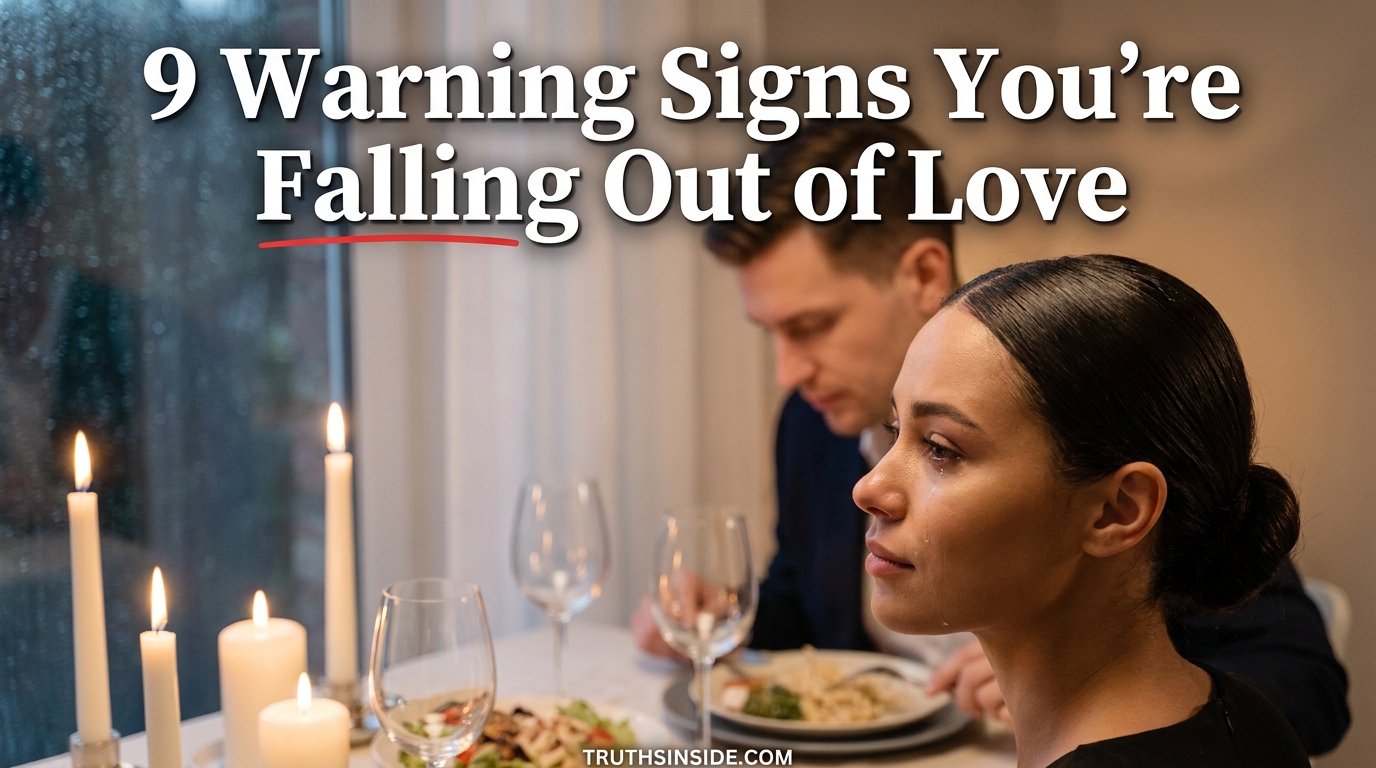
Have you ever caught yourself sitting next to the person you once could not stop thinking about — and felt almost nothing at all? No warmth. No pull. No quiet excitement at their presence. Just a hollow, unsettling stillness where the feeling used to live. If that moment sounds familiar, you are not alone — and you are not broken.
Falling out of love is one of the most quietly devastating experiences in human relationships. It rarely happens in a single dramatic moment. According to research from Stony Brook University, romantic love activates the same neural reward pathways as addiction — which means the fading of those feelings can feel disorienting, confusing, and even grief-like, long before either partner fully understands what is happening.
A 2021 study published in the Journal of Positive Psychology found that emotional disconnection — one of the primary markers of falling out of love — begins on average 12 to 18 months before couples actually acknowledge it to each other or to themselves. That gap between the feeling and the acknowledgment is where the most damage quietly accumulates. Recognizing the signs you’re falling out of love early is not an act of surrender. It is an act of courage — and it may be the very thing that saves everything worth saving.
Why Falling Out of Love Happens — And Why It Is More Common Than You Think
Before exploring the specific signs, it is important to understand what falling out of love actually is — and what it is not.
Falling out of love does not always mean the relationship is over. It does not always mean the wrong person was chosen. And it does not always mean something irreparably broken has happened between two people.
What it often means is that the relationship has been running on emotional autopilot for too long. That the daily investments of attention, effort, affection, and intentional connection have slowly been replaced by routine, assumption, and quiet neglect — not out of malice, but out of the ordinary pressure of living busy, complicated human lives.
Psychologist Dr. Helen Fisher, one of the world’s leading researchers on romantic love, explains that the brain’s early-stage love chemistry — dominated by dopamine, norepinephrine, and serotonin — naturally shifts over time. The intense neurochemical cocktail of new love does not last forever. What takes its place is meant to be a deeper, calmer, more sustainable form of attachment. But that transition requires active tending. Without it, what fills the space is not deeper love — it is emotional distance.
Understanding this removes the shame and panic from the experience — and replaces it with something far more useful: clarity about what is actually happening and what can still be done about it.

9 Signs You’re Falling Out of Love
1. Their Presence No Longer Brings You Comfort or Joy
In the early stages of love, simply being near your partner produces a measurable emotional response — warmth, calm, excitement, or happiness. Their presence is its own reward. When that response begins to fade — when their arrival home no longer shifts your mood, when sitting beside them feels neutral rather than comforting — something significant has changed.
This does not happen overnight. It is a gradual dulling of the emotional signal that your nervous system once associated strongly with this person. You may notice it first as mild indifference — and then, over time, as something closer to quiet relief when they are not around.
If you find yourself more emotionally regulated when your partner is absent than when they are present, that pattern deserves honest attention rather than rationalization.
2. You Have Stopped Being Curious About Their Inner World
One of the most consistent hallmarks of being genuinely in love with someone is an almost insatiable curiosity about them — their thoughts, their feelings, their day, their dreams, their fears. You want to know them more deeply. The more you know, the more you want to know.
When that curiosity fades and their inner world begins to feel irrelevant — when their stories feel like interruptions rather than gifts, when you find yourself nodding through conversations rather than genuinely listening — emotional disconnection has taken root.
Curiosity about your partner is not just a feature of new love. It is a practice that sustains long-term love. When the desire to truly know them disappears, what remains is familiarity without intimacy — and that distinction matters enormously.
3. Small Things About Them Irritate You Disproportionately
This is one of the most uncomfortable signs you’re falling out of love — because it can feel petty, unfair, and deeply confusing. The habits, quirks, and mannerisms that once felt endearing or neutral begin to feel genuinely grating. The way they laugh. The way they eat. The phrases they repeat. The sounds they make.
Psychologists call this negative sentiment override — a state in which the emotional filter through which you view your partner has shifted so significantly that even neutral behaviors are interpreted negatively. When the warmth is gone, irritation fills the space it left behind.
This sign is particularly important to recognize because it can easily be mistaken for a personality conflict — when in reality it is a symptom of emotional disconnection that may be addressable if caught early enough.
“Falling out of love rarely feels like a dramatic ending. It feels like a slow Tuesday — when you realize the warmth that used to greet you there is simply gone.”
4. Physical Intimacy Feels Like an Obligation
Physical intimacy in a healthy relationship is not just about sex. It is about the full spectrum of physical connection — holding hands, spontaneous touch, sitting close, kissing with genuine presence, reaching for each other naturally and without thought.
When those gestures begin to feel like performances rather than impulses — when physical intimacy shifts from something you genuinely want to something you feel you should provide — the emotional disconnection has reached the physical layer of the relationship.
This shift is significant because physical intimacy is one of the primary languages through which romantic love is expressed and reinforced. When it becomes obligatory rather than desired, the feedback loop that keeps emotional connection alive is quietly broken.
It is also important to acknowledge that this sign does not automatically mean the relationship is beyond repair. But it does mean that something needs to be addressed — openly, honestly, and without further delay.
5. You Have Stopped Fighting — But Not Because Things Are Good
Many people assume that a reduction in conflict is a positive sign in a relationship. Sometimes it is. But sometimes — and this is the version that deserves careful attention — the fighting stops not because things have improved, but because one or both partners have stopped caring enough to engage.
Conflict, when handled respectfully, is actually a sign of emotional investment. It means both people care enough about the relationship to express their needs, defend their feelings, and work toward resolution. When that investment evaporates, so does the conflict — and what replaces it is something far more concerning: emotional indifference.
If disagreements no longer produce any strong emotional response in you — if you find yourself thinking “whatever” when conflict arises rather than genuinely wanting to resolve it — that emotional flatness is a significant signal that something important has shifted.
6. You Are Consistently Imagining Life Without Them — And It Feels Relieving
Occasionally imagining different versions of your life is a normal feature of human cognition. But when those imaginations consistently focus on life without your partner — and when those imaginings produce feelings of relief, lightness, or excitement rather than grief — that is a meaningful signal that your emotional investment in the relationship has fundamentally shifted.
This sign often appears quietly and gradually. At first it may feel like harmless daydreaming. But when the pattern becomes consistent — when the life you imagine without them regularly feels more appealing than the life you are living with them — that is your emotional truth telling you something important.
Denying or suppressing that signal does not make it less true. It simply delays the honest conversation that both you and your partner deserve to have.

7. You Have Emotionally Checked Out of the Relationship’s Future
When you were deeply in love, the future felt like something you were building together — something to look forward to, plan for, and be genuinely excited about. Conversations about the future felt energizing. Shared plans felt meaningful.
When emotional disconnection sets in, the future of the relationship begins to feel either irrelevant or quietly dreadful. You may notice that you have stopped contributing to future plans. That conversations about where the relationship is heading produce anxiety rather than excitement. That you have mentally begun making plans — financial, social, personal — that quietly exclude your partner.
This internal withdrawal from the shared future is one of the clearest signs you’re falling out of love — because it represents a disconnection not just from your partner in the present, but from the version of your life that includes them going forward.
8. Your Emotional Needs Are Being Met Elsewhere
Emotional intimacy — the sharing of your deepest thoughts, fears, joys, and vulnerabilities — is one of the most essential features of a romantic relationship. When that intimacy is no longer flowing toward your partner, it tends to flow somewhere else.
You may find yourself sharing your most meaningful experiences primarily with friends, family members, or colleagues rather than with your partner. You may feel more emotionally understood by people outside the relationship than by the person you share your life with. You may notice that the conversations that feel most alive and energizing are happening everywhere except at home.
This is not automatically a sign of wrongdoing. But it is a sign that the emotional core of the relationship has weakened significantly — and that both partners deserve to know it and address it directly.
9. The Thought of Losing Them No Longer Scares You
Perhaps the most quietly definitive of all the signs you’re falling out of love is this: the thought of the relationship ending no longer produces grief, fear, or urgency. It produces something closer to quiet acceptance — or in some cases, quiet relief.
When you were deeply in love, the idea of losing your partner felt like a genuine threat to your emotional world. Now, when the thought surfaces, there is an unsettling stillness where the fear used to be.
This does not mean you want to hurt your partner or that you do not care about them as a person. It means that the romantic emotional bond — the one that makes someone feel irreplaceable and essential — has significantly weakened. And that reality, as painful as it is to acknowledge, is one of the most important pieces of information your relationship can give you.
What to Do When You Recognize These Signs
Recognizing that you may be falling out of love is not the end of the story. For many couples, it is the beginning of the most honest and transformative chapter they have ever navigated together. Here is what to do when these signs become undeniable.
Step 1 — Be honest with yourself first.
Before any conversation can happen with your partner, you need to be clear within yourself about what you are experiencing. Journaling, therapy, or simply sitting with your feelings without immediately suppressing or rationalizing them is an important first step.
Step 2 — Identify the root cause.
Falling out of love rarely happens without reason. Ask yourself honestly: Has the relationship been consistently neglected? Has conflict gone unresolved for too long? Has a breach of trust changed how safe you feel? Has personal growth taken you in a direction that no longer aligns with this relationship? Understanding the root cause shapes what recovery — or resolution — looks like.
Step 3 — Have an honest conversation with your partner.
This is the step most people avoid the longest — and the one that matters most. Your partner deserves to know what you are experiencing. Not a version designed to protect their feelings at the expense of truth, but an honest, compassionate, and clear expression of where you are emotionally and what you need.
Step 4 — Invest in professional support.
Couples therapy is not a last resort. It is one of the most powerful tools available to couples who are willing to do the work of reconnecting. A skilled therapist can help both partners understand what happened, identify what is still worth saving, and build the skills needed to genuinely rebuild — or to part with dignity and clarity if that is what serves both people best.
Step 5 — Make a decision and commit to it.
The most damaging thing you can do — for yourself and for your partner — is remain in an indefinite state of emotional limbo. Either choose the relationship fully and invest in it with everything you have, or choose with honesty and compassion to let it go. Both choices require courage. Both choices are valid. But neither can happen without the decision being made.
“The most loving thing you can do for someone you are falling out of love with is to tell them the truth — before silence does it for you in a far crueler way.”
Can You Fall Back In Love With Someone?
This is one of the most frequently asked questions by people who recognize these signs in themselves — and the honest answer is yes. But with an important condition.
Falling back in love is possible when the emotional disconnection is rooted in neglect, unresolved conflict, or life stress rather than fundamental incompatibility or a chronic pattern of damage. Research from Dr. John Gottman’s relationship institute confirms that couples who deliberately reinvest in their friendship, affection rituals, and emotional attunement can and do experience genuine reconnection — even after significant periods of distance.
But falling back in love requires both partners to be aware of the problem, willing to address it honestly, and genuinely invested in the work of rebuilding. One person cannot fall back in love on behalf of two.
If both people are willing — and if the relationship’s foundation of respect, trust, and shared values remains intact beneath the emotional distance — there is real and meaningful hope.

Final Thoughts
The signs you’re falling out of love are never easy to face. They ask something incredibly difficult of you — to be honest about your emotional reality at a time when honesty feels dangerous, disloyal, or simply too painful to sit with.
But ignoring those signs does not make them disappear. It allows them to deepen silently — until the distance between you and your partner becomes so wide that no bridge feels possible anymore.
You owe yourself the truth. You owe your partner the truth. And you owe your relationship — whatever it has meant to you, whatever it has given you — the dignity of being seen clearly rather than slowly abandoned in silence.
Whether what comes next is rebuilding or releasing, the most important step is always the same: begin with honesty. Everything else — healing, growth, clarity, and eventually peace — follows from there.
💾 Save this article for the moment you need the courage to be honest about where your heart actually is.
📤 Share this with someone who might be feeling something they cannot yet find the words for — this might be exactly what they need to read today.
👣 Follow Truthsinside.com for more honest, psychology-grounded articles on love, emotions, and the signs that matter most in your relationships.
📃 Related article: Signs He Likes You But Is Scared: 18 Behaviors Men Show When Afraid to Commit
Frequently Asked Questions
1. Is falling out of love normal in a long-term relationship?
Yes — more common than most people openly acknowledge. The intense neurochemical experience of early romantic love is not designed to last indefinitely at the same intensity. What is meant to replace it is a deeper, quieter form of attachment and connection. When that transition is not actively nurtured, emotional disconnection can develop. Recognizing this as a common human experience removes the shame from it and makes it possible to address constructively.
2. How do I know if I am falling out of love or just going through a rough patch?
A rough patch is typically tied to a specific external stressor — financial pressure, health challenges, a major life transition, or a period of high conflict. It tends to be temporary and situational. Falling out of love is characterized by a more pervasive, persistent emotional flatness that is not clearly tied to a single circumstance and does not lift when the stressor passes. If the signs described in this article have been present consistently for several months or longer, it is worth exploring more deeply than a rough patch label allows.
3. Can couples therapy actually help when one partner is falling out of love?
Yes — particularly when the disconnection is rooted in unresolved conflict, prolonged neglect, or poor communication patterns rather than fundamental incompatibility. Couples therapy provides a structured, safe environment for both partners to express what they are experiencing, understand what contributed to the distance, and explore whether reconnection is genuinely possible. Many couples who enter therapy at this stage report significant improvement when both partners are honest and committed to the process.
4. Should I tell my partner I am falling out of love with them?
Yes — with compassion, timing, and intention. Your partner deserves to know what you are experiencing rather than being left to interpret your emotional withdrawal without context. A conversation that is honest, kind, and focused on what you are feeling — rather than on what they have done wrong — gives both of you the opportunity to respond to the situation consciously rather than simply reacting to its symptoms.
5. What if my partner is falling out of love with me — what should I do?
First, resist the urge to panic or immediately try to fix everything at once. Ask open, genuine questions about what they are experiencing and listen without defensiveness. Express your own feelings honestly. Seek couples therapy together if both of you are willing. And most importantly — be honest with yourself about whether both people are genuinely invested in rebuilding, or whether one person is carrying that investment alone. Your emotional needs matter just as much as theirs in this conversation.
🎵 Music
Maren Lull is a singer-songwriter who writes from the places most people don’t talk about out loud.
Not the dramatic grief. Not the obvious heartbreak. The quiet kind — the ordinary Tuesday emptiness, the habit of reaching for someone who isn’t there anymore, the particular exhaustion of being strong for so long that the strength itself wears thin.
Her music lives at the intersection of emotional honesty and soft beauty — breathy vocals over gentle piano, slow tempos, lyrics that feel less like songs and more like something you wrote in a private notebook at two in the morning and never showed anyone.
Maren Lull writes for the people who feel everything deeply and say very little about it. For the ones who listen to sad music not because they want to feel worse — but because being understood, even by a song, makes the feeling easier to carry.
📱 Follow Maren Lull:
→ Spotify
→ Apple Music
→ Youtube
→ Audiomack